Why Internet of Things (IoT) Engineering Technology Matters in Industry 4.0
Internet of things (IoT) engineering technology sits at the center of Industry 4.0. It connects physical devices — sensors, embedded controllers, gateways, and cloud platforms — into a single data-sharing network that lets factories, cities, and supply chains operate with measurable precision. According to McKinsey Global Institute, IoT applications could generate between $3.9 trillion and $11.1 trillion in economic value annually by 2025. For vocational institutions, solution providers, and international training partners, understanding why this technology matters is the starting point for building workforce programs that actually keep pace with industry demand.
Understanding IoT Engineering Technology in Industry 4.0
What the Three-Layer Architecture Actually Does
The idea of "Perception—Connectivity—Application" is not just a picture from a book. There are activities for each level . The perception layer acquires raw data from sensors, RFID readers, and barcode cameras. These pieces of data are transferred from the connection layer across ZigBee, NB-IoT, LoRaWAN or 5G modes. Raw data that you can act on using cloud technologies like AWS IoT, Huawei Cloud IoT or Alibaba Cloud Link IoT. If all three function together, a machine on the factory floor can send out a repair order before it breaks.
Embedded Systems as the Foundation
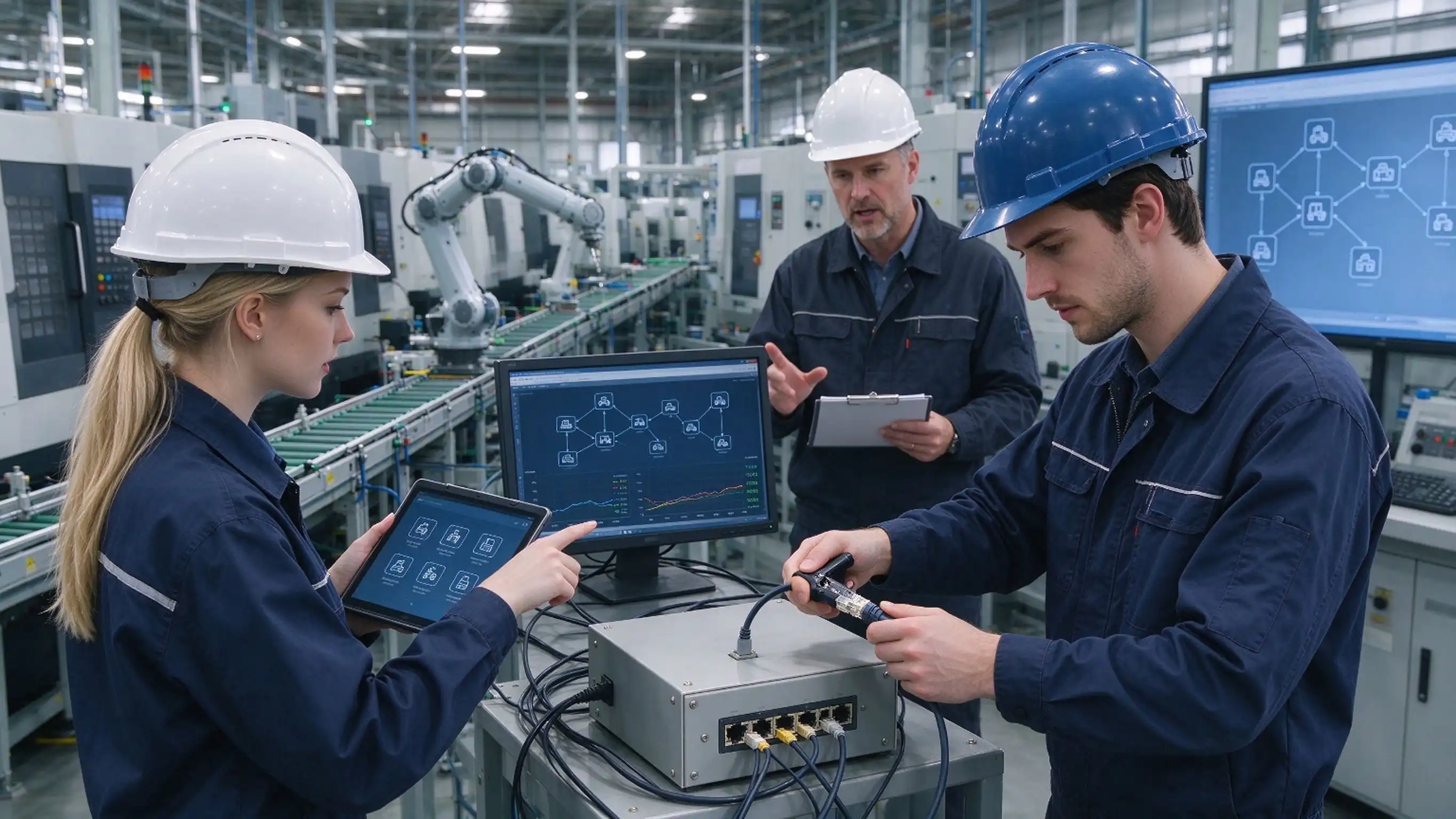
Embedded development is what makes devices that are connected work. Engineers write drivers for I/O and UART, build simple hardware systems, and plan jobs in real time. If the code inside the sensors isn't reliable, the readings will be wrong and the communication protocols won't work. One of the five core skill modules in ECR Academy's IoT Engineering Technology course is embedded system development. This is because skills at the device level determine how well the whole stack works.
Real-World Performance Standards
Industrial IoT devices have to pass strict quality tests before they can be used. Some of these are testing in temperatures from -40°C to +85°C (MIL-STD-810G), using AES-128/256 hardware encryption, and seeing the Packet Success Rate in real-world situations with a lot of interference. International rules, such as ISO/IEC 30141 (IoT Reference Architecture) and IEEE 2413, are used to put together a system. When engineers learn about these standards, they are much better equipped to set up and run systems that are used in production.
Comparison of IoT Engineering Technologies and Traditional Methods
Where Legacy Systems Fall Short
Traditionally, plant monitoring is based on human inspection cycles and siloed SCADA systems with little integration between departments. When a bearing on a CNC machine overheats, the defect is detected after production has stopped. IIoT pilot studies in industry report real-time sensor fusion networks discover temperature abnormalities, typically cutting unplanned downtime by 30–50%.
IoT Platforms: A Practical Comparison
The platform choice shapes the entire system architecture. Here is a brief comparison of leading options relevant to B2B procurement:
- AWS IoT Core delivers broad protocol support (MQTT, HTTP, WebSocket) and tight integration with Lambda and S3 for scalable data pipelines, making it well suited for global multi-site deployments.
- Microsoft Azure IoT Hub is favored in internet of things (IoT) engineering technology enterprise environments already running Microsoft 365 or Dynamics, offering strong device twin management and built-in security certificates.
- Huawei Cloud IoT provides competitive edge-cloud collaboration suited to manufacturing-heavy markets and aligns with China's national IoT infrastructure standards.
- Alibaba Cloud Link IoT supports high-density device connections and is widely adopted in smart city and intelligent logistics projects across Asia.
Each platform differs in latency tolerance, SDK language support, and pricing models. Procurement teams should match platform capabilities to operational requirements rather than brand preference alone.
Total Cost of Ownership vs. Upfront Spend
Legacy monitoring systems carry high maintenance labor costs. An IoT-enabled predictive maintenance program will generally see a positive ROI in 18-24 months by lowering reactive repair costs and increasing equipment lifespans. Edge computing reduces bandwidth costs as data may be processed locally with latency of under 10ms possible without cloud round trip times.
Applications and Emerging Trends of IoT Engineering Technology in Industry 4.0
Where Connected Systems Are Delivering Results
A lot of different areas are already being changed by IoT engineering technology. In smart manufacturing, sound, temperature and current draw are all being monitored at the same time, but any damage to the equipment is looked for. Accurate humidity and GPS sensors in cold chain logistics ensure medications are safe while crossing international borders. When the network changes hands, Store-and-Forward logic makes sure that no data is lost. In smart city infrastructure, utility sensors linked together in a mesh network can find line faults in faraway grids and rebalance loads on their own.
Edge Computing and AI Are Changing the Equation
Processing your data at the network edge saves time and money because you don't have to send it all to the cloud. Finding strange things happens very quickly when AI-powered analytics are run on edge nodes. It is predicted by Gartner that by 2025, more than 75% of business-generated data will be processed at the edge instead of in giant data centers. This means that engineers will need to learn both how to program embedded devices and how to use the cloud.
Security and Interoperability Remain Active Challenges
These days, most devices get their firmware updates over-the-air (OTA). To make sure the device still works when the power goes out, the updates need to be signed with a digital certificate and run on dual-bank flash memory. Engineers still have trouble getting MQTT, CoAP, and DDS to work together in places where different vendors' products are used. Trainees are taught real protocol stacks, such as ZStack for ZigBee development and EPC code standards for RFID, so they can get the skills they need to solve these issues right away.
Procuring IoT Engineering Solutions: What B2B Clients Need to Know
Evaluating Core Components
The successful deployment of IoT requires three kinds of hardware to operate together: sensing devices (such as RFID readers and sensors), gateways for communication, and connections to the cloud. Procurement teams need to request Received Signal Strength Indicator (RSSI) test results, and Power Consumption Profiling data to ensure devices will last as long as they are supposed to. This is the main reason why test tools don't work on a bigger level: these checks are skipped.
Supplier Selection Criteria
Four things are very important when picking an internet of things (IoT) engineering technology provider: how good the technical documentation is, how often the firmware is updated, how many languages the SDK supports, and how long it takes for help to get back to you after the launch. From companies like Siemens, Bosch, and Huawei, you can get thorough safety certificates and different levels of help. The same things should be thought about when getting a training program: how often the material is updated, how qualified the staff is in the field, and how easy it is to use the platform.
Aligning Investment with Strategic Goals
IoT projects that choose hardware based on a three- to five-year plan for use save the most money. If you buy sensors that only work with one type of transmission, you can only buy from that one company. Just like that, it's harder for graduates of programs that only teach one cloud platform to get jobs. You should look for tools and curriculum that can be used with a lot of different programs and have clear update plans when you buy them.
Building Trust with Leading IoT Engineering Brands
Industry Benchmarks Set by Established Players
They are Cisco, IBM, Siemens, AWS, Microsoft, Bosch, and Huawei. Each of them is good at their own industrial IoT projects. Cisco is famous for the way it builds networks safely. With IBM's Watson IoT tool, you can get information at the AI level. Siemens links its MindSphere technology for making things to the Internet of Things (IoT). Not only do these offer different products, but they are also tech settings where licensed experts must be able to work.
Why Certification and Training Partnerships Matter
Managers always look for engineers with platform-specific knowledge when they hire them for smart city, smart transportation, and smart manufacturing projects. For example, they might look for engineers with Huawei HCIA-IoT or AWS IoT certification alignment. Trainees can start adding right away if these business standards are used to make the programs. The IoT Engineering Technology course at ECR Academy follows national guidelines for teaching and is built on the same three-layer architecture as these business platforms.
Post-Deployment Support as a Trust Signal
A lot of the time, you won't know how useful a company is until after the fact. Every school has its own vendor SLA agreements such curriculum updates every 3 months, simple to get to staff members with real life project experience, simulation platform that functions like a real device. They prove that the partner is interested in more than the initial meeting.

Conclusion
Industry 4.0 is not a situation for the future; it is already the way that factories, warehouses, and city streets work all over the world. Embedded development, wireless communication, sensor data gathering, and cloud application levels are all parts of internet of things (IoT) engineering technology that make connected operations possible. Companies and schools that spend money on planned training that meets standards now will be able to hire the people they will need in ten years. The IoT Engineering Technology course at ECR Academy helps you get ready for that in a way that is useful and works with different platforms.
FAQ
1. Can someone with no technical background take this course?
Yes. The course starts with the basics of IoT and then moves on to more complex topics. Students can get used to setting up sensors, networks, and apps without using real gear with this browser-based modeling tool. This gets rid of the problem of tools that stops newbies a lot of the time.
2. What job roles does this course prepare graduates for?
Graduates can work as an IoT perception and control development engineer, an embedded system development engineer, a wireless sensor network engineer, an IoT application development engineer, a system integration engineer, or an industrial internet engineering technician.
3. How does the online learning platform work?
The app has a B/S design and works with a SaaS model. WebGL and HTML5 are also used. Learners can use a web browser on any device to access a full IoT development environment that includes sensor simulation, setting up a ZigBee network, embedded programming, and designing cloud access logic. They don't have to install any software locally.
Explore IoT Engineering Technology Training with E.C.R Academy
They have taught job skills to almost 500,000 people in 28 countries since 2010. Our internet of things (IoT) engineering technology class has a project-based curriculum, senior enterprise faculty, and a simulation platform that can be used in any browser. This gives your business or school a reliable source for IoT engineering technology to help your staff learn. No matter if you want to improve a vocational school or build a road for business training, we can help you reach your goals. You can email us at ecr2008@enteredu.com or visit enteredu.com to ask for a program help.
References
1. McKinsey Global Institute. The Internet of Things: Mapping the Value Beyond the Hype. McKinsey & Company, 2015.
2. Gartner. Gartner Identifies Top Trends in Data and Analytics for 2021. Gartner Research, 2021.
3. International Organization for Standardization. ISO/IEC 30141: Internet of Things (IoT) — Reference Architecture. ISO/IEC, 2018.
4. IEEE Standards Association. IEEE 2413-2019: Standard for an Architectural Framework for the Internet of Things. IEEE, 2019.
5. Schwab, Klaus. The Fourth Industrial Revolution. World Economic Forum, 2016.
6. IHS Markit. IoT Platforms: Enabling the Internet of Things. IHS Markit Technology Report, 2020.