Embodied AI Quadruped Robot for Smart Home Companion
Standards: International home service robot standards
Faculty: Robotics experts, psychology specialists, and education professionals
Platform: Open-source SDK + bionic motion library
Outcomes: Build practical skills aligned with smart home, home service, and companion robot industry needs
Target Partners: Enterprises, educational institutions, industry associations, and other organizations
Embodied AI Quadruped Robot for Smart Home Companion Applications
Course Overview
This course focuses on programming and application development for Embodied AI Quadruped Robot for Smart Home Companion Applications in embodied AI quadruped robots in home companion scenarios. Built around the MagicDog quadruped robot platform, the course covers robot platform architecture, ROS development, multimodal perception, affective computing, smart home integration, and multi-module application development.
Learners work through practical tasks from basic robot operation to home companion application development. Training includes emotional interaction design, daily assistance functions, smart home device control, remote companion systems, and scenario-based automation. The course combines robotics engineering with interaction design, helping learners build practical skills for embodied AI robot applications in home service environments.
Why This Course?
1. Curriculum
Combines theory, hands-on practice, and project-driven learning to support practical application in embodied AI robot development.
2. Standards
Developed with reference to home service robot standards and real-world application requirements for emotional interaction and companion scenarios.
3. Faculty
Delivered by robotics specialists together with instructors in psychology and education, combining technical development with human-centered interaction design.
4. Platform
Uses open-source SDK resources and bionic motion libraries, supporting robot control, secondary development, and flexible learning across locations.
5. Outcomes
Builds practical skills for smart home, home service robotics, companion robot development, and embodied AI application roles.
What You'll Be Able to Do?
This course is designed around the full application workflow of home service quadruped robots, from platform operation to emotional interaction, smart home integration, and companion system development.
1. Robot Platform Operation
- Operate the MagicDog quadruped robot and understand its hardware and software architecture.
- Use multiple control methods, including joystick control, mobile app control, and voice control.
- Apply basic functions such as emotional motion expression, light control, gait adjustment, interactive motions, and voice interaction.
2. Emotional Interaction Development
- Use ROS fundamentals and Python programming for robot application development.
- Develop emotion recognition and affective understanding functions based on multimodal perception.
- Create anthropomorphic motion expression and emotional interaction functions using bionic motion libraries.
- Apply natural language processing, intelligent dialogue systems, and personalized service recommendation methods.
3. Smart Home Integration
- Develop integrated home companion scenarios combining emotional interaction, daily assistance, smart home control, and remote companionship.
- Use mainstream smart home protocols and standards to connect robots with smart devices.
- Design and implement scenario-based automation control solutions.
- Debug code logic, troubleshoot system problems, and optimize robot functions for home applications.
What You Will Learn?
|
Training Module
|
Content Description
|
|
1. Robot Platform Introduction
|
Learn the hardware and software architecture of the MagicDog quadruped robot.
Practice robot operation methods, including joystick control, mobile app control, and voice control.
Set up the basic development environment and study ROS fundamentals, Python programming, affective computing algorithms, GRPC communication, protobuf data structures, and audio/video development.
|
|
2. Basic Module Operation
|
Use basic robot functions such as emotional motion expression, light control, gait adjustment, interactive motions, and voice interaction.
Training combines explanation, demonstration, and verification so learners can quickly become familiar with the platform.
|
|
3. Emotional Interaction Development
|
Develop user emotion recognition and affective understanding functions based on multimodal perception systems.
Use bionic motion libraries to create anthropomorphic motion expression and emotional interaction functions.
Build natural language processing and intelligent dialogue system applications.
|
|
4. Smart Home Integration
|
Connect the robot with smart devices through mainstream smart home protocols.
Develop scenario-based automation control solutions and build a home smart ecosystem around robot interaction and device linkage.
|
|
5. Home Companion Case Training
|
Complete integrated laboratory training based on home companion scenarios.
Projects combine emotional interaction design, daily assistance function development, smart home control, and remote companion system development.
|
|
6. Home Scenario Function Implementation
|
Apply multimodal perception data fusion and affective computing algorithms.
Develop personalized service recommendation and adaptive learning functions.
Build home safety monitoring, emergency response, remote companionship, and interactive home companion features.
|
Learning Environment
The course is built around the MagicDog bionic quadruped robot platform by Magic Atom. The platform is equipped with multimodal perception modules, including 3D LiDAR, HD cameras, touch sensors, and sound sensors, supporting practical training in robot perception, motion control, and home companion interaction.
MagicDog supports multiple anthropomorphic actions, such as standing, jumping, shaking the head, wagging the tail, and waving. Based on the Magic Atom open-source SDK and bionic motion library, the platform provides pre-set actions and secondary development interfaces. Learners can call existing motion functions or develop custom control programs for emotional interaction, smart home control, and home companion applications.
The platform provides a practical hardware foundation for embodied AI application development, helping learners connect perception data, robot motion, voice interaction, and smart home devices in real-world service scenarios.
Company Strength
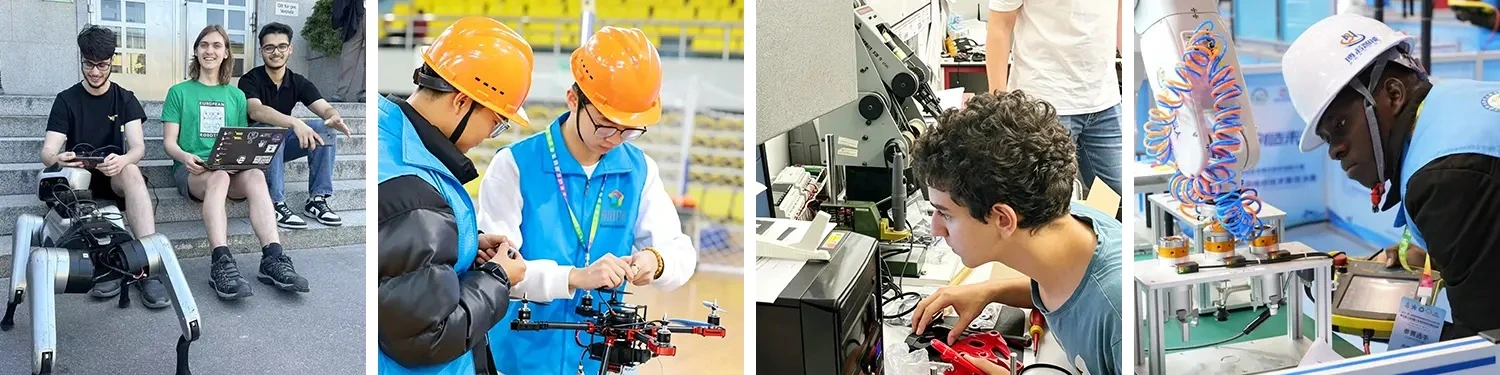
At ECR Academy, we bring unmatched expertise to Embodied AI Quadruped Robot for Smart Home Companion Applications training programs. Since 2010, we've empowered nearly 500,000 learners across 28 countries with future-ready skills. Our comprehensive curriculum for smart home companion robotics is built on:
- 16 years of proven experience in vocational education and skills development
- Access to over 3,300 industry robotics experts and psychology specialists who understand both technical and companion care requirements
- A rich library of 60,000+ educational resources including open-source SDK tools, bionic motion libraries, and industry-aligned assessment systems
- Successful delivery of 150+ technical competitions that sharpen real-world problem-solving abilities
- Project-based learning that covers 12-18 DoF actuation systems, edge AI inference exceeding 30 TOPS, and ISO 13482 safety compliance
- Partnership with 500+ enterprises to ensure your team masters practical applications—from fall-risk monitoring to autonomous home patrol
You gain skills that directly address smart home security, geriatric care, and neurodevelopmental support scenarios.

FAQ
Q: Can beginners take this course?
A: Yes. The course starts with the robot platform introduction and gradually covers hardware and software architecture, basic operation, and the development environment. The learning path is clear and suitable for beginners entering embodied AI robot development.
Q: What job roles can learners pursue after completing the course?
A: Learners can prepare for roles such as:
- Home Service Robot System Integration Engineer
- Emotional Interaction System Development Engineer
- Smart Home Solution Consultant
- Home Service Robot Product Manager
- Home Robot Operations and Maintenance Engineer
- Educational Technology Developer
- Assistive Care Robotics Developer
Q: What are the minimum computer requirements for this course?
A: Recommended configuration: Ubuntu 22.04 or higher, Intel Core i5 or above (GCC >= 11.4), 16 GB RAM or above, 256 GB storage or above, a dedicated graphics card with 4 GB VRAM, CMake >= 3.16, Python 3.10, and support for the C++20 standard.

Contact Us
Ready to master Embodied AI Quadruped Robot for Smart Home Companion Applications? Reach out today at ecr2008@enteredu.com to explore our tailored training solutions.





_1781601799781.webp)