Embodied AI Robotics Programming With ROS: A Step-by-Step Guide
If you are building a new robotics or AI program at your institution and want to know where to start, this guide is for you. Embodied AI robotics programming is reshaping how robots perceive, decide, and act in physical environments — and the Robot Operating System (ROS) sits at the center of that transformation. Whether you are a department head evaluating curriculum packages, a lab director sourcing hardware-software solutions, or a faculty lead planning hands-on training, this step-by-step walkthrough will help you understand the technology, the teaching pathway, and how to make smarter procurement decisions.
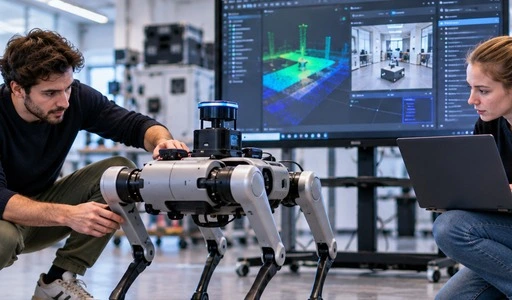
What Is Embodied AI Robotics Programming?
Embodied AI robotics programming goes beyond programming machines to do what you tell them to do. Robots with embodied intelligence don't follow set instructions; instead, they collect real-time sensory data, figure out what it means, and respond in a way that fits their needs. This closed-loop design lets robots work in settings that aren't organized or predictable because perception directly affects action.
From Rules to Reasoning
The tracks that classical industrial robots take are set in stone. As soon as things change, they fall apart. Embodied AI systems, on the other hand, use LiDAR, cameras, and touch sensors, among other things, to get a real-time picture of their surroundings. A 2023 McKinsey study on advanced manufacturing said that companies using adaptable robotic systems cut the number of mistakes made on tasks by as much as 35% compared to companies using older fixed-path automation. In fact, institutional partners and business partners are looking for graduates with just that kind of operational resilience.
Why Institutions Are Prioritizing This Now
The need for robotics experts in the workforce is growing faster. The U.S. Bureau of Labor Statistics predicts that jobs related to robots and automation will grow a lot until 2032. Building organized, approved paths in embodied AI robotics programming now will make it much easier for schools to get students, make deals with businesses, and meet approval standards related to new technology skills.
Why ROS Is the Right Framework for This Work
When you think of an operating system, ROS (the Robot Operating System) comes to mind. It's an open-source middleware framework that makes it easier for software nodes, hardware drivers, and external sensors to talk to each other. It is now the standard place to work on advanced robots research and tech projects all over the world.
Modularity That Scales
ROS divides robot software into separate nodes that can be used again and again. These nodes talk to each other using set topics and services to send messages. Because it is flexible, a student can work on a perception module and a guidance module separately and then combine them without having to rewrite the core logic. This architecture makes it easier to create progressive courses for academic programs, starting with exercises that only use one node and building up to projects that integrate the whole system.
ROS 2 and Real-World Deployment Readiness
ROS 2 added deterministic communication, better security, and support for real-time control, all of which are in line with standards for industrial deployment. Schools that teach ROS 2 with tools like RViz for localization and map display are training students for real jobs in the industry, not just school projects. The project modules at ECR Academy include ROS 2 navigation tools, waypoint configuration, and GRPC-based system monitoring. This makes sure that graduates can work right away in real engineering workflows.
A Step-by-Step Path Through the Curriculum
The ECR Academy embodied AI robotics programming course is set up so that students can learn by doing projects that get harder as they go. It was made to meet international standards for technical skills, and business engineers and university experts worked together to make it. This is how the learning path goes.
Stage 1 — Platform Familiarization and Environment Setup
First, students learn about how a clever four-legged robot's hardware and software are put together. They learn how to use a gamepad and make mobile apps work. They also set up the development setup and learn the basics of ROS and Python code. At this stage, the technical foundation is set up without thinking that the person has knowledge.
Stage 2 — Sensor Integration and Basic Module Programming
Students use LiDAR sensor data to turn on obstacle avoidance functions, change lighting, gait, and movement parameters, and write simple scripts for customization. This stage is easy to get to and moves quickly thanks to guided demonstrations. By the end, students should be able to map out a real space and write simple responses to it.
Stage 3 — Intelligent Application Development
This is where the course changes from controlling to understanding. Students use 4K HD camera feeds to implement YOLOv8 object detection, work with RTSP video streams, use GRPC communication protocols, and work with protobuf data structures. These are not fake jobs; they are done on a real four-legged robot platform with real hardware for sensing.
Stage 4 — Full System Integration and Competition Preparation
All of the parts come together in the closing stage. Students make an intelligent patrol system that includes human Contact, independent path planning, mapping the environment, and finding strange things. Using ROS2 RViz, navigation algorithms, and structured waypoint management, they also get ready for challenges set up like a competition. This stage develops the engineering skills that companies look for, like fixing bugs in logic, fixing hardware problems, and making functions work better.
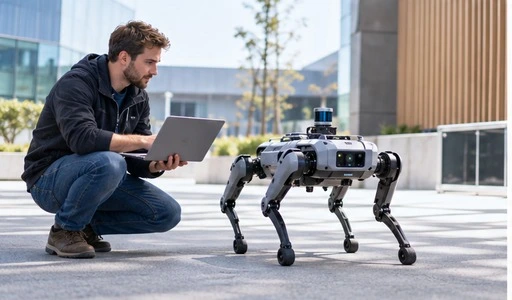
An open-source motion library with pre-set motion sequences and secondary development interfaces helps with the curriculum. Students can use pre-made routines or write their own control programs, which gives them real technical and creative freedom in a structured learning setting.
Embodied AI vs. Traditional Robotics: What Changes for Your Program
When you are making decisions about what to buy or planning a program, it is important to understand this difference. Kinematics, fixed-path programming, and PLC-based control are all important parts of traditional robotics schooling, but they aren't meeting the needs of the business any longer.
Embodied AI robotics programming introduces a new level of intelligence that is adaptable. This way of training robots can handle unstructured situations like cluttered stores, changing terrain, and job patterns that don't repeat without having to be reprogrammed by hand. Computer Science and Artificial Intelligence Laboratory (CSAIL) at MIT has done research that shows embodied learning agents can generalize tasks much faster than rule-based counterparts when they are shown new object configurations.
For institutions, this means that graduates from your schools will be ready for jobs that didn't even exist five years ago, like Robot Vision Algorithm Engineer, Autonomous Navigation Engineer, ROS Development Engineer, and Intelligent Patrol System Developer. Right now, business partners are having a hard time filling these jobs.
Challenges to Anticipate — and How This Program Addresses Them
Putting in place a new program for embodied AI robotics programming isn't easy. These are the most common problems that schools have, and the ECR Academy program is made to directly solve them.
Curriculum-hardware misalignment is the most frequently cited obstacle. When schools buy robots, they often find that the course materials they need were made for a different platform. There is a high-performance four-legged robot with LiDAR, 4K cameras, and touch sensors that was used in the ECR Academy course. The "two separate tracks" problem is no longer a problem at all because each module maps straight to that hardware.
Faculty readiness is another real concern. To teach embodied AI, teachers need to know both how to make software and how to connect physical systems, which is not often found in academia. As part of its institutional partnership package, ECR Academy offers training for faculty. This is done by the same engineers and academic experts who created the curriculum.
Finally, ongoing content relevance matters. The models for robotics and AI change quickly. The ECR Academy curriculum is based on ROS, ROS 2, Python, and YOLOv8, which are all regularly kept and widely used technologies. It is also updated to match international technical standards to make sure it will last.
Conclusion
Embodied AI robotics programming is not just a trend; it is a top goal for hiring in the production, logistics, farm, and service sectors. If schools start making organized, hardware-integrated, industry-aligned training programs right away, they will have a big edge when it comes to getting new students, getting accredited, and building business partnerships. ROS is the main piece of technology. The framework for teaching is provided by a well-designed program. Everything else is taken care of by the right institutional partner.
FAQ
1. Can students with no prior coding background take this course?
Yes. Before Python and ROS are taught, the program starts with getting to know the platforms and doing simple tasks. The structured progression makes it easy for beginners to understand while still being difficult enough for students who have used technology before.
2. What hardware does the course require?
The course is built around a powerful four-legged robot base with LiDAR, 4K HD cameras, and touch sensors. Students need a PC with Windows 10 or higher, an Intel Core i5 or similar CPU, 8GB of RAM, 256GB of storage, and a dedicated GPU with at least 4GB of VRAM.
3. What roles can graduates pursue?
The program prepares graduates for a variety of jobs, such as ROS Development Engineer, Robot Vision Algorithm Engineer, Autonomous Navigation and Path Planning Engineer, Quadruped Robot Application Developer, and Intelligent Patrol System Engineer.
4. Does this course support institutional partnership programs?
Yes, ECR Academy works closely with businesses, schools, and industry groups to help create new programs, train teachers, and make sure they follow the rules set by accreditation bodies.
Partner With E.C.R Academy to Build Your Embodied AI Program
E.C.R Academy offers complete embodied AI robotics programming solutions, including curriculum, hardware, training for teachers, and continued support, for schools that want to make their programs ready for the future. We are a reliable provider of embodied AI robotics programming with 16 years of experience in 28 countries. We have what your institution needs to launch with confidence. Get in touch with us right away at ecr2008@enteredu.com or go to enteredu.com to look into business choices.
References
1. Siciliano, B., & Khatib, O. (Eds.). Springer Handbook of Robotics. Springer, 2016.
2. Quigley, M., et al. "ROS: An Open-Source Robot Operating System." ICRA Workshop on Open Source Software, 2009.
3. Pfeifer, R., & Bongard, J. How the Body Shapes the Way We Think: A New View of Intelligence. MIT Press, 2006.
4. Andrychowicz, O., et al. "Learning Dexterous In-Hand Manipulation." The International Journal of Robotics Research, 2020.
5. Macenski, S., et al. "Robot Operating System 2: Design, Architecture, and Uses in the Wild." Science Robotics, 2022.
6. Levine, S., et al. "End-to-End Training of Deep Visuomotor Policies." Journal of Machine Learning Research, 2016.


_1781601799781.webp)