Internet of Things (IoT) Engineering Technology
Standards: Aligned with national teaching standards and international technical specifications
Faculty: Senior enterprise engineers and college experts
Platform: Browser-based online platform for IoT design, simulation, and deployment
Employment: Industry-aligned skills across sensing, networking, application development, and system integration
Target Partners: Enterprises, educational institutions, industry associations, and other organizations
Internet of Things (IoT) Engineering Technology
Course Overview
Grounded in the IoT "Perception — Connectivity — Application" technology framework, this course focuses on Internet of Things (IoT) Engineering Technology and building IoT product innovation design and development capabilities, covering core skill modules including:
- Sensor technology
- Embedded development
- Wireless sensor networks
- IoT identification.
This course adopts an international engineering education methodology, guiding learners through integrated hands-on training — from IoT product requirement analysis and technical architecture design to functional module development and system integration and deployment — producing IoT engineering technology professionals with a global perspective.
Why This Course?
1.Curriculum
Theory integrated with practice, project-driven learning supporting practical application of acquired skills.
2.Standards
Benchmarked against national instructional standards and integrated with international technical specifications, cultivating highly skilled professionals with international technical perspective.
3.Faculty
Senior enterprise engineers and academic experts co-deliver instruction, combining theoretical depth with real-world experience.
4.Platform
An online development platform built on a B/S (Browser/Server) architecture, enabling IoT system design, simulation, and deployment directly through a web browser.
5.Career Pathways
Aligned with real industry demands, covering the full value chain from perception and control, networking and communication, to application development and system integration.
What You'll Be Able to Do?
This course is benchmarked against the full lifecycle of IoT products, covering core competencies from the perception layer through to the application layer:
1. IoT Perception and Control Development
- Apply sensor data acquisition and processing technologies; implement IoT identification technologies including RFID and barcodes
- Develop, test, and maintain IoT perception devices
2. IoT Networking and Communication Development
- Develop IoT protocols and apply wireless sensor network technologies
- Implement wireless communication protocols such as ZigBee; develop sensor network protocols, configure device access, and set up network configurations
3. IoT Application Development
- Develop applications on IoT platforms, edge devices, and mobile terminals
- Process and apply data for device control; develop, test, and deploy IoT applications
What You Will Learn?
|
Training Skills
|
Description
|
|
1. Introduction to IoT Engineering
|
Apply iot models and architecture frameworks.
Understand intelligent perception technologies and key network communication technologies.
Explore iot platform, edge-side, and mobile terminal application development.
Apply iot security technologies and system integration methods.
|
|
2. Embedded System Development
|
Design embedded hardware minimal systems.
Use software development tools.
Develop i/o port and uart drivers.
Implement task management, synchronization and mutual exclusion.
Communication, interrupt management, and time management in embedded systems.
|
|
3. Sensor Technology
|
Acquire and control data from temperature/humidity, photosensitive, gas-sensitive, ultrasonic, and infrared sensors.
Install and deploy data acquisition systems.
Analyze and troubleshoot faults; implement multi-sensor fusion systems.
|
|
4. IoT Identification Technology
|
Apply rfid system principles.
Program high-frequency readers.
Implement epc coding standards.
Develop barcode and qr code encoding programs.
Design and operate rfid systems.
Use api operations and develop front-end data acquisition modules.
|
|
5. Wireless Sensor Network Development
|
Develop using the zstack protocol stack.
Apply zigbee specifications.
Perform data packet encapsulation and parsing.
Develop wireless bus communication applications.
Configure wireless device access.
Route and forward data packets.
Implement unicast, multicast, and broadcast communication.
|
Learning Environment
The IoT Online Development and Teaching Platform is a professional skills training platform built on a B/S (Browser/Server) architecture, leveraging HTML5 and WebGL technologies to enable browser-based IoT system design and simulation. The platform provides complete functional modules including:
- Sensor data simulation
- Wireless network configuration
- Embedded programming
- Cloud access control logic design — supporting real-time scene editing device linkage preview to improve design visualization and development workflow.
A built-in library of IoT device models and communication protocols enables hardware resource virtualization and software logic decoupling, ensuring cross-platform resource synchronization and making development practice more accessible, providing professional technical support for rapid IoT product development and deployment.
Company Strength
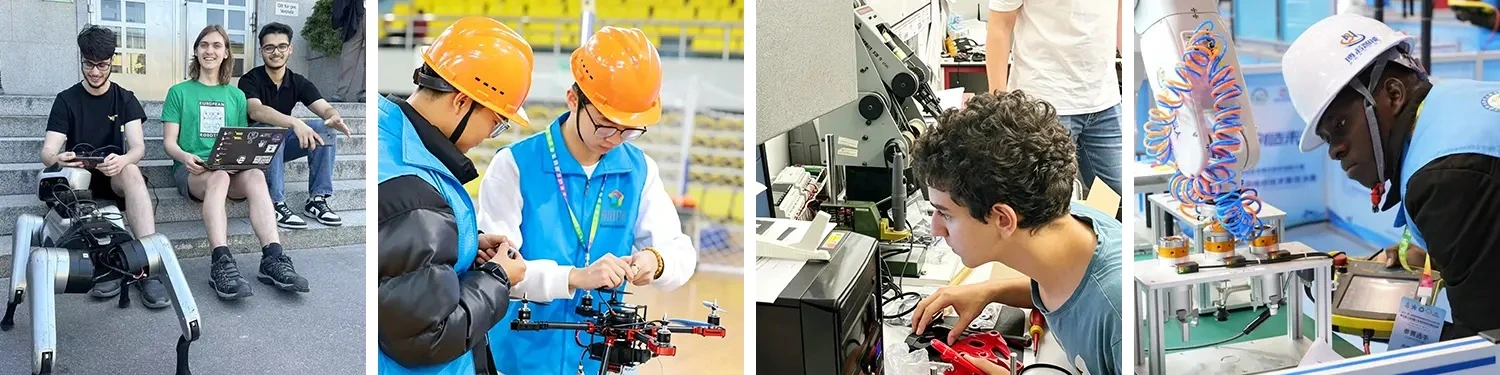
At ECR Academy, our Internet of Things (IoT) Engineering Technology training program is built on deep industry insight and extensive global reach. We've empowered nearly 500,000 participants across 29 countries since 2010, with over 300,000 earning recognized certifications. Our program offers you:
- Access to a robust ecosystem of more than 3,300 industry and academic experts specializing in IoT system design and deployment
- Partnership network spanning over 500 enterprises actively shaping IoT innovation in sensing, networking, and application development
- Comprehensive learning resources exceeding 60,000 items—including IoT skill standards, simulation courseware, real-world case studies, and assessment systems
- Proven track record organizing over 150 technical competitions where 30,000+ learners gained hands-on experience in edge computing, sensor integration, and protocol implementation
- 16 years of professional experience delivering industry-aligned training that bridges theory with practical IoT engineering challenges you'll face in smart manufacturing, infrastructure monitoring, and logistics systems

FAQ
Q: Can I take this course with no prior background?
A: Yes. The course begins with IoT fundamentals and follows a step-by-step progressive learning path. With a visual simulation platform and online experiment environment, learners can complete full-process practice across the perception, network, and application layers without any physical hardware — making the entry barrier low and onboarding fast.
Q: What career paths are available after completing the program?
A: Learners can prepare for roles such as:
- IoT perception and control development engineer / sensor network engineer
- Embedded system development engineer / IoT application development engineer
- IoT system integration engineer / IoT deployment engineer
- IoT operations and maintenance engineer / IoT technical support engineer
- Industrial internet engineering technician / smart hardware product manager
Q: How is the learning platform deployed?
A: The platform operates on a SaaS cloud service model, removing time and location constraints and supporting flexible access from PCs, tablets, and smartphones across devices. A complete IoT development environment and simulation testing system are built in — all coding, device configuration, and system debugging can be completed in the browser with no need to set up a local development environment, supporting integrated learning and practical application in a browser-based environment.

Contact Us
Reach out to us at ecr2008@enteredu.com to explore partnership opportunities and training solutions for Internet of Things (IoT) Engineering Technology tailored to your needs.








_1781601799781.webp)