How to Apply Industrial Energy Conservation Technology in Energy Storage
Five initiatives can help organisations utilise industrial energy conservation technology in energy storage. The first is to measure a site's energy utilisation. The second is to right-size storage capacity according to actual workloads. The third is to optimise the equipment surrounding the battery or thermal storage tank. The fourth is to incorporate predictive maintenance and continuous monitoring. The fifth is to compare energy savings against an established baseline.
Every gain in efficiency may minimise waste before energy reaches storage, and every kilowatt-hour of stored energy can provide more productive labour. This course includes major problems, basic ideas, step-by-step methods, supplier inspection concerns and examples from public projects. It also illustrates how E.C.R Academy teaches teams to function efficiently with these tools.
This information is aimed at procurement managers, engineers, OEM teams and program directors who are engaged in the design of storage projects or the training of operators. According to the U.S. Energy Information Administration, industry accounts for around one-third of total U.S. energy usage, indicating that even tiny efficiency gains inside industrial facilities may add up to large savings. Energy storage by itself cannot eradicate the underlying energy waste, but may function well in combination with carefully planned energy saving measures.

Understanding the Challenges in Industrial Energy Storage
Round-Trip Losses and Standby Waste
All storage systems lose some power while charging and using it. Studies like the National Renewable Energy Laboratory’s Storage Futures Study estimate round-trip efficiency of lithium-ion systems at roughly 85%. Some 15 of every 100 kilowatt-hours are lost as heat. The same is true of thermal storage. Poorly insulated tanks and cables can continually lose stored heat or cooling capacity. Fans, pumps and control power consume electricity even when the system is not in use. A battery-only efficiency number does not include the increased load from industrial energy conservation technology integration, which is why I encourage customers to identify these additional energy costs before they sign a purchase agreement.
Outdated Equipment and Integration Complexity
Storage is rarely installed in isolation. It connects to legacy motors, switchgear, boilers, chillers and compressors to prevent waste before it even reaches the battery. An oversized motor at full speed against a throttled valve loses the energy the battery was bought to store. Integration makes things more complex. Different protocols can be used for different systems, including inverters, battery management systems, SCADA and building controls. If these protocols don’t match, they can create delays or incorrect dispatches. If a plant buys storage as a separate item, the savings may be eroded by the old equipment around it. A site survey that examines both the storage system and the equipment around it can help prevent this problem.
Limits of Manual Energy Management
Clipboard rounds and monthly invoices tell you only what happened, not why it happened. A paper log cannot remember a compressor short-cycling at 2 a.m. or a chiller going out of tune in a heat wave. On top of that, storage has to make decisions quickly because how it charges and discharges depends on the weather, the quantity of energy available and changes in production. Operators normally require data every 15 minutes to align with utility meters. That’s interval data. Advanced monitoring fills that gap, displaying power, temperature, flow and battery charge level at the same time. Without it, teams cannot accurately quantify savings, and estimates do not usually get through a finance review.
Core Principles of Industrial Energy Conservation Technology in Energy Storage
Measure First with Sensors and IoT
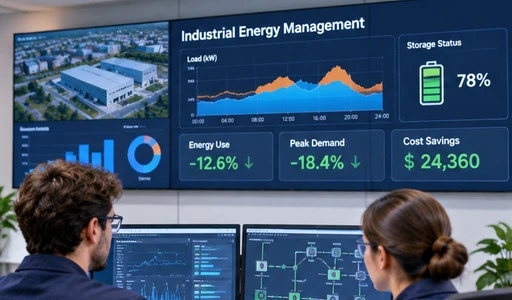
The first rule is easy to understand: you cannot cut down on things you do not measure. With IoT gateways, devices like smart meters, temperature probes, flow sensors, and power-quality analyzers can send data to a main platform. The data is then used by automation to do things like using a variable frequency drive to slow down a pump when demand drops. There are three parts that need to be monitored: the loads that use energy, the storage asset itself, and the connection to the grid. When all three feed into the same screen, workers can see how changes in one place affect the others. This visibility is the foundation of all subsequent steps in industrial energy conservation technology.
Match Storage to Load with Peak Shaving and Load Shifting
When storage is set up to match how a plant actually uses power, it saves money. Peak shaving drains a battery during short spikes in demand to lower demand charges. By shifting load, energy use is moved from expensive times to cheaper ones. The same is true for thermal options. In its thermal storage review, the U.S. Department of Energy says that ice storage makes ice at night for cooling during the day. This shifts the load on chillers from peak times to off-peak times. I look at the site's load profile and find the peak costs before I buy anything. You can use that chart to figure out if you need a battery, a thermal tank, or just simple load control first.
AI-Driven Controls Compared with Traditional Methods
With traditional settings, the batteries are charged at night and drained at noon. Forecasts, prices, and live plant data are read by AI-driven energy management, which then changes the schedule as conditions change. Better information on cell temperature and state of charge is added by smart devices and newer battery management systems. This helps protect battery life. The International Energy Agency says that the use of batteries is growing quickly, which makes smarter control more valuable. But AI does not take the place of sound system design. I believe that a well-tuned fixed schedule on a plant that works well is better than a smart controller running on a plant that does not work well, so I think of software as the last layer and not the first.
Step-by-Step Application of Energy Conservation Techniques in Industrial Energy Storage
Steps One and Two: Audit the Site and Set a Baseline
First do an energy audit. Walk throughout the facility and write down the interval data for twelve months. Make a list of the major loads such lights, compressors, motors, chillers, heaters etc. Then, establish a baseline. ISO 50001 requires companies to create energy performance indicators , and then measure performances against a baseline for industrial energy conservation technologies. The International Performance Measurement and Verification Protocol offers four techniques to prove you saved energy in the future. If you want to prevent debates over the maths later, I recommend you choose the verification technique before the task begins. Fix fast wins like air leaks and inefficient equipment before scaling the storage system so you can understand how much store capacity you really need.
Steps Three and Four: Tune the Loads, Then Size the Storage
First, get the load side fixed. Variable frequency drives are good for motors with changing requirements. Heat pumps may substitute fuel fuelled heaters if the conditions allow. Reactive power correction makes the power factor better. If your load profile is not that high after these enhancements, you should size the storage depending on the hours you wish to cover and the remaining peaks. Duration, round-trip efficiency, cycle life, footprint, safety requirements and local code are all relevant comparisons to make across technologies. Lithium-ion enjoys numerous, short cycles. Areas that require plenty of cooling may store ice. Molten salt is suitable for high temperature thermal storage applications. Adding little storage to a tuned load may be cheaper than adding huge storage to a wasteful one.
Steps Five and Six: Monitor, Maintain, and Verify
Once you’ve got it all set up, you link it all to an IEMS (Industrial Energy Management System) so workers can view pricing, loads and storage all in one place. IoT predictive maintenance included. Temperature, vibration and current patterns may tell you whether a bearing is deteriorating or a heat exchanger is blocked up, before they create downtime. Same methods for vintage fits . First, you put sensors and drives on the equipment you have. Then attach storage using regular connectors. Compare findings with the verification option you had selected before on a monthly basis with the baseline. It advises you where to search for savings when they are not there, for example at control settings, the health of the equipment or changes in tariffs.
Evaluating and Selecting Energy Conservation Technologies and Suppliers
Running Cost-Benefit and ROI Analysis
Build the financial case on measured facts, not on the assertions in a pamphlet. Total cost is the sum of the cost of the tools, installation, controls and testing. Then calculate how much you will save each year with less energy usage, less demand charges, and less downtime, and remove the cost of maintenance and any battery replacements. Divide the cost by the yearly savings to obtain a straightforward return. For longer-lasting assets, do a discounted cash flow. Consult with a tax advisor about possible tax benefits, such as the federal investment tax credit for stand-alone storage under the Inflation Reduction Act. Test the model with a compelling argument. Tariffs and manufacturing timelines vary.
Building the Skills to Run These Systems
Savings come from equipment only when it is run by trained people. Energy management, thermal systems like combined heat and power, cooling and heat pumps, and air blowers are all covered in the Industrial energy conservation technology course at E.C.R. Academy. It also covers technology for saving electricity and energy. Students learn about lithium-ion batteries, how to store energy in ice and molten salt, and how to build an energy storage system. Experts from business and academia teach together, and projects are based on real tasks that are done in production. There are wind-solar-storage devices and battery testing equipment in training rooms, along with modeling, big data, and cloud tools. Since 2010, we've taught almost 500,000 people in China and 28 other countries.
Case Studies: Real Projects and Lessons for Industrial Energy Storage
Hornsdale Power Reserve in South Australia
Hornsdale Power Reserve was built by Neoen with Tesla batteries. It started running at 100 MW and 129 MWh in late 2017. The project is not a business; it is for public use. Still, it shows how fast-responding batteries can support grid operation and how control software determines the value of different services using industrial energy conservation technology. Industrial sites can learn from this: a battery only creates value by providing services such as lowering demand, providing backup power, or lowering energy costs. So, list those value streams first. As a public standard for system scale, I use it. It is not a promise that it will work at your plant.
Solana Generating Station in Arizona
This 280 MW concentrating solar plant is in Solana, which is close to Gila Bend, Arizona. It can make electricity for about six hours after the sun goes down because molten salt stores heat. Here, thermal storage takes the place of batteries and moves heat from the sun to demand in the evening. For business buyers, this means that the type of storage should match the type of energy you have. For plants that use high-temperature process heat, thermal storage may work better than electrochemical systems. Batteries, on the other hand, are often better for electric loads. Solana shows your team the range of choices they should look at.
A Training Scenario: Wind-Solar-Storage Project Work
Scale is taught by public projects, but teams also need to work together on smaller projects to get better at it. Students at E.C.R. Academy work on a wind-solar-storage project in the Energy Storage Technology Training Lab as part of their course. They look at different ways to store data, plan a small system, and use an artificial tool to keep an eye on it. They can test designs in the Energy-Saving Design Simulation Training Lab's simulation tools before they touch real hardware. This is a training scenario, not a client result, because the most important thing is to build skills. When these steps are practiced, teams are ready to go to real sites and audit, size, commission, and check storage.
Conclusion
When industrial energy conservation technology is used for energy storage, the process starts with measuring and ends with checking. Round-trip inefficiency, standby loads, and equipment that does not work well together can all cause storage systems to lose energy, and manual logs cannot show these losses. Sensing, matching storage to the load profile, and smarter control are the main ideas behind it. The method works in a step-by-step way to check the site, set a baseline, adjust loads, decide on storage size, add monitoring and predictive maintenance, and use a known protocol to check for savings. Control compatibility, recorded performance, and service are what determine which supplier to use. Measured data should be used to determine ROI. The types of storage should match the type of energy and the service that is required, as shown by public projects like Hornsdale and Solana. All of these gains stay put when operators are trained.
FAQ
1.Where do I start with an existing storage system?
Start with an energy audit and monthly data covering a full year. Set a baseline, fix any leaks or oversized motors, and then add monitoring. Before you spend more money, these steps will show you how much storage capacity your plant really needs.
2.Is thermal storage suitable for factories?
Yes, when your load involves heating or cooling. Chiller load can be shifted to off-peak hours when ice is stored at night, while high-temperature heat can be stored in systems such as molten salt. Choose the right technology for the required temperature, storage duration, and available space.
3.Are government incentives available?
Yes, the Inflation Reduction Act provides federal tax credits that may apply to eligible energy storage projects. Some states and utilities also have their own programs. It is important to keep up with the latest rules by talking to a tax professional and your local energy company.
4.Does E.C.R Academy teach storage design?
Yes. The class goes over the features of lithium-ion batteries, how to store energy in ice and molten salt, how to build small-scale systems, how to monitor smart energy storage systems, and how to apply these concepts through hands-on lab work.
Talk to E.C.R Academy About Industrial Energy Conservation Technology Training
Need a company that provides industrial energy conservation technology training for businesses to train your team? Enterprise engineers and academic experts teach project-based courses at E.C.R. Academy, which has labs that use simulations, big data, and cloud computing to help students learn. We will come up with a course plan and quote after hearing about your sites, systems, and learner groups. To find out more, email ecr2008@enteredu.com or go to enteredu.com.
References
1. U.S. Energy Information Administration, Monthly Energy Review, 2024.
2. International Energy Agency, Batteries and Secure Energy Transitions, 2024.
3. National Renewable Energy Laboratory, Storage Futures Study: Key Learnings for the Coming Decades, 2022.
4. International Organization for Standardization, ISO 50001:2018 Energy Management Systems: Requirements with Guidance for Use, 2018.
5. Efficiency Valuation Organization, International Performance Measurement and Verification Protocol: Core Concepts, 2022.
6. U.S. Department of Energy, Thermal Energy Storage Technology Strategy Assessment, 2023.