What Skills Does Digital Design and Simulation for Smart Production Lines Develop?
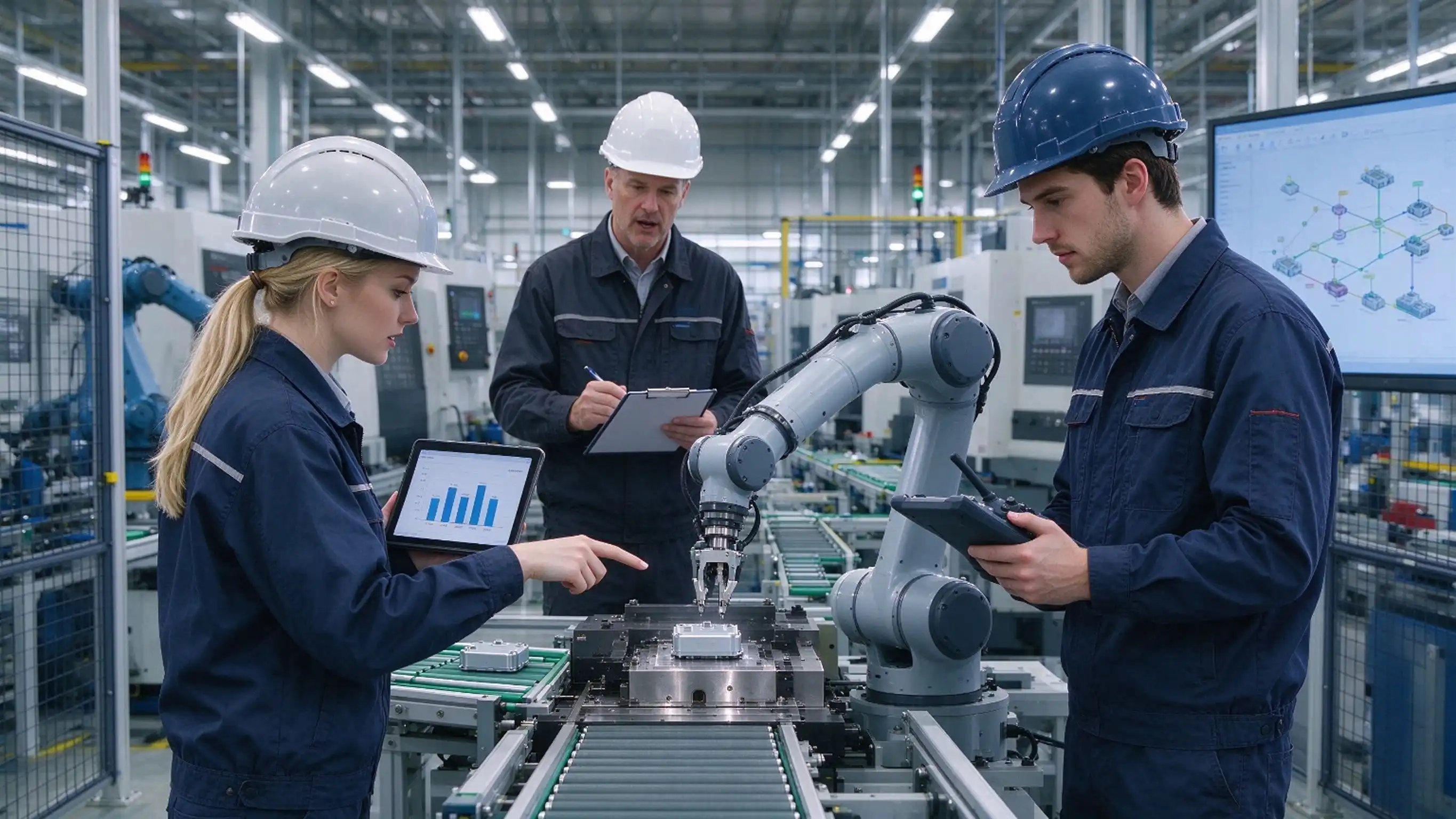
Digital design and simulation for smart production lines build a wide range of job-ready technical and analytical skills. Learners gain hands-on experience in digital twin construction, PLC programming, industrial robot operation, AI-based visual recognition, and MES system integration. These skills mirror the actual workflows found in modern smart factories. Rather than learning in isolation, students work across complete production cycles — from layout planning and equipment configuration to system debugging and performance optimization — making them ready for real roles in intelligent manufacturing environments from day one.
Understanding Digital Design and Simulation in Smart Production Lines
Modern factories no longer rely solely on physical prototypes to test production ideas. Instead, engineers build virtual replicas of entire production systems, run scenarios, and catch problems before a single bolt is tightened. This shift has made simulation literacy one of the most sought-after skills in manufacturing today.

What Is a Digital Twin and Why Does It Matter?
A digital twin is a real-time virtual model of a physical production asset or system. According to ISO 23247, a digital twin framework for manufacturing must support data exchange between physical and virtual environments. In practice, this means a simulated conveyor line or robotic cell can mirror actual machine behavior with sub-millisecond synchronization accuracy, which reduces physical commissioning time by 30–40%.
How Simulation Differs from Simple 3D Visualization
Three-dimensional visualization shows what a production line looks like. Simulation shows how it behaves. A true simulation environment runs underlying control logic, models material flow using Discrete Event Simulation (DES), and tests kinematic behavior under real constraints. This distinction matters when evaluating platforms for industrial training or procurement decisions.
The Role of AI and IoT in Modern Simulation Platforms
Simulation platforms now integrate AI and IoT data feeds. Through OPC-UA or MQTT protocols, a simulation environment can receive live sensor data and transition into a live digital twin. This allows engineers to test predictive maintenance scenarios and production scheduling changes against real operating conditions — a skill that is increasingly required in lighthouse factories and 5G-connected plants.
Core Skills Developed Through Digital Design and Simulation
- Intelligent production line design and simulation: Learners design smart production layouts for real industrial scenarios, build digital twin environments, configure virtual equipment models, analyze logistics paths, and run 3D virtual manufacturing simulations. By working through complete production cycles, students develop the spatial reasoning and data interpretation skills that system integration engineers use every day.
- PLC programming and industrial robot operation: Using Siemens TIA Portal for digital design and simulation for smart production lines, learners write PLC control programs, configure HMI interfaces, perform teach pendant programming, and plan robot motion trajectories. They also configure TCP communication and multi-device signal mapping — skills that directly align with roles like PLC Programming Engineer and Automation Control Engineer.
- AI vision recognition and intelligent voice interaction: Learners collect image data, train AI deep learning models, and deploy visual recognition algorithms to identify materials by color, shape, and position. They also build voice interaction systems for intelligent warehouse applications — a growing area as AI-based sorting becomes standard in high-mix, low-volume electronics manufacturing.
- MES integration and system debugging: Learners configure MES parameters, synchronize virtual and physical production data, perform integration testing, and diagnose equipment faults. This module prepares students for roles in digital twin application engineering and MES system operation.
Comparison and Decision-Making Skills in Digital Production Design
Beyond technical execution, working with simulation platforms develops sharp evaluation and decision-making skills. Professionals who understand simulation can assess vendor platforms against concrete criteria — not just marketing claims.
Simulation vs. Traditional Prototyping
Physical prototyping carries high capital costs and long revision cycles. Simulation typically delivers a 200% ROI through saved labor and avoided physical re-tooling, according to industry benchmarks. Professionals trained in simulation can quantify this trade-off and present it clearly to procurement decision-makers.
Evaluating Software Platforms and Licensing Models
Choosing between open-source tools and commercial platforms like Siemens Process Simulate involves weighing AutomationML compatibility, PLC logic validation support, and Hardware-in-the-Loop (HiL) testing capability. Licensing models — educational use versus commercial deployment — also affect total cost of ownership, a detail that vocational institutions and OEM training departments must assess carefully.
Risk Assessment and Model Validation
Quality simulation work requires applying verification and validation (V&V) protocols such as ASME V&V 40. Key inspection areas include kinematic consistency against actual servo motor specifications, statistical validity of simulation output distributions, and collision volume accuracy. These QC skills prevent expensive errors during real-world deployment.
Practical Steps to Develop and Apply Digital Design and Simulation Skills
It's easy to get better at this subject. There are two ways to learn in the ECR Academy course: one is for people who are just starting out, and the other is for people who have been learning for a while. Both are built on a tool for virtual and real-world training.
Start with Structured, Standards-Based Curricula
The class covers AI deep learning, industrial robots, PLC systems, and machine vision all at the same time. It follows the rules for smart manufacturing around the world. The school doesn't have generalists; it's made up of engineers from business and academia. This makes sure that the lessons are based on real technical problems and how factories work.
Apply Skills Through Real Case Studies
Modeling logic in digital design and simulation for smart production lines is useful in many situations, and case studies from high-mix electronics, pharmaceutical safe packaging, and car body-in-white assembly show students how to use it. For instance, in car BiW welding cells, testing of reachability and collision detection for more than 200 robots is done in 3D before they are set up in real life. This is a real-life example of the skills we learned in class.
Build on the Platform's Modular Flexibility
There are different modules that make up the training platform. These modules can be put together on the workstations in different ways. It doesn't need any complicated software to be installed. As students move from learning how to use basic tools and digital twins to full system integration projects, the platform adapts to fit their needs.
Future Trends and Continuous Skill Evolution in Smart Production Lines
With the help of AI, IoT connections, and cloud-based deployment, simulations can be used for more than just training. They're now being used to run real plants. People who keep their skills up to date will still be useful even as these tools get better.
AI-Driven Simulation and Predictive Operations
AI models that are built into training environments can now tell when tools will break down and suggest changes to the plan before it's too late. It changes what it means to be technically skilled in a smart manufacturing job when upkeep is turned into proactive production management.
Evolving Certification and Procurement Requirements
There are more and more integrated systems on the market that can handle PLC, robot, AGV, MES, and SCADA cases all in one place. Companies and schools that need training now look for platforms that can connect to well-known certifications and let extra development happen on top of the current MES infrastructure.
Lifelong Learning as a Structural Requirement
As new technology comes out, the VDI 3633 standard for simulation modeling and the ISO 23247 standard for digital twin frameworks are always being made better. Professionals need more than just one title; they need organized learning tracks. In the long run, programs with different levels of training, ongoing faculty support, and up-to-date curriculum are better.
Conclusion
Digital design and simulation for smart production lines teach useful skills like how to carry out technical tasks, connect systems, and make smart choices. For example, you need to know how to program PLCs, make digital twins, use AI vision apps, and oversee industrial equipment. These are all skills that smart companies need today. You can use structured simulation training as the head of a vocational program to build a high-level specialty cluster, as the training manager for an OEM to help clients improve their skills, or as the training lead for a factory to get workers ready for digital processes. It is possible to get those skills, there are clear job tracks, and there is a need in the field.
FAQ
1. Can someone with no technical background take this course?
Yes. For people who have never done this before, the course gives them a basic set of lessons. It starts with basic AI ideas, how to use basic tools, and the basics of digital twins. After that, it gets progressively harder to do projects.
2. What career roles does this course prepare learners for?
Right now, grads can apply for jobs like Industrial Robot Engineer, PLC Programming Engineer, Digital Twin Application Engineer, AI Vision Application Engineer, MES System Operation Engineer, and Intelligent Manufacturing Professional Instructor.
3. Does the platform require specialized software installation?
No, the tool can be used for learning both online and off. It's also simple to set up, so students can start right away without having to learn how to use complicated software.
Take the Next Step With E.C.R Academy's Smart Manufacturing Training
Over 300,000 certificates have been given out and over 500,000 students have been helped by E.C.R. Academy in 28 countries since 2010. Our supplier program for "Digital design and simulation for smart production lines" has teachers who are experienced engineers in the field, a virtual-physical training platform, and classes that are the same as those used all over the world. If your school or group needs a reliable partner for digital design and simulation for smart production lines training, email us at ecr2008@enteredu.com or go to enteredu.com.
References
1. International Organization for Standardization. ISO 23247: Automation Systems and Integration — Digital Twin Framework for Manufacturing. ISO, 2021.
2. VDI — Verein Deutscher Ingenieure. VDI 3633: Simulation of Systems in Materials Handling, Logistics and Production. VDI, 2014.
3. American Society of Mechanical Engineers. ASME V&V 40: Assessing Credibility of Computational Modeling Through Verification and Validation. ASME, 2018.
4. Grieves, M., & Vickers, J. "Digital Twin: Mitigating Unpredictable, Undesirable Emergent Behavior in Complex Systems." Transdisciplinary Perspectives on Complex Systems, Springer, 2017.
5. Tao, F., Zhang, H., Liu, A., & Nee, A. Y. C. "Digital Twin in Industry: State-of-the-Art." IEEE Transactions on Industrial Informatics, Vol. 15, No. 4, 2019.
6. World Economic Forum. Fourth Industrial Revolution: Beacons of Technology and Innovation in Manufacturing. WEF, 2019.