The Role of Innovative Design and 3D Printing for Additive Manufacturing in Industry Training
Innovative design and 3D printing for additive manufacturing have become defining forces in how industries train the next generation of engineers and technicians. Instead of just using diagrams in textbooks or expensive prototypes, training programs now put students in the middle of the whole digital-to-physical process, from CAD modelling to process planning to printed parts that are ready to use. This change bridges the gap between what you learn in school and what you do on the job, giving graduates the practical skills that companies in the aerospace, automotive, and smart manufacturing sectors are actively looking for.

Understanding the Fundamentals of Design and 3D Printing in Additive Manufacturing
What Design for Additive Manufacturing Actually Means
For Additive Manufacturing (DfAM), a collection of engineering principles structures a product from the concept phase to be manufactured layer by layer. With DfAM, engineers may, unlike subtractive cutting, bond numerous pieces into one printed unit, use topology optimisation to eliminate redundant material and incorporate lattice structures to save weight. Additive manufacturing encompasses seven process categories as defined by the international standard ISO/ASTM 52900. Each group has their own design guidelines that engineers have to grasp before they can touch a machine.
Core Printing Technologies Every Trainee Should Know
Three process groups dominate professional training. Polymer printing is simple and affordable with FDM, making it ideal for design models. SLA and LCD resin printing can manufacture precision products with layer resolutions of 25–50 microns. Selective Laser Melting (SLM) makes titanium, Inconel, and stainless steel products dense. Aerospace and tooling employ these items. Each process has design restrictions and post-processing demands, thus a well-structured curriculum should cover all three.
The Full Workflow: From Digital Model to Physical Part
Needs analysis, 3D CAD modelling, motion simulation, slicing and process planning, printing, post-processing, assembly, and functional testing are all parts of a full additive manufacturing workflow. A graduate who is ready for work is different from someone who can only run a machine because they are skilled in all parts of this chain, not just printing. Wohlers Associates' research from 2023 on the industry shows that DfAM training cuts the number of prototypes that need to be fixed by as much as 40%. This means that manufacturers can save money on development costs.
Comparing Traditional Manufacturing and 3D Printing for Industry Training
Lead Times and Cost Differences That Matter to Training Programs
For traditional tooling and machining to work, custom fixtures are needed, setup times are long, and a lot of material is wasted. Those lead times make it hard for a training lab to make changes quickly, like when part designs need to be updated every semester or exercises need to be changed to fit new industry projects. For instance, making patterns for metal castings can take weeks. It takes hours to make a similar SLA resin prototype. Because of this speed advantage, teachers can base project-based lessons on real engineering cycles instead of simple, static demonstrations.
Real-World Evidence of Better Training Outcomes
A report from the SME (Society of Manufacturing Engineers) in 2022 found that schools with multi-process AM labs had 35% higher rates of student competition placement than schools with FDM-only setups in Innovative design and 3D printing for additive manufacturing. Being able to use FDM, resin, and metal printing processes helps students find more ways to solve problems and makes the learning environment more like a real production environment. When a student fixes an SLM build that didn't work or makes a topology-reduced bracket better for resin printing, they learn skills that simulation software can't teach them on its own.
Choosing the Right Technology for Each Training Application
Not every program needs SLM metal tools from the start. A useful selection framework looks at three things: the jobs that grads want, the types of businesses that the school works with, and the money that can be spent on supplies and upkeep. Polymer processes (FDM + SLA/LCD) cover most of the skills needed for product design and process planning at a price that is easy to handle. When the program is aimed at aerospace, automotive tooling, or medical device pathways where making metal parts is a core task, SLM capabilities become necessary.
Implementing Design and 3D Printing Solutions in Manufacturing Training Programs
Building a Curriculum That Covers the Entire Production Chain
Effective courses in additive manufacturing do more than just teach students how to use the tools. They organize learning around the whole process of making a product, from coming up with an idea to the final product. This includes concept design, 2D engineering drawings with GD&T annotations, 3D CAD modeling, integrated structure design, motion simulation, process planning, printing, and post-processing. At each stage, skills are built that are then used in the next step. When programs don't include modeling or post-processing, grads have trouble with quality control, which is one of the main issues factory HR managers hear during onboarding.
The main skills that an AM training program should teach are listed below:
- Product concept and solution design — translating functional requirements into manufacturable drawings with dimensions, tolerances, and technical notes, developing design thinking grounded in real engineering constraints.
- Innovative design and 3D printing for additive manufacturing — 3D digital modeling and motion simulation — using professional CAD software (SolidWorks, CATIA) for part, assembly, and parametric modeling, then running virtual motion analysis to verify mechanisms before committing to print.
- Multi-process printing and post-processing — operating FDM, SLA/LCD, and SLM equipment with full parameter control, then completing support removal, surface finishing, assembly, and functional testing to production-grade standards.
These skill areas prepare graduates for jobs like product structure designer and additive manufacturing process engineer. These are jobs where companies want more than just academic qualifications; they also want to see proof of hands-on skills.
Quality Assurance and Certification Alignment
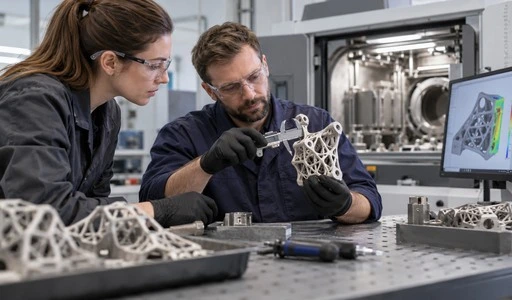
To be useful for teaching, training parts must meet real-world standards for size and quality of the surface. This means showing students how to use a CMM to check for defects, measure surface roughness, and confirm the structure—exactly the same checks that are done on the production floor. By making sure that course content is in line with international standards like ISO/ASTM 52900 and ASTM F42 material specifications, graduates will be able to talk to companies that hire them in the same technical language. It also helps an institution's case when it wants to get program accreditation or co-certification with an industry.
The Role of Enterprise Engineers in Delivering Relevant Training
The level of the instructors decides how up-to-date the curriculum is with what the business does now. Within two to three years, programs taught only by academic staff can become less relevant to real production processes. The course material is based on real engineering projects because enterprise engineers and college experts teach together. Enterprise partners can bring real work orders into classrooms to show students how production standards, client specs, and the business pressures that engineers face every day affect their decisions.
Future Directions for Additive Manufacturing in Industry Training
Emerging Materials and Process Capabilities
A huge amount of new printed materials have come out. FDM methods now use high-performance polymers like PEEK and carbon-fiber-reinforced filaments. Multi-material resin printing lets you make working samples with different Shore hardness levels all in one build. It is faster to make mid-volume metal parts with binder jetting systems on the metal side. When people are trained in this wide range of topics, they emerge with the skills to adapt as process powers continue to improve.
Blended Learning and Remote Simulation
Online motion simulation tools and cloud-based CAD platforms make practical training possible outside of the lab. Any device can be used to practice parametric modeling and mechanism simulation, and machine time can be used for hands-on printing and post-processing. This blended approach is great for schools with a lot of students or students who live in different areas because it keeps the level of teaching high without making the cost of tools go up too much.
Aligning Workforce Investment with Industry Demand
According to the U.S. Bureau of Labor Statistics, the number of jobs in advanced manufacturing will continue to grow until 2032, especially in Innovative design and 3D printing for additive manufacturing. Increasingly, skills in additive manufacturing are listed as a preferred qualification in job postings for aerospace, medical devices, and consumer electronics. Businesses and institutions that start structured AM training now will put their graduates and employees ahead of this demand curve instead of behind it.
Procurement Guide: Sourcing 3D Printing Training Solutions
Key Criteria for Evaluating a Training Program Supplier
When choosing an additive manufacturing training solution, procurement teams should consider technology coverage (does the program cover FDM, SLA/LCD, and SLM?), curriculum depth (does it include simulation, post-processing, and quality inspection?), faculty model (does the supplier include enterprise engineers?), and support continuity. A vendor who provides equipment but leaves after setting it up increases expense without capability.
Understanding Pricing and Implementation Timelines
Full-process AM training programs usually have different line items for tools, software licensing, lesson plans, and teacher training. Implementing in stages, such as beginning with polymer processes and then adding metal capabilities in a later stage, can spread out capital costs over several budget cycles while keeping the curriculum consistent. As part of the deal, institutions should also include help for verification and certification. This is especially important if they want to apply for co-certification or industry recognition programs.
Why ECR Academy Is a Reliable Partner for AM Training
Since 2010, ECR Academy has helped over 500,000 people in 28 countries. It has over 3,300 expert contributors and more than 60,000 learning materials, such as standards, courseware, and evaluation banks. The Innovative design and 3D printing for additive manufacturing program covers the whole FDM + SLA/LCD + SLM workflow. It is taught by a mix of business and academics, and it comes with micro-lesson videos, operation demonstrations, and project cases to help.
Conclusion
Training individuals in Innovative design and 3D printing for additive manufacturing requires covering the complete production chain, not just the printing phase. The graduates from schools that integrate design thinking, digital modelling, multi-process printing and post-processing are ready to go to work in the real world. Companies and organisations spend less time hiring new personnel, improve the number of positions obtained by graduates and promote long-lasting internal capabilities by using this systematic strategy. All the industry surveys and international standards bodies agree: Employers in advanced manufacturing need a lot of individuals who know a lot about a lot of various processes and have worked on a lot of different projects.
FAQ
1. Can an institution with only FDM equipment start this program?
Yes. The lesson plans are set up so that FDM basics come first, then SLA/LCD plastic processes, and finally SLM metal processes. An institution can buy tools in stages while still following the full schedule of lessons. The digital design and simulation modules don't depend on the printing hardware, so students can start learning CAD and DfAM skills right away, no matter how their equipment is set up.
2. How does the joint enterprise-academic instruction model work in practice?
Enterprise engineers bring real production projects into the classroom, complete with real materials, real client requirements, and real limits. The structured theoretical framework and assessment design are provided by academic instructors. Together, they make sure that students learn both the philosophical thinking behind a design choice and the practical thinking that is needed in production settings. With this model, the program doesn't get too academic on one side or too procedural on the other.
3. What certification or accreditation outcomes can institutions expect?
The course is in line with international standards for additive manufacturing skills, which makes it a good choice for university approval reviews and co-certification applications from the industry. The exact results rely on the accrediting body and the needs of the area. The team at ECR Academy can help with the paperwork and proof of alignment that is needed for the program recognition process.
Partner with ECR Academy for Additive Manufacturing Training
The Innovative design and 3D printing for additive manufacturing program from ECR Academy gives your school or business an organized, industry-tested way to go from idea to finished printed parts. We are a trusted provider of additive manufacturing training with 16 years of experience, more than 500 business partnerships, and a full-process curriculum that includes FDM, SLA/LCD, and SLM. We are ready to support your program from the very beginning. Send an email to ecr2008@enteredu.com or go to enteredu.com to ask for a program consultation.
References
1. Wohlers Associates. Wohlers Report 2023: Additive Manufacturing and 3D Printing State of the Industry. Wohlers Associates, 2023.
2. ISO/ASTM 52900:2021. Additive Manufacturing — General Principles — Fundamentals and Vocabulary. ISO/ASTM International, 2021.
3. Society of Manufacturing Engineers (SME). Manufacturing Education Report: Workforce Readiness and Advanced Manufacturing Skills. SME, 2022.
4. Gibson, I., Rosen, D., & Stucker, B. Additive Manufacturing Technologies: 3D Printing, Rapid Prototyping, and Direct Digital Manufacturing (2nd ed.). Springer, 2015.
5. U.S. Bureau of Labor Statistics. Occupational Outlook Handbook: Manufacturing and Production Occupations. U.S. Department of Labor, 2023.
6. ASTM F42 Committee. Standard Terminology for Additive Manufacturing Technologies (ASTM F2792). ASTM International, 2022.