Designing Better Plastic Parts With Additive Manufacturing Technology
Designing better plastic parts with additive manufacturing technology means moving beyond basic prototyping and into genuine industrial-grade production. This approach allows engineers and procurement professionals to rethink part geometry, consolidate assemblies, and reduce material waste — all within a single digital-to-physical workflow. Whether you work in aerospace, medical devices, or mold tooling, understanding how to leverage layer-by-layer fabrication for polymer components gives your team a measurable competitive edge. This guide walks through core principles, real challenges, proven solutions, and how structured training programs like those offered by ECR Academy can prepare your workforce for this shift.
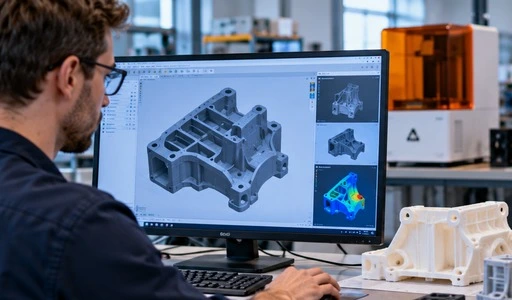
Understanding Additive Manufacturing Technology for Plastic Parts
What Sets AM Apart from Conventional Methods
Adding material layer by layer from a digital model is how additive manufacturing technology builds parts. This is very different from subtractive machining or injection molding. Three polymer-based processes that are used a lot are Fused Deposition Modeling (FDM), Stereolithography (SLA), and Selective Laser Sintering (SLS). Each process works with a different group of materials and gives a different surface quality and set of mechanical properties.
FDM can produce thermoplastic filaments like ABS, PLA, and PEEK, which makes it easy to make useful samples and low-cost. UV light cures photopolymer resins used in SLA, which produces fine feature resolution good for making detailed tools parts. SLS sinters nylon powder without using support structures. This lets you make complex shapes that would need expensive tools for other methods.
Unlike injection casting, these methods don't require any startup costs for tools. Wohlers Associates says that the global market for additive manufacturing technology reached $18.3 billion in 2022, with polymer AM being the most popular material type by volume. When it comes to low to medium production runs, 3D printing plastic parts is a great way to save money. Iterations of designs that used to take weeks of making changes can now be tried in just hours.
Key Challenges and Solutions in Designing Plastic Parts with Additive Manufacturing
Navigating Material Limits and Surface Quality
Despite its benefits, additive manufacturing technology does have some real design limitations that engineers need to think about and work around. One of the most important is anisotropy: parts made with FDM often have 10–25% less tensile strength along the Z-axis than along the XY plane. This means that the way a building is oriented is not just a matter of taste; it has a direct effect on how well it works.
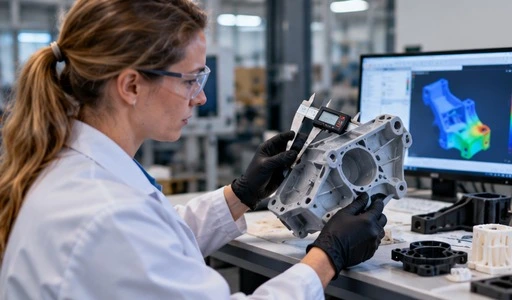
Another issue that comes up often is the surface finish. Layer lines and surface roughness numbers between 5 and 15 µm are common on raw FDM parts. Post-processing steps like sanding, chemical smoothing, or vapor polishing are needed for surfaces that fit together or parts that look good. SLA and SLS usually make base finishes that are smoother, but they still need to be post-processed for applications that need to be very precise.
Here are the core design and process challenges that teams consistently face:
- Material anisotropy management: To lower the risk of delamination failure in structural plastic parts, position the part so that the main stress loads line up with the XY plane.
- Support structure design: Placing the supports incorrectly can make the post-processing process take longer and cause surface flaws. This problem is less likely to happen if you design parts with self-supporting angles above 45°.
- Dimensional accuracy control: Because of thermal shrinkage during FDM printing, the CAD model needs to have offsets added to make up for it. This is especially true for parts with tight tolerances of less than ±0.2mm.
- Consumable cost discipline: High-performance fibers like PEEK or carbon-fiber-filled nylon cost a lot per kilogram, so you need to simulate the process to make sure you don't waste too much before you start printing.
Industrial-grade plastic AM is different from hobbyist printing because these problems are dealt with early in the design process, not afterward.
Optimizing Plastic Part Design Through Additive Manufacturing: Core Principles and Processes
From CAD Model to Functional Part
In plastic additive manufacturing technology, the process of going from concept to production starts with a structured CAD modeling step. The shape of a part needs to be checked not only for its functionality, but also for its ability to be printed. The process factors you choose are affected by the width of the walls, the design of the internal channels, the patterns of lattice infill, and the clarity of the features.
The choice of layer height has a direct effect on both the print time and the quality of the surface. A layer height of 0.1 mm on a SLA system makes the surface detail look almost like it was injected, while a layer height of 0.3 mm on an FDM system cuts print time for draft parts by a large amount. The direction of the print affects both the support needs and the mechanical anisotropy at the same time.
Every choice that comes after material selection is affected by it. High-performance thermoplastics like ULTEM (PEI) can withstand temperatures above 170°C and have UL94 V-0 flame ratings, which makes them useful for parts inside airplanes. Polypropylene AM grades are chemically resistant and can be used to handle fluids. Rigid polymers can't do the sealing and cushioning jobs that flexible TPU materials can.
Before the first print, engineers can use process simulation tools to guess how the material will flow, warp, and have residual stress. This virtual approval step cuts down on failed builds and wasteful use, which is very important when making a case for investing in AM capital.
Industry Applications and Case Studies of Plastic Additive Manufacturing Technology
Where Polymer AM Delivers Measurable Value
In real business settings, plastic additive manufacturing technology is now well past the pilot stage. In aerospace, Stratasys ULTEM-based FDM parts are used in the cabin interiors of business airplanes and have been certified to meet FAA standards. In the medical field, SLA-printed surgery guides and SLS nylon splints are often made with custom shapes for each patient that injection molding can't afford to make.
Automakers use SLS nylon parts for useful end-use brackets and ducting in low-volume specialty cars, so they don't have to spend money on expensive tools. HP's Multi Jet Fusion technology has made it possible to make more than three million custom shoe midsoles for Adidas and New Balance. This shows that polymer AM can be scaled up to commercial volumes.
Conformal cooling inserts made through powder bed fusion have cut injection molding cycle times by up to 30% in case studies from EOS and Renishaw. This is especially useful for trade and applied technology schools when it comes to cast tooling. Even though those inserts are made of metal, the plastic parts they make later on directly benefit from tooling design that can be made with additive manufacturing technology.
How to Choose the Right Additive Manufacturing Technology and Partner for Plastic Part Production
Matching Process Capabilities to Production Requirements
To choose between FDM, SLA, SLS, and new technologies like Multi Jet Fusion, you need to look at more than just the cost of the tools. You also need to be honest about what parts you need to make. FDM is the easiest process to get started with and is widely available, so it can be used in educational labs and for internal prototyping. When surface quality and measurement accuracy are very important, SLA is the best choice for fine-detail jobs. SLS gives you the most design freedom for complicated shapes, but it costs more for equipment and managing powder.
Along with the hardware specs, institutional buyers, especially department heads who are setting up training labs, must also look at how well the software works with the hardware, whether consumables are available, and how well the seller supports training. When students are only taught one process in school, they aren't ready for work settings where more than one tool is used.
The additive manufacturing technology program at ECR Academy was made to meet this exact need. Project-based learning is used in 3D product design, reverse design, machine operation, post-processing inspection, structural optimization, and process modeling. There are both business engineers and academic teachers on the faculty, so students will be exposed to real production logic and not just abstract ideas from textbooks. Before students use real equipment, the virtual simulation platform lets them practice the whole AM workflow. This saves money on supplies and wear and tear on the first set of tools. Graduates are ready for jobs as a product designer, process engineer, equipment operator, or post-processing technician in the manufacturing of plastic products, metal products, and general equipment.
Conclusion
Additive manufacturing technology is changing how plastic parts are developed, tested, and made in industries like aircraft, healthcare, tooling, and consumer goods. Because of the change, engineers and workers need to know not only how to use a printer, but also how to plan for layer-by-layer manufacturing. Businesses and institutions that spend money on structured, industry-specific AM training build long-lasting skills, not just more equipment. Disciplined process knowledge is what makes the difference between printing a prototype and making a good industrial part. Getting that knowledge starts with the right curriculum.
FAQ
1. What is the difference between FDM, SLA, and SLS for plastic parts?
FDM uses melted thermoplastic filament to extrude it, and it works well for making functional prototypes and low-cost products. With UV light, SLA fixes liquid photopolymer resin, giving exact parts high-resolution surface detail. With SLS, a laser is used to fuse nylon powder together, making strong, complex parts without any support structures. Each method has different goals for cost and function.
2. Is additive manufacturing cost-effective compared to injection molding?
For low to medium volumes—usually less than 1,000 units—and parts with complicated shapes, additive manufacturing technology (AM) gets rid of the need for expensive tools and speeds up the iteration cycles by a lot. For large production runs of simple shapes, injection molding is still the more cost-effective method.
3. Can beginners enter an AM training program without prior experience?
Yes. The additive manufacturing technology program at ECR Academy starts with basic engineering materials and mechanical drawing before moving on to core AM skills. Knowing how to use a computer and how things work mechanically are good places to start.
4. What career roles does AM training lead to?
With this degree, you can work as a product designer, process engineer, machine operator, or post-processing technician in the plastics, metals, and general equipment manufacturing businesses.
5. How does process simulation reduce training costs?
Virtual simulation platforms let students practice full additive manufacturing technology workflows, such as design, setting parameters, and process analysis, before they use real tools and materials. This significantly lowers the amount of material waste and equipment wear that happens during training.
Build Industrial-Grade AM Capability With ECR Academy
ECR Academy offers supplier-level training classes for additive manufacturing technology that combine real-world engineering practice with structured classroom teaching. Our project-based learning covers the whole process, from designing 3D products and reverse engineering to post-processing, structural optimization, and process simulation. It does this on five platforms that are both virtual and real. We help institutions and organizations build workforce skills that meet real industry standards. We have more than 16 years of professional experience and work with more than 500 businesses in 28 countries. To learn more about training choices, email ecr2008@enteredu.com or go to enteredu.com right now.
References
1. Wohlers Associates. Wohlers Report 2023: Additive Manufacturing and 3D Printing State of the Industry. Wohlers Associates, 2023.
2. Gibson, I., Rosen, D., & Stucker, B. Additive Manufacturing Technologies: 3D Printing, Rapid Prototyping, and Direct Digital Manufacturing. Springer, 2021.
3. ASTM International. ASTM F2792: Standard Terminology for Additive Manufacturing Technologies. ASTM International, 2022.
4. Ngo, T. D., et al. "Additive Manufacturing (3D Printing): A Review of Materials, Methods, Applications and Challenges." Composites Part B: Engineering, 2018.
5. Stratasys. FDM Technology for Aerospace Applications: Material and Process Qualification. Stratasys White Paper, 2022.
6. EOS GmbH. Industrial 3D Printing with Polymer Powder Bed Fusion: Application Guide. EOS GmbH, 2021.

_1781601799781.webp)