Digital Mechanical Design in the Complete Product Development Cycl
Digital mechanical design is the core of the way that contemporary engineers take a product from idea to produced reality. It substitutes expensive physical iterations with simulated models of all types in high fidelity, from parametric CAD drafting and 3D solid modelling to finite element analysis (FEA) and CNC process planning. Companies that use integrated digital design processes, like those from McKinsey & Company (2022), may minimise time to market by as much as 40% and dramatically lower expenses of prototypes. This full-cycle technique is now a basic necessity, not a competitive advantage, for the engineering faculty, training administrators, and corporate R&D teams.
Understanding Digital Mechanical Design and Its Role in Product Development
From 2D Drafts to Model-Based Definition
Before, engineers used paper drawings and unlinked 2D drafting files. The 3D model is the single source of truth for design, production, and quality control using Model-Based Definition (MBD). One digital model contains dimensions, tolerances, and material calls. This eliminated misconceptions that caused expensive shop floor rework.
Parametric Modeling and Rapid Iteration
Parametric modelling lets engineers modify one element, like a shaft diameter, and immediately update all of its dependencies. This behaviour streamlines design iteration tracking. Teams can compare design history, rollback changes, and keep complete audit trails for ISO 9001 quality standards and engineering education certification using PLM systems that handle changes and versions.
Why It Matters for Engineering Education Programs
The digital design workflow is directly linked to ABET and international engineering education competency standards, which helps department heads of mechanical engineering make sure their courses are the best they can be. Engineers who know how to go from a requirement brief to a verified CAE simulation report are in high demand in the automotive, robotics, and mold manufacturing industries.
The Digital Mechanical Design Process within the Product Development Cycle
Stage One: Concept and 3D Modeling
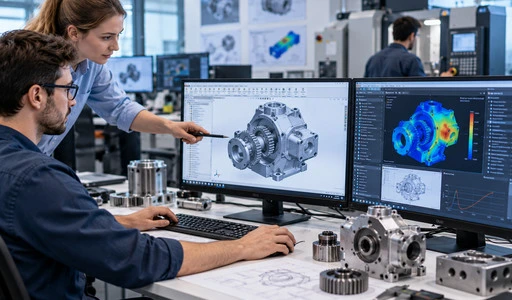
Needs analysis and idea drawing are the first steps in the process. Next, 3D solid modeling is done in programs like SolidWorks, CATIA, or ZWCAD/3D. Engineers put together individual parts, use the properties of materials, and set up geometric relationships. Before any physical parts are ordered, virtual assembly checks make sure that all of the parts fit together.
Stage Two: Simulation and Structural Validation
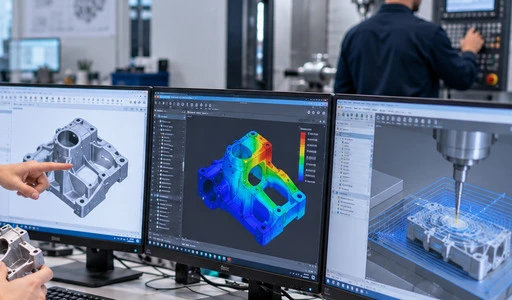
Once the assembly is finalised in digital mechanical design, the Computer-Aided Engineering (CAE) tools are used to perform Finite Element Analysis (FEA) to analyse the distribution of stress, lifespan and amount of deformation under actual load. Here you may also employ Computational Fluid Dynamics (CFD) and motion simulation. The findings aid with structural optimisation. This means engineers may adjust the wall thickness or lower the weight of a structure before they start building it.
Stage Three: CNC Process Planning and Virtual Machining
Once the proposal is validated, the procedure proceeds to preparing for digital production. Engineers design the machining process, choose the cutting tools and settings, generate CNC programs using CAM software, and verify the tool paths by simulating virtual machining. This stage transfers the design intent straight to the machine, reducing setup errors and waste on the shop floor.
Comparing Digital Mechanical Design Software and Solutions for B2B Procurement
When procurement teams look at platforms for large-scale academic or business adoption, they have to choose between features, licensing costs, and training support. Here are the most important things to think about when making this choice:
- SolidWorks (Dassault Systèmes) is used a lot in manufacturing education in the United States. Its easy-to-use design makes it faster for college students to learn, and its modelling tool does a good job of covering basic FEA. Educational seat licenses cost between $1,000 and $5,000 a year, which puts a strain on the budgets of programs that use 200 or more seats.
- Siemens NX is a digital mechanical design program for heavy industry and aerospace manufacturers. Its advanced CAM and multi-body dynamics make it a good choice for graduate research labs and corporate R&D departments, but its steeper learning curve means that instructors are needed to help students learn it.
- Dassault Systèmes' CATIA is still the standard in the design chains of automakers. When programs work with automakers or tier-one parts makers, they often make sure that their courses are aligned with CATIA to make it easier for graduates to get jobs.
- It's a good choice for programs that focus on GD&T and PLM integration because PTC Creo has a strong parametric history and Model-Based Enterprise tools.
Procurement leaders need to go beyond brand comparisons. They also need to consider total cost of ownership (TCO), which includes server infrastructure, teacher certification, yearly maintenance fees and access to a library of ready-made project cases. A courseware, assessment tools and cloud access platform, together with the software, offers a lower real cost per student than if each portion is acquired individually.
Benefits and Challenges of Implementing Digital Mechanical Design in Your Product Development Cycle
Measurable Benefits for Education and Industry
It was found in the Journal of Manufacturing Systems in 2021 that companies that used both CAD and CAE workflows were able to make physical prototypes 35% faster. It has been found that students who learn how to use full-process digital tools have a much better chance of getting skilled jobs within six months of finishing from trade and applied engineering schools.
Common Implementation Challenges
It's not always easy to switch to a new digital design tool. The three main problems are large-scale software licensing costs, time spent by instructors learning new skills, and making sure that course material is in line with what is currently being done in the business. When programs don't give their teachers formal training, teachers often only teach a small part of the platform's features, leaving students unprepared.
How Leading Programs Overcome These Hurdles
To get around these issues, successful programs pick platforms that have built-in mini-lectures, graded project libraries, and cloud-based access so that students can practise even when they're not in the lab. Work with a training group that gives teachers ongoing help, up-to-date case studies, and evaluation standards that are in line with the industry to close the gap between what students learn in school and what employers want.
How to Choose the Right Digital Mechanical Design Solution for Your Business
Define Your Workflow Coverage Requirements
First, make a blueprint of the workflow you need for digital mechanical design. Does your program have to do everything, from engineering drawings to 3D models, CAE structure analysis, CNC code, and virtual machining? If so, a platform that handles all of these steps in one place cuts down on mistakes in data translation and makes IT management easier.
Evaluate Licensing, Cloud Access, and Compliance
Institutions that use a lot of commercial CAD software are worried about the risk of theft. Give priority to companies that offer verified school licenses that can be deployed in the cloud. Cloud access gets rid of the need for pricey hardware changes on-site and lets students do their job from any device.
Assess Curriculum Support and Partner Resources
You can learn with the help of the software platforms that come with them. Ask the provider if they offer project-based case libraries, teacher guides, formative tests, and the necessary paperwork for getting engineering education accredited. Programs that help faculty develop on a regular basis always say that their students do better than programs that only use vendor documentation.
Conclusion
Digital mechanical design is no longer a speciality. In the car, robots, mould making, and precise production businesses, this is how things are usually done. On the job, graduates and engineers from engineering programs and enterprise training teams that teach full-cycle skills like CAD drawing and 3D modelling, as well as CAE validation and CNC preparation, can start right away. That can happen again and again with the right training tool, case libraries from real life, and licenses that follow the rules.
FAQ
1. What core skills does this course build?
You can learn engineering drawing, 3D solid models, FEA structural analysis, and CNC programming in a way that is useful in the real world through the ECR Academy Digital mechanical design training.
2. How does the curriculum align with industry standards?
There are jobs in mechanical design, process engineering, and digital production that require these skills in a lot of different fields.
3. What software and hardware does the course use?
Engineering drawing, 3D models, CAE structure analysis, CNC programming, and virtual machining are all part of the software. The software is run on powerful hardware and has cloud-based training access, so students can practice in the lab or from home without any performance issues.
Ready to Build Industry-Ready Engineers? Connect with E.C.R Academy
Since 2010, the E.C.R. Academy has taught professional skills to almost 500,000 people in 28 countries. Through project-based, industry-specific training, our Digital mechanical design course, a full-service Digital mechanical design supplier option for schools and businesses, includes CAD, 3D modeling, CAE analysis, and CNC programming. Visit enteredu.com or email our team at ecr2008@enteredu.com to set up a program consultation and talk about how we can help you reach your goals for developing engineering talent.
References
1. McKinsey & Company. Industry 4.0: Capturing Value at Scale, 2022.
2. Journal of Manufacturing Systems. "Integration of CAD-CAE Workflows in Product Development," Vol. 58, 2021.
3. ABET. Criteria for Accrediting Engineering Programs, 2023–2024 Cycle, 2023.
4. Tao, F., et al. "Digital Twin-Driven Product Design, Manufacturing and Service." International Journal of Advanced Manufacturing Technology, 2018.
5. Stark, J. Product Lifecycle Management: 21st Century Paradigm for Product Realisation. Springer, 2020.
6. Bi, Z. M., & Mueller, D. "CAD/CAE Integration for Mechanical Design Education." Computer Applications in Engineering Education, Vol. 29, 2021.