Build Job-Ready Skills With Intelligent Connected Vehicle Technology
The car industry is at a historic crossroads. Intelligent Connected Vehicle Technology is now a holistic system that merges environment sensing, decision-making algorithm and vehicle-to-everything connection to revolutionise transportation safety, efficiency and user experience. The confluence of these technologies necessitates a new breed of experienced workers who can assemble, calibrate, test and debug complex systems that include sensors, computer platforms, drive-by-wire chassis and C-V2X infrastructure. As manufacturers rush to get autonomous fleets and intelligent mobility products to market, the skills gap only grows, presenting critical possibilities for institutions and corporations to engage in comprehensive, job-ready training programmes.
Understanding Intelligent Connected Vehicle Technology
Core Components and Operating Principles
Modern linked automobiles are made possible by a multi-layered design. LiDAR, millimetre wave radar, ultrasonic arrays and high-resolution pictures are sophisticated sensors that capture real-time environmental information. These inputs are processed by perception programmes running on high speed computers that can discern people, automobiles, road markings and objects apart. Then, decision-making modules decide the optimum routes and drive-by-wire systems perform steering, braking, and accelerating orders without mechanical linkages (SAE International, 2021).
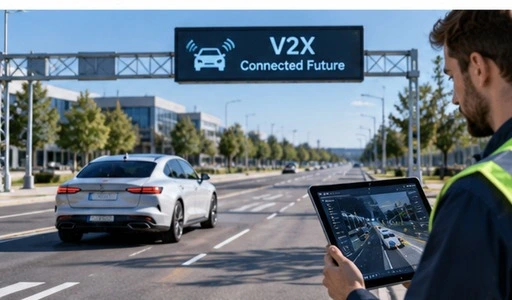
automobiles may rapidly swap Basic Safety Messages with roadside equipment and other automobiles using C-V2X communication systems. This car-road collaboration also heightens awareness beyond line-of-sight, warning drivers of unseen threats and coordinating traffic signal timing to alleviate congestion. Edge computing devices handle data processing near the location of storage, lowering latency and allowing processes to be safely interrupted if cloud connectivity is lost.
Strategic Benefits for OEMs and Tier 1 Suppliers
When automakers use connected car systems, they report quantifiable benefits. Over-the-air software changes and real-time scans cut down on warranty claims and trips to the service center. Commercial fleets use 10–15 percent less fuel when they use platooning technology because it improves aerodynamics and synchronized acceleration. Predictive maintenance alerts look at sensor data to find wear trends before a part fails (IEEE Vehicular Technology Society, 2022). This stops expensive crashes.
Tier 1 suppliers also enjoy faster integration because to standard interfaces and modular designs. Engineers that know about sensor fusion, cybersecurity protocols such as ISO/SAE 21434, and functional safety criteria under ISO 26262 can test and certify things faster. With this information in hand, procurement teams may negotiate better contracts, assess how dependable a supplier is, and ensure that technological roadmaps are aligned with the evolution of industry norms.
Essential Skills to Master for Intelligent Connected Vehicle Technology
Technical Expertise in Hardware and Software
Those working in this field need to know how to install and calibrate sensors. The way the camera is situated influences its ability to locate things, and millimeter-wave radar must be carefully aligned to prevent numerous false positives. LiDAR sensors generate millions of data points per second, and you need to know how to collect, analyse and comprehend them. Combined navigation systems employ GPS, inertial measurement units and wheel encoders for precise navigation tracking to the centimetre level. You need this for parking itself and remaining in your lane.
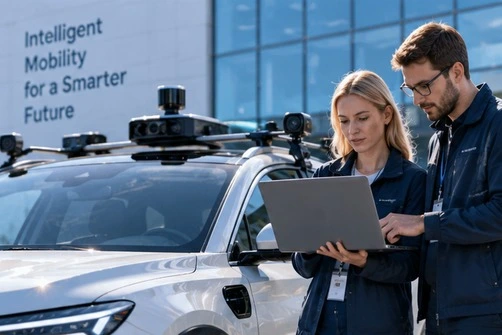
Computing platforms add another layer of complexity to the mix. Engineers need to choose hardware that can process, dissipate heat, and be certified for usage in the automobile industry. Real-time operating systems, perception algorithms and data pipelines linking sensors to decision modules are installed to set up operational environments. To operate a drive-by-wire chassis system, you have to know about electronic control units, CAN bus protocols, and fail-safe mechanisms which switch on mechanical backups when an electrical malfunction occurs.
Analytical Capabilities and System Integration
Reading raw results from sensors is not enough to understand sensor data in Intelligent Connected Vehicle Technology. Professionals look at object classification confidence scores, sensor overlap zones, and problems in multi-modal fusion to figure out what's wrong. Intelligent cockpit systems are more advanced because they combine speech recognition, motion controls, and head-up screens into one user experience. To test these interactions, you need to carefully think through different possible outcomes, such as simulating emergency braking and checking V2V handshakes in a range of network situations.
For vehicle-road collaboration systems to work, people need to know about On-Board Units, Roadside Units, and edge computing architectures. Installers set up IP addresses, check the percentage of delivered packets, and make sure that application scenarios like queue warnings and traffic signal prioritization work as expected. All of these things are tested together as part of comprehensive whole-vehicle testing, which checks for compliance with regulations, emergency reaction, and related functions in urban, highway, and off-road settings. The loop is closed by writing detailed test reports and looking at performance metrics, which allows for continuous improvement.
Procurement Insights: How to Source Intelligent Connected Vehicle Technology Effectively
Evaluating Suppliers and Technology Maturity
The world of vendors is very disorganized for procurement leaders. Hardware from well-known automakers is reliable, but software may not be as up-to-date. Tech startups come up with cutting-edge algorithms, but they don't have the manufacturing scale or long-term support to back them up. A strict evaluation framework checks the maturity of the technology using measurements like the range of sensors that can detect things, the throughput of the computing platform as measured in TOPS, and the delay in communication when there is real-world interference.
Scalability is very important when making deployments to multiple sites. Suppliers should show off modular designs that let improvements be made in small steps without having to replace whole systems. As part of the after-sales support, you can get OTA updates, help with managing security patches, and talk to technical experts during the integration stages. Auto News (2023) says that a cost-benefit study compares the total costs of ownership, taking into account things like installation work, upkeep contracts, and possible downtime during software migrations.
Best Contracting Practices and Risk Mitigation
Performance standards, like minimum uptime rates and reaction times for major breakdowns, should be written into contracts. Intellectual property terms protect secret algorithms and make sure that troubleshooting documents can be accessed. As technology changes, flexibility provisions let the scope be changed. This keeps vendors from being locked in and lets suppliers compete for future phases.
Before a quality assurance procedure is accepted, both Hardware-in-the-Loop and Software-in-the-Loop tests must be done. Buyers check that sensor calibration stays stable at different temperatures, that V2X packet delivery rates work in urban valleys, and that communication channels are secure. Field operating tests in a variety of conditions, such as rain, fog, and areas with a lot of electromagnetic interference, make sure that systems meet standards for durability over the lifecycle of the car.
Overcoming Challenges and Ensuring Security in ICV Projects
Interoperability and Data Management Complexities
When you combine parts from different sources, you often find that the data formats and transmission methods don't work with each other. Radar tracks, camera frames, and LiDAR point clouds all arrive at different times and in different ways. Aligning time and space is done by middleware solutions, but configuration mistakes cause latency spikes that go beyond safety margins. Setting up standard interfaces based on ROS 2 or AUTOSAR Adaptive makes merging easier and speeds up the time it takes to launch.
As test fleets produce terabytes of data every day, data management problems grow. Scenario libraries keep track of edge cases that train and test vision algorithms. For example, people crossing the street without looking is an example of an edge case. To get useful information from this much data, you need big data tools and subject knowledge. The cost of cloud storage is going up quickly, which is pushing businesses toward edge computing strategies that filter and compress data before sending it (Journal of Automotive Engineering, 2022).
Cybersecurity Frameworks and Real-World Case Studies
Bad people are interested in connected vehicles because they are easy targets in Intelligent Connected Vehicle Technology. If an OBU is hacked, it could send out fake messages that cause fake traffic jams. Braking or driving systems could not work if ECUs are hacked. As part of defense-in-depth strategies, V2X messages must be encrypted, software changes must be verified with digital signatures, and safety-critical networks must be kept separate from entertainment systems.
Layered frameworks that are in line with ISO/SAE 21434 are used by organizations that want to have strong security. During the planning process, they model threats, do penetration testing before production, and set up methods for how to handle incidents. During pre-launch checks, one European car found security holes. They then sent out patches over-the-air (OTA), which kept hundreds of thousands of vehicles from having to be recalled. Continuous monitoring finds strange patterns in how people talk to each other and sends out alerts when someone tries to get in without permission.
Future Trends and Career Growth Opportunities in Intelligent Connected Vehicle Technology
Emerging Technologies Shaping the Industry
As solid-state LiDAR gets better, it will likely be cheaper and more reliable than mechanical scanning systems. AI-powered sensor fusion algorithms learn from huge datasets collected from all over the world, which is how they achieve 99.9 percent sense accuracy. 5G networks allow very low-latency V2X transmission, which supports tasks like changing lanes together and driving in groups at high speeds on the highway. MIT Technology Review (2023) says that integrating digital twins shortens development processes by letting virtual licensing and scenario testing happen before physical prototypes are made.
Autonomous truck platooning is becoming more popular in transportation routes because it saves fuel and keeps drivers from getting tired. Robotaxi fleets in cities use HD maps that are updated in real time by crowdsourced data from cars that are linked to the internet. Smart ports use fully autonomous heavy machinery that is coordinated through V2X. This makes it possible for operations to go smoothly even when visibility is low. Because of these uses, there is a need for experts who know not only about car systems but also about integrating infrastructure and following rules.
Critical Certifications and Training Pathways
Professionals who want to get ahead in their field seek out certifications that are in line with industry standards. Employers around the world know skills that are proven by programs that cover ISO 26262 functional safety, ISO/SAE 21434 cybersecurity, and IEEE 802.11p or 3GPP C-V2X protocols. The actual skills that hiring managers look for are built through hands-on training in eight core lab environments: sensor calibration, computing platform deployment, drive-by-wire systems, intelligent cockpit integration, vehicle-road teamwork, and thorough whole-vehicle testing.
ECR Academy provides modular, project-based training that was created by working together with businesses. In C-V2X simulation areas, learners use equipment that is used in the real world to do real-world tasks like testing, debugging, and putting things together. Over 60% of the course time is spent on hands-on activities, which make sure that graduates are ready for certification in areas like commissioning, calibration, and fault diagnosis. This method is similar to ones that have been used successfully in 28 countries, where 300,000 students earned certificates that prepared them for jobs in manufacturing, testing, R&D support, and professional services.
Conclusion
When automotive engineering, artificial intelligence, and advanced communication systems all come together, it opens up opportunities for skilled professionals that have never been seen before. To become good at understanding the surroundings, making decisions, using drive-by-wire, and working with the road, you need to go through a lot of training that includes both theory and lots of practice in Intelligent Connected Vehicle Technology. Companies that engage in developing their employees get strategic benefits like lower costs for hiring outside workers, faster product launches, and making sure they meet changing safety and privacy standards. As self-driving cars and smart mobility solutions change the way people get around, having job-ready skills in connected vehicle technology is important for people and organizations that want to be at the head of this change.
FAQ
1.What backgrounds do successful learners typically have?
People from computer science, electronic information engineering, automotive engineering, and other related technical fields are taking part. People who are already working in the field and want to move into connected vehicle roles should have experience with vehicle maintenance, electronics troubleshooting, or software development. People who want to change careers because they think the industry will grow often start with basic modules and then move on to more advanced topics.
2.How long does it take to achieve certification readiness?
The length of time depends on what you already know and how intense the training is. Full-time students usually finish all of their training within six to twelve months, while part-time programs can work around busy schedules for longer periods of time. More than 60% of the program is spent on practical training, which makes sure that graduates are skilled in all key areas.
3.Which job roles become accessible after completing the program?
Graduates can work as research and development (R&D) assistants, doing things like making prototypes for testing and making sure they work. As a manufacturing worker, your job is to put things together, fix bugs, calibrate, check for quality, and make the process run more smoothly. There needs to be experts on hand in after-sales technology help who can find problems and fix them. Testing companies hire people who are good at making scenarios, analyzing data, and making sure they follow the rules.
How Does ECR Academy Prepare Your Workforce for ICV Excellence?
ECR Academy offers modular, certification-based training that is in line with industry standards for testing, assembling, and commissioning vehicles. Our school-enterprise co-development plan brings together full-time teachers, technical experts, and business advisers to make lessons that are based on problems that happen in the real world. There are eight specialized labs that cover everything from sensor calibration to computer platforms, drive-by-wire systems, intelligent cockpits, and C-V2X infrastructure. These labs are fully immersive and help students learn how to fix and diagnose problems in the whole car. Our tried-and-true platform can help you reach your goals whether you're an automotive school looking to set up ICV training bases, a Tier 1 supplier needing customized upskilling programs, or an industry group wanting to standardize talent development across the region. Get in touch with our team at ecr2008@enteredu.com to find out how working with a reliable Intelligent Connected Vehicle Technology provider can help you quickly change your workforce and become more competitive in the ever-changing mobility ecosystem.
References
1. SAE International. (2021). Taxonomy and Definitions for Terms Related to Driving Automation Systems for On-Road Motor Vehicles. SAE Standard J3016.
2. IEEE Vehicular Technology Society. (2022). Connected and Automated Vehicles: Opportunities and Challenges for Transportation Systems. IEEE Transactions on Vehicular Technology, 71(3), 2450-2468.
3. Automotive News. (2023). Supplier Strategies for the Connected Vehicle Era. Automotive News Network.
4. Journal of Automotive Engineering. (2022). Data Management and Edge Computing in Autonomous Vehicle Development. Proceedings of the Institution of Mechanical Engineers, Part D: Journal of Automobile Engineering, 236(8), 1654-1670.
5. MIT Technology Review. (2023). The Future of Autonomous Driving: Sensors, AI, and Infrastructure.
6. National Highway Traffic Safety Administration. (2022). Vehicle-to-Everything (V2X) Communications for Safety. U.S. Department of Transportation.


_1781601799781.webp)