Industrial Robot Training Course for Smart Manufacturing Skills
Modern manufacturing faces a critical challenge: bridging the gap between legacy operational practices and the demands of Industry 4.0. Our Industrial Robot Training Course for Smart Manufacturing Skills addresses this by combining industrial robotics technology fundamentals with system integration capabilities, preparing technical teams to deploy, program, and maintain automated production environments. This comprehensive program moves beyond basic robot operation, delivering project-driven curricula that develop full-cycle competencies—from teach pendant programming and PLC integration to digital twin commissioning and intelligent predictive maintenance. Designed for technical institutions, system integrators, and equipment manufacturers, this training solution empowers your workforce to execute complex automation projects with confidence and precision.
Understanding Industrial Robotics Technology for Smart Manufacturing
Types of Robotic Systems in Production Environments
Articulated robots do heavy operations like welding car bodies. Six-axis arms spot weld thousands of times a day with millimetre precision. SCARA designs are suitable for high-speed assembly tasks, notably electronics, where horizontal plane motion and vertical insertion cycles must exceed 150 picks per minute. Food factories pack mostly using Delta robots. They operate continuously in regulated temperatures or high humidity with rigorous hygiene regulations. Cobots operate with humans without safety cages. They may be utilized in small-batch manufacturing or quality testing when human judgment and robotic uniformity are desired.
The payload capability, degrees of freedom, and protection scores of these robotic systems are very different. Cobots usually work with masses between 3 kg and 16 kg, while articulated systems can handle loads from 5 kg to over 2,000 kg. Both types of systems have safety features that limit force in line with ISO/TS 15066 standards. Knowing these differences helps buying teams match the powers of technology with the needs of specific manufacturing processes.
Benefits Driving Adoption in Manufacturing Sectors
When manufacturers use robotic automation, they report real improvements in a number of practical areas. When compared to human processes, robotic welding cells in auto assembly plants cut cycle times by 30 to 40 percent while keeping weld quality consistent, which lowers failure rates to less than 0.5%. Vision-guided robotic pick-and-place systems help electronics manufacturers make better first-pass yield rates by eliminating human error in component orientation.
In addition to measuring productivity, robotic deployment also looks at how to keep workers safe in dangerous places. When robots are used to take die castings from foundries, workers are kept out of areas with temperatures above 700°C. Similarly, chemical processing plants use automatic systems in areas with volatile organic compounds to lower the number of accidents that happen at work. Cost structures also change in a good way. Manufacturers usually get their money back within 18 to 36 months by saving money on labor, cutting down on waste, and increasing throughput. This is true even tho they still have to make big investments in capital.
Emerging Trends Shaping 2026 and Beyond
New advances in robotics technology focus on cognitive skills and learning that changes over time. With the help of AI-integrated vision systems, robots can now pick up parts from bins without having to worry about their exact direction. Machine learning systems look at past motion data to find the best paths on the fly. This cuts cycle times by 8–12% without having to re-program everything by hand. Edge computing designs built into robot controls process sensor data locally. This lets grip force or assembly pressure be changed in real time based on detecting differences in the material.
Digital twin technology has grown up and is now a useful testing tool that lets engineers test PLC logic and robot programs in virtual worlds before they are installed in real ones. This virtual-to-physical process cuts commissioning times by 40–50% and keeps expensive on-site fixing to a minimum. Meanwhile, fieldbus protocols like EtherCAT and PROFINET make it easier for robots and other equipment to work together. This lets multiple robots do tasks at the same time with the microsecond-level accuracy needed for fast assembly lines.
Core Skills and Curriculum of an Industrial Robot Training Course
Foundational Technical Competencies
The first training lessons give you important background information. Learners get good at teaching pendant operation, which includes setting up the coordinate system (World, Tool, and User frames), teaching points, and the basics of program structure. The safety routine guide goes over how to stop the robot in an emergency, how to define a limited workspace, and how to avoid collisions in a way that meets ISO 10218-1 safety standards. Next, the basics of a Programmable Logic Controller (PLC) are taught. This includes ladder logic programming, timer/counter features, and discrete I/O management, all of which are needed for robot cell integration.
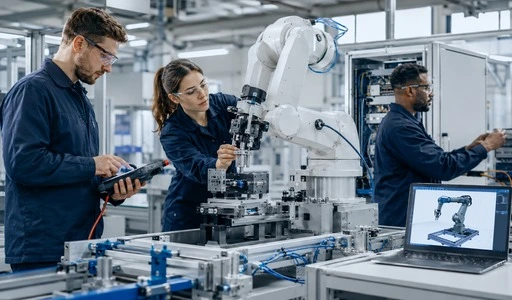
Training in mechanical maintenance covers common service tasks like when to lubricate the gearbox, when to replace the encoder battery, and how to inspect the cable harness. This helps people do preventative maintenance that increases the average time between failures to more than 60,000 operational hours. Vision system basics talk about how to calibrate cameras, how to set up lights, and how to use image processing processes for tasks like finding parts and defects.
Advanced Integration and Commissioning Skills
Advanced lessons take on real-world system integration problems by building on basic information. Offline programming instruction uses modeling software to create complicated motion sequences, find the fastest path routes to cut down on cycle time, and check for collisions before putting the code into action. Learners do projects where they coordinate multiple robots and set up coordinated motion patterns. The accuracy of the timing affects how much work can be done.
Digital twin and virtual commissioning lessons inIndustrial Robotics Technologyteach people how to set up virtual production cells, connect artificial robots to virtual PLCs, and test and confirm process logic over and over again. This method greatly lowers the risk of finishing on-site and speeds up the project delivery schedule. Vision-guided robotic applications are taught along with machine vision integration training. These include teaching feature matching algorithms, edge detection techniques, and dimensional measurement methods that allow parts to be grasped even when their position changes.
Intelligent maintenance tools include predictive analytics, teaching how to understand vibration analysis, thermal imaging for checking the health of motors, and energy consumption tracking that finds performance degradation before it gets too bad. Setting up a remote tracking system lets users create cloud-connected dashboards that show the state of equipment in real time, fault history logs, and repair schedule alerts.
Industry-Specific Application Training
Because the needs for welding in the automotive industry are very different from those for putting together electronics or packaging drugs, our curriculum includes projects that are specific to each industry. Automotive-focused modules focus on techniques for manipulating large loads, tracking seams for welding purposes, and checking the quality of spot welds. Electronics training focuses on teaching high-speed delta robot programming, how to keep a clean room clean, and how to protect against electrostatic discharge (ESD). The units for food processing take into account clean design principles, IP67 ingress protection standards, and FDA-mandated food-grade lubricant specs.
This alignment with the industry makes sure that training participants gain skills that can be used right away instead of general theoretical knowledge. This means that they can quickly contribute to production operations after finishing the course.
Selecting the Right Industrial Robot Training for Your Business
Evaluation Criteria for Training Providers
Brand environment compatibility is extremely crucial. Manufacturing companies using ABB systems should train on RAPID and RobotStudio. FANUC-using firms should learn KAREL and ROBOGUIDE. KUKA facilities need KRL and WorkVisual setup tools. The Yaskawa facilities need INFORM language and MotoSim simulation systems. Multi-brand training packages may be utilized for numerous brands but lack brand-specific additional features.
The qualifications of the instructors have a big effect on how well the training works. Programs run by teams of business integration engineers and university experts give useful information based on real-life project experience. Engineers who have built dozens of production cells bring with them a natural ability to figure out what's wrong and ways to get around problems that aren't covered in official manuals. Academic contributors make sure that the structure is pedagogical and that all basic principles are covered in detail so that there are no knowledge gaps.
The framework for post-training help should be looked at closely. Programs that offer ongoing technical support, access to updated courseware that includes the newest software releases, and alumni networks where students can share their knowledge with each other are valuable long after the original teaching times are over. Some providers keep online forums where graduates can work together to solve problems, which effectively extends learning beyond the length of a course.
Training Delivery Formats and Business Impact
You may learn about your robot models, production equipment, and real-world workflow difficulties at your manufacturing plant and use what you learn straight away. This approach reduces travel issues and allows whole expert teams to participate at once, fostering shared knowledge and problem-solving. Being there in person lets you practice using your tools with an instructor observing, building confidence before you use them alone.
Virtual simulation-based training allows remote workers to rehearse on computer screens instead of actual assets, avoiding production issues. Contemporary virtual platforms successfully imitate robot behaviour, enabling programming, route optimization, and defect diagnosis without physical access to the equipment. This strategy is ideal for pre-deployment training before large equipment arrives or when operations are transferred and physical trainers can't go straight away.
Investment Considerations and Return Analysis
Targeted courses on a particular skill cost less than complete certification programs that take weeks. It may seem like a huge investment, but it pays off in many ways. Trained teams can set up robotic cells 40–50% quicker than inexperienced teams, reducing project delivery timelines and labour costs. Because well trained personnel don't commit programming errors that harm equipment or workpieces, operational error rates reduce substantially. Scrap prices which cover training costs in months are reduced.
Training in predictive repair skills keeps planned breaks from happening. According to manufacturing facilities, trained maintenance technicians can spot failures 70–80% earlier thru vibration analysis and thermal monitoring. This means that repairs can be done on time during planned maintenance windows instead of having to stop production in an emergency, which costs thousands of dollars an hour in lost output. When added up over three years, these perks usually give a return on training cost of 300 to 500%.
Implementing Industrial Robot Skills into Smart Manufacturing Operations
Workforce Deployment Strategies
Clear roles and skills lead to successful implementation. Training system integration engineers set up the communication network, robot cells, and peripherals. They can share data across robots, PLCs, vision systems, and MES via fieldbus protocols and I/O mapping. Programmers use offline tools and application-specific code to produce production-optimal motion patterns.
Maintainers study predictive analytics and switch from reactive repair to proactive monitoring. Training-based inspection techniques such inspecting harmonic drive backlash monthly, encoder battery voltage every three months, and continuous vibration trend analysis extend equipment life and avoid catastrophic failures. Risk-assessment-savvy safety managers can assure collaborative robot workspace design, speed/force limitation settings, and emergency stop usability.
Performance Optimization Through Applied Skills
Programming skills inIndustrial Robotics Technologyallow for ongoing efforts to improve things, which add up to bigger and bigger practical wins over time. Engineers who know how to use path optimization methods look for places where cycle times get stuck. They use tools like fly-by waypoints to get rid of needless cycles of slowing down and speeding up, and zone-based motion blending to keep the speed steady thru non-critical path segments. All of these improvements cut run times by 10-15% without changing any hardware.
Vision-guided application skills provide flexible production, unlike fixed automation. Trained technicians install vision systems that can manage 20-mm part position changes. This eliminates costly fixtures and allows flexible manufacture of diverse parts in robot cells. Technicians that can interpret controller alarm codes and diagnose sensor issues save downtime. They can repair issues in minutes instead of hours with outside help.
Real-World Implementation Results
An automotive tier-one supplier that used trained integration engineers to set up a new robotic welding cell said that commissioning was finished 45% faster than usual. They said that this was because the digital twin validation was so good that it found PLC logic errors before the equipment was installed. After that, their skilled maintenance team kept equipment availability above 97% by using predictive maintenance. This was a big improvement over the average for their facility, which was 89% for equipment that wasn't automated by robots.
A contract electronics maker put trained programming workers to work on their SCARA robot assembly lines and cut cycle time by 12% in just six months by improving vision system calibration and finding better ways to optimize paths. They estimated that the money spent on training would be returned within eight months just by higher output, without taking into account lower scrap rates or lower costs for outside service calls.
Future-Proofing Your Manufacturing Workforce with Continuous Robot Training
Navigating Rapid Technological Change
Industrial Robotics Technology development is quickening. New AI-driven adaptable grasping algorithms, edge computing integration, and cloud-connected fleet management platforms are always coming out, and within 18 to 24 months, basic skill sets will be useless. Companies that want to keep their employes trained create learning environments where technical teams are constantly exposed to new technologies thru refresher courses, manufacturer update seminars, and going to industry conferences.
Leading robot makers offer certification maintenance programs that need to be renewed on a regular basis. This is done by completing new training that includes the newest controller software versions, new programming instructions, and better safety features. These structured learning paths make sure that expert staff stay up to date on the features of the tools they are responsible for, so that advanced features aren't wasted because of a lack of knowledge.
Building Internal Expertise and Reducing Dependency
Increasing the internal training capacity is a smart way to spend in the staff. Organizations that train a core group of master technicians who then teach their peers create knowledge transfer systems that can keep working on their own. This method works especially well for big companies with multiple factories because master technicians make sure that best practices are used at all of them while adapting lessons to fit the specific equipment setups and production needs of each factory.
Having internal knowledge makes it less necessary to use outside service providers for small changes and regular troubleshooting. Manufacturers say that the number of service calls dropped by 60–70% after they set up internal expert teams and only used outside help for complex integrations or major system upgrades. This change cuts operating costs by a huge amount and speeds up reaction times because internal experts can respond right away instead of having to wait for an outside technician to schedule and journey.
Fostering Innovation Through Collaborative Learning
Innovations can be made when trained robotics technicians, process engineers, and production supervisors work together across functions. This is something that formal training alone cannot do. Technicians who share their recent successes in solving problems at regular meetings create organizational learning that builds on the training that individuals receive. Some companies hold internal innovation challenges where teams are asked to come up with ways to improve automation. These teams can use their robotics skills to get rid of bottlenecks or make quality control better.
Entering industry skills tournaments is a good way for teams to get outside feedback on their skills and see how their peers are using new and different methods. Competitive settings help people learn faster by forcing them to solve a lot of problems quickly. This builds troubleshooting instincts that can be used right away on the work floor.
Conclusion
Mastering Industrial Robotics Technology thru thorough training is a strategic must for companies that want to turn their operations into smart ones. Our Industrial Robot Training Course covers everything your expert teams need to know, from basic programming and safety rules to advanced system integration, digital twin activation, and predictive maintenance analytics. We get your employes ready to confidently set up, improve, and take care of automated production systems by using project-based learning, virtual simulation platforms, and expert instruction from both academic and industry professionals. When companies invest in systematic skill development, they get faster commissioning times, more available equipment, fewer operational mistakes, and a competitive edge that lasts as automation technology changes.
FAQ
1. What prerequisites do learners need before enrolling?
Basic understanding of electronics and electricity, basic mechanics, and how to use a computer is good to start with. Our program is designed to be easy for motivated beginners to follow, but it also goes deep enough to challenge experienced technicians. It starts with robot structure and basic principles and then moves on to programming, PLC control, and simulation design.
2. What career roles can trained individuals pursue?
Industrial Robot Application System Integration Engineer, Robot Operation and Programming Engineer, Automation Control System Installation and Commissioning Engineer, Robot System Maintenance Engineer, Smart Manufacturing Technical Support Engineer, and Industrial Robot Sales and Technical Service Engineer are just a few of the jobs that graduates can get. The in-depth program trains students for jobs in every part of the automation value chain.
3. How is the training platform deployed and accessed?
Virtual simulation technology and computer-based teaching devices are used in the platform. For learners to finish virtual modeling practice thru the software, their computers must have a Windows 10 operating system, 8GB of memory or more, and a dedicated graphics card. This method lets students choose their own learning times and gives them very realistic training environments before they use real production equipment.
Partner with E.C.R Academy for Industrial Robotics Technology Training Solutions
E.C.R Academy offers complete Industrial Robot Training Courses made just for trade schools, system developers, and automation equipment makers who want to develop their staff to the highest standards. As a top provider of Industrial Robotics Technology training with 16 years of experience working with 500+ enterprise partners in 28 countries, we offer a range of flexible engagement models, such as custom curriculum development, bulk licensing for institutional deployment, and OEM partnership arrangements that let integrators deliver our content to end clients under their own brand. Our virtual simulation platform includes all steps of the technical process, such as programming robots, integrating PLCs, using machine vision, commissioning digital twins, integrating systems, and performing intelligent maintenance. This helps your teams get ready for the challenges they will face in real life deployments. Get in touch with us at ecr2008@enteredu.com to talk about how our tried-and-true training programs can help you speed up your smart manufacturing projects and give your company the system integration skills it needs to compete.
References
1. International Federation of Robotics (2023). World Robotics 2023: Industrial Robots Report. Frankfurt: IFR Statistical Department.
2. Society of Manufacturing Engineers (2024). Workforce Development for Advanced Manufacturing: Skills Requirements and Training Methodologies. Dearborn: SME Education Foundation.
3. Robotics Industries Association (2023). Best Practices for Industrial Robot System Integration and Commissioning. Ann Arbor: RIA Technical Publications.
4. National Institute of Standards and Technology (2023). Digital Twin Framework for Manufacturing Systems: Implementation Guidelines. Gaithersburg: NIST Advanced Manufacturing Series.
5. International Organization for Standardization (2022). ISO 10218-1:2022 - Robots and Robotic Devices - Safety Requirements for Industrial Robots. Geneva: ISO Technical Committee.
6. Association for Advancing Automation (2024). State of the Industry Report: Industrial Robotics Technology Trends and Workforce Development Challenges. Ann Arbor: A3 Research Division.


_1781601799781.webp)