What Does AI Training & Application Teach Beyond Data Annotation?
AI training & application teaches far more than labeling. Data annotation turns raw images, text, or audio into examples a model can learn from, but it is only one step. Learners also practice defining the business problem, building clean datasets, training and tuning models, checking errors, deploying services, and maintaining systems after launch. Teams that judge a program by annotation volume alone often miss the skills that decide whether an AI project works in practice. This article explains what those skills are and how to assess a course that teaches them.

From Labeled Data to Working Models: What Training Teaches?
Models Learn to Generalize, Not Memorize
A label is only an answer key. Training is the step where a model studies thousands of labeled examples, learns patterns such as the shape of a defect on a part or the wording of a customer request, and then applies those patterns to data it has never seen. The textbook Deep Learning by Goodfellow, Bengio, and Courville calls this ability to perform well on new inputs generalization, and it is the central goal of training. A model that only memorizes its examples fails in production. For that reason, learners need to understand how data splits into training and test sets, and why the test set stays untouched until the final check.
Label Quality Matters as Much as Label Volume
More labels do not always mean a better model. In 2021, researchers led by Curtis Northcutt reviewed ten widely used test sets and estimated an average label error rate of at least 3.4 percent. Errors like these can distort how teams judge model quality. This is why our course teaches learners to write annotation standards before labeling starts, then review the finished work against those standards. Learners practice cleaning raw data, building structured datasets in VOC format, and managing separate training and testing sets. Annotation becomes a quality-controlled step in a larger process, not a task measured only by speed or count.
Matching Training Methods to Business Goals
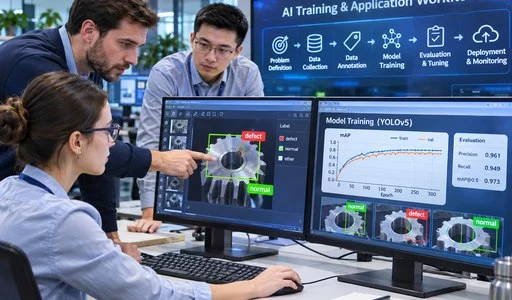
Different goals need different approaches. Supervised learning is suited to tasks with known outcomes, like classifying defects or sorting invoices. If you don’t have many labels, unsupervised or self-supervised learning can help you find clusters or anomalous patterns. Reinforcement learning is good for sequential decisions like moving a robot but needs controlled feedback. Deep learning can be used for complex tasks such as those involving images, speech and language. The right choice depends on data availability, business risk and expected value. Our course has hands-on projects, including object detection with YOLOv5. Learners validate each model and analyze error cases so technical results can be compared with the business goal.
What AI Training & Application Teaches Beyond Data Annotation?
Defining the Problem Before Collecting Data
Strong projects start with a question, not a dataset. Teams must decide what the model should decide, how many errors the business can accept, how fast the system must respond, and who reviews uncertain results. Our course begins with business data workflow design. Learners analyze requirements, design a data collection, processing, and review workflow, and find weak modules that AI technology could improve. They practice business analysis methods and workflow design tools. This early planning shapes every later choice, from what data to collect to how to write labeling rules, and it prevents the common mistake of picking a fashionable model before the problem is clear.
Monitoring, Error Analysis, and Retraining
A model does not stay accurate forever. In a 2014 survey on concept drift, Gama and colleagues explained that the statistical properties of incoming data can change over time, which lowers prediction quality. New products, shifting customer behavior, or updated rules can all cause this. Teams therefore need continuous monitoring, error review, human checks, and retraining. Through AI training & application, our learners practice the first steps of this habit. They use tools to find the causes of error cases, then correct the data or the parameters. They also learn to maintain training and testing datasets over time, which matches the daily work of AI trainers and system maintenance staff.
AI Versus Traditional Software
Traditional software follows fixed rules and gives the same output for the same input. AI systems produce probable answers based on learned patterns, so they need representative data, test sets, confidence thresholds, and a plan for uncertain results. A 2015 paper by Google researchers on hidden technical debt in machine learning systems showed that model code is only a small part of a real-world system. The surrounding data, configuration, and serving components make up most of it. AI is also not always the right tool, because fixed calculations and strict compliance rules often work better as ordinary code. Our course reflects this mix by teaching learners to connect model APIs with hardware and control logic.
How Our Course Teaches the Full Chain From Data to Deployment?
Course Design and Standards
Our AI Training & Application course is project-based, which means theory is paired with hands-on practice. It builds on the core competency model of AI trainers and follows industry-standard data processing methods: business data workflow design, data collection and cleaning, annotation standard formulation, model training and tuning, and system deployment. The content aligns with international technical skills standards, and the faculty includes industry practitioners and experienced academic instructors. Target partners include enterprises, educational institutions, industry associations, and other organizations. Since 2010, E.C.R Academy has delivered training and assessment services to nearly 500,000 participants across China and 28 countries, and we have partnered with more than 500 enterprises.
Three Training Modules
The course has three training modules, and each one builds on the last:
- AI dataset creation: Learners collect and clean raw data, annotate images for object detection, and build structured datasets in VOC format. They apply labeling standards and practice data quality management, which gives every later training step a dependable starting point and teaches why careful dataset construction affects final model results in practice.
- Deep learning engineering applications: Learners import datasets, select a model such as YOLOv5, and tune parameters. They validate the trained model and deploy it as an API service, which shows how a trained network becomes a working service that other software can call and that a team can test before release.
- AI system assembly, adjustment, and operations maintenance: Learners capture image data, call model APIs, and run object detection. They connect indicator lights, servos, and serial displays, and they use serial communication protocols for control and data exchange, which builds hands-on skills in system integration, debugging, and day-to-day operation in real-world scenarios.
Together, these modules show learners the full path from raw data to a working system.
The Learning Platform and Cloud GPU Access
Our course in AI training & application runs on the AI Teaching and Training Platform (HD-AiLab V1.0), a one-stop development platform with a B/S architecture. It combines an AI all-in-one machine, a human-AI collaborative data annotation platform, an algorithm platform, and an AI scenario application training station. The platform supports Python, R, Java, and C++, more than 100 machine learning algorithm libraries, and deep learning tools including TensorFlow, Keras, PyTorch, and Caffe. It provides over 5 TB of pre-loaded experimental data, plus documents, videos, experiment code, and datasets. Cloud-based GPU computing resources let learners train models without a complex local setup, which addresses a common cost and setup worry for schools and training teams.
Choosing the Right Training Path and Avoiding Common Mistakes
Pre-Trained Models, Fine-Tuning, and Custom Training
Organizations typically go with pre-trained models, fine-tuning and end-to-end custom development. Pre-trained models are the quickest way to begin, but teams need to consider privacy, vendor dependence, domain accuracy and cost of use. Fine tuning helps with specialized terms, product catalogs or document formats. For proprietary inspection or regulated processes with unique data, custom training makes sense. And deployment matters. The cloud is flexible, but sensitive data or tight response times might be better on-prem or hybrid. One reason we teach the full chain and not just a single step is that a team that knows dataset creation, training, and deployment can make those trade-offs with confidence.
Common Mistakes in AI Projects
Several errors appear again and again. Inconsistent labels, missing edge cases, and unrepresentative samples weaken results even when annotation volume is large. Some teams pick a fashionable model before they define the problem and the acceptance criteria. Others underestimate deployment, security, and maintenance work. A 2022 survey by Paleyes and colleagues, which reviewed published case studies, found that challenges appear at every stage of deployment, from data management to model deployment. High-risk workflows also need human oversight, including confidence thresholds, approval steps, and audit trails. A sound project measures label quality, tests with realistic data, plans operations early, and builds a feedback loop.
A Practical Path for Schools and Training Teams
U.S. community colleges, universities, and employer training teams can follow a simple order. Pick one repeatable process with clear value. Audit data quality, access rights, and computing needs. Run a small pilot with defined success criteria. Then review results with both technical measures and business goals before expanding. Our course supports this approach by training people for roles such as AI trainer, data annotation specialist, AI algorithm tester, AI application development engineer, and AI system operations and maintenance engineer. Technician roles in smart agriculture and intelligent retail also fit the skills taught. The cloud-based platform keeps the setup light for a first pilot.
Conclusion
Data annotation builds the learning material for a model, but AI training & application covers the larger process that makes a model useful. Learners define the business problem, create and manage quality datasets, train and tune models, analyze errors, deploy services, and maintain systems after launch. Research on label errors, concept drift, and deployment challenges supports this wider view, since weak labels, changing data, and operational gaps can all reduce results. The choice between pre-trained, fine-tuned, and custom models also depends on skills across the full chain. The central point is that a program should be judged by how well it teaches this complete cycle through hands-on projects, not by labeling volume alone.
FAQ
1. Can I join with no AI background?
Yes. The course starts with basic data collection and annotation, then moves step by step toward deep learning and system integration. I recommend basic computer skills and a preliminary understanding of Python. The platform's pre-loaded resources also help beginners get started.
2. Which jobs does the training support?
Graduates can pursue roles such as AI trainer or data annotation specialist, AI algorithm tester, AI application development engineer, and AI system operations and maintenance engineer. Technician roles in smart agriculture and intelligent retail are also options.
3. How is the platform deployed?
It provides cloud-based GPU computing resources. Learners develop and train models without a complex local setup and can access the platform anytime, from anywhere.
4. Does annotation still matter?
Yes. Annotation remains important for supervised learning and model evaluation. The course teaches it as one quality-controlled step within a full process that also covers workflow design, training, deployment, and maintenance.
5. Who can partner with E.C.R Academy?
Target partners include enterprises, educational institutions, industry associations, and other organizations. Contact us to discuss which learner group and course format fit your goals.
Talk With E.C.R Academy About AI Training & Application
If your school or company is comparing an AI training & application supplier, E.C.R Academy can help you review course options. Our project-based course covers dataset creation, deep learning engineering, and system deployment, taught by industry practitioners and experienced academic instructors. Email us at ecr2008@enteredu.com with your goals, learner group, and timeline. You can also read more at enteredu.com.
References
1. Goodfellow, I., Bengio, Y., and Courville, A. Deep Learning, MIT Press, 2016.
2. Northcutt, C., Athalye, A., and Mueller, J. "Pervasive Label Errors in Test Sets Destabilize Machine Learning Benchmarks," NeurIPS Datasets and Benchmarks Track, 2021.
3. Gama, J., et al. "A Survey on Concept Drift Adaptation," ACM Computing Surveys, 2014.
4. Sculley, D., et al. "Hidden Technical Debt in Machine Learning Systems," Advances in Neural Information Processing Systems, 2015.
5. Paleyes, A., Urma, R.-G., and Lawrence, N. "Challenges in Deploying Machine Learning: A Survey of Case Studies," ACM Computing Surveys, 2022.
6. Géron, A. Hands-On Machine Learning with Scikit-Learn, Keras, and TensorFlow, O'Reilly Media, 2022.