Which Careers Benefit from New Energy Vehicle Detection & Maintenance Technology Training?
Specialised training in new energy vehicle detection & maintenance technology provide tangible benefits to professionals throughout the electric car sector. With the accelerated adoption of EVs internationally – the International Energy Agency estimated more than 14 million new EV registrations in 2023 alone – the need for technically skilled service workers is far outpacing what conventional automotive programs can provide. Diagnostic engineers, battery experts, procurement officials and after-sales technicians – this training bridges the gap between classroom theory and workshop-ready expertise.
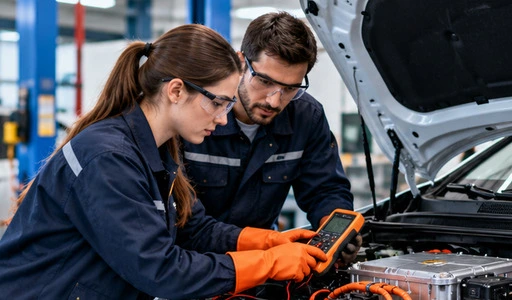
Understanding the Landscape of New Energy Vehicle Detection & Maintenance
The EV service industry is based on completely different technological foundations than traditional vehicle maintenance. High voltage systems, battery management topologies and software-defined vehicle platforms are now part of the regular workshop chores. Understanding this transition is the first step for any professional wanting to create a career in this industry.
The Scale of Market Demand
BloombergNEF predicts that EVs will account for 45% of global car sales in 2035. And this immediately correlates to a serious scarcity of competent NEV service technicians. In fact, the U.S. Bureau of Labour Statistics lists automotive repair jobs requiring electronics and diagnostic skills among the fastest expanding vocations in the industry.
Core Technologies Reshaping NEV Servicing
Modern EV maintenance relies on integrated diagnostic systems, Battery Management System (BMS) data analysis, thermal management inspections, and CAN-bus communication validation. Fault detection has also shifted toward software-based tools and OBD interface analysis, requiring technicians to interpret data streams rather than rely solely on mechanical intuition.
Why Standard Automotive Training Falls Short
A technician trained exclusively on internal combustion engines lacks the skills to safely handle 400V–800V high-voltage systems, perform insulation resistance testing, or calibrate drive motor zero-position parameters. Without purpose-built NEV training, both safety and diagnostic accuracy are at risk.
Key Careers Enhanced by NEV Detection & Maintenance Technology Training
Specialized EV training does not serve just one job title — it adds measurable value across multiple professional roles. Below are the career paths that benefit most directly.
Automotive Diagnostic Technician
Diagnostic technicians gain hands-on competency in reading fault codes, analyzing resolver faults, diagnosing phase loss conditions, and verifying repair results through system-level testing. ECR Academy's training covers twelve structured fault diagnosis modules built around real NEV scenarios, from overtemperature failures to cooling system breakdowns.
Battery and Electric Drive System Specialist
Battery management and electric drive specialists in new energy vehicle detection & maintenance technology work directly with BMS data, insulation fault detection, and SOC/SOH estimation procedures. Training in powertrain disassembly, eight-in-one drive controller assembly, and static drive system testing gives these professionals precise, job-ready skills that employers actively seek.
After-Sales Service and Technical Support Engineer
After-sales engineers benefit from structured training in high-voltage safety protocols, standardized maintenance procedures, and emergency response in workshop environments. These competencies directly reduce return-repair rates and warranty costs — a measurable business outcome for OEMs and 4S dealer groups managing large service networks.
Procurement and Supply Chain Professional
A procurement officer who understands the technical specifications of diagnostic hardware — insulation testers, multimeters, VCI tools, OBD interfaces — makes more accurate sourcing decisions. Training in NEV systems gives procurement teams the technical vocabulary and evaluation criteria needed to assess suppliers, compare product capabilities, and avoid costly misaligned purchases.
Comparing Traditional vs. New Energy Vehicle Maintenance Careers
What Traditional Training Does Not Cover
New energy vehicle detection & maintenance technology training involves technical aspects that are frequently briefed or not covered at all in regular automotive programs. The traditional maintenance education often takes the internal combustion engine, mechanical transmission, fuel system and other relevant components as the primary body, but the new NEVs need more knowledge of the electric powertrain and electronic control systems. Learners need hands-on expertise with drive motors, motor controllers, BMS, OBC, DCDC, PDU and VCU technologies and high-voltage safety protocols. They also identify defects related to resolvers, insulation, communications, phase loss, overtemperature and cooling systems utilizing diagnostic tools and testing equipment. ECR Academy fills this gap with project-based training, virtual simulation, and hands-on practice, enabling learners to acquire skills that more accurately mirror existing NEV testing, maintenance, manufacturing, and after-sales support responsibilities.
The Career Relevance Argument
People in the business world who get structured NEV training say they have a better chance of getting hired. After finishing the ECR Academy, people can work as a NEV Drive Motor System Testing Engineer, an Electric Drive System Assembly Engineer, a Drive Motor Fault Diagnosis Engineer, or a NEV Powertrain Technician. Ten years ago, there were no jobs like these in the general auto job market.
Long-Term Value of Upskilling
If you spend money on specialized EV training, it pays off in ways that go far beyond getting certified. Professionals who know how to use flexible, system-based troubleshooting tools can easily switch to new platforms as battery chemistry and car designs change. Training at the ECR Academy is in line with professional standards around the world. That way, it can be used in any market and meet job goals.
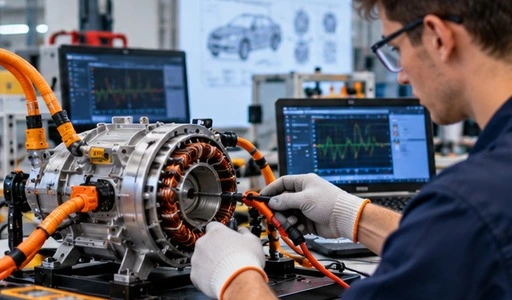
How NEV Detection & Maintenance Training Supports Effective Procurement Decisions
Buyers in the business world (B2B) care a lot about technical knowledge when they look for diagnostic tools and training platforms.
Understanding What to Buy
There is a difference between a general-purpose scan tool and a VCI device that can read BMS data streams or PDU syncing settings. People who work in procurement and have been trained in NEV systems know this. The value and safety of work in the company are affected by this difference.
Evaluating Suppliers with Confidence
To properly evaluate well-known diagnostic tools in new energy vehicle detection & maintenance technology, you need to know how they work with different communication protocols, how accurate their insulation tests are, how clear their data logs are, and how often they update their software. If you get training, you'll be able to do this. Without this base, people often choose what to buy based on how well they know the brand instead of how well it does the job.
Aligning Purchases with Operational Needs
ECR Academy's teaching is built on an electric powertrain platform that can be used in eight different ways. Teams that buy things get to try out the parts they buy, like drive motor controllers, DCDC systems, OBC and VCU interfaces, and more. This makes equipment specs more correct and lowers the chance of getting the wrong thing in high-value bids.
Future Outlook: Career Opportunities Driven by Advancements in NEV Technology
It is important to keep up with the changes in the skills needed to run NEVs if you want to keep your job.
AI-Assisted Fault Detection and Remote Diagnostics
In service settings, AI-powered fault finding tools and remote tracking systems are already in use. It's easier for techs who know how to work with these systems if they also know how to analyze data streams and use business rules.
Emerging Roles in the EV Service Sector
In every part of the business, new jobs are opening up for people with skills like high-voltage battery remanufacturing expert, ADAS recalibration engineer, and NEV fleet diagnostic analyst. Structured training in maintaining new energy vehicles gives people the exact skills they need for the jobs, like being able to correctly diagnose problems and having a deep understanding of technical issues.
Continuous Certification as a Career Strategy
To stay competitive, professionals must see certification as an ongoing process, not a one-time credential. This is true even when vehicle platforms change. This is possible because of the platform from ECR Academy; it has virtual simulation environments that can act like fault scenarios that are always changing. Students can get better at diagnosing things this way without having to buy new tools.
Conclusion
You might be able to get a job in areas like EV diagnosis, battery systems, after-sales service, and technical procurement if you learn how to use new energy vehicle detection & maintenance technology. A virtual modeling platform that meets international technical standards is used in the twelve practice lessons that make up ECR Academy's course. These lessons cover all the main diagnostic scenarios, such as resolver and insulation faults and cooling system failures. You can use these skills right now in the job market, whether you are a department head making a program or a worker trying to move up.
FAQ
1. What prior knowledge do I need before enrolling in NEV detection and maintenance training?
It is helpful to know the basics of mechanical engineering, electrical and electronic engineering, and how computers normally work. After going over basic NEV structures, the ECR Academy course goes on to drive motor systems and how to figure out what's wrong. Because of this, people who don't know much about EVs can still take the lesson.
2. Which industries actively hire professionals with NEV maintenance certifications?
Techs with the right skills can find work at OEM after-sales offices, independent EV service shops, business fleet repair shops, vocational and technical schools, and battery remanufacturing facilities. In the car supply chain, this technical knowledge is also useful for teams that buy things and find suppliers.
3. How does the virtual simulation platform work?
PCs with Windows 10, 8GB or more of RAM, and a dedicated graphics card can use the platform to take apart engines, calibrate drive motors, look at fault codes, and test the whole system. It feels and looks like a real workshop too. You can use it to learn both online and off, which is useful in places where network access changes a lot.
Take Your NEV Training Program to the Next Level with E.C.R Academy
Since 2001, E.C.R. Academy has been a reliable source of new energy vehicle detection & maintenance technology for over 500,000 students in 28 countries. Our project-based program, taught on a single virtual reality platform by engineers who work in the field, gives your team the exact tech skills the EV business needs. We can help you find a program that works for your staff, whether you work for a company, a school, or an industry group. Email us at ecr2008@enteredu.com or go to enteredu.com today.
References
1. International Energy Agency. Global EV Outlook 2024. IEA, 2024.
2. BloombergNEF. Electric Vehicle Outlook 2023. Bloomberg Finance L.P., 2023.
3. U.S. Bureau of Labor Statistics. Occupational Outlook Handbook: Automotive Service Technicians and Mechanics. U.S. Department of Labor, 2023.
4. Society of Automotive Engineers International. SAE J2910: Safety Standards for High-Voltage Electric Vehicle Systems. SAE International, 2022.
5. International Organization for Standardization. ISO 6469-3: Electrically Propelled Road Vehicles — Safety Specifications. ISO, 2021.
6. Institute of the Motor Industry. IMI TechSafe: High Voltage Electric Vehicle Competency Framework. IMI, 2022.