What Will You Learn in Renewable Energy Equipment Technology Training?
You learn how to build, install, test, and take care of wind and photovoltaic (PV) equipment in renewable energy equipment technology training. You also learn about the systems that convert and send power to the equipment so that it can connect to the grid. Theory and project-based practice are both parts of the E.C.R. Academy course. This means that students do real production tasks like making PV modules, commissioning machines, and fixing problems. Each stage is helped by tools like virtual simulations, big data, and the cloud. You can see the skills, labs, and career paths below. This way, schools, businesses, and groups can decide if the program meets their needs.
Why Renewable Energy Equipment Technology Training Matters?
A Growing Need for Skilled Technicians
More and more people in the energy sector need to be trained. In 2023, the International Labor Organization (ILO) and the International Renewable Energy Agency (IRENA) said that renewable energy would create 16.2 million jobs around the world. The Bureau of Labor Statistics in the United States says that jobs for technicians who work on wind turbines and installers of solar photovoltaic panels will grow much faster than the average for all jobs. These numbers show a problem in real life. Many employers can't find workers who know how to put together, test, and fix new equipment fast enough. Targeted training fills that gap by letting students work with real equipment before they go to a job site.
What Renewable Energy Equipment Technology Covers?
The hardware and controls that safely collect energy from the sun and wind, turn it into electricity that can be used, and deliver it are referred to as renewable energy equipment technology. Our course is mostly about making equipment and electromechanical systems. Learners learn how to design processes, put together new energy equipment, lift and install it, and start it up. They also learn about how to run, manage, maintain, and rebuild new energy power plants. There is a stronger focus on wind power generation equipment and PV power generation equipment in this program than in a general electromechanical degree.
Who Benefits From the Training?
The program helps three main types of people. It is used by colleges and universities to make useful majors and training labs for new energy. Firms that make or fix wind and PV equipment use it to train people to be assemblers, commissioning staff, and maintenance technicians. It's used to help regional skill-building programs by industry groups and training centers. Each group has a different goal, but they all need students who can read written instructions, follow written steps, and work safely near electrical equipment. Over and over again project work, not just lectures, is how the course builds those habits.
Core Skills You Build in the Course
Equipment Assembly and On-Site Installation
The first skill is putting things together. Learners look at the parts and building ideas of equipment that makes wind and solar power. Then, they put together mechanical and electrical parts in the workshop by following the right way to use tools, assembly processes, and standards. On-site mechanical and electrical installation methods, such as lifting and installation tasks, are also covered in the course. In addition to doing things with their hands, students also practice planning and overseeing installation tasks. That's important because a field crew can only do a good job if the steps, tools, and safety checks all work together. Learners get ready for jobs on factory floors and on project sites with this mix.
PV Module Fabrication and Testing
One of the most concrete parts of the program is making PV modules. Learners work on single soldering, string soldering, layup, and TPT/EVA cutting. To finish a module, they use laminators. After making the PV cells, they check how they look, how well they work electrically, and use testing equipment on them. Product standards set the scene for this work. For instance, IEC 61215 specifies the requirements for design qualification and type approval for terrestrial PV modules. This means that a technician who knows how to inspect and test can communicate with quality teams. Students can make connections between each step of the making process and the inspection that comes next in the lab.
Commissioning, Sensors, and Control
Commissioning turns equipment that has been put together into equipment that works. Learners learn how to do mechanical inspections and electrical commissioning in a workshop for wind power equipment. After that, they follow set procedures and do machine integrated commissioning for wind or PV systems while they are still on-site. Control and testing skills help with this work. Learners look at basic control needs and strategies, learn how to use sensors that pick up common signals, figure out what common control devices are, and learn how to read electrical control drawings correctly. This series, IEC 61400, describes wind energy systems and helps students understand how the industry checks and specifies turbines.
Power Conversion, Distribution, and Maintenance Skills
Power Conversion Technology
Power from wind and solar panels has to be changed before it can be used or sent to the grid. Learners learn how to analyze power electronic devices as well as drive and protection circuits in this module. They study controlled rectifier circuits, DC-DC converter circuits, and inverter circuits and build them. Then they fix problems with power converters that are used in wind or PV systems and equipment. This skill area connects the theory of circuits to problems with real equipment. A student who knows about every rectifier, converter, and inverter stage can use logic to figure out what's wrong instead of guesswork.
Power Supply and Distribution Systems
Since power moves through distribution equipment, the course covers installing and maintaining power supplies and distribution systems. Learners get good at using and protecting relays and other major electrical equipment. They figure out power loads, secondary circuits, and automatic devices. They also check for electrical safety. They also figure out how to avoid short circuits, choose and check electrical equipment, and read and draw circuit diagrams. The National Electrical Code (NFPA 70) in the US tells people how to install things, and Article 690 of that code talks about solar PV systems. It is helpful for students to understand how diagrams, protection, and calculations work together before they start studying local codes.
Maintenance, Overhaul, and Safe Work Habits
After it's been put into use, maintenance keeps the equipment working. Learners work with maintenance processes, standards, and procedures to learn how to inspect, maintain, and fix problems with wind and PV equipment on a regular basis. They look at common problems, make sure they correctly fill out maintenance logs and fault overhaul records, and practice setting up schedules for maintenance staff. The program also includes upkeep and repair of electrical equipment in substations. All of this work is based on safety. NFPA 70E, which is the standard for electrical safety at work, tells us how careful we need to be around equipment that is powered up. That care is supported by clear records that show what was done and when.
How the Training Is Delivered
Project-Driven Curriculum
Project-based learning is used in the curriculum to connect theory and practice. The lessons are based on real production projects and everyday work tasks, so each one is related to something a technician does, like putting together a unit or starting up a system. No background knowledge is needed because the lessons start with basic theory and build on it step by step. Intelligent monitoring and virtual simulation technology help with the projects and let students practice a step until it feels natural. This method trains flexible tech experts who can meet the needs of an industry that is growing and moving toward smart, digital operations.
Enterprise Engineers and College Experts
Two groups teach together. Business engineers bring skills from the workshop and the field, while college experts bring theory and the way they teach. The course meets the technical skill standards around the world and the needs of workers in the renewable energy equipment industry. This kind of partnership has been up and running at E.C.R. Academy since 2010. More than 3,300 experts and more than 500 businesses have worked with us, and we've made more than 60,000 learning resources, such as standards, courseware, case studies, and test banks. The lesson can show both the engineering reason and the shop-floor method, which is good for the students.
Labs, Simulation, and Cloud Tools
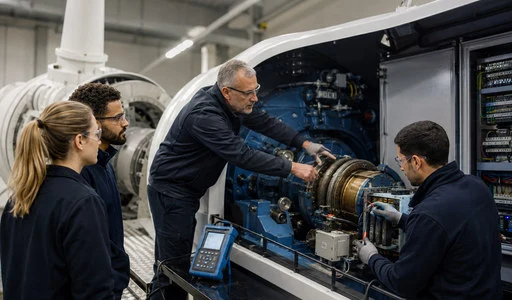
There are three levels to the learning space. Electrical engineering basics, renewable energy equipment technology, electrical control circuits, programmable control, and power electronics are all covered in foundational skills labs. These labs have experiment benches, multimeters, oscilloscopes, and software for programming and simulating PLCs. Professional core labs teach the basics of wind turbines and how to control them. They also put together and start up whole machines, test the performance of PV cells, and make PV modules and resin-drip boards. Virtual simulation labs help with training in designing and building PV power systems and simulating wind turbines. They also help with maintenance and overhaul. Big data, cloud computing, and AI all add to a setup that looks a lot like the real world of work.
Career Outcomes and Program Applications
Roles Learners Can Prepare For
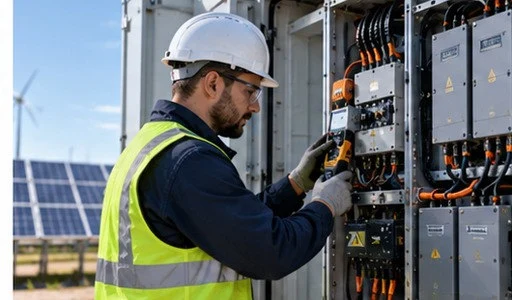
Grads can get ready for a number of jobs, such as process design engineer for renewable energy equipment, assembly engineer for wind or PV equipment, operation and maintenance engineer for a renewable energy power plant, commissioning and testing engineer, and equipment maintenance technician. There is a link between these roles. For each one, you have to read drawings, follow a process, and write down the results. Students learn these habits through project work in the course, so they get practice with them before an employer asks for them. Because hiring depends on the local job market and how hard each learner works, these are just preparation paths and not guaranties.
Fit for Colleges and Universities
If you want to build a school or improve an energy major, you need a clear list of skills, lab categories, and ways to teach them. All three can be found in our course. Schools can buy licenses for the course materials and simulations, work with us to make a program, or use certain modules to fit with their current majors. With simulation labs, schools can practice with physical equipment more than once, which is helpful when heavy equipment is expensive or not available. When enterprise engineers and college experts teach together, lessons stay relevant to current job needs, which helps with both planning the program and working with employers.
Fit for Enterprises and Associations
Service companies and companies that make equipment can use the same skills to set up in-plant training for teams that put together, start up, and do maintenance. Simulations let people practice without having to stop a production line or put people near live equipment. The course structure can be used for regional skill-building programs by industry groups and training centers, as each module is linked to clear tasks and requirements. Each partner and I talk about the project's scope, timeline, and delivery. This is because a factory with 200 workers and a regional training base need different plans. That conversation makes sure that the training is useful for the people who go to it.
Conclusion
Training in renewable energy equipment technology teaches students how to work on wind and PV equipment, from putting it together to keeping it running smoothly. Assembling, commissioning, testing and making PV modules, testing and control, maintenance and overhaul, power conversion, and power distribution are all skills that are related. These skills are put to use in the real world through project-based lessons, labs with simulation, big data, and cloud tools, and lessons taught by both enterprise engineers and college experts. More and more jobs are opening up that need trained people, according to IRENA and the Bureau of Labor Statistics. Standards like IEC 61215, IEC 61400, NFPA 70E, and the National Electrical Code help everyone do their jobs safely and technically. The main thing to remember is that technicians learn how to follow processes, read drawings, and work safely by doing real tasks over and over again with help.
FAQ
1. Can I take this course with no prior background?
Yes. The course starts with basic ideas and builds on them one step at a time. Learners practice with professional teachers in training labs, so they learn skills in a planned order, from basic electrical principles to setting up and starting up equipment.
2. What careers can the course prepare me for?
Trainees can get ready for jobs like process design engineer, wind power or PV equipment assembly engineer, O&M engineer for a power plant, commissioning and testing engineer, and maintenance technician. The number of openings depends on the job market in the area.
3. How does this course differ from a traditional electromechanical program?
This class is all about new energy equipment, especially wind and solar panel power generation, and it looks at what makes each type of equipment unique. It also includes virtual simulation, big data, cloud computing, and AI, all of which are in line with the industry's move toward being digital, networked, and environmentally friendly.
4. Who can partner with E.C.R Academy?
We can work with businesses, schools, industry groups, and other groups to license courses, provide training in-plant, or create programs together.
Build Your Renewable Energy Equipment Technology Program with E.C.R Academy
Through its training courses in renewable energy equipment technology, E.C.R. Academy has helped almost 500,000 people in China and 28 other countries since 2010. As well as course licensing, we also train production teams in-plant and help schools make their own programs. Get in touch with us at ecr2008@enteredu.com with your timeline, learner numbers, and goals, or go to enteredu.com for more information. We'll get back to you with a clear plan for your team.
References
1. U.S. Bureau of Labor Statistics, Occupational Outlook Handbook: Wind Turbine Technicians, 2024
2. International Renewable Energy Agency and International Labour Organization, Renewable Energy and Jobs: Annual Review, 2024
3. National Fire Protection Association, NFPA 70E: Standard for Electrical Safety in the Workplace, 2024
4. National Fire Protection Association, NFPA 70: National Electrical Code, 2023
5. International Electrotechnical Commission, IEC 61215: Terrestrial Photovoltaic (PV) Modules – Design Qualification and Type Approval, 2021
6. International Electrotechnical Commission, IEC 61400-1: Wind Energy Generation Systems – Design Requirements, 2019