What to Look for in an AI Training & Application Program
When evaluating an AI training & application program, the right choice goes far beyond course length or price. A strong program must cover the full machine learning lifecycle — from dataset creation and model training to system deployment — using industry-standard frameworks like TensorFlow and PyTorch. It should be taught by practitioners with real project experience, supported by a capable development platform, and aligned with recognized certification standards. This guide walks through the key criteria so you can make a confident, well-informed decision.
What a Strong AI Training & Application Program Actually Covers
Too many programs say they teach a lot about AI but only teach the basics. Before making a decision, make sure that the course covers the whole workflow that an actual AI engineer does on the job.
Core Technical Modules You Should Expect
A good school goes over more than just theory when it comes to making datasets, training deep learning models, and integrating intelligence systems. You should be able to do real-world work with VOC, object detection, image annotation, and structured dataset formats. These are things that real AIs do every day.

Framework Exposure Matters More Than You Think
Employers in the field expect graduates to be able to use TensorFlow, PyTorch, Keras, and more and more, tools like YOLOv5, with confidence. Students aren't ready for even entry-level jobs in machine learning tech or AI application development because their school skips framework-specific labs.
From Data to Deployment: The Full Pipeline
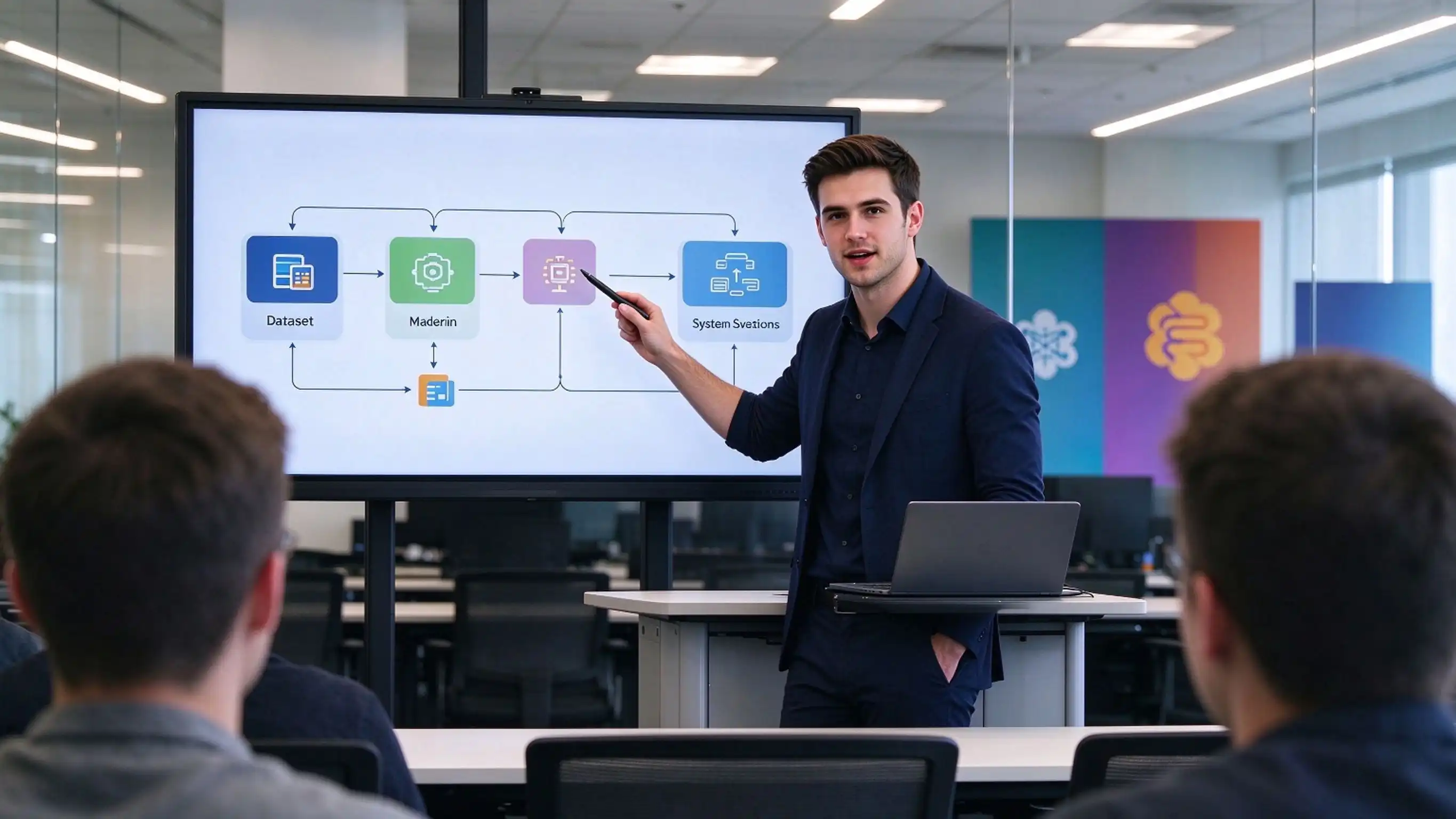
The best programs walk students through every step, from gathering data to cleaning it up, annotating it, improving the model, deploying APIs, and keeping the system running. The AI training & application course at ECR Academy is based on this end-to-end method and the core competency model of AI teachers.
Why Faculty and Platform Quality Define the Learning Outcome
The subjects taught are important, but the setting where students learn affects how well they can use what they have learned in the real world. Who teaches and what tools students use for practice stand out.
Industry Practitioners, Not Just Academics
The World Economic Forum said in a study in 2023 that 44% of key job skills will likely change in the next five years, especially in AI training & application. Programs that are taught only by academics who have never worked on a project in the real world tend to fall behind this pace. For the best teachers, find ones who have built and used AI systems in business or industry.
A Platform Built for Realistic Practice
The HD-AiLab V1.0 tool from ECR Academy is browser-based and works with Python, R, Java, C++, and more than 100 packages for machine learning algorithms. It comes with more than 5 TB of experimental datasets already loaded, and it works with TensorFlow, PyTorch, Keras, and Caffe. Cloud-based computing resources are built in so that students can train and deploy models without having to manage complicated GPU infrastructure locally.
Teaching Resources That Go Beyond Slides
Strong programs give you documents, videos, experiment code, and annotated datasets all in one package. This is especially important for schools that are adding scientific study projects, certification training tracks, or preparation for skills competitions to normal schoolwork.
How to Evaluate Certification Alignment and Career Outcomes
A program's value is partly measured by what doors it opens after completion. Certification alignment and stated career pathways tell you how seriously a provider takes post-program outcomes.
Does the Program Connect to Recognized Credentials?
ECR Academy's curriculum aligns with international technical skills standards and supports certification training tracks for roles like AI Trainer, Data Annotation Specialist, and AI Application Development Engineer. This alignment is not cosmetic — the course structure maps directly to the competency requirements these certifications test.
Realistic Career Pathways, Not Generic Promises
After completing ECR Academy's program, students qualify for roles including AI Algorithm Tester, AI System Operations and Maintenance Engineer, and AI Application Technician in sectors such as smart agriculture and intelligent retail. These are specific, verifiable job titles — not vague assurances about "AI careers."
Institutional and Enterprise Partners Validate the Outcomes
ECR Academy has delivered professional training and assessment services to nearly 500,000 participants across China and 28 countries. Over 300,000 learners have obtained recognized skills certifications. These numbers reflect 16 years of operational delivery — a trackable record, not a marketing claim.
Red Flags That Signal a Weak Program
It takes just as little time to know what to avoid as it does to know what to look for. Several trends always show that a program will not live up to expectations.
Before you sign a buying deal, keep an eye out for these red flags:
- No framework-specific labs: If a program discusses deep learning without requiring students to train a model in PyTorch or TensorFlow, the hands-on component is likely insufficient for job readiness.
- No deployment module: Building a model is only half the job. A program that ends at model training without covering API deployment, system integration, or hardware communication protocols is incomplete.
- Vague update commitments: The AI training & application field moves quickly. IBM's 2023 Global AI Adoption Index found that 42% of enterprises have already deployed AI in their operations. A program with no stated curriculum review cycle risks becoming outdated within a year.
- No access to real datasets: Pre-loaded datasets and annotation tools are not a luxury — they are necessary for students to practice at realistic scale. Programs that rely solely on toy datasets produce graduates who struggle with production data.
All of these holes reveal a bigger issue: the program was created based on what is simple to teach, not what the business world really needs.
Future Direction: What AI Programs Need to Keep Up With
The technical bar for AI roles continues to rise. Programs that stay current address model robustness benchmarks, inference latency optimization, and edge deployment techniques like model quantization — converting FP32 weights to INT8 to run efficiently on constrained hardware.
MLOps Is No Longer Optional
Concept drift — when a deployed model's performance degrades as real-world data patterns shift — is a documented operational risk. Programs aligned with current industry practice introduce students to MLOps pipelines and monitoring workflows, not just model building.
Privacy-Aware Training Methods Are Becoming Standard
Federated learning and differential privacy are moving from research papers into production environments, particularly in healthcare and financial services. A program worth investing in addresses these techniques, even at an introductory level.
Edge and Offline Deployment Competence
Not every real-world application runs on a cloud server with constant connectivity. Programs that cover on-premise and edge inference prepare students for a wider range of industry deployment scenarios.
Conclusion
There are five things you should look for in an AI training & application program: the depth of the curriculum, the coverage of the framework, the experience of the faculty, the ability of the platform, and the alignment of the certification. A program that checks all five gives students and the businesses or institutions that fund them a real return on their money. The AI training & application course at ECR Academy was made with all of these things in mind. It is based on 16 years of experience teaching skills in more than 28 countries.
FAQ
1. Can someone with no prior AI experience take this course?
Yes. The course starts with basic jobs like collecting data and making notes, and then moves on to more advanced topics. The HD-AiLab platform comes with datasets and guided experiments that are already loaded, so beginners can start using real tools right away without having to set up a local environment first.
2. What computing resources do students need?
Users don't have to own or handle their own GPU hardware because the app uses GPU infrastructure in the cloud. You can get to it from any browser, at any time.
3. Is the curriculum updated to reflect industry changes?
Experts in the field and business partners help ECR Academy make sure that training materials are always in line with how things are deployed today. The program is based on how real projects are done, not on static information from textbooks.
Partner with E.C.R Academy for AI Training & Application Supplier Solutions
As a reputable AI training & application provider for businesses and schools in 28 countries, E.C.R Academy has 16 years of experience. With our HD-AiLab platform, practitioner teachers, and widely aligned curriculum, your company can get a program that is designed to get real results. You can email us at ecr2008@enteredu.com or go to enteredu.com to talk about partnership options and how the program fits your team.
References
1. World Economic Forum. The Future of Jobs Report. 2023.
2. IBM Institute for Business Value. Global AI Adoption Index. 2023.
3. McKinsey Global Institute. The State of AI in 2023: Generative AI's Breakout Year. 2023.
4. OECD. OECD Principles on Artificial Intelligence. 2019.
5. Goodfellow, I., Bengio, Y., & Courville, A. Deep Learning. MIT Press. 2016.
6. Sculley, D., et al. "Hidden Technical Debt in Machine Learning Systems." Advances in Neural Information Processing Systems (NeurIPS). 2015.