Virtual Reality (VR) Product Design & Development: A Complete Training Guide
If you are building a VR curriculum or training a development team, understanding virtual reality (VR) product design & development from the ground up is the right starting point. This guide covers the full workflow — from concept and scene construction to interaction logic and browser-based deployment — drawing on ECR Academy's structured course model that combines project-based learning, international technical standards, and a browser-native development platform called VeryEngine. Whether you lead a digital media program at a university or manage engineers at a VR content studio, this guide was written with your goals in mind.
Understanding Virtual Reality Product Design
What VR Product Design Actually Means
Planning, building, and providing three-dimensional interactive experiences through a virtual world is what VR product creation is all about. It's not the same as augmented reality, which adds digital material to the real world, or mixed reality, which combines the two. In VR, the user is completely immersed in a simulated space. This makes planning the space, rendering details, and how to interact with it much more important.
How a VR Product Goes From Concept to Prototype
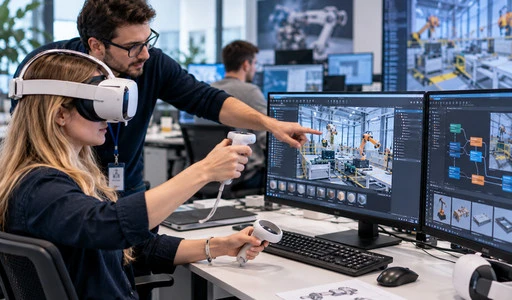
Finding out what the end user's situation is and how they want to interact with the VR product is the first step in making it work. After that, teams plan scenes, get assets ready, build using the engine, and write scripts for interactions. Finally, they test and release the game on the web. In this workflow, designers, engineers, and people with a stake in the business or institution work together, not one after the other.
Why B2B Organizations Are Investing in VR
Businesses in manufacturing, education, healthcare, and cultural tourism all say that using VR has paid off in a measurable way. PwC's 2020 report on VR in the workplace says that employees who were trained in VR were 275% more confident in their ability to use new skills than employees who were trained in the classroom. VR is a good practical investment for B2B clients because it lowers the cost of testing, speeds up team onboarding, and makes project visualization better.
Core Principles and Best Practices in VR UX and Product Design
The Three Principles That Drive Effective VR Design
The VR course at ECR Academy is based on three main ideas: involvement, immersion, and imagination. This is called the "3I" structure. Interaction makes sure that people can have meaningful experiences in the virtual space. Display quality, spatial audio, and motion tracking accuracy all play a role in how immersed you feel. When you use your imagination, you can come up with creative and story-based ideas for a VR product.
Iterative Prototyping and User Testing
Instead of one long production process, the best VR goods in virtual reality (VR) product design & development go through several short build-test cycles. Iterative testing helps developers find UX issues early on, like camera changes that are hard to follow or UI panels that are too crowded. To confirm cross-device performance, you also need to do a lot of user testing on a variety of hardware configurations, such as Meta Quest 3, PICO 4, and regular PC browsers.
Managing Common Technical Challenges
Motion-to-photon (MTP) delay above 20ms makes users' vestibular systems hurt, which is a well-known problem with both hardware and software. Cross-device support, render speed that isn't uniform, and slowdowns in the file process are some other common problems. When using a browser-based B/S platform like VeryEngine, these problems are less likely to happen because the platform standardizes graphics through HTML5 and WebGL, which gets rid of client-side differences.
Tools, Hardware, and Platforms for VR Product Design
Hardware That Matters for Institutional and Enterprise Use
When VR goods are used in businesses, they usually use separate headsets with 6-DoF tracking, like the Meta Quest 3 or the PICO 4, or desktop-tethered setups for better quality. When space and power are limited in the lab, browser-based workflows make hardware much less important because students can see previews of VR scenes and interact with them directly in a web browser.
Comparing Development Platforms: Unity, Unreal, and WebXR
In China, Unity is still the most common engine taught in digital media programs. On the other hand, Unreal Engine is preferred for photorealistic rendering in big-budget movies. WebXR lets you create immersive experiences right in your browser, so you don't need app stores or builds that are specific to each device. The course offered by ECR Academy talks about these industry standards and teaches students how to use VeryEngine, which uses the same B/S design concept and has tools that are best for teaching and quick changes.
How VeryEngine Changes the Lab Setup Equation
VeryEngine only needs a web browser to work. Real-time editing, previewing, and publishing of 3D scenes are possible with HTML5 and WebGL. Student computers don't need to be installed for this to work. This gets rid of the hassle of complicated software licensing and the costs of setting up each device for lab administrators who are in charge of 30 to 200 seats. Keeping local and server settings' resources in sync also eases the load on the network, which is important in places where bandwidth is shared.
Strategic Decision-Making in VR Product Development Procurement
Vendor Evaluation Criteria That Actually Matter
Procurement teams should look for three things in a VR training or development platform: does it cover the whole process, from designing the scene to deploying it on the web; does it match well-known technical skill standards; and does the vendor support include course materials, training for teachers, and updates after the platform is deployed? The program at ECR Academy covers all three, and its teachers come from both business engineering teams and academic institutions.
Here are the main criteria that procurement teams should use for evaluation:
- Workflow coverage: Does the platform support scene construction, interaction development, and B/S-based publishing end to end?
- Standards alignment: Is the virtual reality (VR) product design & development curriculum referenced against international VR and immersive media standards used in real project delivery?
- Institutional flexibility: Can the course be adopted within a university credit system or adapted to corporate training modules?
These criteria help procurement teams stay away from buying tools that only work with a portion of the pipeline. This is one of the main reasons why projects fail in the middle of their scope.
Pricing, Contracts, and Outsourcing Considerations
When institutions buy something, they usually have to figure in the total cost of licensing the platform, training new faculty, and regular updates to the curriculum. VR content businesses looking at this program as an internal training resource should also check to see if they can buy modules separately, which would allow focused skill-gap training instead of enrolling the whole cohort. Partnerships with businesses, schools, industry groups, and government-affiliated groups are all welcome at ECR Academy.
Future Trends and Innovations in VR Product Design
AI-Generated Content and WebXR Are Reshaping Workflows
Tools that use AI to create 3D assets, like text-to-model tools and random scene makers, are already cutting the time it takes to make scenes by 40–60% on some projects. Teams can now create and share VR experiences without having to make builds that are specific to each platform, thanks to WebXR's browser-native deployment standard. If these trends aren't covered in courses, grads and engineers might not be ready for the real work setting they will be entering in 12 to 18 months.
5G and Cloud Rendering Are Expanding Deployment Scenarios
5G connectivity lets lightweight devices stream high-fidelity VR, so there's less need for local rendering hardware. Cloud-based production processes let teams that are spread out work together on the same scene at the same time. For cultural tourism groups, this means that VR visitor experiences can be updated from afar, without having to change any hardware on-site. This is useful for managing digital exhibitions that are held in more than one place.
Cross-Industry Applications Are Growing Fast
According to Grand View Research (2023), the global VR training market will be worth more than USD 14 billion by 2030, up from About UsD 2.2 billion in 2022. Surgical simulations, training in how to maintain equipment, architectural walkthroughs, and digitizing museums are just a few of the uses. Because each sector needs a slightly different interaction logic and asset pipeline, training that covers the whole process, from design to deployment, is more useful than just teaching you how to use a single tool.
Conclusion
No longer is virtual reality (VR) product design & development a niche field. It's becoming an expected skill in teaching digital media and making material. Most students and new coders get stuck between knowing how to use a tool and making a full VR product. A structured training path that includes building scenes, making interactions, and deploying in browsers is a reliable way for both academic programs and business teams to close that gap. The way ECR Academy teaches, through project-based learning and a browser-native tool, is similar to how VR projects are taught in the real world right now.
FAQ
1. Can someone with no coding background take this course?
Yes. The course is set up so that it starts with building visual scenes and then moves on to interaction logic and scripting. The VeryEngine platform has a visual editing interface that makes it easier for people who don't know how to code to learn.
2. How is this course different from learning Unity or Unreal independently?
Self-directed engine learning talks about tools, but not the whole product process, from figuring out what the needs are to putting the product on the web.
3. What roles can graduates pursue?
Graduates are ready for jobs in the cultural tourism industry as a VR Interaction Designer, 3D Development Engineer, VR Scene Modeler, VR Application Architect, and Digital Exhibition Designer.
Start Your VR Training Program with ECR Academy
Since 2010, ECR Academy has helped almost 500,000 students in 28 countries. Our virtual reality (VR) product design & development course gives businesses and institutions a structured, browser-based way to learn—no complicated hardware setup or installation issues, and lessons that are in line with how things work in the real world. We'd love to talk to you directly if you are looking for a virtual reality (VR) product design & development source for your business or team. To find out more, email us at ecr2008@enteredu.com or go to enteredu.com.
References
1. PwC. The Effectiveness of Virtual Reality Soft Skills Training in the Enterprise. 2020.
2. Grand View Research. Virtual Reality in Training Market Size, Share & Trends Analysis Report. 2023.
3. IEEE. IEEE Standards for Extended Reality (XR) and Immersive Environments. 2022.
4. EDUCAUSE. 2023 EDUCAUSE Horizon Report: Teaching and Learning Edition. 2023.
5. Radianti, J., Majchrzak, T. A., Fromm, J., & Wohlgenannt, I. A Systematic Review of Immersive Virtual Reality Applications for Higher Education. Computers & Education. 2020.
6. Merchant, Z., Goetz, E. T., Cifuentes, L., Keeney-Kennicutt, W., & Davis, T. J. Effectiveness of Virtual Reality-Based Instruction on Students' Learning Outcomes in K-12 and Higher Education. Computers & Education. 2014.