Which Skills Matter in Industrial Production Virtual Simulation & Development?
If you work in smart manufacturing or vocational education, you already know that industrial production virtual simulation & development has moved from a niche specialty to a core workforce requirement. But what specific skills actually matter on the job — and how do you build them systematically? This article breaks down the technical, analytical, and interpersonal capabilities that define competent simulation professionals today, drawing on real course structures and industry practice.
Understanding Industrial Production Virtual Simulation
In industrial production, virtual simulation means making digital copies of machines, processes, and production lines. These copies are then used for testing, training, and improving things before they are used on real hardware. A study from 2023 by MarketsandMarkets says that the global digital twin market will grow at a rate of 60.6% per year and reach $73.5 billion by 2027. That number shows how seriously companies now take growth based on simulations.
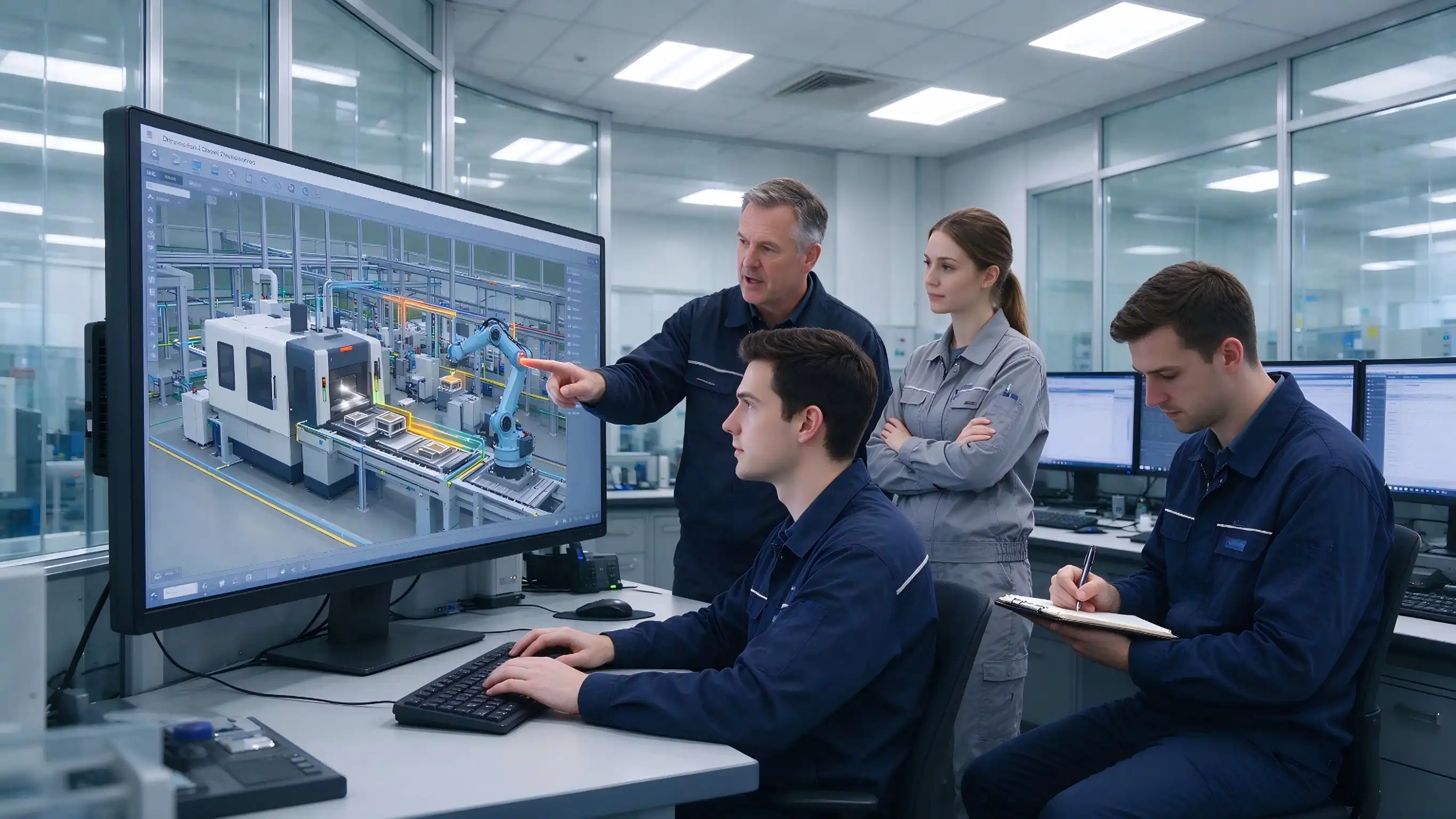
The technology has many parts, including building 3D scenes, modeling object movements, interacting with multimedia, and making browser-based apps using HTML5 and WebGL. Engineers and teachers can use these tools to create UAV assembly sequences, simulations of reducer mechanisms, and traffic control logic, all without having to use real equipment. This lowers the cost and risk of hands-on workplace training for vocational schools and business training units.
Core Technical Skills Required for Virtual Simulation Development
Being technically fluent is the most important thing for any virtual job. Here are the three groups of skills that are always mentioned in job postings and structured training programs.
3D Scene Construction and Equipment Modeling
A person who makes simulations needs to know how to make realistic virtual scenes by placing equipment in the right places, using material rendering, and setting up lighting to look like a real factory. Not only does this affect how nice the design looks, but it also has a direct effect on how useful a simulation is for training or process evaluation.
Motion Logic and Object Control
It is essential to comprehend how industrial equipment actually moves in industrial production virtual simulation & development. Developers write orders that model rotation, transmission, and sequential motion. For instance, they might model how a reducer gear set moves force between shafts. Without this, a simulation will look right but act wrong, which will make it less useful for training.
Script Programming with JavaScript and TypeScript
These days, simulation systems let you use JavaScript and TypeScript to make your own interaction code and add-on plug-ins. This means that programmers can write conditional branches, events based on triggers, and automatic testing sequences. These are skills that are directly useful for both web front-end development and logic for industrial automation. People who finish organized training programs in these languages have a much better chance of getting jobs in both industry and education technology.
These three professional skills are the bare minimum for anyone who wants to work in the area of industrial virtual simulation development. Schools that only teach visual tools instead of scripting often turn out grads who can't stretch or change platforms to fit the needs of real projects.
Analytical and Problem-Solving Competencies in Virtual Simulation Projects
Technical skills alone do not produce reliable simulations. Analytical thinking determines whether a simulation actually mirrors the real process it represents.
Production Data Interpretation
Developers must read and interpret production data — cycle times, machine fault rates, material flow volumes — and translate that data into simulation parameters. A reducer mechanism simulation, for instance, requires accurate torque load values and rotational speed data sourced from real equipment specifications.
Bottleneck Diagnosis Through Scenario Testing
Running iterative test scenarios within a virtual environment lets developers identify process bottlenecks before physical commissioning. Industry data suggests this approach can reduce on-site commissioning time by 30–50% by catching logic errors virtually.
Systems Integration Thinking
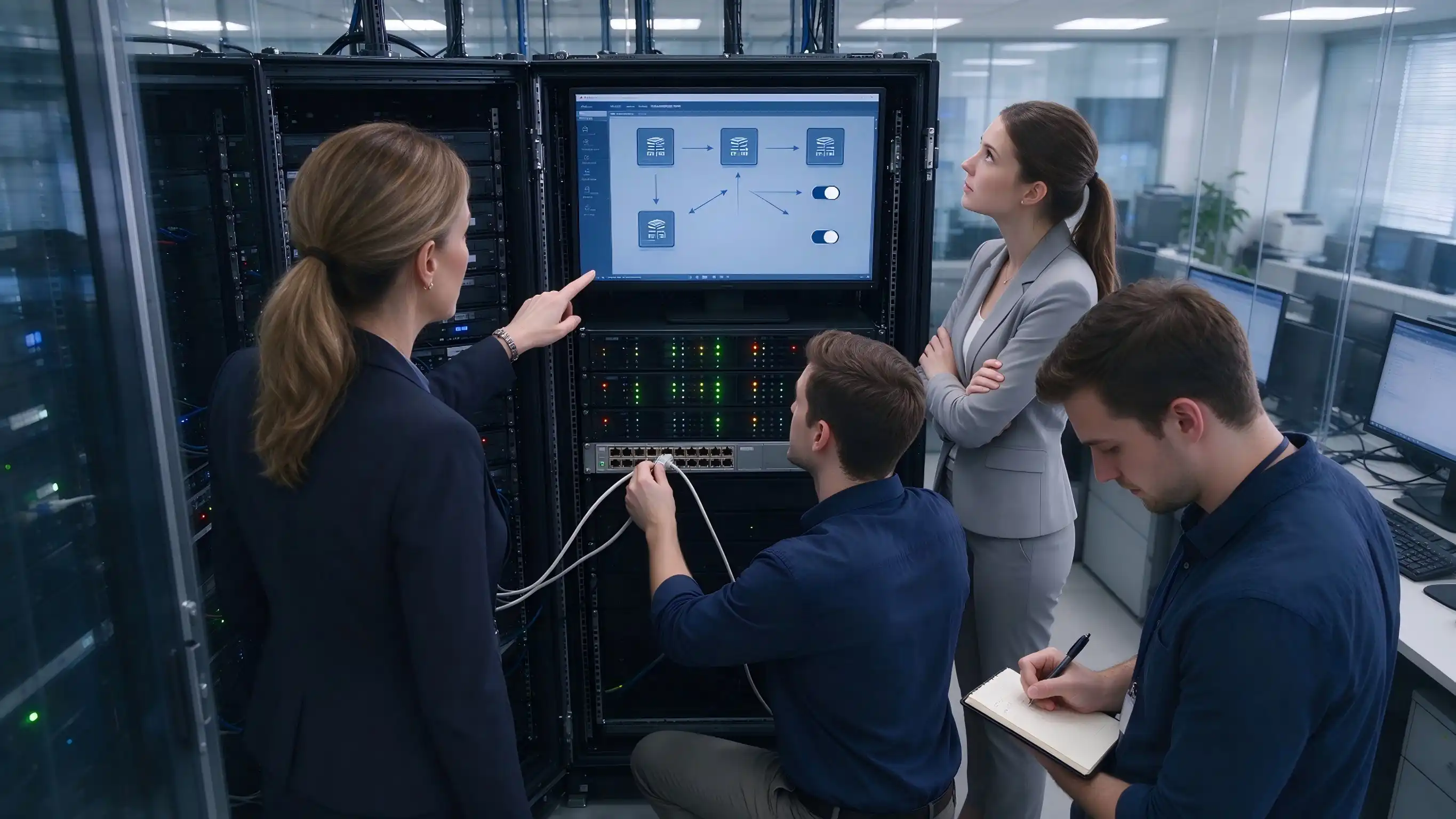
Many simulation professionals also need to connect their virtual environment to broader systems — learning management platforms, enterprise training databases, or institutional academic portals. Understanding data exchange protocols and platform compatibility is increasingly expected, especially in vocational education contexts where simulation results feed into student performance records.
Soft Skills and Cross-Functional Collaboration for Success
Strong technical output isn't usually fully useful if communication skills aren't also strong. This is true whether you work for a company that makes things or for a school that is building a virtual training center.
Translating Technical Work for Non-Technical Audiences
Simulation engineers often show their results to people who don't write code, like operations managers, department heads, or academic directors. A unique professional skill is being able to explain what a program shows and why it's important without losing the audience.
Documentation and Requirement Interpretation
Simulation products in industrial production virtual simulation & development can be given to someone else, updated, or checked for errors if they keep good documentation habits. Needs interpretation, which means correctly reading a client brief or project plan and turning it into development tasks, is the first step in every successful simulation project.
Continuous Skill Development
Simulation systems are often updated. JavaScript systems change over time. Standards in business change. Professionals who see learning as an ongoing process instead of a one-time event for getting a credential always do better than those who don't. This is especially important for vocational training, where standards for the curriculum need to keep up with changes in the smart manufacturing industry.
Implementing Virtual Simulation in Factories and Training Centers — Practical Guidelines
Moving from individual skill-building to institutional deployment requires a structured approach.
Readiness Assessment Before Procurement
Before selecting a platform or curriculum, institutions and enterprises should assess their current skill baseline — what can their instructors or engineers already do, and where are the gaps? This prevents the common failure mode where platforms are purchased but go unused because staff lack confidence.
Phased Rollout Starting With Pilot Projects
A successful deployment typically starts with one or two contained case projects — for example, a UAV system simulation or a single production line module. This gives developers hands-on experience with a low-stakes scope before tackling full-scale implementation.
Browser-Based Platforms Lower the Adoption Barrier
One practical consideration often overlooked in procurement decisions: installation overhead. Platforms built on B/S architecture, accessible directly through a web browser with no client-side installation, reduce IT friction significantly. The VeryEngine platform used in ECR Academy's program operates exactly this way — HTML5 and WebGL render the 3D environment in-browser, meaning institutions can deploy training across hundreds of workstations without software licensing headaches.
These criteria are industry agnostic. Whether you lead a vocational Training Facility, an enterprise training department, or a factory digitalisation project, progressive adoption coupled to quantifiable skill outputs delivers the most consistent results.
Conclusion
Industrial production virtual simulation & development needs three types of skills: being good at using technical platforms and scripts; being able to think analytically to understand data and figure out where problems are; and being able to communicate clearly across teams. Without structured, project-based training that is tied to real-world work situations, none of these skills can be learned reliably. As the use of smart manufacturing grows, the difference between businesses and groups that spend in simulation functionality and those that don't will get bigger. It is practical and time-sensitive to decide to build these skills now, with the right curriculum, teachers, and platform.
FAQ
1. How long does it take to develop job-ready virtual simulation skills?
Most people who already know how to use computers can finish basic training in 8–12 weeks with a structured, project-based program. The important thing is to use project-based learning instead of just teaching theories. Full-cycle case projects, which include everything from analyzing requirements to publishing the product, tend to make developers more skilled more quickly.
2. Can virtual simulation fully replace physical training?
Not all of them, but a lot of the expensive and dangerous training scenarios are replaced by this. In a virtual world, you can safely and repeatedly practice using tools that are too expensive, too dangerous, or not available, like industrial UAV systems or big mechanical assemblies. Physical practice is still helpful for jobs that require small motor skills and calibrating specific pieces of equipment.
3. What prior knowledge is needed to start this type of training?
You don't have to be a programr to begin with. If you already know how to use a computer, then you may utilise applications that bring together visual editing with a gentle introduction to scripting, beginning with the foundations of JavaScript and then to TypeScript and plug-in creation. Knowing the fundamentals of 3D is beneficial, but not required.
Start Building Simulation Skills With E.C.R Academy
The E.C.R. Academy'sThe Industrial production virtual simulation & development course is designed for students, schools, and business training teams that require simulation skills that can be verified and used right away on the job. The course is taught by both academic teachers and business engineers using the browser-based VeryEngine software, which doesn't need to be installed and is fully web-accessible. Our program offers structured, standards-based training with real project outcomes, whether you are looking for an industrial production virtual simulation & development supplier for co-development with an institution or registering individual students. To make an appointment, email us at ecr2008@enteredu.com or go to enteredu.com.
References
1. MarketsandMarkets. Digital Twin Market — Global Forecast to 2027. 2023.
2. Chryssolouris, G., Mavrikios, D., & Mourtzis, D. Manufacturing Systems: Skills & Competencies for the Future. CIRP Annals — Manufacturing Technology, 2013.
3. Mourtzis, D. Simulation in the Design and Operation of Manufacturing Systems: State of the Art and New Trends. International Journal of Production Research, 2020.
4. World Economic Forum. The Future of Jobs Report 2023. World Economic Forum, 2023.
5. Zhong, R. Y., et al. Intelligent Manufacturing in the Context of Industry 4.0: A Review. Engineering, 2017.
6. Nee, A. Y. C., & Ong, S. K. Virtual and Augmented Reality Applications in Manufacturing. CIRP Annals — Manufacturing Technology, 2013.