Innovative Design and 3D Printing for Additive Manufacturing in Modern Engineering Education
Innovative design and 3D printing for additive manufacturing are the hallmarks of modern engineering curriculum. As the world moves to digital fabrication and on-demand manufacturing, engineering institutions are under pressure to turn out students who can do more than simply operate equipment — they have to be able to think through the complete design-to-production chain. This article explores the growth of AM education, the most important concepts and technologies, and how institutions and organisations may design training programs that really prepare learners for the shop floor.
The Evolution of Design in Additive Manufacturing Education
From Subtractive to Additive Thinking
Traditional engineering curriculum were based on subtractive processes: CNC machining, turning and milling. These strategies sculpt a work piece by material removal, and sculpt the way students learn to think about design restrictions. AM flips that reasoning on its head. Material added layer by layer, which allows for shapes that subtractive tools alone cannot make. According to Wohlers Associates, the worldwide AM sector surpassed $15.1 billion in revenues in 2021, showing high industry need for individuals skilled in these technologies.
CAD-Driven Workflows and Iterative Design
CAD-driven procedures let students to swiftly get from concept sketch to printed prototype in today's AM education. Parametric modelling, motion simulation, and assembly verification may be done without touching material using SolidWorks and CATIA. This iterative technique eliminates expensive mistakes and trains students to digitally verify assumptions. Graduates of topology optimisation and generative design programs consider material efficiency from the start.
Industry Collaboration as a Teaching Requirement
No amount of classroom teaching can substitute exposure to actual engineering challenges. Programs that include enterprise engineers in the teaching team or send students to work on actual industry projects reduce the gap between academic knowledge and job preparation. ECR Academy directly tackles this with a collaborative training methodology, partnering an academic lecturer with enterprise engineers with recent project expertise for every session.
Key Principles of Innovative Design and 3D Printing for Additive Manufacturing
Design for Additive Manufacturing (DfAM)
DfAM is the practice of designing parts specifically to take advantage of what AM processes can do — not just adapting old designs to a new printer. This includes part consolidation (replacing assemblies of 10 parts with a single printed unit), conformal cooling channels in mold tooling, and lattice structures that reduce weight without sacrificing load-bearing capacity. GE Aviation's fuel nozzle, which consolidated 20 components into one printed part and reduced weight by 25%, remains one of the most cited industrial examples of DfAM applied successfully.
Material Selection and Process Matching
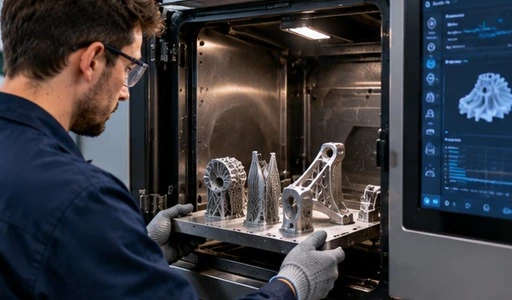
Material choice directly affects part performance and process suitability in innovative design and 3D printing for additive manufacturing. Polymers are highly suited for FDM and SLA/LCD applications such as quick prototyping, appearance models and functional fixtures. Metal powders such as Ti6Al4V and Inconel 718 utilised in SLM procedures are suitable for high stress structural parts in aerospace and automotive applications. A fundamental competence is teaching students how to fit the content to the process and end-use need. ECR Academy’s course curriculum combines FDM, SLA/LCD resin printing and SLM metal 3D printing into one study track, providing learners with a comprehensive overview of material-process connections.
Simulation Before Fabrication
Before printing, motion simulation, stress analysis, is not optional in the professional world. It’s a matter of best practice. Simulation may identify problems with mechanisms, interference and structural flaws, when the cost of adjustment is only time. ECR Academy’s platform embeds motion simulation into the design workflow so students experience this verification phase as part of their normal process, rather than as a separate technical course.
Comparing Additive Manufacturing with Traditional Methods for Product Development
Design Flexibility and Lead Time
One of the most obvious benefits AM offers over injection moulding or CNC machining is flexibility of design at low to mid production levels. A new injection mould may cost between $10,000 and $100,000 and take 6 to 10 weeks to build. The identical component geometry may be made in days and with no tooling expense via an AM method. This speed-to-prototype statistic is important for product development teams assessing 3D printing providers and may effect time-to-market and iteration cycles.
Technology Comparison: FDM, SLA, SLM
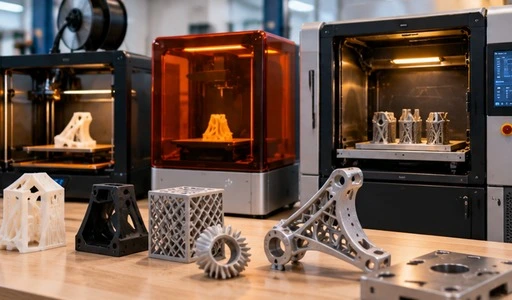
Here are the three primary technologies engineering programs and procurement teams evaluate most often:
- FDM (Fused Deposition Modeling): Low equipment cost, broad material range, suitable for functional prototypes and training environments. Layer resolution typically 100–300 microns. Best for early-stage prototyping and educational settings.
- SLA/LCD Resin Printing: Higher surface accuracy and finer detail than FDM, with layer resolutions of 25–100 microns. Suited for detailed visual models, dental, and jewelry applications requiring smooth surfaces.
- SLM (Selective Laser Melting): Processes metal powders into structural parts with mechanical properties close to wrought material. Used in aerospace, medical implants, and tooling. Equipment investment is significantly higher, but so is the functional output.
Each technology addresses different production scenarios. A well-designed curriculum exposes students to all three so they can make informed process selections in real job roles.
Procurement Considerations for Institutions
When engineering schools or enterprise training centers evaluate innovative design and 3D printing for additive manufacturing equipment procurement, they weigh more than unit price. The decision covers supplier certifications, after-sale technical assistance, curriculum integration packages and compliance with government procurement requirements. ECR Academy is a one stop source that helps universities throughout the whole procurement and implementation process, from project design to equipment validation and faculty training.
Building Effective AM Training Programs: What Institutions Need
A Full-Process Curriculum Structure
Isolated equipment demonstrations do not build job-ready skills. Students need to move through the complete product development sequence: requirement analysis → structural design → digital modeling → motion simulation → process planning → printing → post-processing → assembly → testing. ECR Academy's course organizes all ten learning modules around this sequence, so every skill taught connects to a step in a real workflow.
Blended Learning Resources
Micro-lesson videos, step-by-step operation demonstrations, and recorded project scenarios aid blended learning. These resources let students study technical processes alone, freeing up class time for problem-solving and practice. The U.S. Department of Education's 2010 meta-analysis indicated that blended learning methodologies are more successful than face-to-face or online education, which continues to influence serious training providers' platform design.
Measurable Skill Outcomes
Training programs need to answer one question clearly: what can graduates do after completing the course? The ECR Academy’s curriculum educates learners for particular positions such as additive manufacturing process engineer, 3D printing engineer, product structure designer, mechanical designer, intelligent manufacturing equipment operator, and more. The results are closely linked to the job descriptions that companies offer, thus the curriculum is applicable to both applications for academic credentials and workforce development objectives.
Conclusion
AM education has evolved beyond being a specialist add-on to engineering schools, particularly in innovative design and 3D printing for additive manufacturing. It's a fundamental competence area that institutions, training centers and enterprise learning teams need to handle with organized, full-process curriculum. Programs that combine FDM, SLA and SLM into one design-to-production learning path—supported by trained instructors, actual project examples and proven learning outcomes—give students a significant edge in an expanding manufacturing industry. It's the appropriate educational partner that separates a lab that shows technology from a program that develops careers.
FAQ
1. Can a student with no prior manufacturing background take this course?
Yes. The course starts with the basics of product design and takes you through modelling, simulation and printing. Micro-lesson videos and operation demos facilitate self-paced study between sessions, and project advice from corporate mentors is accessible throughout.
2. What software does the course use?
In addition to 3D printing slicing tools, the course employs 3D CAD platforms like SolidWorks or CATIA. Institutions usually provide software licenses via their training centers or cloud platforms. An online simulation module is also provided for students without local installations.
3. What career roles does this program prepare learners for?
Graduates are qualified for additive manufacturing process engineer, 3D printing engineer, product structure designer, mechanical designer, reverse engineering engineer, 3D modelling engineer and process equipment R&D engineer.
Build Your AM Program with E.C.R Academy
E.C.R Academy brings 16 years of professional training experience, 500+ enterprise partners, and 60,000+ learning resources to every institutional collaboration in innovative design and 3D printing for additive manufacturing. Our Innovative Design and 3D Printing for Additive Manufacturing Course is a proven supplier solution for schools and enterprises ready to build real AM capability — not just equipment showcases. Contact our team at ecr2008@enteredu.com or visit enteredu.com to request a program consultation today.
References
1. Wohlers Associates. Wohlers Report 2021: Additive Manufacturing and 3D Printing State of the Industry. Wohlers Associates, 2021.
2. Gibson, I., Rosen, D., & Stucker, B. Additive Manufacturing Technologies: 3D Printing, Rapid Prototyping, and Direct Digital Manufacturing. Springer, 2015.
3. U.S. Department of Education, Office of Planning, Evaluation, and Policy Development. Evaluation of Evidence-Based Practices in Online Learning: A Meta-Analysis and Review of Online Learning Studies. 2010.
4. Thompson, M. K., et al. "Design for Additive Manufacturing: Trends, Opportunities, Considerations, and Constraints." CIRP Annals — Manufacturing Technology, 2016.
5. Tofail, S. A. M., et al. "Additive Manufacturing: Scientific and Technological Challenges, Market Uptake and Opportunities." Materials Today, 2018.
6. National Science Foundation. Convergence Accelerator: Future of Work at the Human-Technology Frontier — Workforce Training in Advanced Manufacturing. NSF, 2022.