Exploring AI Applications in Humanoid Robot Programming Course
AI is reshaping how robots think, move, and interact with people. In the field of humanoid robot programming, this means building machines that don't just follow fixed commands but actually respond to their environment in real time. ECR Academy's course on this subject is built around that exact idea — giving learners hands-on experience with embodied intelligence systems, ROS/ROS2 development, multi-sensor integration, and intelligent motion control. Whether you're a vocational institution looking to upgrade your program or a technical leader evaluating training options, this course addresses the skills gap that's growing fast across global robotics industries.
Understanding the Foundations of AI in Humanoid Robot Systems
It's helpful to know what AI does inside a lifelike robot and why it's harder to get right than most people think before picking a course or training method.
What Makes Humanoid Robot Programming Different
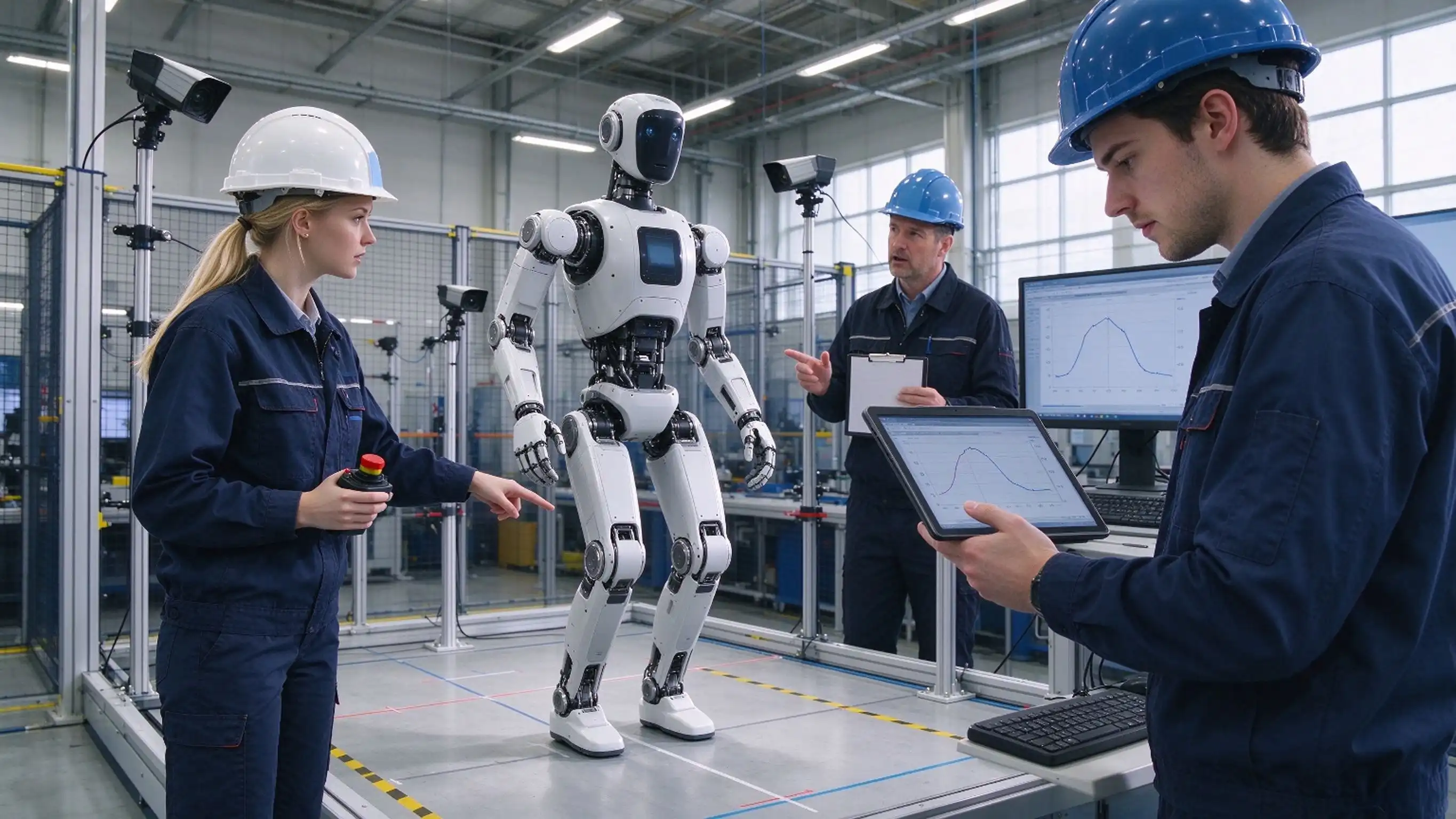
Humanoid robots work in human spaces, which means they have to deal with unpredictable variables. To program them, you have to keep track of 20 to 50 active degrees of freedom at the same time, which usually means working at control loop frequencies of 1 kHz or higher to keep things balanced. Any delay over 1 ms at the shared order level could make things less stable. That's the kind of real constraint that business needs but rarely sees in academic programs.
The Role of AI in Motion and Perception
An AI method called Reinforcement Learning (RL), Model Predictive Control (MPC), and Whole-Body Control (WBC) are used together to deal with the unpredictable physics of walking on two legs. Multiple sensors, including 3D LiDAR, depth cameras, and fisheye systems, work together to give the robot a complete picture of its surroundings. These features are required for any real rollout; you can't do without them.
Programming Languages and Open-Source Tools
When it comes to robotics AI development, Python and C++ are still the most popular languages. Python works well with machine learning tools like TensorFlow and PyTorch. C++ is in charge of the low-latency control levels. ROS2, which is based on a DDS communication layer, is now the standard way to connect these parts. Courses that don't cover ROS2 aren't training students for the job market right now.
How AI Is Built Into Modern Humanoid Robot Courses
A well-thought-out training program doesn't treat AI like an extra part that is added at the end. It uses AI to think about every skill level, from basic movement to integrating the whole system.
This is exactly what the Humanoid robot programming lesson at ECR Academy does. Here are some of the main subjects where AI is used throughout the curriculum:
- AI-driven motion control: Students work with high-level motion APIs and low-level joint interfaces to program dynamic actions — standing, recovering from falls, back bending — using MPC-style control logic. The MagicBot Gen 1 platform supports 42 active degrees of freedom, which means students practice on a system that reflects real engineering constraints.
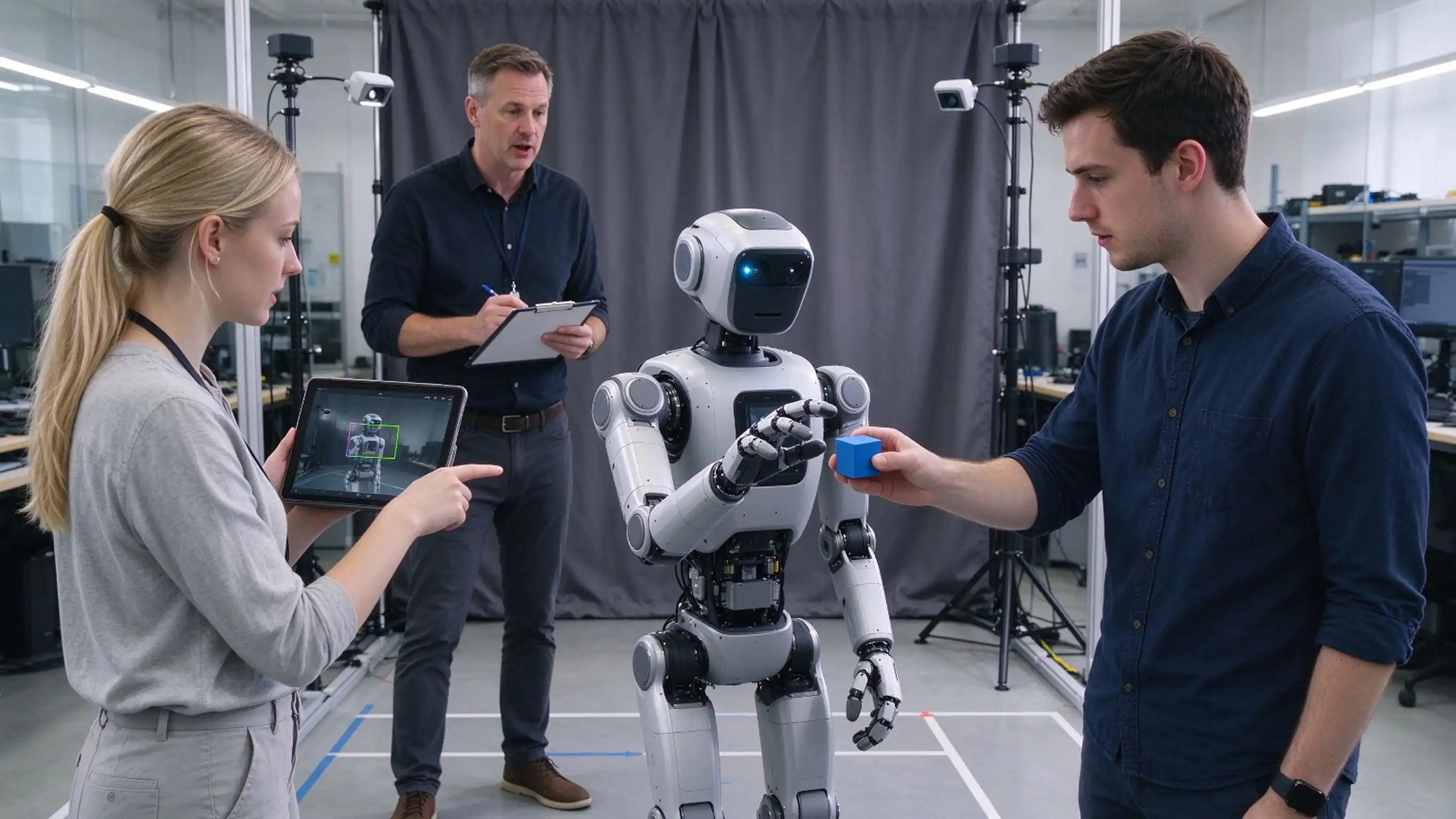
- Multi-modal perception and SLAM: Using 3D LiDAR, two depth cameras, and three fisheye cameras, students in humanoid robot programming build environment maps and run obstacle detection pipelines. This hands-on approach to multi-sensor fusion mirrors what's actually required in warehouse, healthcare, and field robotics applications.
- YOLO-based object detection: Students apply YOLO models to process real-time video streams, integrating visual recognition into navigation and manipulation workflows — a direct mirror of current industry practice.
- Human-robot interaction design: Voice recognition, face detection, and anthropomorphic gestures like waving or handshaking are programmed using the SDK's preset action libraries and custom interaction logic.
These skills come together in two capstone project tracks: a smart tour guide app and a workplace situation where multiple robots work together. In both tracks, students have to do more than just copy demos; they have to solve real integration problems.
Comparing AI-Ready Platforms for Humanoid Robot Training
When procurement teams look at training options, they should pay close attention to the hardware and software environment of a course. This is because the environment determines how well skills can be used in real jobs.
Boston Dynamics SDK vs. NAOqi vs. MagicBot SDK
Boston Dynamics' SDK is meant for researchers and comes with high gear costs. The NAOqi framework, which is used by SoftBank's Pepper and NAO robots, is well-documented and easy to use, but it can only be used for smaller-scale service interaction scenarios. The Magic Atom open-source SDK (magicbot-gen1_sdk) used in ECR Academy's course has two C++/Python interfaces, built-in action libraries, and direct access to a full-size, 174 cm humanoid platform. This is something that not many training settings can give at a similar price.
Python vs. C++ for AI Integration
Python is a good place for most beginners to start because it is easy to use. Because it works with PyTorch and TensorFlow, it makes it easy to build AI models. When real-time control performance is important, which it always is at the joint level in humanoid systems, C++ is a must. If a student only learns one language in school, they will have to learn another one on the job.
Custom AI Solutions vs. Pre-Built Libraries
Pre-built action sets cut down on the time it takes to build apps and let students focus on more complex thinking. Custom AI solutions that are made from scratch using RL or imitation learning help people understand things better, but they take a lot of time and computing power. Both are covered in the ECR Academy course. At first, students call and change pre-set actions, and then as they get better, they add custom control logic to make them longer.
How to Choose the Right AI-Focused Training Course
Robotics training has become very popular very quickly, but not all of them live up to their claims. Here's what really matters when choosing between options.
Match Technical Depth to Your Institution's Goals
Students who only learn the basics of ROS2 and not multi-sensor fusion or real-time joint control will not be prepared for modern robots jobs. Hands-on hardware, not just simulations, must be part of the curriculum if your school wants to train students to compete in skill competitions or work on projects.
Evaluate the Faculty and Support Structure
The course at ECR Academy for humanoid robot programming is taught by both enterprise engineers and academic teachers, which keeps the theory grounded in real-world use. The Train-the-Trainer model also lets your faculty get direct skill development. This solves one of the most common problems schools have, which is buying a good course but not having enough teachers to teach it.
Check Certification and Standards Alignment
When it comes to job markets and competitions, courses that are in line with foreign standards for professional skills are more valuable. The courses at ECR Academy are made to meet those standards, and the credentials you earn are set up to support recognition both in the United States and other countries.
Real-World AI Applications That Validate This Approach
Pepper from SoftBank was one of the first robots to show how AI-powered natural language processing and mood recognition could change how robots interact with people in public places. Honda's ASIMO program showed what's possible when real-time balance systems and whole-body control have been improved over many years of use. Multi-robot coordination systems are used in factories today to move materials and put parts together. This is exactly what students do in ECR Academy's capstone project.
These aren't just hypothetical examples. They show the clear job paths that people who finish a tough course in creating humanoid robots can take: ROS2 development engineer, motion control engineer, autonomous navigation engineer, or multi-robot systems developer. The International Federation of Robotics (IFR) says that a record number of robots were installed around the world in 2022: 553,052. Service robots and AI-integrated systems were two of the fastest-growing types of robots. This means that people will really need the skills that this course teaches them.
Conclusion
AI is now the main way that advanced artificial robots make decisions, and humanoid robot programming help ensure these systems run reliably. A good training program shows students how to use that logic directly, not just look at it from the outside. This can be done through motion control, multisensor perception, and intelligent Contact. The Humanoid robot programming training from ECR Academy gives schools an organized, hardware-backed way to teach their students and teachers how to do that. The MagicBot Gen 1 platform, open-source SDK, and courses that are all in line with international standards make it a good investment for schools that want to stay up to date on embodied intelligence education.
FAQ
1. Do students need prior robotics experience to enroll?
No prior experience is required. The course begins with robot platform orientation and hardware fundamentals, then builds progressively toward ROS2 development and advanced AI integration. Beginners will find the pacing manageable, while students with some programming background will advance quickly through the early modules.
2. What programming languages does the course cover?
The course focuses on Python and C++, which are the two primary languages used in professional robotics development. Python is used for AI model integration and application scripting, while C++ is applied for real-time joint control and performance-critical code.
3. Does the course include certification?
Yes. The curriculum is aligned with international technical skills standards, and completion supports recognized qualifications. This matters for both employment outcomes and institutional accreditation purposes.
Partner With ECR Academy for Your Humanoid Robotics Curriculum
Since 2010, ECR Academy has worked with almost 500,000 people in 28 countries, with help from more than 3,300 experts and more than 500 business partners, covering fields like humanoid robot programming. If your school is looking for a humanoid robot programming course provider for the next school year, our team can give you a full rundown of the program, trial access, and a training plan for your faculty that fits your current setup. Get in touch directly to talk about your needs: ecr2008@enteredu.com | enteredu.com.
References
1. International Federation of Robotics. World Robotics Report 2023. IFR Press, 2023.
2. Siciliano, B., & Khatib, O. (Eds.). Springer Handbook of Robotics. Springer, 2016.
3. Atkeson, C. G., et al. "What Happened at the DARPA Robotics Challenge Finals." Journal of Field Robotics, 2018.
4. Peng, X. B., et al. "DeepMimic: Example-Guided Deep Reinforcement Learning of Physics-Based Character Skills." ACM Transactions on Graphics, 2018.
5. Quigley, M., et al. "ROS: An Open-Source Robot Operating System." ICRA Workshop on Open Source Software, 2009.
6. UNESCO-UNEVOC. Skills for Work and Life: Transforming Technical and Vocational Education and Training. UNESCO, 2021.


_1781601799781.webp)