Mechanical Design, Manufacturing & Automation Skills for Smart Factories
Mechanical design, manufacturing & automation skills sit at the center of every modern smart factory. As production floors grow more digitally connected, the ability to read part drawings, write CNC programs, verify toolpaths, and operate machining centers has become a baseline requirement—not a specialty. At ECR Academy, we built a full-process training program that takes learners from technical drawing analysis all the way through practical machining, equipping them with the hands-on competencies that today's advanced manufacturing employers expect.
Understanding the Mechanical Design Process and Its Role in Smart Manufacturing
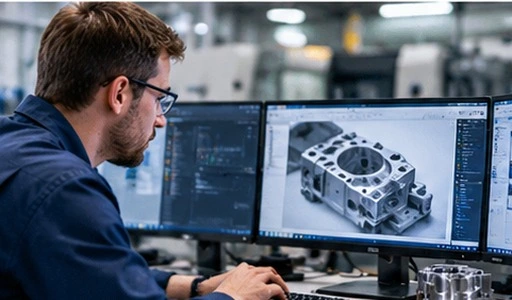
Smart factory operations rely on engineers who know how a part goes from being an idea to a finished product. It's not enough to just draw shapes to be good at mechanical design. You need to know how materials behave, how tolerance stacking works, and how each design choice impacts what happens on the shop floor.
From Drawing to Process Plan
The first useful skill in any CNC workflow is being able to correctly read a part drawing. Before choosing a tool or writing a single line of code, a worker has to find the important machining areas, figure out what the geometric dimensioning and tolerancing (GD&T) callouts mean, and check to see if the material can be machined. This is where our program starts, teaching students how to connect the goals of design with the realities of production.
CAD and Simulation in the Design Loop
CAM software and virtual machine models have changed how engineers check plans before they cut metal. Toolpath simulation is a safe way to find interference, overcut, and parameter errors. A 2022 Deloitte report on smart manufacturing says that companies that use simulations in their design processes can save up to 40% on the cost of physical prototypes.
Process Integration and Industry 4.0 Readiness
When it comes to mechanical design, the picture is not the end. Industry 4.0 needs closed-loop feedback, which can be made by connecting design data to CNC programs and then to digital manufacturing systems. What makes the difference between a capable workforce and a reactive one is teaching technicians to think about this whole chain, from the drawing to the machined part.
Manufacturing Automation Systems: Types, Advantages, and Impact
Automation in machining takes several forms, and choosing the right type depends on production volume, part complexity, and flexibility requirements. Understanding these distinctions helps both institutions and enterprises make better training and equipment decisions.
Fixed, Programmable, and Flexible Automation
Fixed automation suits high-volume, single-part production. Programmable automation—the foundation of CNC machining—allows engineers to reprogram machine behavior for different parts. Flexible automation, including multi-axis machining centers with automatic tool changers, supports mixed-part production without lengthy setup changes. Our training labs cover all three levels, from basic turning cycles to multi-process machining center operations.
Measurable Production Benefits
Here are the core performance improvements that well-deployed CNC automation delivers in practice:
- Dimensional consistency: Closed-loop control systems with encoder feedback hold tolerances at the micrometer level, eliminating the variability that manual operations introduce.
- Reduced cycle time: Optimized toolpaths and automatic tool changes in mechanical design, manufacturing & automation cut machining time per part, directly improving equipment utilization and overall equipment effectiveness (OEE).
- Lower scrap rates: Simulation-verified programs reduce first-article errors, which the Manufacturing Institute estimates account for 15–20% of rework costs in precision machining operations.
These gains are not theoretical. Automotive and aerospace suppliers consistently report OEE improvements of 10–25% after introducing structured CNC programming training alongside equipment upgrades.
Training Impact on the Shop Floor
Equipment alone does not raise OEE. A 2021 study published in the Journal of Manufacturing Systems found that technician skill level was the single strongest predictor of CNC machine utilization rates. Training that covers process planning, programming, simulation, and live machine operation produces technicians who can maintain those gains independently.
Selecting the Right Mechanical Design & Automation Solutions for Your Business
If you are in charge of a vocational school building a high-level program or a manufacturing company improving the skills of engineers, the criteria you use to choose training solutions and equipment are the same.
Evaluating Full-Process Coverage
Students who only learn G-code syntax will not be able to plan a process, choose the right tools, or figure out what went wrong with the machining. Drawing analysis → process planning → programming → simulation → machine operation → dimensional inspection is all part of the right solution. This is the exact order in which our program is set up, and real-world projects serve as the basis for each subject.
Comparing Training Delivery Models
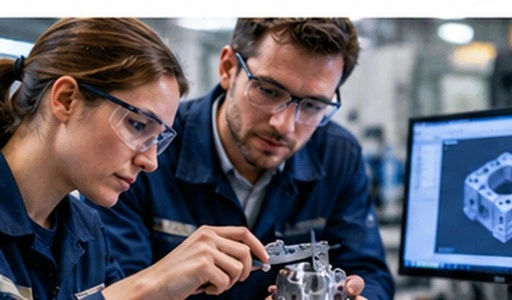
For learning professional skills, project-based learning always works better than lecture-only methods. When students work on real-world tasks like writing a stepped shaft, milling a cavity, or turning a thread, they remember how to do things better than when they just study orders. Our standard project model gives institutions a structure for delivering work that can be used again and again, and it gives businesses a consistent starting point for training new engineers.
Assessing Faculty Quality and Lab Infrastructure
The teachers are just as important as the lessons. Our plan has two teachers: college teachers and business engineers. Master's-level mentors help students make technical decisions about difficult process choices. There are four specialized labs for equipment: CNC turning, CNC milling, machining center, and digital manufacturing. These labs give students hands-on experience with machines that they can't get from simulations alone.
How to Choose and Procure Mechanical Design & Automation Services and Equipment
There are a lot of people involved in procurement choices in this area, and the process takes a long time. When you know how the process works, you can ask better questions and avoid common delays.
Key Criteria for Provider Selection
When looking for a company to teach mechanical design, manufacturing & automation, you should first make sure of three things: the curriculum should cover the whole machining process; the lab equipment should be similar to the machines that students will use on the job; and the company should be able to show that students have learned by giving them recognized certificates. It is hard to give providers an objective rating when they can't answer these questions with specifics.
Certification and Compliance Alignment
For vocational schools to get approval for their programs in mechanical design, manufacturing & automation and help graduates get jobs, they have to make sure they are in line with national trade skill standards. Our lessons are based on the levels of skill needed to operate a CNC machine, a milling machine, or a machining center. They support both the goals of institutions to be accredited and the certification pathways for students.
Long-Term Support and Partnership Structure
Maintenance on equipment, software updates, and ongoing training for faculty are costs that show up after the initial purchase. We work with businesses, schools, and trade groups as long-term partners, not just as one-time suppliers. This includes assistance after the machine is installed, improvements to the curriculum as machine tool technology changes, and working together to make training lessons that are special to the business.
Future Trends and Strategic Insights for Smart Factory Development
The direction of precision machining is clear: more axis complexity, tighter tolerances, and tighter integration between machine data and factory systems.
AI-Assisted Process Planning and Digital Twins
AI tools are beginning to assist process planners in selecting cutting parameters and sequencing operations. Digital twin technology allows a virtual replica of a physical machining cell to run in parallel, catching process deviations before they produce scrap. Training technicians to work alongside these tools—not just operate machines—is the preparation gap most institutions and enterprises have yet to close.
IoT Connectivity and MES Integration
Modern machining centers generate data continuously: spindle load, tool wear estimates, cycle time logs. Connecting this data to MES and ERP systems turns individual machine performance into factory-level intelligence. Our digital manufacturing lab introduces learners to this connectivity layer, giving them a working understanding of how machine data flows into production management systems.
Workforce Strategy for Smart Factory Leaders
The factories building toward lights-out and lighthouse status need engineers who can both run machines and read the data those machines produce. Building that capability requires a structured training investment, not just equipment acquisition. Institutions that build complete training chains from drawing analysis to digital manufacturing will produce graduates that enterprises actively compete to hire.
Conclusion
Smart factory readiness depends on people who can easily go from a part drawing to a finished machined part and understand every choice that was made along the way. The program at ECR Academy teaches skills in mechanical design, manufacturing & automation that cover the whole workflow that modern CNC roles need. Students and partner organizations can be sure that the program will lead to measurable skill gains thanks to its four professional labs, dual-instructor faculty model, and project-based delivery based on real-world problems. The basics we talked about here—process planning, code, modeling, and machine operation—will always be the most important parts of precision manufacturing, even as other technologies change.
FAQ
1. What background do I need before starting this course?
It is suggested that you have the basic skills to read mechanical drawings, understand metals and how they are machined, and use a computer in a normal way. Learners who need more help getting ready can get basic help before the core classes start.
2. What industries hire graduates of this program?
The school helps people get started in careers making general or specialized equipment, machining parts for cars or spacecraft, or working as a technician at a company that makes CNC equipment or cutting tools.
3. Can someone with no CNC programming experience complete this course?
Yes, the theory modules use diagrams and animated demonstrations to move from the most basic to the most advanced topics. There is a set order to programming lessons: commands are explained, examples are shown, and students are given time to practice. Learners can get comfortable with real tools before they use simulation software and training equipment.
Partner with ECR Academy for Mechanical Design & Automation Training
Since 2010, ECR Academy has helped train almost 500,000 people in 28 countries, and more than 300,000 of them have earned accepted skill certifications. Our mechanical design, manufacturing & automation program offers institutions and businesses a tried-and-true way to learn the whole process, from analyzing drawings to real-life machining. It is supported by professional labs, qualified dual teachers, and certification results that are in line with the needs of the industry. If you want to build a high-level vocational program or hire new manufacturing engineers, we'd love to talk about a partnership that works for you. To ask for a program consultation, email us at ecr2008@enteredu.com or go to enteredu.com.
References
1. Deloitte Insights. 2022 Manufacturing Industry Outlook. Deloitte, 2022.
2. Kusiak, Andrew. "Smart Manufacturing." International Journal of Production Research, 2018.
3. Manufacturing Institute. Closing the Skills Gap: 2021 Report on the Manufacturing Workforce. Manufacturing Institute, 2021.
4. Tao, Fei, et al. "Digital Twin in Industry: State-of-the-Art." IEEE Transactions on Industrial Informatics, 2019.
5. Bi, Z. M., and L. Wang. "Advances in 3D Data Acquisition and Processing for Industrial Applications." Journal of Manufacturing Systems, 2021.
6. International Federation of Robotics. World Robotics 2023: Industrial Robots Report. IFR, 2023.