Why Agricultural UAV Applications Matter for Crop Protection
Agricultural UAV applications matter for crop protection because they help growers spot problems sooner and treat only the areas that need help. Drones scan fields from above, map plant stress that the eye misses, and carry spray systems into places where tractors struggle, such as wet paddies, steep slopes, and orchards. The result is less trampled crop, less guesswork, and better records for every pass. The benefit still depends on trained people, because even a good aircraft performs poorly in untrained hands. Below, I explain the main uses, buying checks, and workflow steps, and I show where skills training fits.
The Crop Protection Problems That Agricultural UAVs Help Solve
Why Manual Scouting and Ground Rigs Fall Short?
Walking a field is slow, and two scouts rarely record the same thing. On large or fragmented plots, whole corners may go unchecked until damage shows. Tractor sprayers add another problem: heavy wheels can compact wet soil and crush standing crop. Satellite images help, but cloud cover and pass schedules limit them, and their resolution can be too coarse for small plots. A review in Information Processing in Agriculture (2023) describes drones as a way to monitor and spray crops with less labor and with access to areas that ground machines reach poorly. That gap between need and skill is where training starts.
Where Drones Work When Other Tools Cannot?
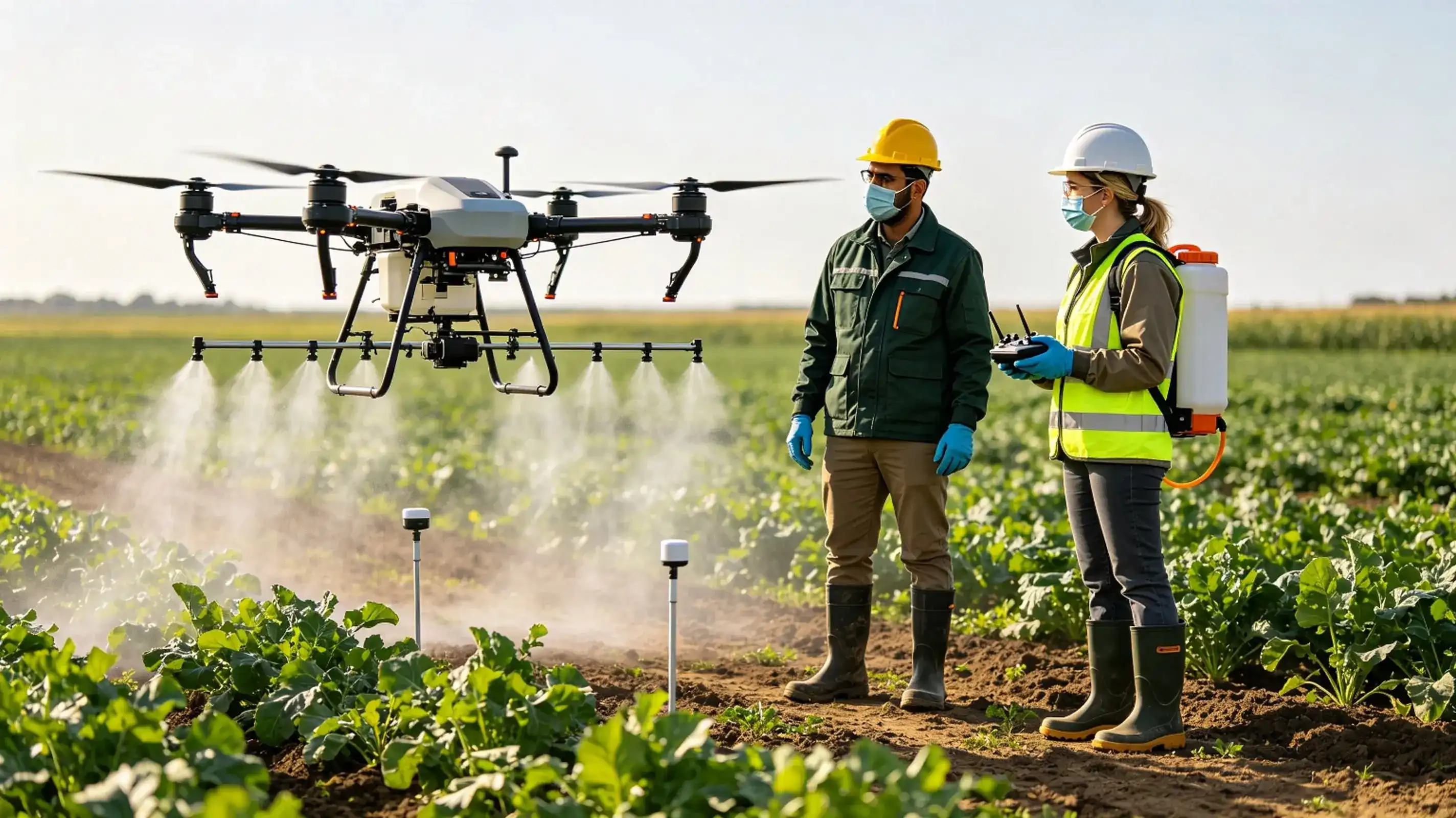
Multirotor drones take off vertically, so they need no field lane or paved edge. They can fly over flooded rice paddies, terraced hillsides, orchards, and small irregular plots. Because they never touch the ground, they avoid rutting and compaction. Sensors add another benefit. Multispectral cameras measure how plants reflect light, and indexes such as NDVI can point to stress before leaves visibly change. Ground checks still confirm the cause, since a color shift can come from pests, disease, drought, or a nutrient shortage. I think of the drone as a fast scout that tells the agronomist where to look first.
Worker Safety and Better Field Records
Spraying by hand or with a backpack unit places the operator close to the chemical. A drone moves the operator away from the spray zone, which lowers direct exposure when the crew follows label rules and safe procedures. Flight logs add a second benefit. Ground station software can record the route, the time, and the spray settings, so a team can show what was applied and where. These records help with audits, customer reports, and later comparison of results. A review by Tsouros and colleagues in Information (2019) lists crop monitoring, spraying, and mapping among the main precision agriculture uses of UAVs.
How Agricultural UAV Applications Work in Real Fields?
From Sensor Data to a Treatment Decision
RGB, multispectral, and thermal sensors each record something different. RGB images show plant gaps and lodging. Multispectral data supports vegetation indexes. Thermal images can reveal water stress. Software stitches the images into a map, and the team uses that map to choose scouting points. After scouting confirms a problem, the spray plan targets only the affected zones. This cycle of fly, check, treat, and fly again makes the drone part of a repeatable workflow rather than a one-time photo session. E.C.R Academy's training follows this chain through multi-sensor data processing, where learners collect GPS, IMU, and camera data for navigation, crop growth monitoring, and pest and disease identification.
Precision Spraying and Variable-Rate Application
Agricultural UAV applications rely on planned routes guided by satellite positioning. RTK modules can narrow position error to the centimeter level, which limits skipped strips and overlap. Variable-rate application changes the spray amount by zone, based on terrain, crop type, and pest or disease pressure. Droplet size matters too. Fine droplets cover better but drift more, so operators adjust atomization and flow to fit the job. Wind adds risk, and many operators keep spraying to light winds, around 5 m/s or less. Lan and colleagues, writing in the International Journal of Agricultural and Biological Engineering (2017), discuss drift and application quality as major issues in precision aerial application.
Drones Compared With Traditional Methods
Drones and ground rigs do different jobs. Drones respond quickly inside narrow weather windows, avoid driving through standing crop, and reach awkward terrain. Ground sprayers often carry larger tanks and may cover wide, open fields at a lower cost per acre. Savings in chemical, water, fuel, and labor are possible, but they vary with crop, terrain, local rules, and operator skill, so I avoid promising one percentage. Many farms will use both tools. A drone program works best when the team knows when to choose each one.
Choosing and Buying Agricultural UAV Systems With Confidence
Match the Platform to the Job
Start with the task. Mapping needs accurate positioning, a suitable camera, and long endurance. Spraying needs enough tank capacity, a dependable pump, flow control, well-chosen nozzles, and a battery plan that keeps the aircraft flying between refills. Fixed-wing aircraft cover broad areas for survey work, while multirotor aircraft hover, take off vertically, and fly flexible spray paths. Sensors should match the goal: RGB for general inspection, multispectral for vegetation analysis, and thermal for water stress. Before you shortlist any model, compare obstacle avoidance, terrain following, wind resistance, data formats, and upkeep needs.
Count Total Cost of Ownership
Purchase price is only the first line of the budget. Batteries, chargers, payloads, software, insurance, spare parts, maintenance, transport, and training all add cost over the life of the aircraft. Ask each supplier whether it is a manufacturer, OEM provider, distributor, or system integrator, and request warranty terms and repair procedures in writing. A clear quotation lists the configuration, performance data, delivery terms, and support scope. Regulations deserve equal attention. In the United States, commercial drone pilots need a Remote Pilot Certificate under FAA Part 107, and spray work typically brings added rules for agricultural aircraft operations and for aircraft over 55 pounds. Check current FAA guidance before buying.
Mistakes to Avoid and Supplier Checks
Buyers often choose on price alone, trust laboratory specifications over field output, or treat an aerial image as a full diagnosis. Tank size, flight time, or camera resolution cannot predict daily output by themselves. Refill logistics, charging speed, terrain, weather, and operator skill also count. Ask for field performance data and calculate cost per acre or per mission. Review a supplier's component sourcing, assembly checks, calibration, final inspection, firmware updates, spare-parts supply, and response times. Useful quality checks include spray uniformity across the effective swath, electromagnetic compatibility near power lines, vibration resistance, and corrosion resistance of pumps and nozzles.
Building a Dependable Crop Protection Workflow
A Step-by-Step Mission Workflow
A good agricultural UAV applications program starts before the aircraft leaves its case. The team defines the crop, field area, mission goal, treatment product, weather limits, expected output, and safety needs. Next, they calibrate equipment, check batteries and sensors, and verify positioning. Aerial findings get compared with ground samples, agronomist visits, weather records, and soil data before anyone decides to spray. During application, the operator watches the route, flow rate, wind, terrain, obstacles, and battery status. Afterward, post-treatment imagery and logs show whether the treatment worked and what to change next time.
Business Value for Contractors, Schools, and Farm Groups
Different groups gain different things. Commercial farms can cover more acres during short protection windows. Contractors can offer mapping, spraying, and monitoring as separate services. Schools and training centers can build programs around real job tasks. Industry associations and agricultural organizations can use shared training standards to bring operators to a similar skill level. Clean field records also support traceability, resource tracking, and customer reporting. None of this happens by accident. Each gain depends on pilots and technicians who can plan, fly, and maintain the aircraft correctly.
Why Skills Decide the Result?
Equipment alone does not protect a crop. The operator carries the safety responsibility, and that person must read the weather, set the spray system, and respond to faults during flight. Learners with mixed backgrounds need a structured path that starts with basics and builds toward field tasks. Organizations also want training linked to real work, so graduates can step into service roles with confidence. For that reason, I treat training as part of the equipment decision rather than an afterthought.
How E.C.R Academy Training Supports Agricultural UAV Applications?
Project-Based UAV Plant Protection Curriculum
E.C.R Academy's course focuses on multi-rotor UAVs in agricultural plant protection. Learners move from basic operation to full field tasks: platform architecture, flight control debugging, spraying system integration, field operation planning, and inspection and maintenance. Projects follow real scenarios in wheat, rice, and corn fields. Six training modules cover platform introduction, basic system operation, flight control and operation planning, multi-sensor data processing, plant protection case training, and operation plan implementation. UAV technology experts and plant protection specialists deliver the course, which was developed with reference to agricultural plant protection practices and current UAV application workflows.
A Full-Process Training Platform
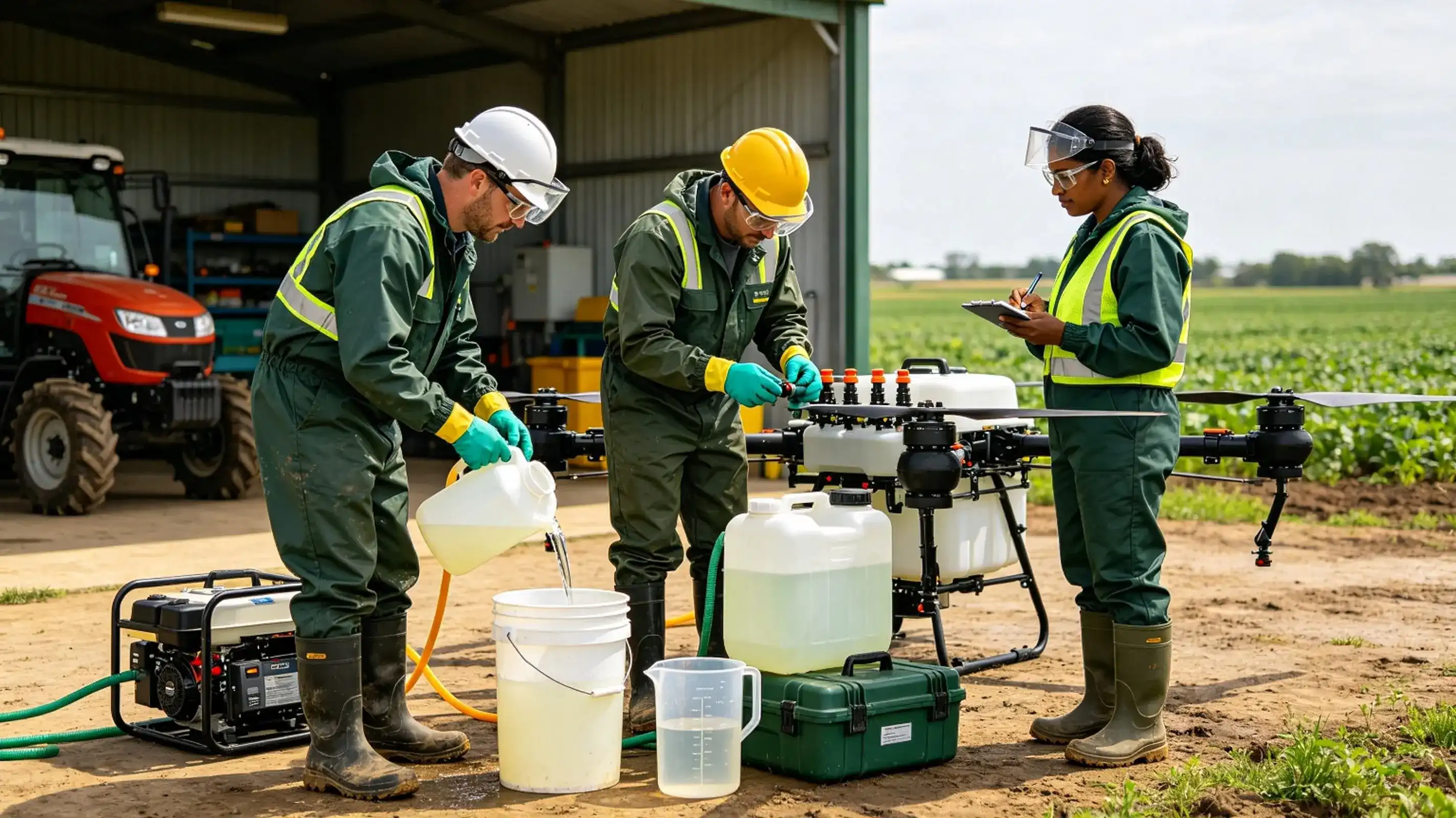
The learning environment covers UAV selection and integration, virtual simulation, flight operation, and maintenance inspection. The selection and debugging platform supports three frame layouts, five motor specifications, three ESC types, and four propeller specifications. Virtual simulation lets learners rehearse plant protection missions for different crops and terrain before they fly. The operation platform offers long endurance, heavy payload capacity, and high-precision positioning for complex field conditions. The maintenance platform trains fault detection and repair across power distribution, power management, communication, and power systems. Together, these stations let learners practice the whole chain from build to repair.
Skills and Job Roles After Training
Learners practice takeoff, hovering, route flight, and precision spraying. They set flow control and atomization, use GPS and IMU data for navigation and route planning, tune flight control parameters, diagnose common faults, and plan variable-rate operations. These skills point toward roles such as agricultural UAV plant protection pilot, UAV assembly and maintenance technician, and system integration engineer. Target partners include enterprises, educational institutions, agricultural organizations, and industry associations. Since 2010, E.C.R Academy has delivered training and assessment to nearly 500,000 participants across China and 28 countries, and across all its programs more than 300,000 learners have obtained recognized skills certifications.
Conclusion
Agricultural UAV applications matter for crop protection because they connect sensing, mapping, and precise spraying in one repeatable workflow. Drones reach wet fields, slopes, and orchards that ground rigs handle poorly, and they produce records that support safer, better-documented treatment. They do not replace tractors in every setting, so crop, terrain, local rules, and cost per acre should guide each choice. Buyers who match platforms to tasks, count total ownership cost, and check supplier support avoid common mistakes. Results depend most on trained operators who can plan missions, tune systems, apply variable-rate spraying, and maintain aircraft. A project-based course built around wheat, rice, and corn scenarios shows how that training can match real field work.
FAQ
1. Can beginners take this course?
Yes. The course begins with an introduction to UAV platforms, then moves through hardware and software architecture, basic operation, and the development environment. The learning path is clear and suits beginners who want to enter agricultural UAV plant protection work.
2. What job roles can learners prepare for?
Learners can prepare to work as an agricultural UAV plant protection pilot, UAV assembly and maintenance technician, plant protection UAV system integration engineer, agricultural data analyst, UAV maintenance technician, or plant protection solution designer.
3. What are the recommended computer requirements?
The recommended configuration is Windows 10 or higher, an Intel Core i5 processor or above, 8 GB of memory or more, 256 GB of storage or more, and a dedicated graphics card with 2 GB of VRAM. The computer must also run UAV flight control parameter tuning software and virtual simulation software. These specifications support both the simulation work and the tuning exercises.
Talk to E.C.R Academy About Agricultural UAV Applications Training
Looking for an agricultural UAV applications supplier that pairs project-based plant protection training with full-process training equipment? E.C.R Academy works with enterprises, educational institutions, agricultural organizations, and industry associations. Email ecr2008@enteredu.com with your crop types, learner groups, and training goals, and our team will discuss a fitting course plan. Visit enteredu.com for course details.
References
1. Information Processing in Agriculture, 2023: "Implementation of drone technology for farm monitoring and pesticide spraying: A review."
2. Information (MDPI), 2019: "A Review on UAV-Based Applications for Precision Agriculture."
3. International Journal of Agricultural and Biological Engineering, 2017: "Current status and future trends of precision agricultural aviation technologies."
4. Procedia Computer Science, 2018: "Review on Application of Drones for Crop Health Monitoring and Spraying Pesticides and Fertilizer."
5. Federal Aviation Administration, 2016: "14 CFR Part 107, Small Unmanned Aircraft Systems."
6. Federal Aviation Administration, 2018: "Special Authority for Certain Unmanned Systems, 49 U.S.C. 44807."