Combining Additive Manufacturing (3D printing) with Reverse Engineering: Career Course
Combining additive manufacturing (3D printing) with reverse engineering represents one of the most career-defining skill sets in modern manufacturing education. This course at ECR Academy builds end-to-end capabilities — from physically scanning an existing component to reconstructing a precise digital model, then producing an optimized part through 3D printing. Structured around the Geomagic software platform and aligned with international technical standards, it equips learners with job-ready competencies in sectors including automotive, aerospace, and mold manufacturing. Whether you are an educator building a new program or an institution upgrading a training lab, this course delivers measurable, industry-validated outcomes.
Understanding the Synergy Between 3D Scanning and Additive Manufacturing
There is a reason why reverse engineering and additive manufacturing are being quickly adopted by companies in the aircraft, automobile, and industrial tooling industries. Each technology is strong on its own, but when used together, they fill in a major gap in the way digital production works.
How Reverse Engineering Feeds 3D Printing Workflows
Using laser scanners or structured-light systems, reverse engineering gets the exact shape of a physical object and turns it into a dense point cloud. After that, the data goes straight into CAD reconstruction, which makes a parametric model that is ready to be printed in 3D. ISO/ASTM 52900 says that this digital-to-physical loop keeps the same or better dimensions than the original part. When procurement professionals look at training programs, this integration means that when students finish, they have skills that cover the whole lifecycle of a product, not just software understanding.
It's clear that trade schools have a strategic value. Traditional engineering schools are having trouble getting students, and industrial hubs are still looking for people who know how to use scanning, digital models, and additive fabrication. This skill gap can be directly addressed by Combining Additive Manufacturing (3D printing) with Reverse Engineering in an organized program.
Core Processes Covered in This Career Course
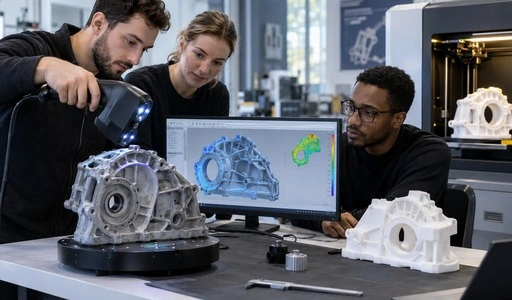
The steps in this course are organized in a strict order: 3D scanning, data processing, digital model rebuilding, 3D inspection, and new design. Each stage builds on the last, making sure that students learn real skills instead of just knowing the basics.
The Geomagic series, along with Geomagic Wrap, Geomagic Design X, and Geomagic Control X, is at the heart of this program. These are normal tools that engineers at companies like Boeing, Ford, and Siemens use. This means that students learn how to use software that they will actually use in their jobs.
In this course, students go through these five main modules:
- Reverse Engineering Fundamentals: Students learn about the three application levels: replication, improved design, and original design. They also learn how to make good decisions about which methods to use based on the part's shape and how it will be manufactured. Case studies include redesigning brackets for cars and restoring cultural artifacts.
- 3D Data Acquisition: Students use both desktop and pocket laser scanners to practice setting the scanners up, placing markers, and combining data. They also learn structured-light scanning and how to use a CMM, which gets them ready for a wide range of industry settings.
- 3D Data Processing with Geomagic Wrap: Learners can use Geomagic Wrap to turn raw point cloud data into clean, high-quality polygon models by following workflows for removing noise, filtering, merging, and mesh generation that meet professional quality standards.
- CAD Model Reconstruction with Geomagic Design X: Students use feature extraction and constraint-based modeling to rebuild parametric CAD models from scanned data. Complex parts, like consumer parts and car systems, can be modeled using both solid modeling and surface modeling.
- 3D Inspection with Geomagic Control X: Students learn how to analyze deviations, visualize color maps, compare cross-sections, and evaluate tolerances. They then write organized inspection reports, which is a skill that is directly valued in quality control roles.
Not one of these modules is taught by itself. Each build comes after the other, which is how engineers actually create products in the real world. Project-based tasks that require students to use what they have learned so far at every stage help students move from one module to the next.
Industry Applications and Real-World Relevance
Combining Additive Manufacturing (3D printing) with Reverse Engineering is not just a thought experiment. It can be used in some of the toughest industrial industries in the world.
Automotive and Mold Manufacturing
Auto engineers use 3D scanning to get old parts (parts for which there is no original CAD data) and rebuild them so that they can be used in production or to improve the design. When making molds, reverse engineering helps find defects and make sure that cavities are correct, which lowers the cost of making mistakes with the tools. When students finish this course, they learn the scanning and modeling skills that are needed for these jobs.
Aerospace Maintenance and Repair
When aircraft teams use reverse engineering and additive manufacturing together, they can make new hardware parts out of certified metals or high-performance polymers that were taken off the market. The deviation analysis tools in Geomagic Control X can be used directly in the inspection processes used in MRO (maintenance, repair, and overhaul) settings.
Quality Inspection Engineering
The 3D inspection module gets students ready for jobs where meeting dimensions is a must. Students learn how to use Geomagic Control X to line up scan data with standard CAD models, make color deviation maps, and make reports with a level of accuracy of ±0.1 mm to ±0.15 mm, which is good enough for production-level needs in precision engineering and the car industry.
Why This Integrated Approach Outperforms Standalone Training
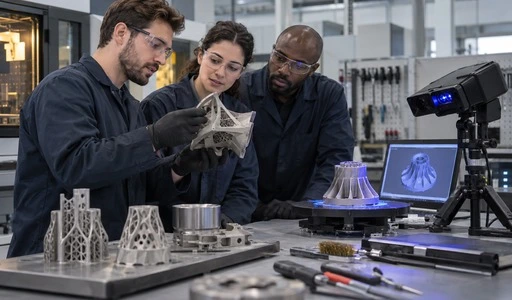
A lot of places teach 3D printing as a separate skill. Others offer basic modules in reverse engineering that are not related to results from manufacturing. This course adopts a different stance: Combining Additive Manufacturing (3D printing) with Reverse Engineering in a single, project-driven workflow results in grads who comprehend both the digital and physical parts of the manufacturing process.
Comparing Learning Outcomes
In traditional industrial training, skills in subtractive methods like CNC cutting, turning, and milling are honed. Separate additive manufacturing classes teach how to build things layer by layer, but they don't always teach the upstream skills that employers want, like how to get data and make digital models. This course combines both ways of learning: taking pictures of physical shapes, putting them back together digitally, and then making or checking the final product. This is exactly the kind of skill set that employers want in the mold, aerospace, and automotive industries.
The program is based on international technical standards for developing ability around the world. This means that graduates have skills that can be used in different countries and industries. If schools add this program as part of a larger effort to improve their digital manufacturing labs, their graduates will be better prepared to get jobs in advanced manufacturing.
Conclusion
Combining Additive Manufacturing (3D printing) with Reverse Engineering training is creating the talent pipelines that the manufacturing sector needs. The job course at ECR Academy includes a full Geomagic-based process, project-based learning, and teachers with experience in both business engineering and academia. Since 2010, ECR Academy has helped over 300,000 students earn accepted skills badges and over 500,000 people in 28 countries. This program shows that level of experience by giving schools a tried-and-true way to go from lab upgrades to college results that are in line with industry needs.
FAQ
1. Can students with no prior background take this course?
Yes. The course starts with basic ideas in reverse engineering and moves step by step through scanning, data processing, model rebuilding, and inspection. The structure is organized in a clear order: learning objectives, task description, task analysis, essential knowledge, task implementation, and task evaluation. This makes it easy for beginners to understand while still being technically challenging.
2. What career roles does this course prepare graduates for?
Reverse Modeling Engineer, 3D Scanning Engineer, Mold Designer, Quality Inspection Engineer, and Additive Manufacturing Technology Engineer are some of the jobs that graduates are ready for. These jobs are in high demand in the aircraft, automotive, and industrial production industries.
3. Do institutions need specific software licenses?
Yes, licensed installations of Geomagic Wrap, Geomagic Design X, and Geomagic Control X are needed on computers used by businesses. As part of the onboarding process, ECR Academy works with partner institutions to make sure that they understand the licensing needs, deployment scope, and lab setup.
4. Is this course aligned with international competition standards?
The lessons are in line with global standards for technical skills, such as those used in WorldSkills Additive Manufacturing competitions. This helps schools that use competition training as a way to measure the quality of their programs.
Partner With ECR Academy to Launch This Program at Your Institution
ECR Academy brings 16 years of experience teaching skills around the world to every partnership with an institution. As a reliable provider of Combining Additive Manufacturing (3D printing) with Reverse Engineering curriculum, we provide full lab solutions that include Geomagic platform integration, 3D scanning equipment, Train-the-Trainer faculty development, and certification pathways that are aligned with those in other countries. Institutions that want to turn their mechanical or cast programs into digital manufacturing hubs can get in touch with us. To ask for a program consultation, email us at ecr2008@enteredu.com or go to enteredu.com.
References
1. Gibson, I., Rosen, D., & Stucker, B. — Additive Manufacturing Technologies, Springer, 2021.
2. Raja, V., & Fernandes, K. J. (Eds.) — Reverse Engineering: An Industrial Perspective, Springer, 2008.
3. ISO/ASTM 52900 — Additive Manufacturing — General Principles — Terminology, International Organization for Standardization, 2021.
4. ISO 10360-2 — Geometrical Product Specifications (GPS) — Acceptance and Reverification Tests for Coordinate Measuring Machines, International Organization for Standardization, 2009.
5. Wohlers, T., & Gornet, T. — Wohlers Report: 3D Printing and Additive Manufacturing Global State of the Industry, Wohlers Associates, 2023.
6. Varady, T., Martin, R. R., & Cox, J. — "Reverse Engineering of Geometric Models — An Introduction," Computer-Aided Design, Elsevier, 1997.

_1781601799781.webp)