How New Energy Vehicle Design & Control Technology Uses 3D Printing for Prototyping
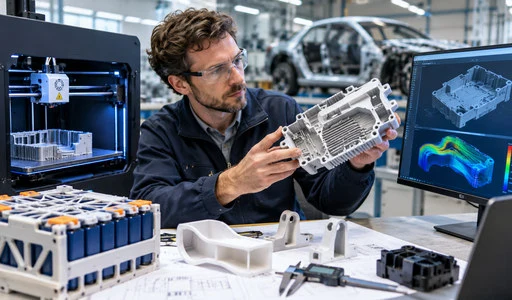
New energy vehicle design & control technology uses 3D printing to turn CAD models into physical parts quickly, so engineers can test fit, airflow, cable routing, and sensor placement before they pay for production tooling. Printed battery mock-ups, controller housings, brackets, and cooling ducts let teams check packaging and assembly early. These parts also support control work. Engineers can mount real sensors, connectors, and boards on them and compare bench results with simulation. Printed prototypes do not replace final validation, but they reduce costly surprises. In this article, I explain how the process works and which skills it requires.
Why 3D Printing Matters in New Energy Vehicle Development?
A Job That Crosses Many Engineering Fields
New energy vehicle development ties together mechanical design, electrical engineering, software, thermal management, and manufacturing. A change in one area often touches the others. A larger battery enclosure, for example, may shift cable routes, cooling paths, and sensor positions. The International Energy Agency reported that electric car sales reached nearly 14 million in 2023, about 18% of all new cars sold worldwide. That volume keeps pressure on development teams to work faster. 3D printing gives them a quick way to build physical parts from CAD files and judge these links by hand instead of only on a screen.
Where Traditional Prototyping Falls Short?
Machining, hard tooling, and low-volume molding can produce accurate prototypes. Still, they often bring longer lead times, higher setup costs, and less flexibility when a design changes. That matters for battery enclosures, motor controller housings, cooling channels, sensor mounts, and vehicle control unit structures. A late hardware change can affect software calibration, wiring, thermal performance, and supplier qualification. Without an early physical part, teams can miss fit, vibration, airflow, cable routing, or high-voltage integration problems. Those issues then appear during design verification, when fixing tooling costs the most. Early physical checks move that discovery to the cheapest point in the schedule.
How Early Physical Parts Reduce Redesign Risk?
A printed part lets an engineer hold a design, fit it into a vehicle bay, and route a harness around it. ISO/ASTM 52900 groups additive manufacturing into seven process categories, including material extrusion, vat photopolymerization, and powder bed fusion. This lets teams match a process to the goal of each part. When CAD, simulation, and physical testing work together, packaging and integration issues surface sooner. Purchasing and engineering teams then get better data for sourcing and production decisions. I treat these early parts as cheap answers to expensive questions, not as final products.
How 3D Printing Supports New Energy Vehicle Design and Control Technology?
From CAD Model to Physical Part
3D printing turns CAD models and simulation results into physical parts quickly. Engineers can test several design versions before they commit production money. Typical prints include visual styling models, battery pack mock-ups, motor housings, ECU enclosures, cooling ducts, sensor brackets, wiring guides, and test fixtures. Printed parts help with both appearance reviews and functional studies, though prototype materials may differ from final production materials. They also complement finite element analysis, CFD, digital twins, and hardware-in-the-loop testing. When a bench result differs from a simulation, the team learns where the model needs correction. That feedback improves control algorithms, supplier talks, and engineering change management.
Applications Across the EV Powertrain
In new energy vehicle design & control technology, the same method reaches across the powertrain and control architecture. Engineers print inverter enclosures, gear reduction structures, high-voltage connector supports, cell holders, battery modules, and thermal management parts. These parts help teams compare front-wheel-drive and all-wheel-drive layouts, confirm service access, and check cable routing. Battery prototypes clarify sensor positions, cooling concepts, isolation distances, and assembly methods. In thermal systems, printed ducts, channel concepts, pump mounts, and interfaces reveal flow restrictions or installation conflicts before production tooling begins. The goal is simple: find the clash on a bench, not on the assembly line.
Developing Control Strategies on Printed Hardware
Control engineers need real hardware as much as models. Motor and inverter prototypes support work on torque, speed, field-oriented, sensorless, and efficiency control, and they show how packaging affects performance. Battery pack prototypes help validate state-of-charge estimation, cell balancing, thermal protection, fault detection, and charging control. In hybrid vehicles, prototypes support engine-motor coordination and energy allocation studies. Teams also use them to evaluate brake-by-wire interfaces, regenerative braking, traction control, and torque vectoring. Safety-related functions still follow ISO 26262, the functional safety standard for road vehicles. Final confidence requires hardware-in-the-loop, environmental, and vehicle validation.
The Prototyping Workflow and How It Compares with Other Methods
A Repeatable Workflow, Step by Step
A dependable workflow starts by defining the vehicle type, engineering goal, operating conditions, tolerances, materials, and procurement needs. Engineers then build the CAD model, apply design-for-additive-manufacturing rules, and run structural, thermal, fluid-flow, vibration, and packaging simulations to spot critical interfaces. Next, the team picks a print process and material that match the purpose of the part, whether visual, dimensional, thermal, or functional. Inspection and assembly confirm fit with sensors, connectors, wiring, batteries, motors, and cooling systems. Test results then guide the next revision. They also signal when to move to machining, molding, casting, composites, or production-grade additive manufacturing.
3D Printing Versus CNC, Molding, and Casting
The right method depends on project stage, part needs, and quantity. 3D printing offers fast revisions, low tooling commitment, and freedom for complex or customized shapes. CNC machining suits tight tolerances, high-strength parts, and representative metal interfaces. Injection molding and die casting make sense once a design is stable and volume justifies tooling. A printed structure with machined inserts often gives an efficient compromise. I suggest comparing lead time, material behavior, inspection needs, surface finish, and total development cost instead of unit price alone. A cheap part that needs three rebuilds costs more than a fair-priced part that works the first time.
Benefits and Limits You Should Plan For
The benefits are clear: shorter design cycles, lower early tooling cost, easier customization, and earlier discovery of assembly problems. Low-volume programs, specialized platforms, battery development, and control-system packaging gain the most. The limits matter just as much. Strength may change with print direction, and surface finish, dimensional accuracy, heat resistance, chemical resistance, electrical behavior, and durability depend on the chosen process. Academic reviews of additive manufacturing discuss these material and process challenges in detail. Printed prototypes should not be treated as production-ready parts. Critical EV components need structural, thermal, electrical, environmental, and safety validation before approval.
Choosing a Prototyping Approach and the Right Technical Partner
Match the Method to the Development Stage
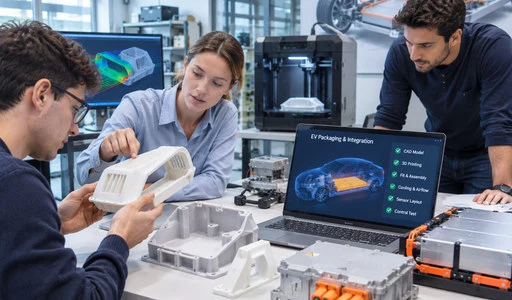
In new energy vehicle design & control technology, concept projects usually value speed, appearance, and packaging, so fast prints work well. Engineering validation needs accurate interfaces and functional performance. Control-system work leans on sensors, actuators, ECUs, wiring, and communication interfaces, which push teams toward parts that accept real electronics. Design verification calls for representative materials and repeatable environmental tests. Production preparation then shifts toward manufacturability, supplier quality, and total cost. I recommend writing down the goal of each build before ordering. That habit keeps a team from asking a concept model to prove strength it was never made to show.
What to Check Before You Order Parts or Services?
Before placing an order, I would confirm six items: material suitability, inspection documents, revision control, integration capability, lead times, and design protection. A capable supplier should show experience with EV powertrains, battery management systems, motor controllers, vehicle control units, and thermal systems. Quality systems should include dimensional inspection, material traceability, and nonconformance handling. On the commercial side, ask about minimum order quantities, post-processing, logistics, and confidentiality terms. Also ask whether the supplier can support the move from early prototypes to production-intent parts. Clear answers to these questions protect both schedule and budget.
Prototype Shop or Integrated Control Partner?
A prototype shop makes parts from your files. An integrated control-system partner also covers mechanical design, electronics, software, testing, and calibration. Both have a place. A simple bracket fit check needs the first. A battery management or hybrid control project often needs the second. The people behind either option matter as much as the printers. Engineers who understand CAD, EDA, simulation, and control logic ask better questions about each build, and they read test results correctly. Training programs aim to build exactly that skill base, which leads to the course I describe next.
Building Prototyping Skills with New Energy Vehicle Design & Control Technology Training
What the Course Covers?
E.C.R Academy's New Energy Vehicle Design & Control Technology course joins mechanical design, electrical control, and system integration, supported by CAD, EDA, and digital simulation. Learners work on overall vehicle design, electronic and electrical system design, reducer and transmission design, suspension and chassis design, EDA and PCB design, charging system design, and CAE analysis. The powertrain content covers motor vector control, power battery structure, high-voltage distribution safety, and battery management. Because the course follows the full path from CAD structural design to control programming and debugging, learners see how a printed part connects to the control system that runs it.
Virtual–Physical Labs and Software
Training pairs virtual work with physical labs. The component design lab holds CAD workstations running CATIA, UG, and SolidWorks, an EDA platform with Altium Designer, Cadence, and KiCad, and industrial-grade 3D printers for rapid prototyping and component verification. The three-electric system performance testing laboratory adds a motor test bench, a battery testing system, and an electronic control system testing platform with CAN bus analyzers. Simulation software such as ANSYS and MATLAB/Simulink is covered as well. Together, these labs let learners move between model, printed part, and test data. Learners may choose one or two main software tools for deeper study.
Faculty, Certificates, and Career Paths
Enterprise automotive engineers and college instructors teach the course together, so lessons connect theory with industry practice. The program supports preparation for NEV engineer, CAD mechanical design, and EDA electronic design certifications. Learners can prepare for roles such as new energy vehicle design engineer, component design improvement engineer, prototype testing engineer, charging system development engineer, automotive electronic control system engineer, and technology R&D engineer. Universities, enterprises, industry associations, and other organizations can work with E.C.R Academy, which has delivered training and assessment services since 2010 to nearly 500,000 participants across China and 28 countries.
Conclusion
3D printing supports new energy vehicle design & control technology teams by helping them move from CAD models to physical checks before they pay for production tooling. Traditional prototyping can be accurate, but long lead times and costly late changes make surprises expensive. Printed housings, battery mock-ups, brackets, and ducts expose fit, routing, and thermal problems early. They also give control engineers real hardware for bench work on motor, battery, and braking functions. The best results come from combining printing with CAD, simulation, inspection, and hardware-in-the-loop testing, and from matching the method to the project stage. Printed parts have limits in strength, heat resistance, and durability, so critical components still need full validation. The skills behind this work include CAD, EDA, simulation, and control development.
FAQ
1. Are 3D-printed prototypes ready for production?
Usually not. Some printed parts enter low-volume or specialized production, but most early prototypes need structural, thermal, electrical, and environmental validation first.
2. Which EV parts suit 3D-printed prototypes?
Battery mock-ups, ECU housings, sensor mounts, cooling ducts, brackets, and powertrain packaging structures suit printing well. Teams mainly check fit, routing, and assembly with them.
3. Can beginners take the E.C.R Academy course?
Yes. Foundation modules start with mechanical drawing, engineering mechanics, automotive mechanical fundamentals, and automotive electrical and electronic technology. Advanced modules then build professional skills step by step.
4. How does a prototype shop differ from a control-system partner?
A prototype shop makes parts from your files. An integrated partner also supports mechanical design, electronics, software, testing, and calibration. E.C.R Academy provides training, not parts.
Talk to E.C.R Academy About New Energy Vehicle Design & Control Technology Training
Universities, three-electric enterprises, and industry associations can Contact E.C.R Academy to discuss training in new energy vehicle design & control technology. As a supplier of this course, we combine CAD, EDA, and simulation lessons with virtual–physical labs, taught by automotive engineers and college teachers. Send your goals and timeline to ecr2008@enteredu.com, or visit enteredu.com for details.
References
1. ISO/ASTM 52900, Additive Manufacturing – General Principles – Fundamentals and Vocabulary, 2021
2. Additive Manufacturing Technologies, 3rd Edition (Gibson, Rosen, Stucker, Springer), 2021
3. Additive Manufacturing (3D Printing): A Review of Materials, Methods, Applications and Challenges, Composites Part B: Engineering, 2018
4. Modern Electric, Hybrid Electric, and Fuel Cell Vehicles, 3rd Edition (Ehsani, Gao, Longo, Ebrahimi, CRC Press), 2018
5. ISO 26262, Road Vehicles – Functional Safety, 2018
6. Global EV Outlook 2024, International Energy Agency, 2024