Why Digital Media Technology Matters for Immersive Brand Experiences
Digital media technology matters for brand experiences because it turns a one-way message into something people can touch, test, and remember. Interactive screens, 3D models, motion graphics, and sound let visitors understand a product by using it instead of reading about it. Skilled people build these experiences, so the tools only work when teams know graphic design, interaction design, video, 3D animation, and visual effects. I wrote this article for program leaders who prepare students for that work. It covers applications, selection criteria, risks, trends, and the training that connects them.
What Digital Media Technology Is and Why It Matters?
What Is Digital Media Technology?
Digital media technology is the software, devices, platforms and data systems that create, manage, distribute, display and measure digital content. It drives websites, mobile apps, digital signage, interactive kiosks, virtual events, augmented reality and virtual reality. Digital marketing is about attracting and converting the audience, this technology offers the tools and spaces where the experience occurs. A complete solution is typically made up of five layers – content, user interface, management platform, hardware and analytics. Each layer corresponds to a human skill. Designers and animators create the content, interaction designers define the interface, and technical staff maintain the platforms and hardware.
Why It Matters for Brand Experiences?
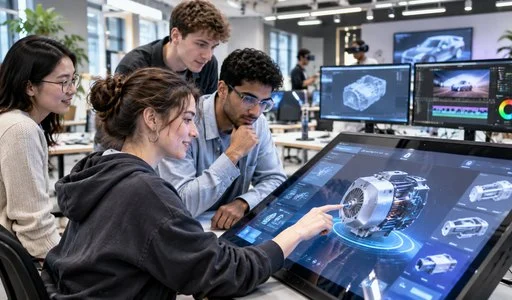
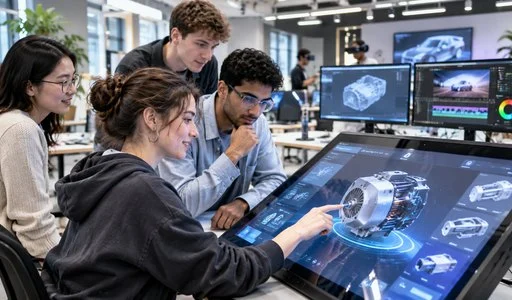
A 2009 Journal of Marketing study by Brakus, Schmitt, and Zarantonello defined brand experience as the sensations, feelings, thoughts, and behavioral responses that brand-related stimuli trigger. Digital tools produce many of those stimuli through motion, sound, depth, and interaction. A visitor who rotates a 3D model of a machine sets the pace and sees every side, which a flat spec sheet cannot show. Pine and Gilmore argued in The Experience Economy that experiences form a distinct economic offering, separate from goods and services. Technical companies therefore need creators who can turn complex products into clear visuals and interactions.
How Brand Experiences Deliver Business Value?
Digital experiences that are well designed can improve product understanding, message consistency, and customer education. Product configurators allow buyers to compare variants without a physical sample. Central content systems mean less duplicated effort between marketing and sales, and analytics show which features get the attention. But value still comes down to clear goals, accurate content and steady upkeep — not just flashy effects. This is a practical lesson for program leaders: employers need graduates who can plan a project, build it, test it with users, and revise it. A course that replicates that same cycle gives students experience with real briefs.
Key Applications and Main Types of Digital Media Technology
Key Applications Across Industries
I see digital media technology in many settings. Trade shows use interactive catalogs, digital walls, and product demonstrations. Showrooms and stores use self-service screens and guided selling. Training centers use simulations and progress tracking. Museums and entertainment venues use projection mapping, spatial audio, AR, VR, and interactive storytelling. Corporate lobbies use visitor systems and display networks. Each setting calls for the same core skills: poster and exhibition board design, promotional video, 3D product presentation, and motion graphics. Each setting also needs someone who can update content as products change. Those skills match the outputs students produce in the E.C.R Academy digital media course.
The Main Types of Digital Media Technology
Digital media technology is a field of connected categories, not a single product. It includes tools for creating content for video, 3D models, animation, motion graphics and sound. Asset management platforms control storage, approvals, versions and scheduling. Interactive technology includes kiosks, touchscreens, sensors and voice interfaces. Extended reality includes AR, VR, projection mapping and mixed reality. Digital signage is made up of commercial displays, LED walls, projectors and media players. Analytics and AI deliver personalization and measurement. No college program can teach you every device, but it can teach you the creation and design skills that transfer to all devices.
Tools, Platforms, and Solutions Compared
Buyers usually compare four routes: off-the-shelf software, custom development, equipment-only suppliers, and full-service providers. Off-the-shelf software deploys faster, while custom work fits unusual workflows. Equipment suppliers focus on displays and installation, and full-service providers add strategy, content, and support. Compare cost over three to five years, not only the first invoice. Training buyers face a similar choice. The E.C.R Academy program teaches Photoshop and Illustrator for image processing and visual design, Premiere and After Effects for video and effects, and 3ds Max, Maya, and related 3D software for modeling and animation. Confirm educational licensing terms with each software vendor before deployment.
How to Choose and Implement the Right Solution?
How to Choose the Best Digital Media Technology?
Start with the audience, setting and result you want. Then, check functionality, integration, security, usability, accessibility and total cost of ownership. Cloud, On-Premise, and Hybrid Models vs. Data Policies and IT Resources The W3C has released the Web Content Accessibility Guidelines 2.2, a common standard for accessible digital content, and I would recommend checking any interactive project against it. Request a live demo, a sample project and an itemized quote that breaks out course fees, platform access and training from your vendors. Itemized pricing also makes it easier to review budgets internally.
Implementing Digital Media Technology Step by Step
The acquisition of software or screens is merely the initial phase. Discovery is the foundation of successful implementation; establish the audience, objectives, and success metrics. Design is the subsequent step, which encompasses screen sizes, accessibility, and usability. ISO 9241-210 delineates the process of human-centered design for interactive systems, which encompasses the following activities: comprehending the context of use, defining user requirements, developing design solutions, and assessing them. Discoverability and feedback are prioritized in The Design of Everyday Things by Don Norman. Subsequently, implement a pilot with representative users, followed by a transition to training and documentation. The E.C.R Academy program's Interaction Design module adheres to a similarly structured sequence: requirement analysis, information architecture, flowcharts, drafts, and user experience evaluation.
Common Risks and How to Avoid Them
Buyers see projects as hardware purchases and projects often underperform. Great effects won't make up for bad content or unclear goals. Assign content ownership, approvals and version control early, and review integration, cybersecurity and privacy before signing. Four Risks for Education Programs I hear often: software licensing for students and teachers, hardware requirements, faculty with little industry experience, ownership of student work. Please respond to each in writing including if student projects may be displayed or used commercially. E.C.R Academy recommends a computer with a dedicated graphics card and 16GB or more of memory. School computer labs can help bridge the gap. Classroom industry practice joint teaching of enterprise engineers and college experts.
Course Content That Builds Brand Experience Skills
Core Modules in the E.C.R Academy Program
The program is project-driven and pairs theory with practice. Three core modules connect most directly to brand experience work:
- Digital Visual Design: Learners create posters, VI design works, illustrations, and brand visual systems. They develop creative concepts from project requirements and produce work that meets professional and commercial design standards, which builds the visual consistency that exhibition boards, product pages, and screens all need in order to look like one brand.
- 3D Animation Production: Learners use 3ds Max, Maya, and Cinema 4D to complete the full workflow of modeling, materials, textures, lighting, rendering, and animation. Typical outputs include 3D product presentations, architectural visualization, and game characters, which gives students portfolio pieces for advertising, game, and media employers. Fundamentals of 3D Software covers polygon and NURBS modeling first.
- Digital media technology supports visual effects production, where learners use After Effects and related software to create text effects, motion graphics, particle effects, green-screen keying, and compositing. These skills build post-production ability for film, video, and digital media projects, including animated elements for interactive displays, promotional videos, short videos, and microfilms.
Interaction design and audio-video modules complete the chain from concept to finished media.
Faculty and Training Platforms
Teaching quality shapes outcomes, so I want to explain who teaches and what they use. Enterprise engineers and academic instructors teach jointly, combining professional theory with project-based practice. Six training platforms support the work: graphic and image processing, digital visual design, interaction design, audio and video production, 3D animation production, and visual effects production. Together they form one connected technical system, so learners follow a single skills workflow from graphic processing to 3D animation. Beginners can start with Introduction to Digital Media Technology, Graphic and Image Processing, and Fundamentals of 3D Software.
Career Paths for Graduates
The program aligns with advertising design, film and media, internet services, and game development. Learners can prepare for roles such as visual designer, interaction designer, post-production specialist, 3D animator, visual effects artist, and new media operations specialist. The U.S. Bureau of Labor Statistics describes special effects artists and animators as workers who create animation and visual effects for television, movies, video games, and other media, and employers also review a portfolio of work. Project-driven coursework gives students finished pieces to show: posters, product pages, promotional videos, and 3D presentations.
Future Trends and Partner Selection
Future Trends in Digital Media Technology
Several trends are taking shape. AI now helps with copywriting, translation, and image or video adaptation, although human review, intellectual property protection, and data governance still matter. AR, VR, mixed reality, gesture control, and voice interfaces create new ways to examine products. Real-time 3D engines and digital twins can link engineering data to marketing and sales experiences. Buyers also weigh energy use, remote management, and equipment lifecycles. These trends change tools quickly, so I advise programs to teach durable skills first: composition, color, motion, modeling, and user testing. New software can follow as it matures.
How to Select a Digital Media Technology Partner?
Look for a partner with experience in comparable audiences and project sizes. Ask whether the provider covers strategy, content production, software, training, and ongoing support. Ask about platform compatibility, timelines, service-level terms, upgrade policies, and recurring costs. A long-term partner offers more than a one-time vendor because it keeps content, courses, and tools current as software releases change. For an academic program, also ask how often the course content updates, who teaches it, and how student work connects to competitions and internships.
Proof of Experience: E.C.R Academy by the Numbers
Trust should rest on evidence, so here are the facts I can share. Since 2010, E.C.R Academy has delivered professional training and assessment services to nearly 500,000 participants across China and 28 countries, and more than 300,000 learners have obtained recognized skills certifications. We have organized over 150 domestic and international skills competitions, engaged more than 3,300 experts, partnered with 500+ enterprises, and developed over 60,000 learning resources, including standards, courseware, case studies, and test banks. Our partners include enterprises, educational institutions, and industry associations.
Conclusion
Digital media technology gives brands tools to turn one-way messages into interactive experiences, and those experiences depend on people with the right skills. This article covered what the technology includes, how research defines brand experience, and where it appears in trade shows, showrooms, training, and venues. It compared solution types, listed selection criteria, and described a pilot-based implementation. It also flagged risks such as unclear goals, licensing, hardware demands, and content ownership. Graphic processing, visual design, interaction design, audio-video work, 3D animation, and visual effects form the skill base behind these experiences. A project-driven course taught jointly by enterprise engineers and college experts links that base to advertising, film, internet, and game roles.
FAQ
1. How does digital media technology differ from digital marketing?
Digital marketing attracts and converts audiences. Digital media technology supplies the software, devices, and platforms that create and deliver the experience. The two work together, but they solve different problems.
2. Can beginners join the program?
Yes. The program starts with fundamentals and works step by step. Learners do not need a design or computer background. It opens with Introduction to Digital Media Technology, Graphic and Image Processing, and Fundamentals of 3D Software.
3. What roles can graduates pursue?
They can prepare for visual designer, interaction designer, post-production specialist, 3D animator, visual effects artist, and new media operations specialist roles. Advertising, film and media, internet, and game development industries align with these skills.
4. What computer do learners need?
A computer with a dedicated graphics card and 16 GB or more memory is recommended. School computer labs can support learners without one.
Build Brand Experience Skills with E.C.R Academy
Looking for a digital media technology supplier that pairs project-driven courses with enterprise engineers and college experts? E.C.R Academy offers training platforms for visual design, interaction design, audio-video production, and visual effects. Email ecr2008@enteredu.com with your program goals, student numbers, and timeline, and we will reply with course options. For details, please refer to the website: enteredu.com.
References
1. Brakus, J. Josko, Bernd H. Schmitt, and Lia Zarantonello. "Brand Experience: What Is It? How Do We Measure It? And Does It Affect Loyalty?" Journal of Marketing, 2009.
2. Pine, B. Joseph, and James H. Gilmore. The Experience Economy. Harvard Business Review Press, 2011.
3. International Organization for Standardization. ISO 9241-210, Ergonomics of Human-System Interaction: Human-Centred Design for Interactive Systems, 2019.
4. World Wide Web Consortium. Web Content Accessibility Guidelines (WCAG) 2.2, 2023.
5. U.S. Bureau of Labor Statistics. Occupational Outlook Handbook: Special Effects Artists and Animators, 2024.
6. Norman, Don. The Design of Everyday Things: Revised and Expanded Edition. Basic Books, 2013.