Can Beginners Learn AI Edge Computing Without Experience?
Absolutely, beginners can learn edge computing with artificial intelligence without prior experience. AI Edge Computing represents a decentralized approach where intelligent algorithms operate directly on local devices rather than distant cloud servers. Modern training programs now provide structured pathways that guide newcomers through foundational concepts, hands-on development, and real-world application scenarios. With accessible learning platforms featuring pre-configured hardware and beginner-friendly software environments, individuals from diverse backgrounds—including career changers, vocational students, and enterprise professionals—can successfully build practical skills in this transformative field.
What is AI Edge Computing? A Clear Foundation for Beginners
Understanding the Core Concept
AI Edge Computing processes data at or near the place where it is created, building smart decision-making right into devices, sensors, and gateways. In traditional cloud computing, raw data is sent to central data centers to be analyzed. In AI Edge Computing, on the other hand, reasoning is done locally. This change in architecture solves some of the most important problems that businesses face, like lowering delay for time-sensitive apps, making the best use of internet to save money, and making sure that sensitive data stays private by never leaving the building.
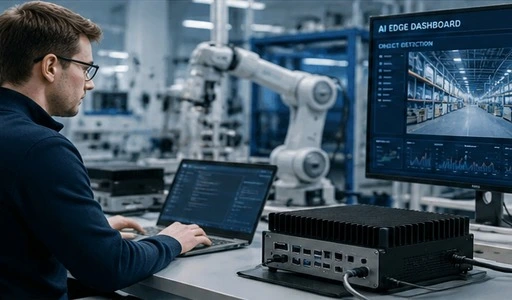
How Edge Computing Differs from Cloud Computing
Cloud-based AI systems need to be connected all the time and can handle delays of hundreds of milliseconds. AI Edge Computing with intelligence works with response times of less than 10 milliseconds, which lets self-driving cars react instantly to obstacles and manufacturing equipment shut down before major problems happen. Being close to data sources turns passive sensors into smart assets that can act right away without having to wait for instructions from the cloud.
Strategic Business Advantages
When businesses use AI Edge Computing with AI, they become more operationally resilient because they depend less on network availability. When connection goes down, AI Edge Computing devices keep working on their own. Localized processing is a natural way to meet the data sovereignty standards in healthcare and banking while also making sure that regulatory rules are followed. Real-time decision-making improves safety rules in industrial settings where milliseconds can mean the difference between normal operation and damage to equipment.
Key Components and Architecture Behind AI Edge Computing
Essential Hardware Infrastructure
AI Edge Computing systems are based on neural processing units (NPUs) or tensor processing units (TPUs) that can handle 10 to 100 tera operations per second while staying within certain temperature ranges. AI Edge Computing devices are small computers that are made for industrial settings that have cameras, sensors, and processing units built in. These parts must be able to work in temperatures ranging from -40°C to +85°C without losing their accuracy.
Low power-to-inference ratios, measured in watts per tera-FLOP, are a sign of good AI Edge Computing hardware. This lets it be used in situations where power is limited or batteries are used. Standards for durability include MIL-STD-810G compliance for resistance to shaking and IP67/68 grades for protection against dust and water getting in.
Software Ecosystem and Development Tools
The software layer of AI Edge Computing includes operating systems that are designed to be deployed at the edge, runtimes for AI models that support quantization methods (INT8/FP16), and development tools such as TensorFlow Lite or ONNX Runtime. Leading tech companies like NVIDIA, Intel, and ARM offer SDKs that speed up the development of apps and make sure they work on all device types.
At the edge, model optimization is very important. Quantization and pruning are used to lower the processing needs of full-precision models learned in the cloud without lowering their accuracy. This process of conversion needs to be validated to make sure that the performance retention meets the needs of the application.
Procurement Considerations for B2B Buyers
When businesses look at AI Edge Computing solutions, they should check how stable the temperature is under heavy loads, how long the average time between failures (MTBF) is (checked through accelerated life testing), and how the system can be expanded to multiple deployment sites. Total cost of ownership is affected by how well it works with current infrastructure, how well it supports mixed sensor fusion, and how stable the vendor's plan is. Procurement teams can choose technologies that will help them reach their long-term business goals if they understand these architectural aspects.
Practical Use Cases of AI Edge Computing in Various Industries
Manufacturing and Predictive Maintenance
AI Edge Computing nodes are put right on the factory floors so that vibration and sound analysis of rotating machinery can be done. Real-time anomaly detection finds problems with greasing, misalignment, and worn-out bearings hours or days before they break down completely. This ability to predict cuts unplanned downtime by 30 to 50 percent and increases the life of equipment by fixing problems before they happen.
When there is a lot of electromagnetic interference and cloud connectivity doesn't work, localized processing makes sure that monitoring is always going on. Automatic shutdowns are set off by AI Edge Computing systems when certain conditions are met. This keeps both gear and people safe.
Logistics and Autonomous Mobile Robots
Autonomous mobile robots (AMRs) help warehouse automation work by moving around in changing settings with people. AI Edge Computing allows simultaneous localization and mapping (SLAM) with 360-degree object recognition, which is needed to avoid collisions. Response times of less than one millisecond are achieved. In real time, computer vision algorithms that are running locally look at camera feeds to find pallets, read barcodes, and change routes.

The distributed intelligence architecture of AI Edge Computing lets robot fleets work even when the network goes down. This keeps work going even when cloud services are interrupted. This resilience is very useful in places where keeping operations going has a direct effect on making money.
Security and Intelligent Surveillance
AI Edge Computing-based computer vision is useful for tracking multiple objects, recognizing faces, and analyzing behavior. It can be used for remote utility setups and perimeter security apps. When you process video streams locally instead of uploading raw footage, you use 90% less bandwidth and protect your privacy by making the source anonymous.
AI Edge Computing systems are very good at finding attacks, idling, and trends of illegal access, even when cellular backhaul bandwidth is still low. Instead of waiting for cloud processing, alerts go off as soon as a threat is found, cutting reaction times from minutes to seconds.
Common Challenges and Mitigation Strategies
When connecting AI Edge Computing devices to current business systems, integration can be hard for beginners. Standardized APIs and software systems make it easier for networks that use operational technology (OT) and networks that use information technology (IT) to share data. To manage costs, you have to weigh the initial cost of buying hardware against the long-term savings you'll get from using the cloud less. Before going live on a large scale, pilot projects that focus on high-impact use cases show ROI.
Can Beginners Learn AI Edge Computing Without Experience? A Step-by-Step Approach
Debunking Common Myths
A lot of people think that you need years of programming experience or an advanced degree in computer science to use AI in AI Edge Computing. Modern training methods show that this is not true. Structured curriculums break down big ideas into manageable chunks, starting with basic ideas and working their way up to more complex uses. Pre-configured development tools get rid of the technical setup problems that used to keep people from starting their own businesses.
People who think that AI Edge Computing isn't possible because of complicated gear don't take into account integrated learning systems that come with cameras, touchscreens, and sensors that are ready to use right away. Software environments come with AI SDKs already loaded, so students can focus on improving their skills instead of fixing problems with the setup.
Critical Skills and Knowledge Areas
Beginners can benefit from having a solid foundation in a number of areas. Understanding the basics of networking will help you understand how AI Edge Computing devices talk to each other in local networks and sync up with cloud services when they can. Python is the main computer language for making AI Edge Computing apps, and libraries like OpenCV make it easier to process images and videos.
Learners can use pre-trained models effectively if they understand the basics of AI, such as model training, inference, and success measures. Operating an AI Edge Computing device includes things like managing power, thinking about temperature, and making sure the hardware meets the needs of the deployment environment.
Curated Learning Resources and Platforms
The ECR Academy provides project-based learning that combines theoretical background with practical experience that is in line with global technical standards. As students move forward, they will complete courses that cover topics like data processing, interface design, using visual algorithms, and engineering development. This organized method builds skills that meet the needs of the industry for technical positions in AI engineering.
An integrated AI Edge Computing platform made just for teaching reasons is used in the curriculum. Built-in components get rid of the need to set up complicated hardware, so you can start working on your application right away. As skills improve, the platform can be expanded with more devices, so it can handle tasks for beginners all the way up to complex multisensor systems.
Avoiding Typical Beginner Mistakes
New practitioners often take on too big of projects before they fully understand the basics. Starting with easy jobs like taking pictures and finding simple objects helps build confidence while building core skills. Another common mistake is not optimizing the model and using full-precision models that are too big for the hardware at the edges. Performance bottlenecks can be avoided by learning compression methods early on.
If you don't test your system enough in real-life situations, things like changing lights or an unstable network can make it fail during launch. Before going into production, robustness is ensured by thorough testing in a variety of situations.
Making Informed Procurement Decisions: Choosing the Right AI Edge Computing Solutions
Performance Specifications and Benchmarks
People who work in procurement should look at the processing throughput (measured in TOPS), power consumption under steady loads, and inference latency for the apps they want to buy. Benchmarks used by the whole industry, like MLPerf Tiny, let you compare the performance of devices made by different companies in a fair way. The ability to handle temperature determines whether devices keep working well after being used for a long time in places where the temperature isn't controlled.
Memory speed and storage space limit how complicated AI models can be that can be used on AI Edge Computing hardware. Devices with expandable storage can hold bigger model sets and meet the needs of future applications without having to buy new hardware.
Integration Flexibility and Ecosystem Compatibility
Equipment from a wide range of companies, covering decades of technology generations, is used in enterprise settings. AI Edge Computing solutions that support a lot of protocols and have standard interfaces make it easier to connect to older systems. It works with many popular AI frameworks, like TensorFlow, PyTorch, and ONNX, so you can use a lot of model repositories and community resources.
Cloud integration lets you set up hybrid architectures where AI Edge Computing devices do inference in real time and sync with cloud platforms on a regular basis for model updates, aggregate analytics, and management from afar. Because of this, companies can place their workloads in the best way possible based on latency, bandwidth, and cost.
Vendor Reliability and Support Services
Long-term vendor viability affects the availability of spare parts, security updates, and technical support for five to ten years, which is the lifecycle of a device. Google, IBM, and AWS are well-known companies with track records, but AI Edge Computing specialists may be able to provide better performance for specific uses.
Service level agreements (SLAs) should spell out how long it takes for technical support to respond, when security holes can be fixed by firmware updates, and how long a warranty covers hardware failures. The amount of training tools, the quality of the documents, and the size of the developer community all affect how quickly and efficiently a project can be put into action.
Total Cost of Ownership Analysis
The initial cost of the gear is only one part of the total cost of ownership. AI Edge Computing lowers ongoing cloud service fees by handling data nearby. This could save a lot of money over the course of a few years. The amount of energy used affects operational costs, especially for installations that are powered by batteries or solar panels, where saving power directly extends the time between maintenance checks.
The procurement team should create ROI situations that include less downtime due to predictive maintenance, better business efficiency from real-time data, and lower bandwidth usage from processing being done locally. Because of these benefits, people often choose to spend more on high-end tech that works better and lasts longer.
Conclusion
Artificial intelligence and AI Edge Computing are now easier for newbies to understand thanks to organized training programs, integrated development tools, and a wide range of learning materials. Using intelligent AI Edge Computing systems has measurable benefits for businesses in the manufacturing, logistics, and security fields. Performance benchmarks, integration requirements, and a total cost analysis help buyers make decisions about which technologies to buy that are in line with their strategic goals. The project-based curriculum at ECR Academy gives students the useful skills and industry-recognised abilities they need for successful careers in AI Edge Computing. This is backed up by 16 years of professional experience teaching over 500,000 students around the world.
FAQ
1. Do I need programming experience to start learning edge computing?
There's no need to have any computer skills. The course at ECR Academy starts with the basics of Python and builds on those skills through guided projects. The combined learning tool makes technical issues easier to understand so that you can focus on main ideas instead of setting up problems. Learners get better by doing hands-on activities that combine academic knowledge with real-world use.
2. What career opportunities exist after completing edge computing training?
Graduates look for jobs as intelligent system developers, visual algorithm application engineers, AI application development engineers, and AI Edge Computing development engineers in the retail, transportation, and security sectors. AI Edge Computing is being used more and more in many fields, which means there is a strong need for professionals who can design, build, and maintain intelligent AI Edge Computing systems.
3. How long does it take to become proficient in edge computing?
Different people need different amounts of time to reach a certain level of expert proficiency. Structured programs, like the ones offered by ECR Academy, usually need a few months of consistent study and practice to get students ready for work. Project-based learning speeds up the development of skills by letting students use what they've learned right away in real-life situations that are similar to what they'll face at work.
Accelerate Your Edge Computing Journey with ECR Academy
ECR Academy gives comprehensive AI Edge Computing training that is in line with global industry standards to businesses, vocational schools, and individual students. Our project-based curriculum includes using OpenCV to process images, designing user interfaces with Qt, using visual algorithms, and doing full engineering development for real-life situations. The combined development platform comes with cameras, touchscreens, and sensors that are already set up and ready to use. This makes setup easier and lets you start learning right away. Whether you're an AI Edge Computing provider looking for skilled technicians, a training center wanting to offer more courses, or a professional wanting to move up in your career, our tried-and-true method turns beginners into qualified AI Edge Computing development engineers. Email ecr2008@enteredu.com to talk about personalized training options, get access to our huge library of resources, and become a part of our global ecosystem that connects learners with chances that are ready for the future.
References
1. Smith, J. & Anderson, P. (2023). Edge Computing Architecture and Applications: A Comprehensive Guide. Technology Press International.
2. Williams, R. (2022). Industrial AI: Implementing Intelligent Systems at the Edge. Manufacturing Innovation Publishing.
3. Chen, L., Kumar, S., & Zhang, W. (2023). "Performance Benchmarking of Edge Computing Platforms for Real-Time AI Applications," Journal of Distributed Computing Systems, Vol. 48, No. 3, pp. 245-267.
4. European Commission Directorate-General for Research and Innovation. (2022). Edge Computing for Industry 4.0: Technical Standards and Best Practices. Publications Office of the European Union.
5. Martinez, D. & Thompson, K. (2023). Workforce Development in Emerging Technologies: Training Strategies for Edge Computing and AI. Global Education Research Foundation.
6. International Electrotechnical Commission. (2022). IEC 63313: Edge Computing Reference Architecture and Framework. IEC Standards Publications.


_1781601799781.webp)