Photovoltaic Engineering Technology and the Future of Solar Engineering
Photovoltaic engineering technology is the discipline that turns sunlight into dependable grid power by combining cell and module science, system design, construction, commissioning, and long-term maintenance. The future of solar engineering points toward higher-efficiency N-type and tandem cells, battery storage, digital monitoring, and microgrids, and each of those needs technicians who understand both hardware and data. I wrote this guide for college leaders, training managers, and project teams who want to see how the field works today and which skills it will ask for next. Along the way, I share facts, selection criteria, and a look at our E.C.R Academy course.
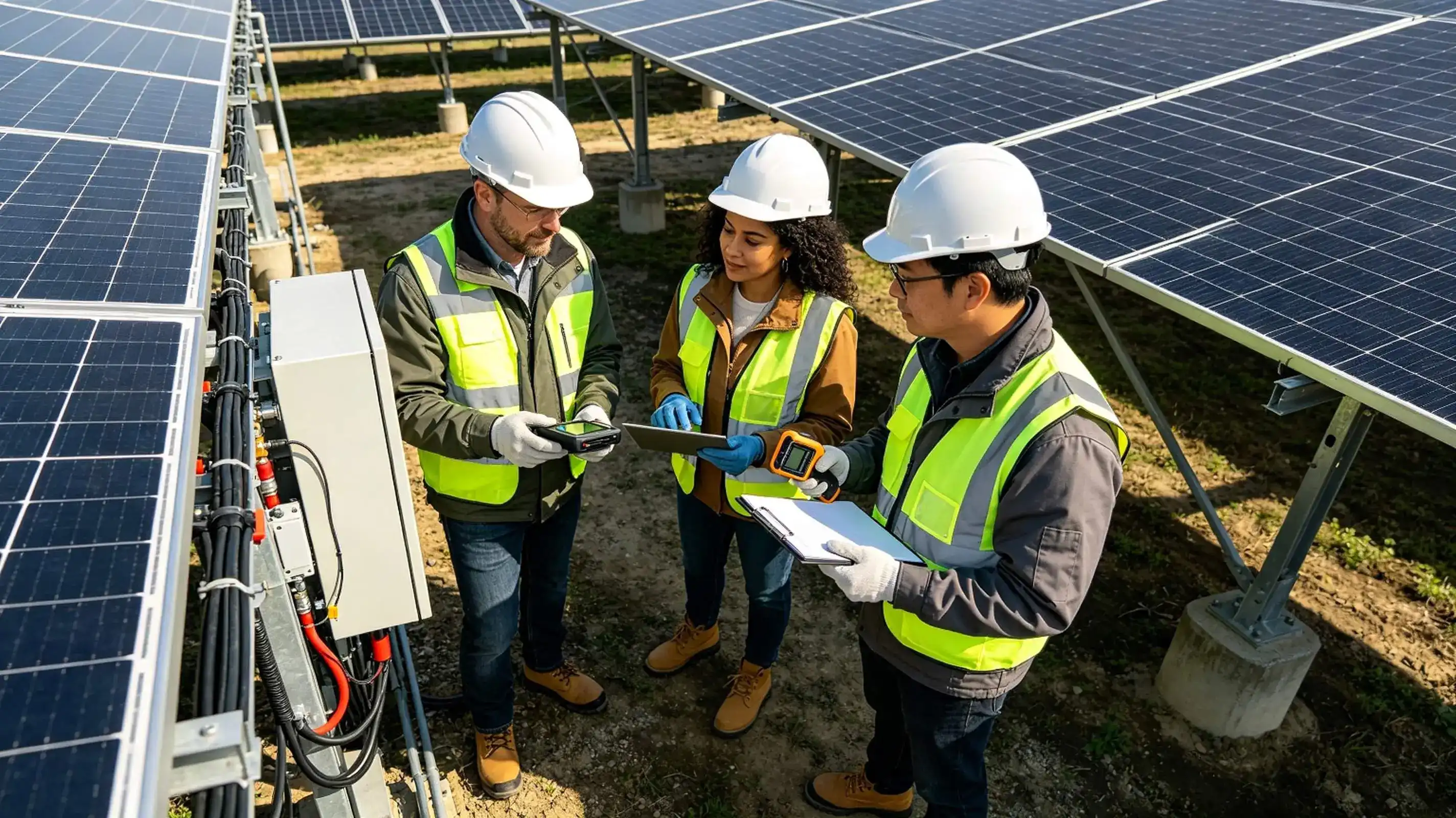
What Photovoltaic Engineering Technology Covers?
A Full Lifecycle, Not Just a Panel
When people hear "solar," they often picture a panel on a roof. The field covers much more. It starts with solar resource assessment and a site survey. It moves through system design and equipment selection, then continues with construction, grid connection, commissioning, and years of operation and maintenance. It also reaches back into manufacturing, because cell and module fabrication shapes the performance that engineers design around. The International Energy Agency's Renewables 2024 report expects solar PV to drive most of the growth in global renewable capacity through 2030. A large share of new power work will therefore happen across this full lifecycle.
Core Components and the Skills Behind Them
A working system has more parts than most buyers expect: modules, inverters, mounting structures, cables, combiner boxes, transformers, protection equipment, and optional battery storage. Each part draws on a different skill. Electrical and electronic engineering explain how current moves and where it can fail. Engineering drawing and CAD turn a design into construction documents. Power conversion explains how an inverter changes DC from the array into AC for the grid. Module quality matters too. IEC 61215 covers design qualification and IEC 61730 covers safety qualification, so technicians who read test results can spot a weak product early.
Applications and System Configurations
Rooftop systems utilize existing structures and equip buildings with steady daytime demand. Tilt and spacing are more flexible for designers using ground-mounted arrays, making them suitable for utility-scale sites with land and grid access. Floating solar puts the modules on water, where the cooling can increase the output, but the equipment has to be highly resistant to humidity and salt mist. Microgrids combine PV, storage and controls to supply power for campuses, factories or remote sites. Distributed and centralized plants also differ in permitting, financing and how closely output matches local demand. The right choice begins with space, load profile, grid conditions and project goals.
Selecting and Designing a Solar System
Comparing Cell and Module Technologies
Technology choice should follow project needs, not product popularity. Leading commercial N-type modules now exceed 24% efficiency, and they typically carry temperature coefficients between -0.29%/°C and -0.35%/°C, which matters in hot climates. TOPCon and HJT are the main N-type cell designs in commercial production. Meanwhile, perovskite-silicon tandem cells have passed 33% efficiency in laboratory tests, according to the NREL Best Research-Cell Efficiency Chart. Bifacial modules add rear-side gain over bright ground, and trackers follow the sun to raise yield at the cost of more moving parts. I suggest comparing efficiency, land use, temperature behavior, maintenance needs, and long-term availability together.
Feasibility Studies and System Sizing
A sound design begins with a feasibility study based on photovoltaic engineering technology, which includes solar irradiation, shading, roof or land condition, structural capacity, climate, environmental limits and grid availability. Engineers then size modules, inverters, and any storage based on energy demand, available area, and expected losses. Series-parallel calculations maintain string voltage within inverter limits even on the coldest morning when voltage increases. Then comes the cost-benefit analysis. Projects that have carbon goals can include emission monitoring and calculation of carbon trading volume. Accurate early work means fewer construction changes, fewer permitting delays, and fewer production shortfalls that are much more costly to correct later.
Electrical Safety and Code Compliance
Safety design is not an add-on. Engineers address grounding, surge protection, emergency shutdown, fire safety, and local grid codes from the first drawing. In the United States, NFPA 70, the National Electrical Code, sets requirements such as rapid shutdown for PV systems on buildings under Section 690.12, which helps protect firefighters. Battery projects add questions About Usable capacity, cycle life, thermal management, and fire protection. Control and protection systems also need testing before energization. A designer who knows these rules early avoids redesign during inspection, and a technician who knows them works more safely on site.
Building, Running, and Costing Solar Projects
Construction, Commissioning, and Acceptance Testing
Delivery involves permitting, factory inspection, structural installation, module and inverter assembly, cable routing, grid interconnection, and handover. Acceptance testing then verifies polarity, insulation resistance, operating voltage, string current, inverter function, protection systems, and monitoring communication. Electroluminescence (EL) scans before shipment and after installation can reveal micro-cracks that the eye misses. Schedule, budget, quality, and safety management run through the whole stage, and construction organization documents keep crews aligned. In our training, learners practice on a grid-connected PV station of no less than 60 kW, so the commissioning checklist feels familiar before the first job.
Operation, Maintenance, and Monitoring
Once a plant runs, routine work protects its output. Crews clean modules, inspect thermal images, check connectors, control vegetation, service inverters, and review structures. Drone thermography finds hot spots from bypass diode failure or shading. String-level monitoring pinpoints a single soiled or faulty string, which saves time compared with searching an entire array. Operators watch irradiance, temperature, energy output, alarms, and performance ratio to catch faults early and support warranty claims. Large ground-mounted plants and distributed plants fail in different ways, so technicians need fault-analysis practice on both. Intelligent microgrids add storage control and protection to the maintenance list.
Costs and Financial Evaluation
Project cost covers modules, inverters, mounting, electrical balance-of-system equipment, engineering, construction, grid connection, storage, logistics, permits, and ongoing O&M. SEIA and Wood Mackenzie report that the United States installed about 50 gigawatts (direct current) of solar in 2024, which shows how much work and spending now sit in this sector. Cost per watt helps with early benchmarking, but total cost of ownership tells the fuller story, including degradation, warranties, and replacement needs. Financial tools include payback period, internal rate of return, net present value, and levelized cost of electricity, along with models such as power purchase agreements.
Procurement, Risk, and Decision Criteria
Choosing Suppliers and Partners
When sourcing equipment for photovoltaic engineering technology projects, separate component manufacturers, system integrators, EPC contractors, distributors, and O&M providers, because different suppliers have different scopes, before you compare quotes. Check the ability to deliver, technical support, warranty terms, manufacturing capacity, financial stability and project history. Ensure that modules, inverters, batteries, mounting and monitoring platforms are compatible in electrical and communication protocol. Cross-border buying adds incoterms, import duties, certifications, lead times and factory inspections. A structured pre-qualification and tendering process reduces supply-chain uncertainty. A clear tender will include specifications, expected energy yield, test procedures, warranties, scope of installation and O&M duties.
Common Risks and How to Avoid Them
Nameplate capacity is not identical to output, though. Production is affected by orientation, shading, temperature, soiling, inverter design, curtailment, installation quality and maintenance. Common risks include wrong yield estimates, inadequate electrical infrastructure, mismatched components, unclear warranties, late deliveries, poor monitoring and undefined O&M responsibilities. Such problems mean lost energy, safety incidents, increased replacement costs and disputes. “Control begins with feasibility and continues through supplier audits, factory inspection, construction supervision and commissioning. Performance guaranties, documentation rules, response-time commitments and independent technical review add protection. Trained crews catch mistakes before they get to the field. Skilled people reduce risk as well.
A Simple Decision Process
I suggest four steps. First, define the goal: lower power bills, resilience, sustainability targets, or grid export. Second, set measurable criteria such as energy yield, performance ratio, availability, degradation, installed cost, operating expense, payback, and warranty. Third, match the configuration to the application, whether a commercial rooftop, an industrial site, a utility plant, or a remote microgrid. Fourth, weigh lifecycle value, compliance, and long-term support instead of unit price alone. Written down, this process also gives a committee a shared basis for approval.
The Future of Solar Engineering and the Skills It Needs
Technology Trends Shaping Solar Projects
Module technology changes quickly. PERC gave way to TOPCon and HJT within a few years, and perovskite-silicon tandems are now moving from the laboratory toward pilot production. Bifacial generation, battery storage, floating solar, agrivoltaics, and building-integrated photovoltaics widen where and how solar works. Solar also becomes a platform that can include microgrids, virtual power plants, demand management, and electric-vehicle charging. Models such as solar-as-a-service, battery-as-a-service, and corporate power purchasing lower upfront cost barriers. For educators, the lesson is plain: teach fundamentals that outlast any single cell type, and pair them with current industry practice.
Workforce Demand and Skill Gaps
The Interstate Renewable Energy Council's National Solar Jobs Census 2023 counted more than 260,000 solar workers in the United States. Those jobs span design, installation, and O&M. Remote monitoring, big data analysis, and cloud platforms now sit next to wrenches and meters in the job description. Credentials matter as well. NABCEP, for example, offers certification for PV installation professionals. Colleges and training centers therefore need programs that connect theory to field tasks, with lab hardware, simulation, and instructors who have worked on real projects.
How the E.C.R Academy Course Builds These Skills?
At E.C.R Academy, we teach photovoltaic engineering technology through project-driven learning that ties theory to real production projects and typical work tasks. The core subjects include PV generation principles, cell and module fabrication, engineering drawing and CAD, electrical and electronic engineering, and power conversion. Learners then practice system design, construction and commissioning, operation and maintenance, and intelligent microgrid topics such as storage configuration and protection. Enterprise engineers and college experts co-deliver the lessons, and the content aligns with international skill standards and PV industry job requirements. Virtual simulation, big data, and cloud computing support the training. Labs include a PV module production lab with laser scribing machines, EL testers, and laminators, plus a grid-connected station of no less than 60 kW. Since 2010, we have trained nearly 500,000 participants across China and 28 countries.
Conclusion
Photovoltaic engineering technology covers the full path from site survey and design through construction, commissioning, operation, and maintenance, so a solar project succeeds only when each stage is handled well. Technology choice should follow project needs, with N-type and tandem cells, bifacial modules, and storage compared on efficiency, temperature behavior, and lifecycle cost. Safety design, code compliance such as the National Electrical Code, careful supplier checks, and early risk controls protect both output and people. Costs are best judged by total ownership, not price per watt. Because modules, digital monitoring, and microgrids keep changing, the industry needs technicians who combine electrical fundamentals, project experience, and data skills, and training that links theory to practical work meets that need.
FAQ
1. What is photovoltaic engineering technology?
It is the engineering of solar power systems across their full lifecycle, from cell and module manufacturing to the design, installation, commissioning, and maintenance of power stations.
2. Can I take this course with no prior background?
Yes. The course starts with foundational theory and progresses step by step, covering electrical and electronic engineering and engineering drawing. Training facilities and experienced instructors help beginners build core skills gradually.
3. How does this program differ from traditional electric power programs?
This program focuses on photovoltaic power generation. It places more weight on solar system planning and design, construction, and operation and maintenance, so learners practice full-lifecycle management of PV power stations and keep pace with the new energy industry.
4. Which careers can the program prepare me for?
Learners can prepare for roles such as PV power station planning and design engineer, installation and commissioning engineer, operation and maintenance engineer, PV product design and process engineer, intelligent microgrid O&M engineer, and project management engineer.
Request Photovoltaic Engineering Technology Course Details from E.C.R Academy
Looking for a photovoltaic engineering technology supplier for course content? E.C.R Academy brings 16 years of skills education experience and a course built on real projects, simulation, and international skill standards. Tell us whether you want training for a campus, a company, or an association, and we will discuss your goals. Email ecr2008@enteredu.com, or visit enteredu.com for details.
References
1. International Energy Agency, Renewables 2024 (2024)
2. SEIA and Wood Mackenzie, U.S. Solar Market Insight 2024 Year in Review (2025)
3. Interstate Renewable Energy Council, National Solar Jobs Census 2023 (2024)
4. International Electrotechnical Commission, IEC 61215-1: Terrestrial Photovoltaic (PV) Modules – Design Qualification and Type Approval (2021)
5. National Fire Protection Association, NFPA 70: National Electrical Code (2023)
6. National Renewable Energy Laboratory, Best Research-Cell Efficiency Chart (2025)