New Energy Vehicle Design & Control Technology for BMS and Motor Controller Design
New energy vehicle design & control technology stands at the crossroads of mechanical engineering, power electronics and software defined systems. As Battery Electric Vehicles (BEV) and Plug-in Hybrids (PHEV) expand quickly, the Battery Management System (BMS) and motor controller are two of the most technically challenging subsystems to design right. Getting them properly is important for the safety, range accuracy and drivetrain responsiveness of vehicles. This handbook covers the basics, recent developments, purchasing considerations, and future trends that engineering educators, enterprise trainers, and technical purchasers need to know.
Understanding the Fundamentals of New Energy Vehicle Design
Before you pick out parts or make a curriculum, you should know about the architecture that holds everything together.
Core Architecture Principles
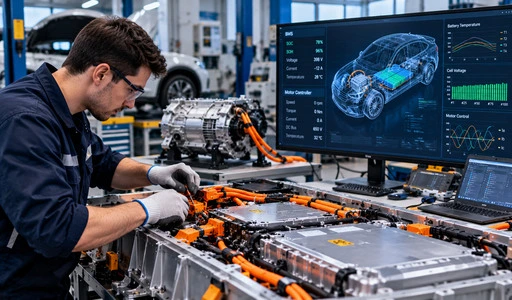
An NEV today has three parts that work together very well: the power battery pack, the drive motor, and the electronic control unit. All three of them work together to make the three-electric device. All of the system's parts work together. For example, a BMS that is properly calibrated sends real-time information to the VCU about the state of charge (SoC). After that, the VCU tells the motor processor how much power to send. If you break any link in that chain, it stops working right or could be dangerous.
Thermal Management as a Design Constraint
The temperature of the cell has a direct effect on the lithium-ion's ability and cycle life. For every 10°C rise in temperature, running lithium cells above 45°C speeds up their breakdown by up to 30% (Journal of Power Sources, 2022). Effective thermal management systems (TMS) should be built in from the beginning of the plan process, not at the end. This is correct for both designs that use submerging and plates that are cooled by liquid.
Real-Time Sensor Data and Safety Requirements
That's why the insulation resistance for the high-voltage bus has to stay above 500 Ω/V. Also, the BMS hardware has to handle voltage, current, and temperature data from over one hundred cells at sampling rates higher than 10 Hz. As of now, all passenger cars must meet the functional safety requirements of ISO 26262 ASIL-D. This means picking the right sensors and making sure they work well is an important part of the design process, not something that is done after the fact.
Advances in Control Technology for BMS and Electric Motors
Since 2013, engineers have changed the way they handle motors and take care of batteries in very clear ways.
AI-Driven State Estimation
Using the old way of counting Coulombs leads to mistakes over time. Open-circuit voltage (OCV) mapping, electrochemical impedance spectroscopy (EIS), and machine-learning filters are some of the newer ways to get a good picture of the state of health (SoH) within ±2% of different duty cycles. A number of automakers now build SoH models using neural networks right into the BMS computer.
FOC vs. DTC in Motor Controller Design
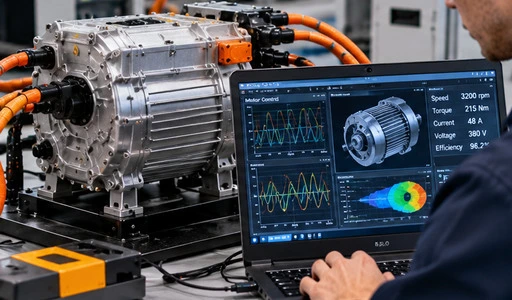
The standard for permanent magnet synchronous motors (PMSMs) in new energy vehicle design & control technology is still Field-Oriented Control (FOC). This is because it splits torque and flux, which makes operation smooth and efficient at a lot of different speeds. It is faster for Direct Torque Control (DTC) to respond to sudden changes, but it has higher torque ripple in the past. More and more production cars have mixed systems that switch to FOC when the speed is low and DTC when the speed is very high.
Vehicle-to-Grid and Bidirectional Control
For vehicles to connect to the grid (V2G), they need on-board chargers (OBCs) that can work both ways and motor controls that can send power back to the grid. The International Energy Agency (IEA) says that by 2030, V2G-capable ships could send up to 200 GW of storage around the world. We will have to change how CAN-FD communication protocols and grid-synchronization algorithms are made because of this.
Comparative Analysis of Battery Management and Motor Controller Solutions
There are a lot of things to think about when picking the right BMS or motor driver for a job.
One of the main things procurement engineers look at when comparing solutions is the level of safety certification, the ability to control temperature, the support for communication protocols, and how well the software toolchain works with the other solutions. Here are the most important things you should think about when making your choice:
- Safety certification: ISO 26262 ASIL-D compliance is mandatory for passenger vehicle BMS designs. Controllers targeting commercial vehicles or stationary storage may accept ASIL-B, but the documentation burden remains substantial.
- Scalability across pack configurations: A BMS architecture that handles both 400 V and 800 V platforms without a hardware redesign reduces development cost significantly. Cell-to-Pack (CTP) and Cell-to-Chassis (CTC) geometries demand tighter integration between the BMS firmware and the structural design team.
- Simulation tool compatibility: Motor controllers validated against MATLAB/Simulink models, CarMaker, or AVL CRUISE integrations reduce HIL (hardware-in-the-loop) rework time and align with engineering workflows already established in most R&D environments.
For example, if the BMS system can work with both 400 V and 800 V platforms, it saves a lot of money on development costs because the hardware doesn't needs to be rethought. The BMS software and the structure design team need to work together better for the cell-to-pack (CTP) and cell-to-chassis (CTC) forms to be real.
Some motor controllers have been tried with MATLAB/Simulink models, CarMaker, or AVL CRUISE integrations. These controllers require less HIL (hardware-in-the-loop) repair time and can work with engineering processes that are already set up in most R&D settings.
Procurement Insights and Best Practices for BMS and Motor Controllers
You can't just compare prices per unit to find automotive-grade control modules. A project's ability to ship on time is often based on its lead time, its ability to track certifications, and its technical support after the sale.
Supplier Qualification Criteria
Serious providers need to be IATF 16949 certified and have an ISO 26262 functional safety management method that is written down. Buyers should also ask for proof of the Production Part Approval Process (PPAP) and find out how the provider manages the different versions of ECU software for each production batch.
Software Licensing and Toolchain Access
People who buy industrial software for new energy vehicle design & control technology often forget about the licensing issue. Companies and groups that use modeling systems need to show that they have the right licenses to use tools like Altium Designer or MATLAB/Simulink. It is harder to do checks on copies that aren't allowed, and teams that work in different places can't use the same version control system.
Long-Term Partnership vs. Spot Purchasing
When you place an order with a good supplier, you almost never get the full value that they can offer. When you sign an annual framework deal that includes training support, firmware update rights, and joint application building, the total cost of ownership goes down. These agreements also make it possible for companies to work together to make the next generation of platforms.
Future Trends and Strategic Directions in New Energy Vehicle Control Systems
AI and Big Data Integration in BMS
Cloud-connected BMS platforms that aggregate fleet-level charge/discharge data enable predictive maintenance at a scale impossible with individual-vehicle diagnostics. By 2025, several tier-one suppliers plan to move SoH prediction from on-board microcontrollers to edge-computing modules that process data locally before syncing to fleet management platforms.
Autonomous Vehicle Control and Sensor Fusion
Autonomous driving adds a new layer of requirements to the motor controller: sub-10 ms torque response times, redundant CAN-FD or Automotive Ethernet communication paths, and functional safety architectures that can execute controlled stops without human intervention. Sensor fusion — combining wheel speed, IMU, and radar signals — feeds directly into the VCU torque arbitration logic.
Embedded Software Platforms and Open Standards
AUTOSAR Adaptive is replacing legacy Classic AUTOSAR in high-performance domain controllers because it supports dynamic service-oriented architectures. For motor controller firmware, this means modular software components that can be updated over-the-air (OTA) without full ECU reprogramming — a significant change to both design practice and supplier contracts.
Conclusion
The motor driver and BMS are no longer two different pieces of hardware in new energy vehicle design & control technology. These systems are now very important for safety. They depend on a lot of software and need engineering teams that understand both electronics and control theory. The biggest challenge for both schools that are building NEV engineering programs and companies that are training new R&D teams is to close the gap between what students learn in school and how they can use what they've learned in real life. Students will get the most useful set of skills for the job market if they learn the whole technical process, from CAD structural layout and EDA circuit design to digital modeling and start-up of control systems.
FAQ
1. Can someone with no prior engineering background take an NEV design course?
Yes. The first parts of a well-organized program cover mechanical drawing, engineering mechanics, and basic automotive electrical systems. After that, they move on to BMS design and motor control. The ECR Academy course starts with base lessons that teach basic skills. Next, the course moves on to three-electric system integration.
2. Which simulation tools are most relevant for BMS and motor controller design?
MATLAB/Simulink is the tool that is most often used to make control methods and test HIL. ANSYS lets you do thermal and structural models that you can use to build battery packs. You can use Altium Designer and Cadence, two EDA tools, to plan out PCBs for controller hardware. Every one of these is taught in the ECR Academy path.
3. What certifications can learners obtain?
It helps people get ready for exams to become a NEV engineer, a CAD mechanical designer, or an EDA electrical designer. Having these credentials can help you get jobs designing cars, testing prototypes, and making electronic control systems.
Partner with E.C.R Academy for New Energy Vehicle Design & Control Technology Training
This school has helped almost 500,000 students in 28 countries since 2010. Business, colleges, and industry groups that want organized, hands-on training in the field have used our school for new energy vehicle design & control technology many times. The course is taught in both real and virtual labs by professors who work in automotive engineering and teach at the college level. Email us at ecr2008@enteredu.com or visit enteredu.com to get a business plan and a program plan.
References
1. Journal of Power Sources — "Temperature Effects on Lithium-Ion Battery Degradation Kinetics," 2022.
2. International Energy Agency (IEA) — Global EV Outlook, 2023.
3. ISO 26262:2018 — Road Vehicles: Functional Safety, International Organization for Standardization, 2018.
4. IEEE Transactions on Industrial Electronics — "Field-Oriented and Direct Torque Control Comparison for PMSM Drives," 2021.
5. Journal of Cleaner Production — "Cell-to-Pack Battery Architecture: Design Challenges and Thermal Management," 2023.
6. AUTOSAR Consortium — AUTOSAR Adaptive Platform Specification, Release 22-11, 2022.