How Industrial Robot Maintenance and Integration Services Support Factory Automation
Industrial robot maintenance and integration services are two of the most decisive factors in whether a factory automation system performs reliably over time. Proper robot upkeep—covering mechanical inspection, electrical fault diagnosis, and control system monitoring—directly reduces unplanned downtime and extends equipment lifespan. When paired with well-executed system integration, manufacturers can connect robots with PLCs, MES layers, and vision systems into a unified production workflow. Together, these disciplines form the technical backbone of any serious automation program, and they increasingly define the talent requirements that vocational programs and enterprise training departments must meet.
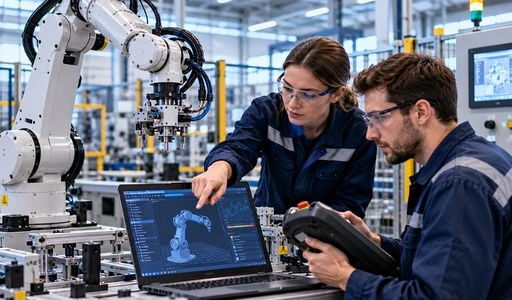
Understanding Industrial Robot Maintenance: Enhancing Factory Automation Reliability
It's not enough to just fix things when they break to keep robots running. Failures can be avoided with structured maintenance plans, and that difference is worth a lot of money.
Why Preventive Schedules Matter
A 2023 study from the International Federation of Robotics says that unplanned downtime costs companies $260,000 per hour in places where a lot of things need to be put together. Every 3,000 hours of use, small checks are done on the lubrication levels, belt tightness, and motor bolt pressure to catch wear trends before they get worse. When factories stick to written preventative plans, they consistently spend less on spare parts and get better Overall Equipment Effectiveness (OEE) scores.
Predictive Diagnostics and Condition Monitoring
Engineers can keep an eye on servo motor insulation resistance, harmonic distortion in power supplies, and grease spectroscopy data to find metals that wear away inside the motor. Looking at used grease shows how much iron and chromium is in it, which is kind of like a blood test for gearboxes. This lets teams plan to replace the gearbox before it has a full mechanical seizure. The mean time to fix is cut down by this data-driven method, and the mean time between failures is increased.
Safety Compliance as a Non-Negotiable Baseline
A safety circuit validation test must be done at the end of every maintenance cycle. ISO 10218-1 and RIA R15.06 say that E-Stops and light blinds must work within a certain number of milliseconds. Skipping this step leaves facilities open to regulatory responsibility and, more importantly, to accidents that could have been avoided at work. Adding compliance checks to regular schedules saves both workers and the flow of output.
The Industrial Robot Integration Process: Building Smarter Automated Systems
Integration is the process of adding a robot to a bigger production system so that all of its parts—hardware, software, and communication protocol—work together as a single unit.
Planning and Protocol Compatibility
A thorough mapping of fieldbus needs is the first step in a successful integration project. Different protocols, like Profinet, EtherCAT, and OPC-UA, are used for different amounts of delay and data. If the wrong protocol is chosen during the planning stage, it will have to be redone, which will cost a lot of money. Engineers who know how to work with robots from different brands—like FANUC, ABB, KUKA, and Yaskawa—need to make their own driver libraries that give operators a unified HMI interface.
Commissioning and Cycle Time Optimization
Once the wiring and software configuration are done as part of industrial robot maintenance and integration services, the commissioning teams check the cycle time against the target takt. Published case data from ABB's application engineering teams shows that trajectory path optimization alone can cut the amount of power a robot needs by up to 15%. Failure Mode and Effects Analysis (FMEA) done during testing finds any remaining risks in the integrated cell before production starts. This lowers the chance of failures happening early in the product's life.
Scalability for Evolving Production Demands
Manufacturers can add robot cells without having to rethink the whole line with modular interface architecture. This is especially important in factories where production levels change with the seasons or where there are a lot of different kinds of products. Including scalability in the initial design of the integration is a choice that will pay off for many years after the project is over.
Effective Strategies for Maintaining Industrial Robots: A Complete Guide
A good maintenance plan combines the number of inspections, the level of skill, and the available funds into a single, logical plan. These are the main areas of practice that make the biggest difference in how things work.
Routine Inspection and Lubrication Protocols
As part of regular maintenance, the mechanical system should be checked for things like joint axis play, backlash measures in RV and harmonic drive reducers, and belt tension. By replacing the lubricant every 10,000 hours, you can keep the controller's memory from being lost when the battery backup fails, which is a regular problem that can be avoided. Teams that write down every inspection create a maintenance history that can be tracked down and helps find problems faster in the future.
Electrical System Fault Diagnosis
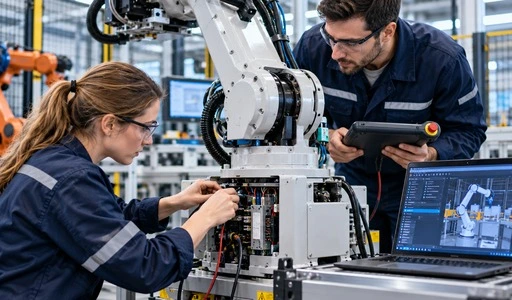
Most of the time when robots aren't working, it's because of electrical problems. To correctly find faults, technicians need to know how to use multimeters, oscilloscopes, and pneumatic circuit tests. Standard procedures like checking the insulation resistance of servo motors and making sure the circuit wiring is correct are often overlooked by staff who aren't experts in the field. Training programs that teach these skills cut down on the need for costly calls to the original equipment maker and speed up the ability to fix things inside the company.
Control System Updates and Network Configuration
Robot controls need to have their software updated on a regular basis to keep their security up to date and get maker performance patches. Setting up network parameters, like IP addresses and assigning fieldbus nodes, needs to be written down and kept track of in different versions. Teams that know how to teach pendant programming can make these changes themselves, which saves money and time when production needs to be reconfigured quickly.
Selecting the Optimal Maintenance and Integration Service Provider
Choosing a service partner is a purchase decision that will have effects for a long time. Making the wrong choice leads to dependence, while making the right choice builds internal power.
Evaluating Multi-Brand Coverage and Certification
A provider that only supports one brand of robots makes it hard for factories to run mixed fleets. To find partners that can work with you on ABB, FANUC, KUKA, and other big brands, look for ones that don't make you commit to just one. Check that the provider's teachers have valid technical credentials and that the course material matches credentials like the 1+X Certificate and the human resources ministry's job standards for robot system operators and repair technicians.
Assessing Curriculum Relevance and Instructor Background
Training budgets are wasted on out-of-date course materials that are based on theory exercises that have nothing to do with real-world work settings for industrial robot maintenance and integration services. The best providers hire instructors who have worked in factories before and not just have academic credentials. The lessons in the course should be related to specific tasks on the job, like taking apart machines, fixing electrical problems, setting up control systems, and teaching wearable programming. Project-based learning, in which students do real tasks in a setting similar to a factory, always turns out more graduates who are ready to work than lecture-only formats.
Reviewing Cost Structures and Long-Term Support
Ask for a breakdown of the costs for things like equipment, curriculum licensing, training for teachers, and support after the deployment. Training-of-Trainers (TOT) program providers add long-term value because they help partner schools build their own teaching skills. This cuts down on ongoing costs and sets up the client group to maintain and grow its own training capabilities on its own.
Future Trends and Performance Optimization in Industrial Robot Services
The technical side of robot repair and merging is always changing, and so are the skills needed to work in this field.
AI-Assisted Fault Detection and Remote Diagnostics
Diagnostic tools that are run by AI now look at vibration patterns, heat patterns, and cycle-time drift to find problems before workers do. Service workers can look at controller logs and suggest fixes without having to go to the site thanks to remote monitoring systems. This feature shortens response times and lowers the risk to production during fault events.
Energy Efficiency as a Maintenance Metric
Keeping an eye on how much power a robot uses over time shows how joint cleaning and mechanical balance get worse over time. When buildings look at energy use as a sign of repair, not just a running cost, they notice mechanical problems earlier and make a real difference in meeting sustainability goals. This method is becoming more popular in industries like technology and cars, where reporting standards for energy use are getting stricter.
Skills Development as a Strategic Investment
The IFR predicts that by 2025, more than 4 million industrial robots will be in use around the world. Because of that volume, there is a huge need for qualified operations and maintenance technicians. Businesses and institutions that invest in structured training programs that are in line with industry standards will be able to avoid a talent shortage that is already affecting the reliability of production in high-automation facilities.
Conclusion
Maintaining robots and integrating systems are not two separate technical jobs; they are connected fields that determine whether factory automation achieves the benefits that were promised through industrial robot maintenance and integration services. The skills needed are very varied and difficult to master. They include putting together machines, finding electrical problems, setting up controllers, and connecting them to a fieldbus. Closing this skills gap through high-quality, project-based training programs gives companies a clear edge in maintaining stable production, keeping maintenance costs low, and getting their workers ready for work. The money spent on structured robot maintenance and integration training is recouped over the equipment's entire useful life.
FAQ
1. How often should industrial robots be serviced?
Minor inspections are recommended every 3,000 operating hours, roughly every six months under standard shift conditions. Major overhauls—including grease replacement, battery backup checks, and full mechanical parameter verification—are required approximately every 10,000 hours. Following these intervals prevents the most common causes of unplanned downtime and protects controller memory integrity.
2. What is the difference between preventive and predictive maintenance?
Preventive maintenance follows fixed schedules regardless of equipment condition. Predictive maintenance uses real-time data—vibration readings, thermal sensors, grease analysis—to service equipment only when indicators suggest an approaching fault. Predictive approaches reduce unnecessary part replacement and deliver higher precision in maintenance planning.
3. Can training programs cover multiple robot brands?
Yes. Quality programs address the major brands—FANUC, ABB, KUKA, Yaskawa—without locking students into a single platform. Multi-brand coverage is essential for technicians entering facilities where mixed fleets are standard.
Partner with E.C.R Academy for Industrial Robot Maintenance and Integration Services Training
Nearly 500,000 people in 28 countries have received skills training from E.C.R. Academy since 2010. Our course on industrial robot maintenance and integration services uses the BN-R365 platform and covers the whole process, from putting together the robot's parts to finding and fixing problems more deeply. We offer project-based material that is built to meet international technical standards, whether you are looking for an industrial robot repair and integration services provider for an institution's curriculum or to improve the skills of employees across the whole company. To make an appointment, email us at ecr2008@enteredu.com or go to enteredu.com.
References
1. International Federation of Robotics. World Robotics Report. 2023.
2. ISO. ISO 10218-1: Robots and Robotic Devices — Safety Requirements for Industrial Robots. 2011.
3. Nof, S. Y. (Ed.). Springer Handbook of Automation. Springer. 2009.
4. Hägele, M., Nilsson, K., & Pires, J. N. Industrial Robotics: Programming, Simulation and Applications. Pro Literatur Verlag. 2006.
5. Groover, M. P. Automation, Production Systems, and Computer-Integrated Manufacturing. Pearson. 2019.
6. Siciliano, B., & Khatib, O. (Eds.). Springer Handbook of Robotics. Springer. 2016.


_1781601799781.webp)