Innovative Design and 3D Printing for Additive Manufacturing: A Complete Training Course
Innovative design and 3D printing for additive manufacturing represent a fundamental shift in how engineers approach product development. Rather than working around the limits of traditional machining or molding, designers now build parts layer by layer—freeing them to create geometries that were previously impossible to produce. At ECR Academy, this course brings that freedom into a structured training environment. From FDM and SLA/LCD resin printing to SLM metal processes, learners move through a complete product development cycle: concept, modeling, simulation, printing, assembly, and testing.
Understanding Innovative Design Tec hniques in Additive Manufacturing
Why Additive Design Differs from Traditional Methods
In traditional manufacturing, designers have to think about things like toolpaths, draft angles, and mold release before they can make any design decisions. These things limit what the product can look like. Many of those limits are lifted by additive manufacturing. Designers can put material exactly where it's needed and leave the rest empty. This is the main idea behind Design for Additive Manufacturing (DfAM), and the course will talk about it directly through structured projects.
The Role of CAD Software in Design Optimization
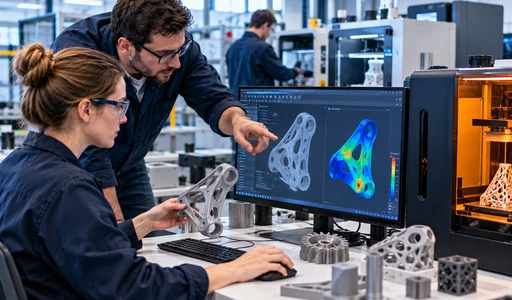
There are two main topics in this course: professional 3D CAD tools and amateur ones. Students learn modeling parts, designing assemblies, and using parametric processes that create files that can be printed right away. Topology optimization and lattice structure design are taught as standard methods, not as advanced electives, because employers in the aerospace, automotive, and robotics industries are looking for people who can design lightweight structures. A study from 2021 by MarketsandMarkets said that the global market for topology optimization software would grow at a rate of over 15% per year until 2026.
Material Selection and Design for Printability
The choice of material affects all decisions that follow. Polymers are taught for FDM, photopolymer resins are taught for SLA/LCD, and metal powders like titanium alloys and stainless steel are taught for SLM. The students learn how the properties of a material, such as layer adhesion, thermal behavior, and shrinkage, affect the quality of the print and the needs for post-processing. When you know about these things during the design phase, you can cut down on failed prints and rework, which is one of the main costs that affects additive manufacturing production settings.
Comparing 3D Printing Technologies for Additive Manufacturing Needs
FDM, SLA/LCD, and SLM: A Side-by-Side Look
Picking the wrong printing method wastes time and money because each one is used for different things. People who take the course learn how to use all three big platforms:
Here are some important ways to compare the three methods of production:
FDM stands for "Fused Deposition Modeling." Ideal for making working prototypes, jigs, and teaching displays. Most of the time, layer resolution is between 100 and 300 microns. Its low cost makes it perfect for planning steps with a lot of changes.With a layer precision of 25–50 microns, SLA/LCD resin printing gives you finer surface detail and tighter limits. It works well for complicated surface shapes and esthetic models made before production.SLM stands for "selective laser melting." Used to make solid metal parts for medical gadgets, mold tools, and spacecraft. Using titanium, Inconel, or tool steel, it is possible to make fully dense metal parts that are similar in mechanical properties to worked material.
- FDM (Fused Deposition Modeling): Best suited for functional prototypes, jigs, and educational demonstration. Layer resolution typically ranges from 100 to 300 microns. Low material cost makes it ideal for iteration-heavy design phases.
- SLA/LCD Resin Printing: Delivers finer surface detail and tighter tolerances, with layer resolution reaching 25–50 microns. Well-suited for complex surface geometries and pre-production aesthetic models.
- SLM (Selective Laser Melting): Used for structural metal parts in aerospace, mold tooling, and medical devices through innovative design and 3D printing for additive manufacturing. Capable of producing fully dense metal components from titanium, Inconel, or tool steel with mechanical properties close to wrought material.
In the context of procurement, these differences are very important. If a school wants to build a full-process additive manufacturing lab, they need all three, not just the cheapest one. The course prepares students to make decisions and explain them.
Balancing Print Resolution and Production Speed
High clarity and fast processing don't usually go hand in hand without some trade-offs. As ways to keep this balance in mind, the course talks about slicing software configuration, support strategy, and build orientation.
Software Tools for Design-to-Print Workflows
Learners work with slicing software to get files ready for each process, in addition to CAD. They practice changing settings and writing down how those changes affect the quality of the output, which is a skill that can be used directly in process engineering jobs. The platform also lets users access simulations online, so students can do motion testing even when they don't have access to software rights locally. This is important for schools that share lab equipment.
Practical Guide to Procuring 3D Printing Services and Equipment
What to Look for in an Additive Manufacturing Training Supplier
When schools invest in additive manufacturing labs, they have to deal with real buying challenges. A reliable innovative design and 3D printing for additive manufacturing provider should offer clear course outlines, partnerships for co-teaching with industry engineers, and support promises after delivery, in addition to just delivering equipment. As target partners, ECR Academy works with businesses, schools, and industry groups, providing a full-process training system rather than separate hardware.
Evaluating Total Cost of Ownership
It can cost more than $100,000 USD for a single SLM metal printer. When schools figure out their return on investment (ROI), they have to include costs like supplies, maintenance contracts, staff training time, and the work that goes into integrating the curriculum. The ECR Academy course plan cuts down on these hidden costs by giving teachers ready-to-use teaching tools like micro-lesson videos, operation demonstrations, and project cases. This way, teachers don't have to start from scratch when they start teaching.
After-Sales Support and Long-Term Curriculum Updates
One thing that worries big buyers all the time is that suppliers might not show up after delivery. Structured faculty co-development, enterprise engineer participation in live instruction, and ongoing curriculum alignment with current industry standards are all parts of the ECR Academy training system that deal with this issue. Schools get an academic partner for life, not just for one deal.
Future Trends and Sustainable Practices in Additive Manufacturing Design
Multi-Material and Hybrid Manufacturing
In the next stage of additive manufacturing, different materials are mixed together in a single build, or additive steps are combined with CNC finishing that removes material. These mixed methods are already used in the medical device and aerospace industries. The course's focus on DfAM principles helps students get ready to use these workflows as the technology gets better.
AI-Driven Design Automation
Now that generative design tools are built into most CAD programs for innovative design and 3D printing for additive manufacturing, they use set load conditions and material limits to automatically create the best geometries. A study published in the journal Additive Manufacturing in 2022 found that using AI to help with generative design cut the weight of parts by 30–40% on average compared to using traditional methods. These tools are taught in the course as useful choices for the planning process.
Sustainability and Waste Reduction
By only adding the material that is needed, additive manufacturing already cuts down on waste compared to subtractive methods. This benefit is strengthened by the course, which teaches how to handle powder for SLM, glue for SLA/LCD, and materials for recycling. These actions are in line with the institutions' promises to be environmentally friendly and lower their ongoing running costs.
Case Studies and Industry Insights from Leading 3D Printing Providers
Aerospace: Part Consolidation in Practice
The direct metal laser sintering process used by GE Aviation to make the LEAP fuel tube combined 20 different parts into a single printed part. The end result was 25% less weight and five times better durability. Integration of structure design to group parts together in this way is one of the main skills taught in the ECR Academy course.
Education Sector: Building Full-Process Labs
When schools build labs that only do FDM, they miss a chance to make their programs stand out when they apply for approval or compete in student events. Since 2010, ECR Academy has helped more than 500 business and institution partners in more than 28 countries, and more than 300,000 students have earned internationally recognized skills credentials. This track record makes procurement teams sure that the training system is of good quality and will last.
Industrial Training: Reducing New Employee Ramp Time
Structured training in additive manufacturing has cut the time it takes to qualify new employees by a large amount. This course has clear competency benchmarks, standardized teaching tools, and project-based evaluation, which all make it easier to track progress and show top management the return on investment (ROI).
Conclusion
This study takes students through the whole process of innovative design and 3D printing for additive manufacturing, making computer models, planning processes, and making 3D printed parts. It includes the FDM, SLA/LCD, and SLM processes in a planned project environment, with help from business engineers and academics. If businesses, schools, and training centers want to get better at additive manufacturing, the ECR Academy course gives them results that can be measured and are in line with current skill standards in the industry.
Partner with ECR Academy for Additive Manufacturing Training
A structured innovative design and 3D printing for additive manufacturing training method is available from ECR Academy. It is based on 16 years of professional experience gained in 28 countries. Our course framework is ready to be used by any organization that needs a qualified innovative design and 3D printing for additive manufacturing supplier. This includes schools, business training centers, and industry groups. Get in touch with us right away to ask for a program overview or to talk about relationship choices. To find out more, email our team at ecr2008@enteredu.com or go to enteredu.com.
FAQ
1. Can institutions integrate this course into existing lab infrastructure?
Yes. The course is meant to work with FDM equipment that you already have while also teaching you how to use SLA/LCD and SLM processes. The teaching resource package has micro-lesson videos, operation demonstrations, and project cases that can be changed to fit the needs of the institution and its equipment.
2. What career outcomes does this course support?
Graduates are ready for jobs like 3D Printing Engineer, Product Structure Designer, Mechanical Designer, Intelligent Manufacturing Equipment Operator, and Additive Manufacturing Process Engineer.
3. Is enterprise engineer involvement part of the standard course delivery?
Yes. Enterprise engineers and college teachers work together to teach the course. This means that students work on real projects while also learning structured theory. They don't just work on simulated case studies that aren't connected to real production conditions.
References
1. Gibson, I., Rosen, D., & Stucker, B. (2021). Additive Manufacturing Technologies: 3D Printing, Rapid Prototyping, and Direct Digital Manufacturing. Springer.
2. MarketsandMarkets. (2021). Topology Optimization Software Market — Global Forecast to 2026. MarketsandMarkets Research.
3. Frazier, W. E. (2014). Metal additive manufacturing: A review. Journal of Materials Engineering and Performance, 23(6), 1917–1928.
4. Wohlers, T., & Gornet, T. (2022). Wohlers Report 2022: Additive Manufacturing and 3D Printing State of the Industry. Wohlers Associates.
5. Gao, W., et al. (2015). The status, challenges, and future of additive manufacturing in engineering. Computer-Aided Design, 69, 65–89.
6. Huang, S. H., Liu, P., Mokasdar, A., & Hou, L. (2013). Additive manufacturing and its societal impact: A literature review. International Journal of Advanced Manufacturing Technology, 67(5–8), 1191–1203.

_1781601799781.webp)