Humanoid Robot Programming Course: Build Real-World Robot Skills
A humanoid robot programming course teaches you to control a human-shaped robot through code, sensors, and motion algorithms. In this E.C.R Academy course, you work on a full-size humanoid platform and write applications in Python and C++ with ROS and ROS 2. You process data from 3D LiDAR and cameras, build maps, detect objects, and program walking, gestures, and voice interaction. Each project mirrors a real task, such as a museum tour guide or a factory handling job. I wrote this guide for college leaders who want to judge the content, the hardware, and the results before they commit.
Understanding the Fundamentals of Humanoid Robot Programming
You should know what the company is about before you compare training options. The next three sections talk about what makes this field special, what languages are important, and what coding skills students need.
What Sets Humanoid Robot Programming Apart
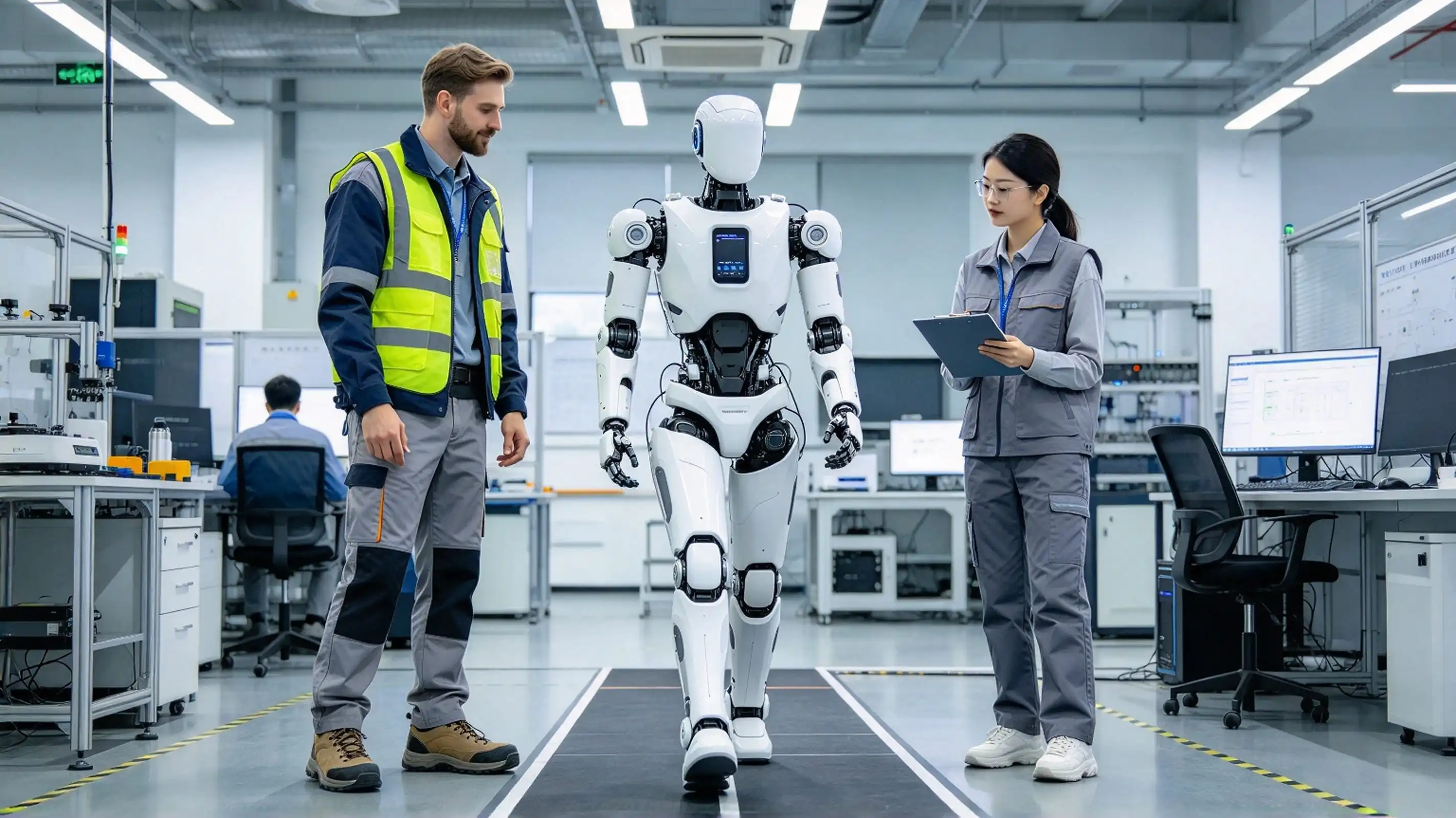
Inside a safe cell, an industrial arm sits on a fixed base and moves along a set path. A drone only needs a few fans to know how to fly. Humanoid robots must be able to walk on two legs, move many joints at once, and work in spaces designed for people. The MagicBot Gen 1 in our class has 42 active degrees of freedom. This means that an incorrect command can affect the movement of the whole body. Introduction to Humanoid Robotics, a book that Kajita and his coworkers wrote in 2014, talks about how to walk on two legs and keep your balance. Students learn that programs need to remain stable throughout operation, not just when they are first developed.
Core Languages and Middleware
Python and C++ are used to build most tasks. Python lets you make quick tests, work with data, and write scripts that say what should happen. C++ is good for code that needs to run quickly, like control loops. ROS is in charge of the message layer that lets sensors, controllers, and motors share information. In 2009, Quigley and his coworkers made ROS as an open-source system. In 2022, Macenski and his coworkers wrote about ROS 2, which has software called DDS. You can use either C++ or Python to interact with the open-source SDK magicbot-gen1_sdk. Our course covers the basics of both ROS and ROS 2. In the same project, students can start with short code examples and work their way up to full applications.
Essential Coding Skills: Motion, Sensors, and Voice
These are the three skills that are most useful. Part of motion processing is being able to stand, balance, make movements, and control joints. Reading 3D LiDAR, depth cameras, and fisheye cameras is a part of integrating sensors. Then, the information from all of these sensors is combined to make a single picture of the room. When you talk to the robot, it can interpret what you want and respond with an appropriate action. In the beginning, our students use high-level motion APIs. Then they move on to low-level interfaces, which let them better control the joints. There are also safety tools that they learn how to use, as well as different troubleshooting modes. When you look at any humanoid robot programming training, write down these three areas and ask how they are taught on real hardware.
Step-by-Step Guide to Building Programming Skills
Knowing the parts is one thing, but putting them together is something else. Our learning process has three steps. The robot is set up and used in practical exercises at the end of each step.
Stage One: Platform Setup and Basic Modules
The first things taught are how the robot's hardware and software work together. Students learn about ROS and ROS 2 and how to set up the development environment. They also use a mobile app, a device, and a remote control to handle the robot. You'll learn how to check on the robot's health, change its voice and lights, and make hand signals like nodding and shaking. Students also use their hands to pick up things and move them around with two fingers. Routines and examples that are shown to beginners help them become better quickly. It's important to know how code turns into movement, and these early exercises will help you understand that connection. You don't need any prior skills to take the course.
Stage Two: Motion Control and Multi-Sensor Perception
In the second stage of humanoid robot programming, students use high-level APIs to control motion so that they can stand up, keep their balance, and move quickly. After that, low-level connections are used to fully control the joints. In more advanced routines, you might work on bending your back, getting back up after falling, and dealing with problems. Students use information from depth cameras, 3D LiDAR, and fisheye cameras all at the same time to find obstacles, make maps of the area, and identify objects. They find things with YOLO, the real-time method that Redmon and his coworkers made in 2016, and process RTSP video sources. In this step, a robot that only follows programmed commands can begin to understand and respond to information from its surroundings.
Stage Three: Integrated Projects and Competition Readiness
The last step is what makes it all work. Students make a smart tour guide for art galleries, museums, and science centers by putting together maps, guidance, path planning, voice interaction, and face recognition. Next is a factory scenario where several robots work together to move things and put parts together. They can respond to mistakes, share maps, and plan their work. Students also come up with simple ways to show how they feel, such as waving, shaking hands, and cheering. They find bugs in the code, fix them, and make the system run better. These projects, which run on a full-size platform, give teams strong hardware support for competition applications.
Comparing Humanoid Robot Programming Platforms and Kits
The next thing you should think about is what hardware will work with the learning path. There are open-source choices, well-known systems, and differences between a small robot kit and a full-size robot in this section.
Well-Known Platforms
A lot of the time, more than one name comes up. Bots called NAO and Pepper are often used in classrooms and research labs. They are both made by SoftBank Robotics. A small robot called NAO looks like a person, and Pepper is a bigger robot with wheels that was made to be friendly. For now, Honda has stopped showing off ASIMO, their robot that can walk on two legs. It showed what was possible. Atlas was made by Boston Dynamics as a research humanoid. It is known for being able to move quickly and easily. The company stopped making the hydraulic Atlas in 2024 and began making an electric one instead. Pick the robot based on what you want to learn, not what it says in the title. You can use each platform for different learning objectives.
Proprietary and Open-Source Options
Most proprietary systems are ready to use, but it may be harder to get licensing, view code, or make changes. People who use open source options, like the iCub humanoid from the Italian Institute of Technology, can change the designs and software more freely. Price, contract terms, freedom, and community support are the four things that make the difference for a college. In our class, we use the open-source SDK magicbot-gen1_sdk. It can be used with both C++ and Python, and it comes with a library of pre-set actions like clapping, shaking your head, waving, and shaking hands. Teachers can either tell an action to happen or write their own control program. Open ROS tools help students learn skills that they can use on other robots too.
Beginner Kits Versus a Full-Size Platform
Small kits are less expensive and a good way to learn how to use servos, code, and make simple actions. If you want to learn basic logic, they can do that, but they cannot fully reproduce whole-body balance, 3D LiDAR mapping, or fine motor skills on a full-size humanoid platform. They cannot provide the same training experience as a full-size platform. The full-size platform stands 174 cm tall and can move in 42 different ways. The MagicHand S01 is on board. Each hand has 11 degrees of freedom. There is also 3D LiDAR, two depth cameras, and three fisheye cameras. With kits, schools can teach students basic robot control, while a full-size platform can support more advanced training and competition teams. Choose based on the level of your students and the learning outcomes you want to achieve.
Procurement Guide for Humanoid Robot Programming Solutions
Platform comparisons can only help you make the first pick. The next three points talk about how much it costs, how the training is set up, and how well the supplier meets the needs.
Weighing Hardware, Software Licenses, and Return on Investment
Price by itself doesn't tell you much. Find out what the whole package includes: the robot platform, the SDK, course materials, help, and time with the teacher. Then, look at that package and think about how it fits with the jobs you want and your plans to enroll. License fees can be cut with open-source tools, and if more than one group uses the same platform, the cost of the gear is split among more students. Check that the course can be taken on the computers in your lab and with the equipment you already have. I believe you should write down each cost line next to each learning result before you ask for prices. The side-by-side view makes it easy to see where the gaps are.
Online Versus In-Person Training Formats
You can learn theory, models, or code all online for humanoid robot programming. Students can also work together even if they are in different time zones. Safe startup, calibration, and fall recovery are all things that need to be done with your hands on the robot. These tasks work best when they are done in person. Students can learn from anywhere with an internet connection thanks to the open-source SDK and preset action library in our course. The work that needs to be done on the physical platform is completed in person. In college, a mixed plan works best most of the time. This is where students learn, and then this is where they use the robot. How you format the course should depend on how big your lab is, how busy you are, and how many robots you have.
Choosing a Supplier You Can Work With Long Term
A good supplier does more than just ship things. Look into the teachers' backgrounds, the lesson plans, and how well the school has done in the past. A lot of robot makers, like UBTECH and SoftBank Robotics, sell platforms. The material that is taught is added by a training provider. The E.C.R. Academy has trained and tested nearly 500,000 people in China and 28 other countries since 2010. We've had the pleasure of putting on more than 150 skill contests with more than 3,300 experts and 500 businesses. Experts in business engineering and academia teach our course, which is based on international standards for professional skills. Written materials and course documentation should clearly explain the training content, instructors, hardware, and expected learning outcomes so buyers can evaluate the program before making a decision.
Overcoming Common Challenges in Humanoid Robot Programming
Everything in a complex robotics project can go wrong, so it's best to be ready for potential problems. We will talk about problems with technology, speech restrictions, organizational problems, and future trends in these four points.
Technical Challenges: Debugging Motion and Sensors
Humanoid robot programming fails in ways that surprise people who are new to it. When sensors give too many noisy readings, the path planner can get off track. A small mistake in timing can throw the robot off balance. Check the system state often, test in small steps, put the code for motion into debug mode before making any changes, and always make sure the safety system is on. The students in our class work on recovering after falls and handling problems. They learn how to read information from more than one screen at the same time. Because it sets rules for personal care robots, ISO 13482 also tells teams that safety rules are important when they are around people.
Speech Recognition and Interaction Limits
Voice chat works better in empty rooms than in crowded hallways. When there is background noise, an accent, or short directions, it's easy to get lost. For the tour guide project, students give the robot more than one way to confirm what a guest wants by letting it talk, recognize faces, and move. They don't just test at their desks; they test in real places like show halls too. Through practical testing, students learn how to set reasonable limits and write down back-up plans, such as asking the visitor to repeat a request.
Organizational Hurdles: Skill Gaps, Integration, and Budget
Many bosses are worried that no one on their staff knows how to teach this subject. A mix of business engineers and academic leaders teach our course. The open-source SDK and library of pre-set actions give teachers a good place to begin. First, make sure that the lab computers meet the requirements that have been made public for integration. These include at least Ubuntu 22.04, 16 GB of memory, and a graphics card with 4 GB of VRAM that is only used for graphics. You could buy things in steps to save money. Start with the course and one platform. As more people sign up, you can add robots.
Preparing for AI-Driven Change
Based on what we know now, robots may be able to learn new skills instead of just doing what they are told. Humanoid robots can walk and move with the help of model predictive control, reinforcement learning, and whole-body control. They will find it much easier to follow these approaches if they already know ROS 2, Python, C++, and multi-sensor perception. You can add more features to the open-source SDK as your class grows. Students can start working on AI-driven projects right away since they have already learned about YOLO object recognition and scheduling multiple robots.
Conclusion
Humanoid robot programming uses code, sensors, and body movement on a platform that needs to stay stable around people. The three skills discussed in this article are voice interaction, motion control, and sensing. It also covered the core languages and the tools provided by ROS and ROS 2. The three-step process went from setting up the platform to tour guides and projects with more than one robot. It also looked at open-source systems, well-known platforms, and small kits versus a full-size robot. Finally, it explained what to consider when buying a solution, including price, training format, and provider capabilities. It also discussed how to fix bugs, set speech boundaries, fill skill gaps, and meet lab requirements. It's important to remember that a school gets the best results when its platform, open tools, teachers, and projects deliver the learning outcomes promised to students.
FAQ
1. Can I take this course with no prior experience?
Yes. Students learn the basics of how the robot works before they make applications because the training builds on those basics step by step.
2. What career roles can I pursue after completing the course?
After you graduate, you can work as a motion control engineer, an autonomous navigation and path planning engineer, a multi-robot collaborative system development engineer, a ROS/ROS2 development engineer, a humanoid robot programming algorithm engineer, an embodied intelligence development engineer, a robot vision algorithm engineer, or as a teacher or trainer for international competitions.
3. What are the minimum computer requirements?
You need at least version 22.04 of Ubuntu, an Intel Core i5 processor, 16 GB of memory, a 256 GB hard drive, and a graphics card with 4 GB of VRAM to use it. The setup for development must be able to run at least CMake 3.16, Python 3.10, and C++20.
Request Humanoid Robot Programming Course Details from E.C.R Academy
Looking for a humanoid robot programming supplier for your college? They have trained almost 500,000 people since 2010. There are expert teachers, a full-size MagicBot Gen 1 platform, and an open-source SDK in our course. Go to enteredu.com or email us at ecr2008@enteredu.com to talk about your program and find out more about training.
References
1. Science Robotics, 2022. Robot Operating System 2: Design, Architecture, and Uses in the Wild.
2. ICRA Workshop on Open Source Software, 2009. ROS: An Open-Source Robot Operating System.
3. IEEE Conference on Computer Vision and Pattern Recognition, 2016. You Only Look Once: Unified, Real-Time Object Detection.
4. Springer, 2014. Introduction to Humanoid Robotics.
5. International Organization for Standardization, 2014. ISO 13482: Robots and Robotic Devices, Safety Requirements for Personal Care Robots.
6. Springer, 2016. Springer Handbook of Robotics, 2nd Edition.