Electronic Product Testing Technology for International Market Access
With the help of electronic product testing technology, businesses can sell their goods in other countries. Rules, tools, software, test methods, and written instructions are used to make sure a product is safe, works, can be trusted, and follows the rules. The FCC sets rules on emissions and UL lists safety in the US most of the time. What it means for Europe is CE marking and RoHS. There are clear steps, correct information, and a useful way to help their teams get better at testing in this guide. It was written for college program directors, quality managers, and lab directors.
What Is Electronic Product Testing Technology and Why Does It Matter?
Definition and Lifecycle Scope
Electronic product testing technology includes every tool and method used to make sure an electronic product meets its needs. Test fixtures, software, written instructions, and the rules that say what needs to be done to pass or fail are all part of that. Testing starts with PCB assemblies and parts. It then moves on to prototypes and production lines. Finally, it ends with finished goods and returns from the field. At each step, the question is different. An engineer first checks to see if the plan works. After that, the production teams make sure that each unit is the same as the approved design. Buyers want to see proof that a supplier can consistently achieve the same outcome using well-tuned tools and records that can be followed.
Verification, Quality Control, and Certification Testing
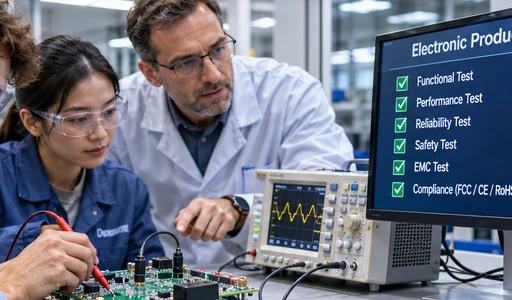
There are two different ways to say the same thing. During product verification, a design is checked against what was asked for in the specification. Every production lot is checked by quality control to make sure that none of them break the rules. One way to test something's dependability is to see how long it lasts when it's hot, humid, and shaking. Tests for certification, which are usually done in a lab that has been approved, prove that something meets a certain standard. All along the line, from the time the parts come in to the time they are inspected, there are manufacturing inspection screens units. It's not possible to skip the next four checks just because the first one says it passed. A weak solder joint could make a product break soon after it's sold, even if it doesn't get too dirty. All five are used at the same time by the best programs.
Why Testing Controls Market Access
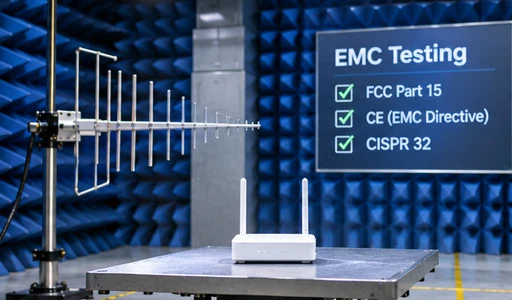
How to get into each market is different. This is what FCC Part 15 says about how much radio frequency emissions electronics can give off in the US. Many buyers and local governments look for UL safety listing. In the European Union, companies that make goods say that their items meet rules such as the Low Voltage Directive, the EMC Directive, and RoHS by putting on the CE mark. RoHS states that ten substances are controlled. Lead, mercury, and cadmium are some of these. People and government agencies both trust test results from labs that follow ISO/IEC 17025. Testing a product early on usually costs less than redesigning it after it failed.
The Main Types of Electronic Product Testing and How They Compare
Functional, Performance, and Reliability Testing
Functional tests make sure that a product can do its job, such as connect, turn on, and respond to keys. Response time, voltage accuracy, power use, and signal quality are some of the numbers that are added up during performance tests. It is checked for reliability to see how long something will last. Changes in temperature, humidity, vibrations, and mechanical stress are some of the things that engineers use to find designs that aren't strong before customers do. Ways like HALT push a design past its normal limits while it is being built. This helps teams quickly find and fix weak spots. These three kinds of tests let you see how well a product works on its first day and after months of use.
Safety, EMC, Environmental, and Material Compliance Testing
During safety tests, electrical risks like fire and shock are looked for. IEC 62368-1 is the risk-based safety standard for things like audio, video, computers, and phones. This test checks two things: how much interference a device sends out and how well it stops interference from other devices. CISPR 32 tells hardware for multimedia what levels of emissions they need to meet. Testing in different climates and levels of humidity makes sure that the system works in all of them. Material compliance testing, also known as RoHS screening, makes sure that substances that aren't allowed don't get too high. There are different types of risks that each group looks for, so a test that passes doesn't cover all of them.
Manual vs. Automated Testing, and ICT vs. Functional Testing
Engineers have a lot of freedom when they test things by hand during development, when designs change a lot. When testing is done automatically, the results can be used again and again, and making a lot of things faster is possible. An in-circuit tester (ICT) pokes a PCB assembly to find holes, shorts, and parts that are missing or don't work right. If you do functional circuit testing (FCT), you turn on the board and test the whole system to see how it works. Many lines use both ICT and FCT because they are different but work together to figure out what's wrong with the system. Tests for safety must be done. With a dielectric withstand test, high voltage is used to see if the insulation breaks down. An insulation resistance test checks how well the insulation stops leaks. They shouldn't be switched around by teams.
Electronic Product Testing Process for International Compliance
Define Markets and Identify Standards
Start with the item and where you want it to go. When sending a power adapter to Germany, the rules are different from when sending a Wi-Fi speaker to the US. Make a list of the countries you want to reach, the items you will use, the power source, the radio features, and the type of product you will sell. Lastly, make sure that each item follows its rules. This would be FCC Part 15 and UL standards in the US, CE directives in Europe, and CCC for products sold in China. There are different rules for each type of product, so it will save you time to talk to an accredited laboratory or compliance specialist right away. Make a compliance matrix that links each requirement to a test and the lowest score that must be achieved in order to pass.
Test Plan, Pre-Compliance, and Formal Certification
For each requirement, the test conditions, acceptance criteria, sample sizes, and tools that will be used are written down in a test plan. Another thing is that teams can test prototypes for emissions, temperature rise, and insulation before they spend real lab time on the project. Most of the time, fixing problems now is cheaper than fixing them after the tools are done. After that, formal certification takes place in a government-approved lab. After that, this lab gives out the report that backs up the declaration, listing, or permission. You should gather extra samples in case you need to do another test.
Mass-Production Transfer, Documentation, and Common Risks
A sample is all that is certified, not every unit that is shipped. This means that the rules for the factory floor need to be changed. Bad firmware updates, wrong product configurations, data that can't be tracked, and high voltage protection that isn't good enough are all common risks. I found it easy to use the controls. They have written changeover procedures, calibrated instruments, interlocked enclosures, emergency stops, revision management, and keeping track of serial numbers. Tech files and records of calibration will need to be kept up to date for auditors. You might not know how much it will cost to fix problems and test again if you only look at the lowest price.
Testing Equipment, Industry Priorities, and Supplier Selection
Core Instruments and Production-Line Architecture
There are controllers, software, safety devices, data interfaces, measurement tools, and fixtures in a modern test system. There are many instruments that are used, such as digital multimeters, oscilloscopes, signal generators, programmable power supplies, electronic loads, hipot testers, LCR meters, environmental chambers, and automated optical inspection (AOI) systems. Barcodes that can be scanned connect each part of a production line to the things that it makes. The data is stored and reports are made using MES or ERP connections. Then, statistical process control charts and real-time dashboards help teams find drift before it turns into a defect. Virtual instruments are used in a lot of music training programs to help students practice early on because real instruments are expensive.
Testing Priorities by Industry
They put more weight on different tests because their products have different risks. When it comes to consumer electronics, safety, EMC, and wireless performance are all important. Car electronics, such as ADAS and battery management systems, need to be checked for vibration and heat shock. Teams check the 5G equipment's RF signal and the speed at which data flows to make sure they are clean. Electrical safety is the most important thing when making medical devices. Tests need to be done to see if IoT and smart home products can work together wirelessly. Power electronics need to be checked for heat and high current. The tests that are used change as a product goes from being a prototype to being engineering validated, certified, put into pilot production, and then into mass production.
Choosing Technology and a Supplier
Start with the project stage, like development, pilot build, mass production, or getting ready for certification. Then you should check the total cost of ownership, test coverage, standards, accuracy, repeatability, cycle time, operator safety, traceability, and how much it costs to run the whole thing. You should not only look at machine prices, but also full technical proposals. Set clear parameters for the products, countries you want to sell them to, standards, test limits, yearly volume, and factory conditions before you ask for quotes. Find out what kinds of products they sell, how to calibrate them, if they offer software support, spare parts, and ways to make changes in the future. Even though hardware is important, training is even more so because tests can become less reliable when staff members leave.
How the E.C.R Academy Course Builds Testing Skills?
Curriculum and Skills You Gain
Theory and practice are combined in our course on Electronic Product Testing Technology. It has four parts: basic testing of electronics, technology for inspecting electronics, testing to make sure safety rules are followed, and practice in certification and accreditation. First, they learn how to use signal generators, multimeters, and oscilloscopes. After that, they do incoming, in-process, and final inspection. Quality analysis, figuring out conformity, and sampling methods are some of the other things they work on. In the safety module, you can test for power, temperature rise, dielectric withstand, leakage current, ground resistance, and flame retardant. When the course is over, students write test reports, answer audit questions, and get documents ready to be certified.
Browser-Based B/S Platform and Virtual Labs
The course runs on a B/S (Browser/Server) platform, so all you need is a web browser to take it. You can keep track of your progress in real time and watch video lessons, take online tests, play virtual games, and use multimedia courseware on the platform. A library of real-life case studies from the business world and a virtual testing lab let students practice using instruments in a fake environment. These learning paths adapt to the learner's background and goals by suggesting content. If you have never taken an electronics class before, you can still sign up and do the simulations over and over until they feel natural.
Standards, Certification Coverage, Faculty, and Partners
International testing standards are used to build the course, and the CCC, UL, and CE certification systems are talked about. We make sure that the content is always up to date with the latest rules in the field. In the role of senior enterprise testing engineers, teachers from both business and academia work together. Since 2010, E.C.R. Almost 500,000 people in China and 28 other countries have been trained and tested by it. It is known that more than 300,000 of these students have earned skills certifications. We work with corporations, schools, and trade groups, among other places. Graduates can learn how to become test technicians, safety compliance test engineers, and product inspectors.
Conclusion
Electronic product testing technology connects a product's design to its marketability. You need to test more than once. There are different kinds of risks that are looked for by the functional, performance, reliability, safety, EMC, and material checks. People are less likely to send in incomplete forms when there is a set process for everything, from setting standards to pre-compliance testing, certification, and factory transfer. The kind of product, the market where it will be sold, and the amount that will be made all have an impact on the suppliers, equipment, and industry priorities that are chosen. The results stay the same after certification because they are recorded, checked, and can be tracked. Planning to train people is just as important as planning to buy instruments because staff turnover can make that less reliable. This class teaches these skills through real-world projects, online labs, and content that is CCC, UL, and CE.
FAQ
1. What is the difference between product testing and certification testing?
As you test a product, you compare its features, how well it works, and how reliable it is to your own standards. The testing for certification usually takes place in a lab that has been approved. It checks to see if a certain standard is met and then sends a report to buyers or regulators. Most things need both of them.
2. Which methods are common in mass production?
A lot of the time, lines do AOI, ICT, FCT, high potency testing, and environmental stress screening all at the same time. The best mix changes based on the risk, the amount, and the type of product.
3. Can beginners take the E.C.R Academy course?
Yes. The first part of the class is about basic electronics, and students can practice over and over again with virtual simulation experiments. Learners don't need to install anything to join; they can just use a web browser.
4. Does the course align with international standards?
Yes. It is tested against international standards, has certifications like CCC, UL, and CE, and is always up to date with the latest industry standards.
Request a Customized Electronic Product Testing Technology Course
Searching for a business that offers employee training in addition to electronic product testing technology? That course at E.C.R. is in a browser. Academy is based on real testing projects and is taught by senior testing engineers and college experts. The course goes over things related to CCC, UL, and CE. Send an email to ecr2008@enteredu.com telling us how many people are on your team, what their jobs are, and what your training goals are. We'll respond with a plan that works for your school, business, or group.
References
1. International Electrotechnical Commission, IEC 62368-1: Audio/video, information and communication technology equipment – Part 1: Safety requirements, 2018.
2. Federal Communications Commission, Title 47 of the Code of Federal Regulations, Part 15: Radio Frequency Devices, 2024.
3. European Parliament and Council, Directive 2011/65/EU on the restriction of the use of certain hazardous substances in electrical and electronic equipment (RoHS), 2011.
4. European Parliament and Council, Directive 2014/30/EU on electromagnetic compatibility, 2014.
5. International Organization for Standardization and International Electrotechnical Commission, ISO/IEC 17025: General requirements for the competence of testing and calibration laboratories, 2017.
6. International Electrotechnical Commission, CISPR 32: Electromagnetic compatibility of multimedia equipment – Emission requirements, 2015.