Why New Energy Vehicle Fault Diagnosis & Troubleshooting Skills Matter Today
The rapid growth of the electric vehicle market has made new energy vehicle fault diagnosis & troubleshooting one of the most sought-after technical skill sets in the automotive industry. According to the International Energy Agency, global EV stock surpassed 40 million vehicles in 2023, and service centers worldwide are struggling to find qualified technicians. For vocational institutions, OEM training departments, and automotive service networks, investing in structured diagnostic training is no longer optional — it is a direct response to a skills gap that is costing the industry billions in delayed repairs and customer dissatisfaction.
Why NEV Diagnostic Skills Are Different From Traditional Automotive Training
The Three-Electric System Changes Everything
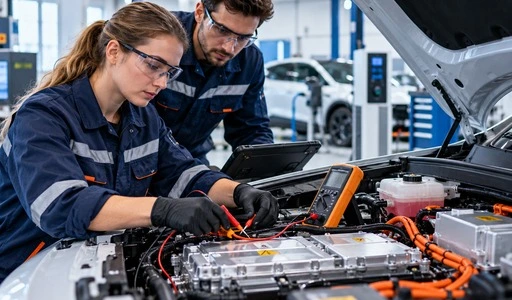
The power battery, the drive motor, and the electronic control unit—collectively known as the "Three Electrics"—are the three main components that make up a new energy vehicle. In contrast to combustion engines, these systems have problems with high-voltage circuits that work above 400V, and more and more above 800V in newer platforms. A mechanic who has only worked on regular cars doesn't have the experience or knowledge to do their job safely and well in this setting.
High-Voltage Safety Is a Non-Negotiable Baseline
In a good high-voltage system, the insulation resistance should stay above 500 Ω/V. The BMS sets off a fault state that grounds the vehicle when this value drops. This usually happens because of moisture getting into connectors or tiny cracks in seals. In any service setting, technicians who can't read BMS safety limits or check the continuity of the High-Voltage Interlock Loop (HVIL) are a risk.
Software Integration Adds a New Diagnostic Layer
Modern NEVs have complicated software stacks and over-the-air (OTA) updates that can change how the system works between service visits. Normal OBD-II readers can't get to private BMS data streams. To find problems with motor driver PWM or voltage imbalances at the cell level, you need special tools and the ability to understand real-time data. You can only learn these skills through organized, hands-on training.
Understanding the Scope of NEV Fault Diagnosis
Battery System Faults Are the Most Common and Costly
A lot of NEV repair events are caused by things like battery degradation, cell imbalance, thermal issues, and BMS signaling mistakes. Safe battery system inspection starts with tests that are in line with GB/T 18384 and UN ECE R100. These tests include checking the insulation under 1000V of stress and making sure the battery can charge and discharge.
Motor and Controller Diagnostics Require Precision Measurement
Before a full fault code is recorded, drive motor faults often show up as changes in how the motor works in new energy vehicle fault diagnosis & troubleshooting. Checking the result of a PWM signal with an oscilloscope helps tell the difference between program errors and hardware problems in IGBTs. If the logic signals are right but the three-phase output is off, the problem is probably with the hardware, which is something that a normal reader can't tell you.
Communication Bus Errors Disrupt the Entire Vehicle
Problems with CAN-FD and Ethernet communication can spread to more than one control module. To tell the difference between bus errors and sensor failures, technicians need defined standards. To do this, they need to know how to use diagnostic tools and have a good idea of how car networks work.
How Structured Training Closes the Skills Gap
Technicians are ready to work as soon as they graduate from vocational schools and OEM training programs that base their lessons on real NEV processes. Being able to make a program that keeps up with technology that changes faster than most school years is hard.
This is covered in detail in E.C.R Academy's course on New energy vehicle fault diagnosis & troubleshooting. The program covers the whole diagnostic process, from putting together low-voltage electrical parts to checking high-voltage batteries and fixing drive motor faults. It is based on a project-based model that combines classroom learning with hands-on practice.
This is what students learn how to do in the course:
- Assemble and test battery systems: Learners install BMS modules, connect high-voltage busbars, perform insulation testing, and verify charge/discharge cycles under simulated operating conditions that mirror real service environments.
- Diagnose drive motor faults: Using professional diagnostic tools and real-time data streams, learners read fault codes, analyze sensor data, identify communication interruptions, and verify repairs — following systematic procedures aligned with industry maintenance standards.
- Apply high-voltage safety protocols: Every practical task is performed under standardized safety procedures, with learners using CAT III 1000V rated insulated tools and Class 0 high-voltage gloves, and following emergency response protocols specific to NEV environments.
These skills are exactly what NEV assembly engineers, battery system testing engineers, drive motor fault diagnosis engineers, and after-sales service technicians need to do their jobs. These are all in high demand across manufacturing, 4S dealer networks, and independent service chains.
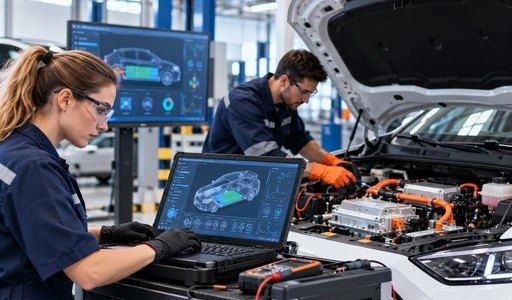
The training platform for new energy vehicle fault diagnosis & troubleshooting has three separate benches: an electrical systems platform for low-voltage circuit testing and assembly, a power battery platform for BMS operation and high-voltage procedures, and a motor diagnosis platform for finding faults and making sure repairs are correct. Learners can practice full workflows instead of just single tasks in this integrated environment.
What Procurement Decision-Makers Should Evaluate
When businesses and institutions look at NEV diagnostic training programs, they should use the same set of standards to see how ready they are for the real world:
- Curriculum alignment: Does the program map to national skill certification frameworks, such as the Ministry of Human Resources and Social Security's NEV maintenance worker qualification standards, or international references like ISO 26262 and SAE J1979?
- Platform capability: Does the training equipment support actual high-voltage procedures, or only simulation? Hardware-level safety features — including insulation monitoring, overcurrent protection, and emergency stop linkage — are non-negotiable for institutional procurement.
- Faculty credibility: Are instructors active industry engineers or only academic specialists? Courses built with OEM technical input carry more weight in employer recognition and graduate placement.
- Content update cycle: NEV technology — including 800V platforms, SiC inverters, and CTP/CTC battery configurations — changes annually. A program without a defined update schedule will become outdated within one product generation.
Conclusion
To keep new energy vehicles safe, you need different skills than those needed for regular car maintenance, particularly new energy vehicle fault diagnosis & troubleshooting. Battery systems, motor controllers, and communication networks all need specific diagnostic skills that aren't taught in most training programs. Businesses and institutions that invest in structured, standards-aligned training now will be able to meet the needs of a growing market and produce technicians that OEM partners know and trust. There is a real gap between what the industry needs and what most programs offer right now, and it will only close when serious money is put into training infrastructure.
FAQ
1. Can someone with no automotive background take this course?
Yes. The course starts with fundamental NEV structures and electrical principles before progressing to high-voltage systems and fault diagnosis. The learning pace accommodates learners from different backgrounds, including those transitioning from adjacent technical fields.
2. What diagnostic tools does the course cover?
The course uses professional-grade diagnostic equipment to perform fault code analysis, real-time data stream interpretation, and repair verification on battery systems, drive motors, and electronic control units. Tool categories align with those used in certified service centers.
3. How does the platform support high-voltage safety compliance?
The training platform includes hardware-level safety protections — insulation monitoring, overcurrent protection, and emergency stop systems — that mirror industrial service standards. All high-voltage tasks follow standardized procedures in compliance with international safety frameworks.
Partner With E.C.R Academy for NEV Diagnostic Training
E.C.R. Academy has been teaching business skills for more than 16 years and has helped almost 500,000 people in 28 countries. We offer institutions and businesses a curriculum based on real industry workflows, delivered by engineers with active OEM experience, as a reliable new energy vehicle fault diagnosis & troubleshooting training provider. We help your talent flow from certification to placement with more than 60,000 learning materials and more than 3,300 experts. To talk about partnership options, email us at ecr2008@enteredu.com or visit our website at enteredu.com.
References
1. International Energy Agency. Global EV Outlook 2024. IEA, 2024.
2. SAE International. SAE J1979: E/E Diagnostic Test Modes. SAE International, 2020.
3. ISO. ISO 26262: Road Vehicles — Functional Safety. International Organization for Standardization, 2018.
4. GB/T 18384. Electrically Propelled Road Vehicles — Safety Requirements. Standardization Administration of China, 2020.
5. United Nations Economic Commission for Europe. UN ECE Regulation No. 100: Battery Electric Vehicles. UNECE, 2023.
6. McKinsey & Company. The Future of Automotive Aftersales: Preparing for the EV Transition. McKinsey Center for Future Mobility, 2023.


_1781601799781.webp)