Building Navigation Systems with Humanoid Robot Programming
Building navigation systems with humanoid robot programming means teaching a robot with a human-like body to move safely and purposefully through real environments. Unlike wheeled robots, humanoid platforms must manage bipedal balance, multi-sensor perception, and real-time path decisions simultaneously. This requires mastery of ROS/ROS2 middleware, SLAM algorithms, depth camera integration, and motion control APIs. At ECR Academy, our structured course translates these technical demands into hands-on skills, equipping learners and institutions with the practical capability to develop, test, and deploy autonomous navigation applications on full-size humanoid robot platforms.
Understanding the Challenges in Humanoid Robot Navigation
Why Humanoid Navigation Is Harder Than It Looks
It doesn't roll; a humanoid computer walks, balances, and rebounds from disturbances while also collecting data about its surroundings. This leads to complex technical issues that stationary industrial arms or self-driving mobile robots on wheels don't have to deal with. Just keeping the dynamic balance needs real-time calculations of joint torque across 40 or more degrees of freedom. These calculations must run at the same time as localization and path planning.
The Localization Problem
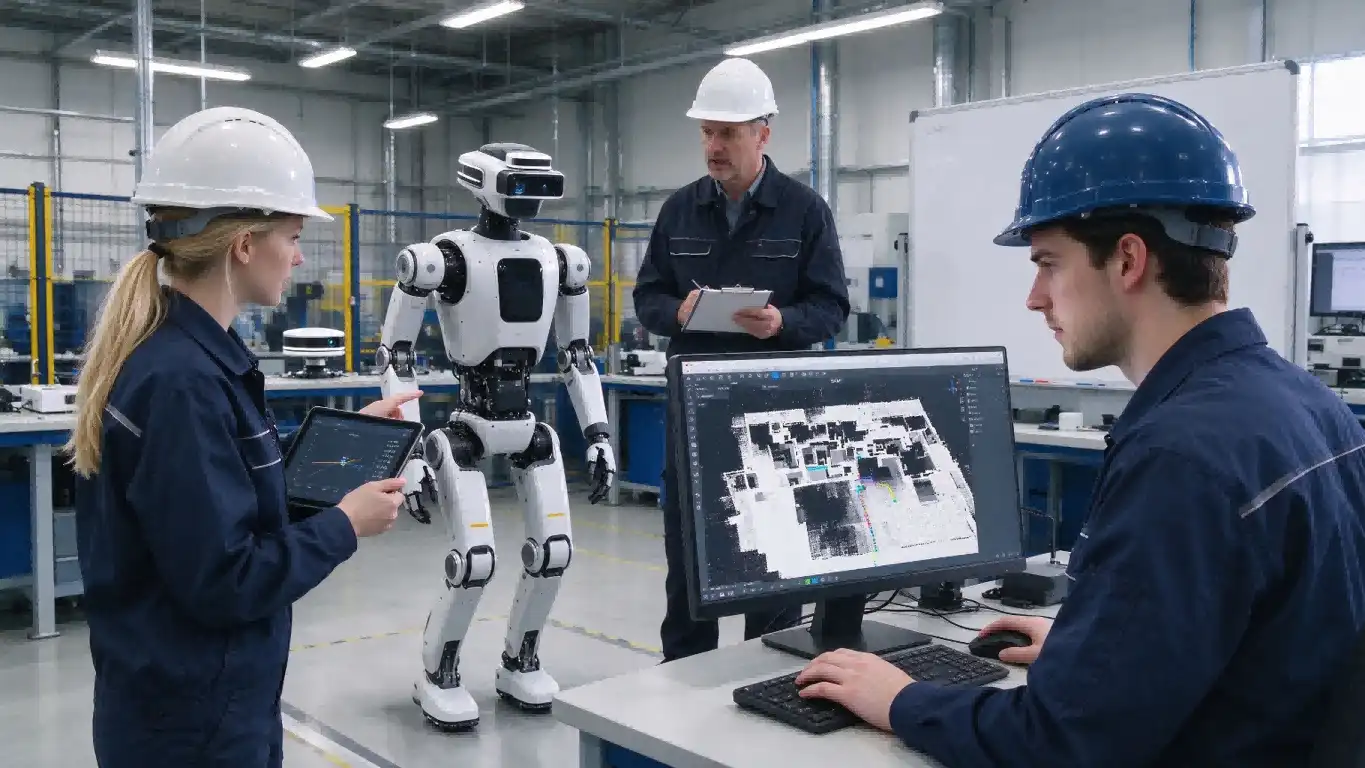
One of the biggest problems in bipedal robotics that hasn't gone away is finding things precisely in unstructured areas. Inside, GPS isn't available, and standard odometry can drift a lot over short distances in places with few features. The practical answer is to combine 3D LiDAR point clouds with depth camera feeds and IMU data. However, it takes well-calibrated devices and finely tuned algorithms to consistently combine these data streams.
Path Planning in Human-Centric Spaces
Usually, when industrial robots plan their paths, they work in a set area. Humanoid robots usually work in places that are meant for people, like offices, stores, and museum halls, where there are lots of people, moving things, and plans that are hard to plan. Planning algorithms like A* and RRT need to be paired with dynamic obstacle avoidance layers and updated at rates that match the robot's physical response time, which is usually less than 100ms per cycle.
Core Components and Technologies for Humanoid Robot Navigation Programming
Sensors That Drive Perception
Reliable perception is the first step to reliable navigation. Each type of sensor is used for a different task by navigation systems on platforms like the MagicBot Gen 1, which has a 3D LiDAR, two depth cameras, and three fisheye cameras. LiDAR makes structure maps, depth cameras find nearby objects and measure distances very accurately, and fisheye cameras take pictures of scenes from many angles to help people understand their surroundings. How well these inputs are combined has a direct effect on the quality of any guidance system.
ROS2 as the Programming Foundation
ROS2 is now the standard software for humanoid robot programming because it lets sensor, vision, planning, and control nodes talk to each other in real time. Among the programming languages used, Python and C++ stand out. The Magic Atom open-source SDK (magicbot-gen1_sdk) supports both languages directly through dual-language interfaces. SLAM packages in the ROS2 ecosystem, like Nav2 and Cartographer, give developers tried-and-true, peer-reviewed building blocks for making maps and running autonomous paths.
AI and Adaptive Behavior
Machine learning is added on top of traditional methods in modern guidance systems. YOLO-based object recognition, for example, lets the robot recognize and follow certain things like people, carts, and doors, and change its direction to avoid them. More and more, reinforcement learning is being used to teach gait stability controllers that can adapt to changes in the ground or unexpected physical Contact, which is something rule-based code alone can't do.
Step-by-Step Guide to Building a Navigation System for Humanoid Robots
Setting Up the Development Environment
Setting up a stable development machine is the first step that can be done in real life. This is how it should be set up: Ubuntu 22.04 with Python 3.10, CMake 3.16 or later, GCC 11.4, and a graphics card with at least 4 GB of VRAM. Once the environment is ready, installing the ROS2 distribution and cloning the magicbot-gen1_sdk repository gives developers access to a C++/Python interface with built-in action libraries that include motions for shaking hands, nodding, and waving. This makes early prototyping much faster.
Sensor Calibration and Map Building
Getting the sensor suite ready is the first step in any path planning. LiDAR-to-camera extrinsic calibration lines up the coordinate frames of both devices, which is necessary for finding obstacles correctly. SLAM algorithms can make a 2D or 3D occupancy map of the target environment once they have been calibrated. As part of their training at ECR Academy, students run this pipeline on the MagicBot Gen 1 platform in simulated display and factory settings before trying it on real hardware.
Motion Control Integration and Testing
As long as there is a map, motion control APIs can turn a planned path into actual joint commands. High-level APIs control actions like standing, walking, and turning. Low-level interfaces let you precisely control joint angles for things like getting back on your feet after tripping or doing a controlled back bend. Before moving on to real trials, testing should always start in modeling using tools like Gazebo. This lowers the risk to the hardware and speeds up the debugging process by a lot.
Comparing Leading Humanoid Robot Navigation Solutions
Platform Considerations for Institutions
When schools choose a platform for their navigation classes, three things always come up: the number of sensors, how open the SDK is, and how good the support documentation is. With 42 active degrees of freedom and a fully open C++/Python SDK, the MagicBot Gen 1 is a good fit for both school and research settings. Because it has a library of pre-set actions, teachers who aren't very good at robots can still run useful labs right away.
Commercial Platforms and Their Trade-offs
SoftBank's Pepper and NAO robots are easier to use because they have simpler programming settings that make them good for studying how people interact with each other in humanoid robot programming. However, they can't move around as well and can't carry as many sensors as full-size platforms. Boston Dynamics' Atlas has great dynamic locomotion, but it is still mostly a research platform, and only institutional buyers can get to the software. An open-SDK platform with strong supplier support is usually a better long-term value for schools that need both a deep curriculum and access to hardware.
Cost and Total Investment
Buying things for a robotics program that focuses on tracking is about more than just how much the tech costs. The real investment includes software platform licenses, training time for teachers, resources for making curricula, and ongoing technical support. This is directly addressed by ECR Academy's course package, which includes course authorization, Train-the-Trainer faculty support, and access to the open-source SDK. This makes it easier for institutions to build the program from scratch and gives them a better idea of the total cost of ownership from the start.
Future Directions in Autonomous Robot Navigation
Edge Computing and On-Board Processing
Network-dependent guidance systems add delay, which can make a walking robot unstable in a very short time. Edge computing designs are becoming more popular. In these architectures, sensing and planning algorithms run entirely on hardware that is attached to the robot. This trend is changing how new navigation stacks are made, with a focus on model compression and making inference faster on GPUs that are built in.
Whole-Body Control and Integrated Planning
Whole-Body Control (WBC) frameworks let a humanoid robot handle moving its body, moving its arms, and doing tasks with its end-effectors all at the same time in a single optimization problem. So, a robot can carry something while walking through a crowded area. It can do this by changing how it walks and how it holds things based on feedback from sensors that are happening at the same time. Adding WBC to navigation lessons is something that ECR Academy is working hard to improve for its more advanced training classes.
Standards and Certification
ISO 13482 sets the safety standards for personal care robots that work in areas where people also work, and its concepts are being used more and more in specs for buying service and industrial humanoid platforms. When courses are matched with foreign technical skills standards, like those at ECR Academy, grads get a credential that directly meets these professional standards.
Conclusion
Navigation is one of the hardest problems in robots from a technical point of view, particularly in humanoid robot programming. To solve it on a two-legged humanoid platform, you need to know a lot about software, sensors, and control theory. This piece went from the problem's roots to the main technologies, step-by-step instructions for building, platform comparisons, and new directions that are shaping the field right now. Structured, standards-aligned training is more likely to produce graduates and researchers who can make a real difference in this industry when institutions and professionals invest in it. The humanoid robot programming course at ECR Academy gives you just that structured path. It is based on real hardware, open tools, and skills standards that are known all over the world.
FAQ
1. Can someone with no robotics background take this course?
Yes. The course starts with basic ideas like hardware architecture, basic operation, and setting up a development environment. Next, it moves on to ROS2 programming and more difficult navigation tasks. You don't need to know anything about robotics before, but knowing Python or C++ will help you get through the programming modules faster.
2. What career roles does this course prepare graduates for?
Autonomous Navigation and Path Planning Engineer, Humanoid Robot Algorithm Engineer, ROS/ROS2 Development Engineer, Robot Vision Algorithm Engineer, and Multi-Robot Collaborative System Development Engineer are some of the jobs that graduates are ready for. The course also trains teachers who want to enter their students in international events for robots and embodied AI skills.
3. What is the minimum hardware needed to study the programming content?
A computer running Ubuntu 22.04, having an Intel Core i5 processor or higher with GCC 11.4, 16 GB of RAM, 256 GB of storage, and a graphics card with 4 GB of VRAM is what you should have. The environment for development needs CMake 3.16 or higher and Python 3.10 with support for C++20.
Partner with ECR Academy for Your Humanoid Robot Programming Program
ECR Academy has been teaching skills for 16 years, has partnered with more than 500 businesses, and has a track record in 28 countries where they have worked with institutions. As a reliable provider of humanoid robot programming courses, we offer full curriculum approval, Train-the-Trainer faculty support, open-source SDK access, and internationally recognized certification. This means that we have everything your school needs to start a credible, job-related program without having to start from scratch. You can email our team at ecr2008@enteredu.com or go to enteredu.com to ask for a course consultation or a study of a sample lesson right now.
References
1. Siciliano, B., & Khatib, O. (Eds.). Springer Handbook of Robotics. Springer, 2016.
2. Thrun, S., Burgard, W., & Fox, D. Probabilistic Robotics. MIT Press, 2005.
3. Quigley, M., et al. "ROS: an open-source Robot Operating System." ICRA Workshop on Open Source Software, 2009.
4. Kajita, S., & Espiau, B. "Legged Robots." Springer Handbook of Robotics, Springer, 2008.
5. Redmon, J., & Farhadi, A. "YOLOv3: An Incremental Improvement." arXiv preprint arXiv:1804.02767, 2018.
6. International Organization for Standardization. ISO 13482: Robots and Robotic Devices — Safety Requirements for Personal Care Robots. ISO, 2014.