How Multi-Rotor Drone Applications and Flight Operations Drive Industry Innovation
Multi-rotor drone applications and flight operations are reshaping how industries collect data, inspect infrastructure, and respond to emergencies. Precision agriculture and power line patrol are being done by rotary-wing UAVs instead of humans in dangerous places. The FAA's 2023 Unmanned Aircraft Systems Integration Roadmap predicts over 100,000 trained remote pilots in the U.S. commercial drone industry by 2026. This shows that firms must offer systematic, standards-aligned training to generate flight-ready individuals who can function across genuine industrial processes.
Key Industry Applications of Multi-Rotor Drones
Multi-rotor UAV platforms have moved well beyond recreational use. Three sectors consistently show measurable returns from professional drone deployment.
Precision Agriculture and Crop Management
Agronomists can detect plant stress weeks before symptoms appear using NDVI maps from rotary UAV multispectral sensor payloads. A 2022 Remote Sensing research found that UAV imagery-guided variable-rate spraying might reduce chemical input by 25% while satisfying output needs. Operators may scan the same parcels many growing seasons with constant overlap in autonomous waypoint flights for dependable crop health monitoring data.
Power Line and Infrastructure Inspection
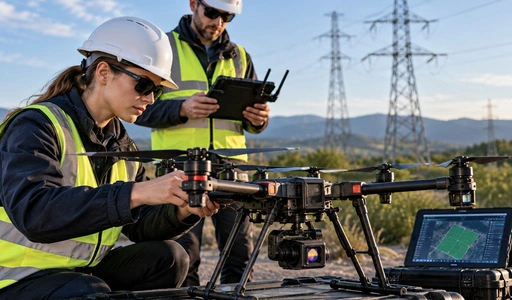
Industrial multi-rotor platforms with thermal and OGI sensors may detect electrical equipment heat anomalies and turbine blade micro-cracks without decommissioning. RTK-GNSS hovers within a centimetre, keeping the sensor at a predetermined standoff distance for repeated measurements. Electric Power Research Institute (EPRI) assessments show that US utility operators have saved 40–60% compared to rope-access teams on inspection costs.
Emergency Response and Search-and-Rescue Operations
Compact multi-rotors with EO/IR payload systems enable SAR teams to swiftly explore large areas, particularly at nite or under heavy canopy. Low-latency data lines provide near-real-time imagery to event controllers for flood response, wildfire perimeter mapping, and missing person situations. Drones were used in almost 60% of federally declared disaster activations in 2023, according to FEMA.
Flight Operations and Best Practices for Optimized Performance
Pre-Flight Verification, Platform Matching, and Regulatory Compliance
The difference between a useful UAV program and one that breaks rules and damages gear is good operating procedure. Professional UAV programs are expected to follow these best practices.
Here are three operational areas that always determine the success of a mission:
- Pre-flight system verification: Before any sortie, pilots must confirm compass and IMU calibration consistency, battery cycle health and voltage sag profiles, and Remote ID broadcast status. Skipping these checks is the leading cause of avoidable flyaways in commercial operations.
- Payload and platform matching: Quadcopter frames in multi-rotor drone applications and flight operations are well-suited to lightweight sensor payloads under 1 kg and short-range survey missions. Hexacopter and octocopter configurations provide redundant propulsion — essential when carrying LiDAR or heavy multispectral rigs — and maintain controlled descent even after a single motor failure.
- Regulatory compliance and airspace coordination: FAA Part 107 in the United States and equivalent CAAC civil drone pilot license frameworks in other markets require documented pilot certification, airspace authorization via LAANC or equivalent systems, and flight logging. Organizations that work with training providers familiar with both sets of regulations reduce approval timelines considerably.
The best way for these practices to work is for teams to get structured training that is based on real operational standards, not just general content made by hobbyists. This is exactly what the ECR Academy's course in multirotor drone applications and flight operations is made for.
Comparing Multi-Rotor Drone Solutions for Commercial Procurement
Buying the right UAV platform is a choice that will have long-lasting effects on mission capability, training costs, and the ease of getting spare parts. This shows how the main types of platforms compare.
Multi-Rotor vs. Fixed-Wing: When Each Fits
Multi-rotor systems are useful for flying inspections, operating in tiny places and the ability to carry a range of loads. Fixed-wing platforms can survey huge regions more swiftly and for longer periods of time, but require a runway or permission to be launched by hand, and cannot hover for close observation. Most of the infrastructure inspections and the agricultural spraying are still performed most often using multi-rotor platforms.
Evaluating Hardware Specifications That Matter
The four most essential technical aspects when considering which industrial grade rotary UAVs to buy are: Push-to-Weight Ratio (industry standard for stability is 2:1), IP grade (IP45 is bare minimum for field use, IP67 is recommended for wet or dusty places), obstacle avoidance coverage (6-directional tracking is now standard on professional platforms) and MTBF (Mean Time Between Failures). The upper end platforms target 500 to 1,000 flight hours MTBF. Depends on how often the motor bearings get repaired.
After-Sales Support and Parts Availability
In the case of selling officers to schools and businesses, the infrastructure that comes with the sale is frequently just as crucial as the tech specs for multi-rotor drone applications and flight operations. Maintenance and troubleshooting training programs such as power distribution, ESC health, motor condition and flight controller diagnostics make planes less dependent on external repair services and reduce downtime during busy periods.
Emerging Trends and Future Outlook for UAV Technology
AI-Assisted Mission Planning
With AI-powered flight control, mission planning is shifting from manually inputting waypoints to automatically optimising the route. The commercial devices we have now use topographical data and real time sensor input to autonomously modify flight altitude and overlap. This helps out the pilots and makes the datasets more uniform.
BVLOS and Swarm Operations
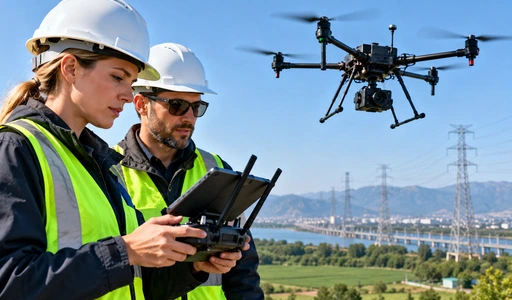
The next major thing in operations is BVLOS operations and coordinating a group of UAVs.” The FAA and CAAC issued additional BVLOS regulations in 2023 and 2024. As soon as the regulations become more concrete, training programs will be ready to serve the demands of pilots that can teach the logic of swarm coordination and collaborative mission scheduling.
Data Security in Connected Operations
As UAV data pipelines increase, government and utility clients will likely want AES-256 encryption for control links and Local Data Mode configurations that prevent unauthorised cloud syncing. When organisations are seeking UAV Training services, they should ensure the program offers instruction on flight mechanics and data processing methods.
Conclusion
The market for professional UAVs is growing faster than the number of certified workers who can support it. The best way to close this gap is to provide structured training that is based on real-world industry processes. This training should cover platform assembly, flight controller setup, multi-sensor data processing, and application-specific operation. The multi-rotor drone applications and flight operations program at ECR Academy covers all of these skill areas. It does this by using project-based learning, industry-standard tools, and instructors who are currently working as engineers and operators. Companies that put money into this foundation now will be in a better position when BVLOS rules get stricter and the need for skilled UAV workers keeps growing.
FAQ
1. Can someone with no drone experience enroll?
Yes. The ECR Academy course starts with UAV platform fundamentals — hardware architecture, basic flight modes, and the development environment — before progressing to advanced application scenarios. The learning path is structured to support beginners with no prior UAV background.
2. What roles can graduates pursue?
Graduates are prepared for positions including UAV Pilot, UAV Assembly and Maintenance Technician, UAV Industry Application Engineer, Flight Control System Development Engineer, Payload System Integration Engineer, and UAV Training Instructor.
3. Does the course address industry-specific scenarios?
Yes. Practical modules cover power line inspection, agricultural plant protection, surveying, and autonomous mission execution. Learners complete integrated projects that replicate real operational workflows rather than generic flight exercises.
Build Your UAV Program with E.C.R Academy
With 16 years of professional skills training in 28 countries and nearly 500,000 trained users, E.C.R. Academy offers organized, industry-aligned training in multi-rotor drone applications and flight operations. We help schools, businesses, and the government by providing project-based lessons, qualified instructors, and all the tools needed for the whole training process. We are a reliable company that teaches multirotor drone applications and flight operations. Visit enteredu.com or email our team at ecr2008@enteredu.com to talk about a program that fits the needs of your organization.
References
1. Federal Aviation Administration. FAA Unmanned Aircraft Systems Integration Roadmap. 2023.
2. Electric Power Research Institute (EPRI). Drone Applications in Utility Infrastructure Inspection: Cost and Safety Analysis. 2022.
3. Zhang, C., & Kovacs, J. M. "The Application of Small Unmanned Aerial Systems for Precision Agriculture." Precision Agriculture, 2012.
4. Radoglou-Grammatikis, P., et al. "A Compilation of UAV Applications for Precision Agriculture." Computer Networks, 2020.
5. Federal Emergency Management Agency (FEMA). FEMA Disaster Response Technology Integration Report. 2023.
6. Mogili, U. R., & Deepak, B. B. V. L. "Review on Application of Drone Systems in Precision Agriculture." Procedia Computer Science, 2018.


_1781601799781.webp)