How to Choose an Industrial Robotics Technology Course
When choosing an Industrial Robotics Technology course, prioritize programs that offer full-spectrum system integration training—from programming and simulation to digital twin applications and intelligent maintenance. Look beyond basic robot operation to ensure the curriculum covers PLC control, machine vision, virtual commissioning, and real-world project-based scenarios. The ideal course blends enterprise engineer expertise with academic rigor, supported by comprehensive virtual simulation platforms that mirror actual production environments (Manufacturing Engineering Society, 2022).
Understanding the Decision Scenario for Choosing a Course
Before you choose a robotics training program, you should make a plan of your company's automation roadmap and workforce goals. The goals are the same whether you're the technical director of a system integrator, the training manager at an automotive supplier, or the dean of a vocational college: you need students who can understand the whole lifecycle of robotic systems and not just know how to press buttons on a teach pendant.
Defining Procurement and Training Objectives
Your training goals should be in line with real-world operational results. Are you getting integration engineers ready to use production lines with multiple robot cells? Do you need repair teams that can use vibration analysis and temperature tracking to make predictions about problems? Or are you making OEM training packages that your sales team can sell to end customers under your brand? Making these goals clear from the start affects every choice that follows, from the depth of the course to the style of delivery.
Stakeholder Needs Across the Organization
For each role, you need to have different skills. Engineers and workers need to know how to program offline, find the best routes, and talk to fieldbuses. Cost-effectiveness, scaling, and vendor compatibility with current equipment like ABB, Fanuc, or KUKA robots are important to procurement managers. On the other hand, OEM partners like being able to customize products, having the freedom to use their own brands, and being able to connect products to their own hardware platforms. A good course takes all of these points of view into account without any compromise.
Industry-Specific Use Cases
In the car industry, training often focuses on safety-rated joint applications, body-in-white assembly, and high-speed spot welding. When making electronics, SCARA robots, cleanroom rules, and sub-millimeter repeatability for placing parts are very important. In general, manufacturing includes things like stacking pallets, moving materials, running machines, and automating packing. Knowing these details helps you choose training material that matches the problems you face in production, so it can be used right away and give you a faster return on investment (International Federation of Robotics, 2022).
Core Metrics for Evaluating Industrial Robotics Technology Courses
When choosing a training partner, you need to carefully consider three factors: how skilled they are, how much they can help you in the real world, and how trustworthy they are in the business. Basic courses teach students how to use robots, while more advanced ones teach them how to be integration engineers.
Technical Depth and Curriculum Breadth
The whole automation stack is covered by a strong program. At the very least, students should learn about robot kinematics, coordinate systems, and how to program pendants. In intermediate sections, you will learn about PLC logic, programming with ladders, and fixing electrical problems. Some advanced topics are offline writing software, detecting collisions, synchronizing multiple robots, and calibrating machine vision. New courses include digital twin technology, virtual commissioning, and predictive maintenance analytics; these are skills that are needed by Industry 4.0 (Robotics Industries Association, 2021).
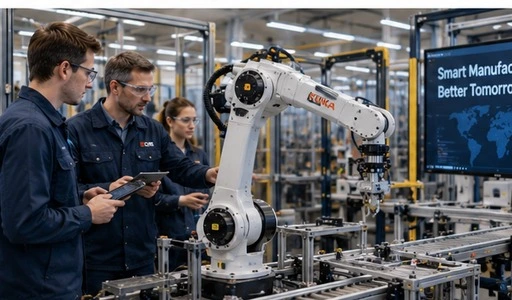
Look for classes that cover more than just flexible arms. These should include SCARA, delta, and joint robots. Communication protocols like EtherCAT, PROFINET, and Modbus TCP should be covered because they are needed to connect robots to things like conveyor belts, vision systems, and Manufacturing Execution Systems (MES).
Practical Application Through Simulation
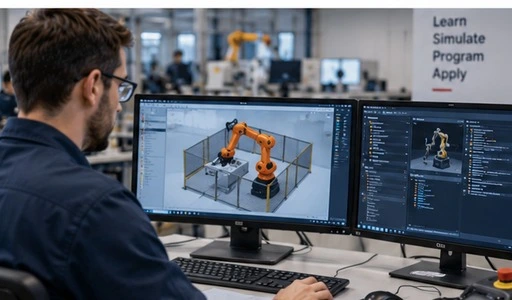
When techs only work with theory, they get stuck when they have to deal with real-life production floor problems. Virtual simulation platforms that accurately recreate work environments are used in the best training. Before touching real hardware, learners should do things like building 3D workpieces, optimizing toolpaths, analyzing reach, and cutting down on cycle times—all in software. This method cuts down on equipment downtime, training costs, and makes it safe to explore edge cases like avoiding singularities and payload overload.
Simulation-based programs for PLC debugging, vision-guided picking, and digital modeling of production lines have clear benefits that can be measured. When trainees get to the plant floor, they already know how to use the logic, interfaces, and troubleshooting processes they will be using every day.
Industry Recognition and Certification
The word "accreditation" means quality and consistency. Certifications that are in line with ISO 9283 performance standards or backed by major robot manufacturers show that the person has the right skills in Industrial Robotics Technology. For procurement managers, this means less risk when hiring new people and an easier time fitting in with existing teams. For schools, accepted credentials improve the employability of graduates and the image of the program. When looking at different service providers, make sure they have partnerships with leaders in the automation ecosystem and that certification exams are overseen and checked by outside experts (Society of Manufacturing Engineers, 2020).
Analyzing Course Options: Types and Formats
Course delivery methods have a big effect on how well students learn, how much they cost, and how easily they can be expanded. Your choice should take into account how the workforce is distributed, how much money you have, and how quickly you need to build capabilities.
Comparing In-Person, Online, and Hybrid Models
In-person training gives you full access to robots, sensors, and PLCs, so you can learn by doing. This format works well for situations where knowing how to use mechanical systems by touch is important, like when a maintenance technician is learning new skills. But it means traveling, finding a place to stay, and maybe even stopping work.
Online courses are flexible and scalable, so teams in different parts of the world can train at the same time without having to deal with extra logistics. Video classes, interactive models, and cloud-based virtual labs are all parts of modern platforms. Online learning is good for classes that are heavy on theory and simulations, but some students may not get the hands-on experience they need.
Hybrid models take the best parts of both online teaching and simulations and then combine them with intense hands-on classes at training centers or customer sites. This structure saves money while still allowing for important tactile learning. Hybrid delivery works best for system developers that manage various sites or OEMs that have clients in other countries.
Specialized vs. Comprehensive Programs
There are specialized courses that focus on specific uses, like collaborative robot safety, automotive welding cells, or pharmaceutical cleanroom automation. These are great for situations where your employees already know a lot about automation and you need to quickly add certain features.
Comprehensive programs, like those that teach everything from basic computing to system integration and clever maintenance, are good for organizations that are building their skills from the ground up or schools that are making degree programs. These kinds of programs make sure that students understand both the differences between platforms and how they work together. The end result is workers who are able to solve problems in a variety of areas.
Customizable Corporate Training Solutions
A lot of advanced providers offer training that is specifically designed to fit your equipment ecosystem, production processes, and operational key performance indicators (KPIs). Customization could include programming exercises based on the shapes of your actual products, integration scenarios using the PLC brands you already have installed, or maintenance protocols that are in line with the preventive maintenance schedules for your plant. As an OEM partner or system developer, you can offer value-added services under your own brand with white-label or co-branded training packages (Journal of Manufacturing Technology Management, 2019). This can help you build stronger customer relationships and find new ways to make money on a regular basis.
Weighing Cost-Benefit Factors and ROI of Industrial Robotics Training
Investing in training needs to be backed up by money. Understanding how prices work and how much money you can make helps you get buy-in from stakeholders and decide how to spend your money.
Pricing Models and Financing Options
Course fees are very different depending on how in-depth, long, and how the course is taught. Online modules for beginners may cost a few hundred dollars each, but full programs with hands-on labs and certification can cost several thousand dollars each. Institutions and big businesses like bulk licenses because it saves them money when they train groups of ten or more people.
Some providers offer subscription plans that give users unlimited access to course libraries and regular content updates, which is useful for companies that want to keep their employees learning. Costs can be more in line with fiscal cycles and budgets if payment terms are flexible. For example, you could set up an installment plan or tie training points to the purchase of tools.
Tangible Business Benefits and Efficiency Gains
Well-trained workers in Industrial Robotics Technology can find and fix problems faster, which cuts down on robot downtime. By better planning paths and setting parameters, they cut down on cycle times and directly increase output. Better safety measures cut down on accidents and the costs that come with them. In one recorded case, a medium-sized electronics company said that after finishing an advanced integration training program, robot-related downtime dropped by 23% and line efficiency went up by 15% within six months (Automation World, 2021).
In addition to practical measures, trained staff speed up the use of technology. They safely use new vision systems, IoT sensors for preventative repair, and digital twin models—innovations that would normally need expensive outside experts. Over the course of three years, these total gains often give a ROI of more than 300%.
Long-Term Skill Maintenance and Support
Technology changes very quickly. Robots can do new things when their firmware is updated, vision algorithms get better as machine learning gets better, and communication standards change. The best training companies offer continued support through technology helpdesks, refresher lessons, and access to up-to-date simulation settings. This consistency makes sure that your employees stay up-to-date without having to go through full retraining rounds. When you're looking at courses, find out how alumni can access them, how often the content is updated, and if there are any post-training consultations that are available. These things add to the value of the initial training over time.
Making the Final Decision: Matching Your Company Needs with Course Selection
The best plan is the one that fits your operating needs, the needs of your industry, and your strategic goals. A structured decision framework makes it easier to sort through the choices.
Role-Specific and Industry-Specific Requirements
Scalability, vendor balance, and clear proof of ROI are important to procurement leaders. They like lessons that have clear prices, modular structures that let them be rolled out in stages, and that work with a variety of robot types. On the other hand, engineers and techs value technical rigor, having access to accurate modeling tools, and being able to practice fixing problems that are hard to understand. By making your choice based on these clear priorities, you can be sure of broad organizational support and a smooth implementation.
The industry context is also important. For automobile uses, you need to know a lot about high-payload robots, spot welding sequencing, and safety standards for cars. To make electronics, you need to be good at SCARA code, ESD standards, and vision-guided micro-assembly. People who work in places that process food need to know about IP69K-rated robots, food-grade lubricants, and HACCP compliance. Choosing a course that specifically addresses the rules and technologies that apply to your industry speeds up the process of becoming competent and cuts down on the time needed to adjust to new conditions after training.
Provider Credibility and Ecosystem Integration
Work with training groups that have strong ties to the business and a history of success. Providers with ties to big robot makers like Fanuc, ABB, KUKA, Yaskawa, or Mitsubishi often offer content that matches the official technical documentation and get updates to the platform before anyone else. Joining groups in your field, like the Robotics Industries Association or the International Federation of Robotics, shows that you are dedicated to following standards and always getting better.
Look into case studies and testimonials from past clients. Has the source been able to teach integration teams at businesses like yours? Do they offer professional help and alumni networks after the training is over? Strong support after training turns a one-time buy into a long-term relationship that pays off long after the initial certification is earned (Manufacturing Technology Insights, 2022).
Building Strategic Partnerships for Continuous Improvement
Think about how a provider can help you with your long-term automation journey, not just your immediate training needs. Can they work with you to make custom modules as you use new technologies? Do they have train-the-trainer programs that let your own experts teach training courses? If you are a system integrator or an OEM partner, does the provider allow white-labeling? This means that you can add training to your own solutions.
These aspects of partnerships set them apart from competitors. When your company can offer certified training along with equipment to clients, you go from being a vendor to a trusted advisor. That change opens the door to higher prices, deeper connections with clients, and chances to make money over and over again.
Conclusion
When choosing an Industrial Robotics Technology course, it's important to make sure that the training material fits with your organization's goals and the needs of the business. Give top priority to programs that cover all aspects of system integration, from programming and modeling to digital twin applications and smart maintenance. Check the provider's technical depth, how well it can be used in the real world through virtual platforms, and how trustworthy they are by looking at their industry partnerships and certifications. Think about delivery formats that strike a mix between low cost and hands-on learning, and make sure that you have the ability to customize the course so that it fits your unique production problems and equipment ecosystem. By making your choice based on these factors, you can be sure that your training efforts will pay off in the form of less downtime, faster adoption of new technologies, and a more flexible workforce. If you take the right course, you can turn operators into integration architects, which will put your company at the forefront of smart manufacturing.
FAQ
1.What prerequisites do learners need before starting an Industrial Robotics Technology course?
Most complete programs assume that students know the basics of how computers work, how mechanical systems work, and how electricity works. A good starting point is to understand coordinate geometry, Boolean reasoning, and the rules of workplace safety. Well-structured classes, on the other hand, include introductory modules that cover basic ideas. This makes them easy for determined newbies who are ready to learn expert material to access. For more difficult parts like digital twin or vision programming, having experience with robotics or programming before is helpful, but not necessary.
2.How does robotics training reduce operational expenses?
Trained workers can find problems more quickly, which cuts down on the average time it takes to fix things and avoids costly production stops. They find the best robot settings and toolpaths, which cuts down on cycle times and boosts output. Better safety practices lower the number of accidents and the costs of insurance that goes with them. Over time, skilled teams take over improvements and integrations of equipment, lowering the need for outside experts. All of these improvements often lead to a ROI of more than 300% in just three years.
3.Are there training options suitable for small and medium enterprises with limited budgets?
Of course. Many online course providers offer modular courses that small businesses can use to learn specific skills without having to commit to full programs. Subscription models let you access course libraries in a variety of ways and at a steady monthly cost. Hybrid models let you learn the basics online and then spend a short time in intense classes, which cuts down on the costs of travel and downtime. Low-cost financing choices and volume savings for small groups make high-quality training available to businesses of all kinds.
Partner with E.C.R Academy for Comprehensive Industrial Robotics Training
Picking the right training service will help you reach your automation goals faster and make your employees more able to handle fast changes in technology. Industrial Robotics Technology courses at E.C.R. Academy are project-based and combine theory with hands-on practice on seven different platforms. These platforms are robot operation and programming, simulation, PLC control, machine vision, digital twin, system integration, intelligent operation and maintenance, and digital twin. Our course, which was created by business engineers and academic experts working together, covers the whole process, from teaching pendant programming to digital starting and predictive diagnostics. Learners get high-fidelity experience before they touch real tools in virtual simulation settings that don't depend on hardware and lower training costs. With the help of over 3,300 industry experts and partnerships with top automation suppliers, we've trained almost 500,000 people in 28 countries since 2010. We make solutions that fit your technology stack and operational workflows, whether you're an institution building a robotics program, an integrator looking for OEM-ready training packages, or a business looking to improve the skills of its maintenance teams. Visit enteredu.com or email ecr2008@enteredu.com to learn more about how our Industrial Robotics Technology training can change the skills of your employees and help you make real productivity gains.
References
1. Manufacturing Engineering Society (2022). Best Practices in Industrial Automation Training.
2. International Federation of Robotics (2023). World Robotics Report 2023.
3. Robotics Industries Association (2021). Certification Standards for Industrial Robot Technicians.
4. Society of Manufacturing Engineers (2020). Competency Frameworks for Smart Manufacturing.
5. Journal of Manufacturing Technology Management (2019). "Customization in Technical Training Programs," Vol. 30, No. 4.
6. Automation World (2021). Case Study: Training ROI in Electronics Manufacturing.


_1781601799781.webp)