What Beginners Can Learn from Innovative Design and 3D Printing for Additive Manufacturing
People who are just starting out can learn how to make a printed part that works by using design thinking and the right printing process. When using innovative design and 3D printing for additive manufacturing, learners can select from FDM, SLA/LCD, and SLM methods. It also shows how to finish surfaces, check results, and merge parts to make them lighter. This book is for teachers, training managers, and new engineers who want to know where to begin and what skills a good course should teach.
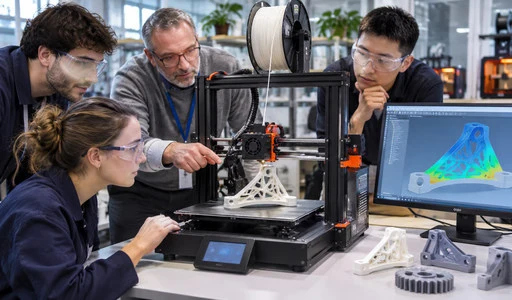
Why Design Thinking Matters in Additive Manufacturing
Moving Beyond Traditional Manufacturing Limits
Traditional methods of making things work well for making a lot of stable parts. Being young is hard to deal with. Some things, like molds, machining access, draft angles, and material waste, can make it harder or take longer to make changes to designs and shapes. ISO/ASTM 52900 talks about how to use digital model data to make parts by adding them one layer at a time. Since there is no need for a special mold, the artist can try out a new shape quickly. I tell people who are just starting to use a printer that learning how to use it is not the most important thing. A lot of what the process can do is lost when you copy a part from a machined drawing. The value shows up when you rethink the design, like when you join two parts into one or add a channel inside that a drill could never reach.
Core Design Principles Beginners Should Learn
A good CAD model is not enough. You can change the strength, surface quality, accuracy, print time, and material use by changing the direction of the build. This is because layers bond in different ways in each direction. Some of the other things that affect how cleanly a part prints are the thickness of the walls, the clearances, the overhang angles, and the access to the supports. These habits are taught in our course through product innovation design: looking at needs, coming up with ideas, designing structures, and making 2D drawings with notes on GD&T and measurements. Some of the mechanical transmissions that students learn about are belt drives, gear drives, and linkage mechanisms. This helps them match motion and speed to function. It's faster to check early on if the part can be made because a part that can't be cleaned, inspected, or put together isn't very useful.
Lightweight and Integrated Structures
Two things make additive design different: putting things together and making them lighter. Integrated structure design turns several parts into a single printable assembly, and assembly-free structure design cuts down on the work that needs to be done later. One side says this can cut fasteners, while the other says it could make it harder to maintain and check. For starters, they need to look at both sides. Lattice structures, weight-reduction holes, and topology optimization are all tools used in lightweight design to get rid of stuff that doesn't carry much weight. The design assignments in our class have clear weight-loss goals, so students can work on losing weight without affecting their ability to do the assignments. It is often used in robotics, aerospace, and cars. Green claims should still be taken with a grain of salt since they don't take into account things like how much energy is used, how much powder or resin is wasted, how to get rid of the support, or how long the product will last.
Matching Printing Processes to Real Applications
FDM, SLA/LCD, and SLM at a Glance
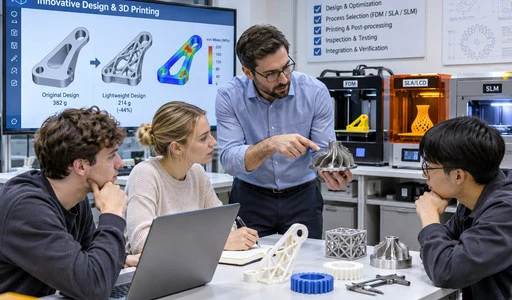
Seven process groups make up ISO/ASTM 52900, which describes how to print. A lot of people start with these three groups. When you melt plastic filament, you extrude it. FDM is a good way to make cheap concept models, fixtures, and enclosures. In SLA and LCD resin printing, which are both types of vat photopolymerization, light hardens the liquid resin. While resins are great for adding fine details and smooth surfaces, some of them aren't good for machine loads that are very heavy. A laser is used to melt metal powder, which holds up prototypes, mold inserts, and metal parts that work. Plastic parts that last a long time can also be made with SLS, but our course is mostly about FDM, SLA/LCD, and SLM.
Choosing a Process for a Specific Application
The process is chosen based on the need, not the machine. Find out about the material's thickness, accuracy, surface finish, quantity, due date, and how hot or cold it is. An enclosure for quick changes points in the direction of FDM. Resin can be seen in a picture because it has smooth curves. The part must be strong, like metal, or it must be able to handle heat. This points to SLM. Next, think about how much it would cost to do innovative design and 3d printing for additive manufacturing, CNC machining, injection molding, casting, and post-processing, as well as how much it would save you by not having to make tools. Printers that use metal powder beds usually cost a lot more than printers that use plastic or resin. This is why schools and businesses should know the rules for safety and how to work before they buy equipment.
From Digital Concept to Printed Part
For beginners, the process is easy to follow. To begin, write down what the item is for, where it will be used, how much of it you need, and your quality standards. It's important to make sure the mechanisms work the way you want them to after making a model of the part and assembly. After that, set the printing parameters, make the supports, and print. The next step is post-processing, which involves taking off the support, sanding, joining, fixing, and finishing the resin parts once they are dry. The last steps are putting it together, making sure it's correct, and testing how it works. It's important to keep track of design changes and inspection results when a prototype moves toward low-volume production. This is because repeatability depends on fixed materials, build orientation, and acceptance criteria. There is always the same order in our class, from going over requirements to tests, so students can see how each choice affects the next step.
What the E.C.R Academy Course Teaches Beginners
Project-Driven Curriculum and Ten Learning Modules
The E.C.R. learns through hands-on design and printing tasks. Theory and practice are combined in Academy's Innovative Design and 3D Printing for Additive Manufacturing course. It has ten modules that cover making 3D models, designing lightweight structures, simulating motion, and designing with integrated structures. The modules cover everything from making new products and transmissions to these topics. Making things out of FDM, SLA/LCD resin, and SLM metal takes up three modules. Tests and putting everything together are covered in the last module. This course is task-based, starts with basic design, and has short video lessons and step-by-step instructions to make it easy for beginners to get started. Business mentors can also help with tasks. Instead of a bunch of separate software lessons, there is now a clear order.
Faculty, Standards, and Learning Platform
Technical training is only as good as the people who teach it and the standards that are used to decide what it covers. This class is taught by both enterprise engineers and regular teachers, so students learn how to do both structured lessons and engineering projects. It talks about international standards for technical skills in additive manufacturing as well as the best ways to do things in the field. The platform has FDM, SLA/LCD, and SLM equipment and is based on 3D CAD software. Micro-lesson videos, operation demonstrations, and project cases make it possible to learn both online and off. People who are learning how to use CAD software like SolidWorks or CATIA use slicing software with it. They can use online simulation to practice motion simulation when they can't get to their own software.
Skills and Career Outcomes
People who take the course will be able to come up with design ideas, draw in 2D with GD&T notes, make parametric 3D models, and plan gear and linkage systems. They can also run FDM machines, plan resin and metal processes, and finish 3D printed items. They know how to properly use measuring tools, keep tools safe, and write technical documents that are easy to understand. That person would be good at jobs like product structure designer, mechanical designer, reverse engineering engineer, and additive manufacturing process engineer if they had these skills. From designing to printing, the whole process helps college students learn through projects and gives them finished work to show off. It helps companies get the most out of their new tech staff.
Avoiding Mistakes and Choosing a Training Partner
Common Beginner Mistakes
A lot of newbies think that 3D printing can be used instead of everything else. It doesn't. What makes something work well is its size, tolerances, surface finish, how it acts, and any certification needs. Trying to make things look hard is another mistake. Not just for looks, lattices and generative shapes should be used to get rid of something, like extra weight, or improve the flow of fluid. A lot of newbies also wait until the very end to clean, inspect, and do post-processing, which makes delivery take longer. When you add metal parts, more questions come up. ASTM F3049 tells you how to talk about metal powders, and ASTM E8/E8M tells you how to test metals for tension. If you learn these checks early on, they will save you a lot of money.
Questions to Ask Before Choosing a Course or Supplier
In colleges and training centers, a short list of questions can help people look at different programs side by side. Does it cover FDM, SLA/LCD, SLM, and the whole process, from making plans to testing them? Does it come with videos, demos, and project cases that can be used to teach? Do business engineers come to class? What kind of software does it need, and does it have permission to run? What rules do they follow to make the content? This way, procurement teams can compare offers based on total value instead of just price. They should also ask for clear scope documents, delivery schedules, and information on how to train staff. This helps make sure that the program fits with real teaching goals before a formal review of the purchase is done.
Why Institutions and Companies Work with E.C.R Academy
Since 2010, E.C.R. Academy has helped over 500,000 people in China and 28 other countries get certified and trained to work as professionals. Over 300,000 of these students have earned credentials that show they have the skills employers look for. We've made more than 60,000 learning resources, like standards, courseware, case studies, and test banks, and worked with more than 3,300 experts and more than 500 businesses. We've also put together more than 150 skill competitions. These numbers show that they have been teaching for 16 years. They also explain why our classes are based on real-life issues and work we do with professionals in the field. People from businesses, schools, industry groups, and other groups are the ones we want to work with.
Conclusion
Beginners in innovative design and 3D printing for additive manufacturing learn that the needs of the product, not the printer's, are what matter most. When you build something layer by layer, you don't need molds. This method supports structures that are light and fit together well, and it rewards designs that are made to work with it. FDM, SLA/LCD, and SLM are all different in how detailed they are, how strong they are, how much they cost, and what they are used for. Which one you use will depend on what the part is for. The process goes from requirements and CAD to simulation, printing, post-processing, putting it together, and testing. People often mess up when they copy machined designs, try to make things more complicated, or skip finishing and inspection. As you can see, a good first course includes design, simulation, testing, and different printing methods all in one project. It is also taught by people who have worked in the field and know the standards.
FAQ
1. Can beginners take this course?
Yes. Work and projects are what the class is based on. The first part is an introduction to product design. The next parts cover requirement analysis, structural design, motion simulation, and 3D printing. There are micro-lesson videos, operation demonstrations, and business mentors to help learners along the way.
2. Is professional software required?
Yes, 3D CAD programs like SolidWorks and CATIA are used in the class. Slicing software is also used to get things ready to print. Schools and training centers may give out software licenses for cloud platforms or training centers. The software works with Windows, and students can use the online simulation feature to practice motion simulation even if they don't have software installed on their computer.
3. Is 3D printing always cheaper than traditional manufacturing?
Cost depends on how much, how long it takes to process, how much work is done, how long the machine runs, how many times it is inspected, and what it is made of. It usually saves money for printing when it doesn't have to make tools or put parts together. But molding or machining may still be better for stable parts that need to be made in large quantities.
4. What job roles can learners prepare for?
This course helps people who want to learn get ready for jobs like product structure designer, mechanical designer, reverse engineering engineer, and additive manufacturing process engineer.
Start a Conversation with E.C.R Academy About Innovative Design and 3D Printing for Additive Manufacturing Training
Looking for a company that can provide innovative design and 3D printing for additive manufacturing for your Training Facility or university? An E.C.R. course is based on projects and is taught by enterprise engineers and college experts. A school that teaches FDM, SLA/LCD, and SLM. We'll get back to you about the course after you email ecr2008@enteredu.com with your learner numbers, the lab equipment you already have, and your goals. Visit enteredu.com to learn more.
References
1. ISO/ASTM 52900: Additive Manufacturing – General Principles – Fundamentals and Vocabulary, ISO/ASTM International, 2021.
2. Additive Manufacturing Technologies: 3D Printing, Rapid Prototyping, and Direct Digital Manufacturing, Springer, 2015.
3. Design for Additive Manufacturing: Trends, Opportunities, Considerations, and Constraints, CIRP Annals, 2016.
4. The Status, Challenges, and Future of Additive Manufacturing in Engineering, Computer-Aided Design, 2015.
5. ASTM F3049-14: Standard Guide for Characterizing Properties of Metal Powders Used for Additive Manufacturing Processes, ASTM International, 2014.
6. Additive Manufacturing (3D Printing): A Review of Materials, Methods, Applications and Challenges, Composites Part B: Engineering, 2018.