How New Energy Vehicle Fault Diagnosis & Troubleshooting Improves Maintenance Skills
New Energy Vehicle Fault Diagnosis & Troubleshooting improves maintenance skills by instructing technicians how to prove a cause before replacing a part. They don't guess and break codes; instead, they follow a method that can be used over and over. They talk about the issue, make sure they are safe around high voltage, check every module, read live data, test the circuit, and make sure the repair was done correctly. These habits help people fix things the first time, find parts they don't need, and stay safe around high-voltage systems. Along with that, it makes you trust the batteries, motors, and electronic controls more. Here is a list of what you need, how to do it, and how to get trained to do it every day.
Why Fault Diagnosis Is Now a Core Maintenance Skill?
Now that electric drivetrains are out there, techs need to know new things. That's why diagnosis is the most important part of the job right now.
Electric Vehicles Work as Connected Systems
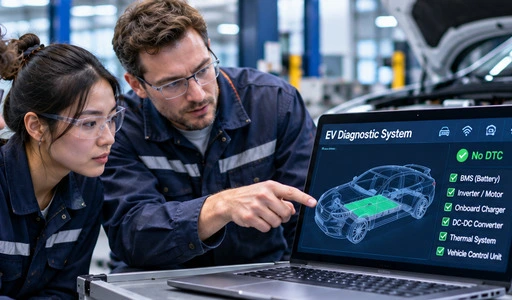
A car that runs on gasoline pretty much always needs to have its mechanics checked out. A car that runs on electricity also needs to have its electrical, software, and network checked. Every part of the car—the inverter, motor controller, onboard charger, DC-DC converter, and vehicle control unit—never stops talking to each other. More than one module can sound an alarm if the signal is weak. The World Energy Council says that more than 17 million electric cars were bought around the world in 2024. That's more than 20% of all new cars that were bought. Because there are more cars, there is a greater need for service. Instead of swapping parts, each car needs a technician who reads data about the whole system.
Guessing Costs Time and Money
Replacing parts over and over again without proof costs a lot of money. Most of the time, a fault code doesn't mean that a part has broken but that something is being watched. When scan tools are used on a car, SAE J1979 says that the information they get must still be looked at by a trained professional. When technicians test first, shops don't have to deal with extra work, customers coming back, or long wait times. Fleets also feel this, since every extra day in the bay means a day without a vehicle that can do its job. I can tell if a team is getting better by how often they fix things the first time and how often they fix the same thing again.
Safety Turns Diagnosis Into a Disciplined Skill
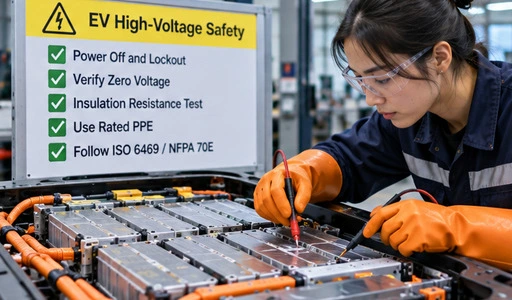
You can't have any bad habits when you work with high voltage. Two different sets of rules, ISO 6469-3 and UN Global Technical Regulation No. 20, both talk about how to keep electric cars safe. Some of the things they talk about are keeping high-voltage circuits separate from the chassis. The UN rule says that the isolation resistance for DC circuits must be at least 100 ohms per volt. It needs to be at least 500 ohms per volt for AC circuits. Technicians who know these numbers don't have to write down readings; they can use them to judge them instead. Rules like NFPA 70E are also used to plan electrical work in shops. Before you touch a terminal with a meter, make sure you have the right tools, the circuit is off, and you're following a written procedure.
Build the Diagnostic Foundation With a Repeatable Process
With a strong new energy vehicle fault diagnosis & troubleshooting process, spreading out checks becomes a habit. These three steps are what EV does every day.
Step 1: Define the Fault Before You Touch a Part
The first step in good troubleshooting is to make the problem clear. I ask the mechanics to write down the car's make and model, the type of engine, the mileage, the history of repairs, how the battery charges, and every warning light on the dashboard. The way is shown by an alert light, but it doesn't say which part failed, so the next step is to fully scan the control modules that matter. In the record, the issue the customer is having, the proof, and the main cause should all be kept separate. From the complaint to the test, the repair, and the last check, that's the path. This keeps everyone on the same page and stops people from making mistakes with their diagnoses.
Step 2: Follow a Systematic Diagnostic Workflow
Technicians can do their jobs safely with the help of a repeatable workflow. First, take a look at it and get ready for high-voltage safety. Take a look at the 12 V battery first. Power with low voltage that isn't strong can look like a bigger problem. Then look at live data and codes, check the wiring, test certain circuits, fix, and make sure everything is okay. Full access to the whole system is important because the BMS, inverter, charger, DC-DC converter, and thermal management system all talk to each other all the time and share data. Safety, communication, insulation, charging, battery, motor, and thermal systems are just some of the things that a shop checklist covers. This helps teams do the same thing for all vehicle brands.
Step 3: Recognize the Most Common Fault Areas
People don't like the charging system, the insulation protection, the thermal management, the CAN communication, the regenerative braking, the motor and inverter, the battery and BMS, and a short list of other things. The voltage difference between cells, the health of the battery, differences in temperature, current, internal resistance, Contactors, and the state of communication are all checked during a battery diagnosis. If there are issues with charging, you need to look at the AC and DC paths, connectors, pilot signals, the charger that is built into the boat, and any connectable devices from the outside. If you test the insulation, you can find leaks in heaters, compressors, battery housings, or cables. To figure out what's wrong with a secondary code, techs can use oscilloscopes, live data, and wiring diagrams.
Turn Data Into Skill: Verification, Equipment, and Practical Cases
Proof, tools, and practice all work together to turn process into skill. The next three steps will show you how to do that.
Step 4: Verify With Data, Not Assumptions
Reading and clearing codes is not diagnosis. Technicians who are skilled put together codes, freeze-frame data, live parameters, wiring information, a physical inspection, and electrical tests that can be done over and over at any time. There are easy ways for shops to keep track of their progress, such as the number of first-time fixes, diagnostic time, repeat repairs, part replacements that aren't needed, downtime, safety incidents, and faults that happen again. Before each vehicle leaves, the team re-scans the modules that need to be done so, checks that the normal operating data is correct, and either charges or drives the vehicle. Then, they keep a copy of the final report for service, fleet, or warranty purposes. The last step proves the repair worked and makes it easy for the next technician to understand what went wrong.
Step 5: Match Equipment to the Work
Type of code and screen size alone don't tell you much. For professional EV work, you usually need to be able to get to the BMS, inverter, motor controller, onboard charger, and thermal system, as well as test, code, and calibrate the actuators. A normal OBD2 scanner might be able to do some checks. You could get an oscilloscope, a charging tester, safety gear, diagnostic software, and a battery tester as part of a full deal. When buying a car, people should also think about how much it will cost them overall, as well as the language support, reporting, training, technical support, warranty, and coverage. To use good tools, you need to be skilled, so skills and tools go together.
Step 6: Practice on Real Maintenance Cases
If there are cases, the method is better than guessing. A drop in driving range can be caused by a number of things, such as battery wear, cell imbalance, brake drag, low tire pressure, thermal problems, the need for heating and cooling, standby drain, or software calibration. If a car won't start, it could be because of a weak 12 V battery, a brake signal fault, an immobilizer problem, a contactor problem, or an isolation error instead of a bad traction battery. Charger-side, AC-side, DC-side, and vehicle-side causes should all be broken down for no charge. Coolant or water getting into a system means that the system needs to be shut down and the insulation needs to be tested by trained professionals in a controlled environment. These kinds of cases teach students how to rule out causes in the right order.
Build a Professional EV Maintenance Program for Long-Term Results
Fixes are not programs. Quality that lasts is made up of rules, records, and tools that work together.
Step 7: Set Authorization, Protective Gear, and Documentation Rules
There must be clear rules for quality that lasts. Workshops should make it clear to technicians what safety gear they need, how to lock out workers, how to make sure that discharges are legal, and what kind of paperwork is expected of them. On the first day, each tech has different needs. At first, people who are new to the job can check out low-voltage systems and then move up as they show they can do the job well. When you write down procedures, they are easier to check and keep staff safe. That's why ISO 26262, which is a standard for functional safety for cars, also tells teams that electronic systems can fail in ways that need pre-planned responses. Again, this is a reason to write down the test steps and grades.
Use Condition Data and a Shared Knowledge Base
The battery's health, temperature patterns, charging habits, and fault history can help you act faster than waiting for the set service times. A shared list of symptoms, test results, known causes, software versions, and repairs can help teams figure out why the same issue keeps happening on more than one model or in more than one place. It helps to keep track of warranties for fleets, distributors, and OEM service networks, plan parts, and make sure that the system is always up and running. Trainees can learn faster because they can look at cases that have already been solved. It's important to be strict. It's important that every record shows what was tested, what was found, and how the fix was proven.
Connect Diagnostic Tools Into One Workflow
When used together, diagnostic tools are more useful than when used alone. System problems are found by scanners, which also show data in real time. There are tools like oscilloscopes, battery testers, insulation testers, and charging equipment that can give exact measurements that prove a diagnosis. Techs, service advisors, fleet managers, and customers can all use standard reports to get an idea of the battery's health, its history of problems, the results of inspections, and proof that the repair was done. When choosing a supplier, buyers should think about what kinds of vehicles they cover, how well their products work in their region, how often they update their software, how well they train their staff, how well they handle bulk orders, and how well they can connect to workshop, telematics, or cloud platforms.
How E.C.R Academy Trains Technicians in New Energy Vehicle Fault Diagnosis & Troubleshooting
For the process and tools to work, people need to be used. This is where our class fits in.
A Project-Based Curriculum With Industry Faculty
Both theory and practice are covered in our New Energy Vehicle Fault Diagnosis & Troubleshooting course. You can use it to do things like put together and test electrical systems, figure out what's wrong with motors, and fix vehicle issues. Engineers from both business and academia teach it, and the design is in line with technical skill standards around the world. They learn how to read circuit diagrams, set up sensors, actuators, and power management modules, connect low-voltage systems, and make adjustments the right way. People of different types can take the course, which starts with the basics of NEV structure and then moves on to high-voltage systems. For this job, you should know the basics of computers, electronics, electricity, and mechanics.
An Integrated Three-Electric Training Platform
The battery, the motor, and the electronic control are the three electric parts of the platform. As a student, you will put together modules, connect high-voltage busbars, set up BMS slave modules and sampling harnesses, test the insulation, and check the battery side for charge and discharge. Some of the things they do on the motor side are to read fault codes and real-time data, fix electrical and communication issues, and make sure the repairs are done correctly. When people train offline, they do so in normal labs that have three full-sized electric test benches. There are now live lessons and simulations on the online platform, so students can study at any time and go over them again.
Safety Training and Career Outcomes
It's all about safety in this class. Learners go over NEV high-voltage procedures, put on the right safety gear, do regular checks and maintenance, and practice what to do in case of an emergency. People who graduate can work as an NEV maintenance technician, an after-sales service technician, an engineer who diagnoses drive motor faults, an engineer who tests power battery systems, an engineer who tests NEV vehicles, or an engineer who puts together and adjusts three-electric systems. Some of the people who work with us are businesses, schools, and industry groups. More than 3,300 experts and more than 500 business partners helped E.C.R. Since 2010, Academy has given tests and trained almost 500,000 people in China and 28 other countries.
Conclusion
New Energy Vehicle Fault Diagnosis & Troubleshooting improves maintenance skills because it replaces guesswork with facts. Find the problem, make sure there is enough high-voltage safety, scan all modules, read live data, test, fix, and confirm. This is how technicians should always do their jobs because electric cars are like systems that are linked to each other. Problems often happen in the charging, communication, battery, motor, insulation, and thermal systems. Checks based on data, matched tools, and real-life examples make that process easy to do. Thanks to shared records, rules about who can see what, and tools that are linked, results stay the same over time. It's clear how far things have come from the number of first-time fixes, repeat repairs, and loss of service. The E.C.R. uses these thoughts. In the Academy course, students learn through projects on a three-electric training platform, and they are taught safety at all times.
FAQ
1. Why does safety inspection come before testing?
Circuits with a lot of voltage can really hurt people. Technicians start by making sure the person is wearing safety gear and is not charged. That order helps keep people safe and makes test results useful.
2. Can a standard OBD2 scanner diagnose EV-specific systems?
It can be checked in some ways. Most of the time, you need software and hardware that can work with EVs to get BMS cell data, access to the inverter and charger, and calibration functions.
3. How is battery health assessed?
Technicians compare readings for BMS data, cell balance, temperature, current, and state-of-health. After that, physical tests are done to make sure what they thought was true.
4. Can I take the course with no background?
Yes. Next, the course goes over high-voltage systems and how to find problems in them. It starts with the basics of how NEVs are put together. It's best to know the basics of how computers, electronics, and cars work.
5. How is the course delivered?
In real-life labs, there are three electric test benches, and there is also an online platform for live lessons and practice exercises.
Build Stronger Maintenance Skills With E.C.R Academy
Since it opened 16 years ago, E.C.R. Academy has turned diagnostic theory into useful skills that are taught through hands-on projects led by engineers and experts in the field. If you're comparing new energy vehicle fault diagnosis & troubleshooting providers, please send us your team size, training goals, and vehicle focus. We'll get back to you with information about the course and the next steps after you email ecr2008@enteredu.com or visit enteredu.com.
References
1. Global EV Outlook 2025, International Energy Agency, 2025.
2. SAE J1979: E/E Diagnostic Test Modes, SAE International, 2017.
3. ISO 6469-3: Electrically Propelled Road Vehicles — Safety Specifications — Part 3: Electrical Safety, International Organization for Standardization, 2021.
4. Global Technical Regulation No. 20: Electric Vehicle Safety, United Nations Economic Commission for Europe, 2018.
5. NFPA 70E: Standard for Electrical Safety in the Workplace, National Fire Protection Association, 2024.
6. ISO 26262: Road Vehicles — Functional Safety, International Organization for Standardization, 2018.