What Is Industrial Robotics Technology Course and What Will You Learn?
Modern manufacturing stands at a critical crossroads. With skilled labor shortages intensifying and quality demands escalating, automation has shifted from optional to essential. An Industrial Robotics Technology course equips professionals with the comprehensive capabilities needed to design, deploy, integrate, and maintain robotic systems across production environments. Through project-driven learning combining theory with hands-on virtual simulation, learners master robot programming, PLC control systems, machine vision, digital twin applications, and intelligent operation and maintenance. This training prepares engineers and technicians for roles spanning system integration, automated production line commissioning, predictive maintenance, and technical support—building the full-process competencies that smart manufacturing demands today.
Understanding Industrial Robotics Technology
From Core Components to Adaptive Intelligence
In order to handle difficult manufacturing jobs, Industrial Robotics Technology combines mechanical engineering, electronic control design, and smart software algorithms. In contrast to basic automation, this field includes articulated arms, SCARA configurations, delta robots, and collaborative units that can move in more than one direction and have feedback loops controlled by sensors. These systems solve some of the most important problems in manufacturing, like the fact that trained workers are hard to find, working conditions can be dangerous, and humans can't keep precision levels below one millimeter during long production cycles.
Core parts of robot systems are servo motors, harmonic drives, encoders, and real-time controls that run specific operating systems. Teaching pendants, offline simulation tools, and high-level languages that work with fieldbus protocols like EtherCAT and PROFINET are all types of programming systems. The technology has changed from fixed-sequence automation to adaptive systems that use computer vision and AI to make decisions. This lets random part orientations be used for "bin picking" and dynamic path optimization.
Procurement managers and integration engineers need to know these basics to fully understand how robots improve efficiency, lower failure rates, and allow data-driven process improvement. Industry 4.0 trends are pushing robots toward linked environments where digital twins replicate physical production, prediction analytics avoid downtime, and remote diagnostics support operations around the world. This makes it more important than ever to get a lot of training.
Course Curriculum Breakdown: What You Will Learn
Core Technical Modules
Learners move thru seven unified training modules that are based on how things work in the real world. For common tasks like moving things, stacking things on pallets, and welding, the on-site programming module includes teaching point operation, teach pendant operation, path planning, and program debugging. Programmable control technology training teaches PLC hardware setup, ladder logic code, timer and counter instructions, and how to fix electrical circuit problems. These are all important skills for coordinating robots with other machines.
Advanced software tools are used for offline programming and simulation training to do 3D modeling, workpiece calibration, collision recognition, and complex path optimization. With this virtual testing feature, engineers can test programs before they are put into use. This cuts down on setup time and avoids the need for expensive physical trials. Machine vision application modules teach camera calibration, edge detection algorithms, feature matching techniques, and dimensional measurement. These skills make it possible for systems that use vision to pick, sort, and check for defects.
The digital twin and virtual commissioning modules in Industrial Robotics Technology teach modeling techniques for creating virtual production lines, fixing problems with PLC logic in virtual environments, and making sure that the virtual and physical mapping is correct. This cutting-edge feature helps digital delivery models that global makers are asking for more and more. System integration training includes setting up Contact between robots and other devices, planning processes, using fieldbus networking, and debugging together for fully automated production cells. Monitoring the status of equipment, analyzing vibrations, using thermal imaging to diagnose problems, planning preventative maintenance, and setting up remote support protocols are all part of intelligent operation and maintenance modules.
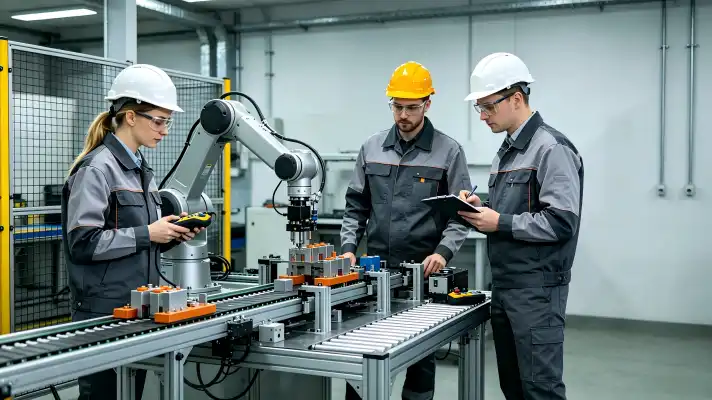
Project-based learning connects abstract ideas to real-world results all over the classroom. Learners do combined projects that simulate loading and unloading stations, welding cells, spray painting lines, and assembly systems. These projects give students the confidence they need to handle a wide range of industrial situations when the course is over.
How Industrial Robotics Technology Benefits B2B Procurement and Manufacturing
From Cost Savings to Strategic ROI: Total Cost of Ownership and Risk Reduction
Using robotic automation has measurable operational benefits that have a direct effect on decisions about what to buy and how well the manufacturing process works. Labor cost reduction is one of the most immediate benefits, since a single robot can work nonstop during multiple shifts, replacing several manual workers and saving money on overtime and training costs related to employe turnover. More importantly, robots do precise tasks over and over again without making mistakes. They can achieve repeatability standards of ±0.01 mm to ±0.05 mm, which is consistency that can't be reached by hand.
Productivity gains show up as higher output, shorter cycle times, and no longer having to deal with slowdowns caused by tiredness. In food processing applications, delta robots that do basic packing regularly make more than 150 picks per minute. Meanwhile, articulated welding robots do thousands of spot welds with uniform bead quality and penetration depth. These gains in performance mean that orders are filled faster, there is less work-in-process material, and more capacity is being used.
The cost-benefit analysis goes beyond the initial investment of money. Procurement managers have to look at the total cost of ownership, which includes whether to buy or lease, the payload capacity needed, the precision requirements, and the software licensing models. Robot providers with adaptable maintenance contracts, a wide range of spare parts, and quick expert help lower operating risk and cut down on the costs of unexpected downtime. Leading brands offer a wide range of models that are best for different tasks. For example, ABB's solutions are the best at body-in-white welding for cars, FANUC is the best at high-speed electronics assembly, KUKA is the best at heavy payload foundry work, and Universal Robots is the best at collaborative applications in small spaces.
Safety compliance is another important issue in the buying process. Modern robotic systems have useful safety designs that include dual tracking, speed and force limits for collaborative modes, and quick emergency stop responses. These features help companies follow OSHA rules, lower the number of injuries at work, and sometimes even lower their insurance rates. Documentation packages that include risk assessments and CE licenses make it easier for facilities to get approvals and show regulatory inspectors that you did your research.
Return on investment times depend on the application, but well-planned operations in making of consumer goods, electronics, and cars usually pay for themselves in 18 to 36 months thru reduced labor costs, better quality, and higher throughput. Comprehensive training programs speed up these returns by letting in-house teams make regular changes to code, fix problems, and improve performance without having to pay for expensive service calls from outside the company.
How to Choose the Right Industrial Robotics Technology Course
Evaluation Criteria
Aligning certifications with the industry adds authority and proves competence. Getting credentials from programs that follow the rules set by groups like the Robotics Industries Association (RIA) or that are in line with national trade qualification systems is a good way to move up in your job. Hands-on practice is very important. Virtual training platforms with realistic robot behavior, physics-based impact detection, and real controller interfaces help students build muscle memory and troubleshooting skills before they use expensive real-world equipment.
Sector-specific customization is important because the needs for welding in the automotive industry are very different from those for food processing or putting together electronics. Courses with industry-specific modules make sure that students learn about the right materials, part shapes, gripper technologies, and process parameters for their work situations. Procurement experts can focus on system specs and criteria for evaluating vendors while engineers learn more about motion calculations and advanced programming techniques in role-based training tracks.
The image of a provider should be carefully looked at for Industrial Robotics Technology. Established training organizations show they have a track record by showing how many of their graduates get jobs, forming partnerships with businesses, and keeping their courses up to date to include new technologies like AI-driven motion planning and cloud-based fleet management. The make-up of the faculty is also important. Courses taught by both working engineers and academic experts combine theoretical rigor with real-world problem-solving experience to give students the best of both worlds.
Traditional classroom models are being challenged by spread teams and tight schedules, making delivery flexibility more important than ever. Different types of organizations can use hybrid programs that combine online theory modules with intensive hands-on workshops, on-site corporate training, and self-paced virtual labs. Access to technical support during and after coursework, as well as to teachers for project advice and help with vendor liaison, increases the value of learning beyond the official training time.
Industrial Robotics Technology Procurement Considerations
Supplier Selection Factors
Customization and installation services set one supplier apart from another. Turnkey integrators offer complete solutions that include mechanical design, electrical engineering, software setup, and on-site testing. This makes them perfect for businesses that don't have their own integration experts. Parts providers offer modular systems that give in-house design teams more control over the creation process but require them to have more technical knowledge. When negotiating a maintenance contract, the parties should talk about response time guaranties, how to store extra parts, how to handle software updates, and how to plan for technology reboot cycles.
To compare brands, you need to know what they're good at. ABB systems have strong controls and a lot of library functions that make them good for complicated welding and material removal tasks. FANUC is the leader in high-reliability situations in technology and cars, with a Mean Time Between Failures that has been proven to be over 100,000 hours. KUKA focuses on heavy payloads and foundry-rated protection for harsh environments. Universal Robots, on the other hand, created the first easy-to-use computer interfaces and lightweight collaborative designs that are perfect for small-batch production and shared offices.
The prices are based on the type of robot, its payload capacity, its reach envelope, its repeatability specifications, and the software packages that come with it. Small SCARA robots for putting together electronics start at about $15,000. Heavy payload articulated systems for using in cars cost between $80,000 and $250,000, depending on how they are set up. Adding a vision system, advanced path planning software, and the ability to coordinate multiple robots comes at extra costs that need to be weighed against the needs of the application.
Future-proof buying methods plan for how manufacturing needs will change in the future. When the products being made change, modular robot designs that accept swappable end effectors can adapt without having to replace whole systems. Over-the-air software updates for controller designs allow for feature additions and speed gains over the lifecycles of equipment. Supplier ecosystems that offer a wide range of third-party component compatibility, such as grippers, sensors, and safety devices, help avoid vendor lock-in and make it easier to keep improving.
When making a budget, training costs should be planned for as an investment, not as an addition. If operators don't know how to program, maintenance teams can't figure out what's wrong, and engineers have trouble integrating systems, then a $100,000 robot isn't worth much. Spending 10 to 15 percent of the budget for capital equipment on comprehensive training programs makes sure that the skills of the workforce match the level of sophistication of the technology. This speeds up the return on investment (ROI) and stops expensive underutilization.
Conclusion
In conclusion, automation in industry has gone from being a competitive advantage to an operational must. An Industrial Robotics Technology course teaches you all the skills you need to set up, connect, and maintain robotic systems correctly. Learners get skills for the whole automation process thru project-based lessons that cover programming, PLC integration, machine vision, digital twin applications, and smart maintenance. These skills help businesses cut down on labor costs, make sure quality is always the same, make the workplace safer, and get the operational flexibility that modern manufacturing needs. Companies can take advantage of automation's transformative potential by strategically buying the right tools and investing in training their workers.
FAQ
1. What prerequisite knowledge do learners need before starting an industrial robotics course?
Understanding basic mechanical concepts, electrical and electronic theory, and how to use a computer are all good starting points. Most complete programs start with the basics, so determined students who are good with technology can do well even if they have never used robots before.
2. How long does it typically take to complete industrial robotics training?
The length of a program depends on its depth and how it is delivered. Intensive bootcamps last between two and four weeks, semester-based classes last between three and six months, and modular corporate training programs make schedules fit the needs of the business and usually finish core competencies in eight to twelve weeks.
3. Can training on virtual simulation platforms truly replace hands-on physical robot experience?
Advanced virtual modeling settings closely mimic robot movements, controller behavior, and impact physics. This lets students safely and affordably learn 70–80% of the skills they need. For sensor integration, cable management, and mechanical repair, physical equipment practice is still useful. This makes for a great combined approach.
Partner with E.C.R Academy for Comprehensive Robotics Training Solutions
E.C.R Academy offers top-notch training in Industrial Robotics Technology for automation integrators, manufacturing companies, and vocational schools. Our lessons include both hands-on projects and state-of-the-art virtual simulations that teach topics like programming robots, PLC control, machine vision, digital twin technology, and smart upkeep and operation. Since 2010, we've trained almost 500,000 workers in 28 countries. Industry engineers and university experts teach together to make sure the training is useful in the real world. If you're an Industrial Robotics Technology supplier looking for ways to help your employes grow, an educational institution building advanced manufacturing programs, or a business looking to improve its automation, we can help. We offer customized training, flexible OEM partnerships, and ongoing technical support. Visit enteredu.com or email ecr2008@enteredu.com to learn more about how our tried-and-true methods and wide range of resources can speed up your road to automation and help you hire the skilled workers that smart manufacturing needs.
References
1. International Federation of Robotics. (2023). World Robotics 2023: Industrial Robots Report. Frankfurt: IFR Statistical Department.
2. Siciliano, B., & Khatib, O. (Eds.). (2016). Springer Handbook of Robotics (2nd ed.). Berlin: Springer-Verlag.
3. Robotics Industries Association. (2022). Industrial Robot Safety Standards: ISO 10218 and ISO/TS 15066 Implementation Guide. Ann Arbor: RIA Publications.
4. Groover, M. P. (2020). Automation, Production Systems, and Computer-Integrated Manufacturing (5th ed.). Upper Saddle River: Pearson Education.
5. Craig, J. J. (2017). Introduction to Robotics: Mechanics and Control (4th ed.). Boston: Pearson.
6. Nof, S. Y. (Ed.). (2009). Springer Handbook of Automation. Berlin: Springer-Verlag.


_1781601799781.webp)