Industrial Production Virtual Simulation & Development: Career Skills Guide
If you are exploring how to build a career at the intersection of smart manufacturing and digital education, this guide is for you. Industrial production virtual simulation & development is one of the fastest-growing skill areas in modern manufacturing training. It covers everything from 3D scene construction and equipment recognition to script-based interaction logic and digital twin applications — preparing professionals to design, build, and deploy virtual simulation products used in real industrial settings.
What Is Industrial Production Virtual Simulation?
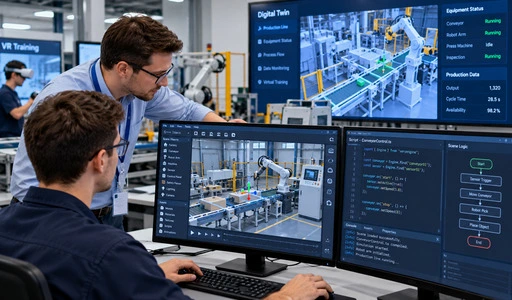
In manufacturing, virtual modelling use computer tools to develop models of production processes, test how equipment will function, and teach personnel without them having to touch actual equipments. Engineers and instructors don’t need to create costly prototypes or halt a manufacturing line to learn. Instead they may build 3D worlds within the browser which exactly replicate the working environment.
The Core Technologies Behind It
VR, 3D rendering, WebGL, and digital twin architecture are all used in this field. Platforms based on HTML5 and B/S (browser/server) design let people access fully interactive work spaces through a web browser, without having to run any software. This is very important for formal adoption.
Why It Matters for Manufacturing Training
A study from 2022 by Deloitte and The Manufacturing Institute says that by 2030, the U.S. manufacturing industry could lose 2.1 million skilled workers. This gap is directly filled by virtual simulation training, which makes training with complex equipment safer, faster, and cheaper than the old ways.
How It Differs From Physical Prototyping
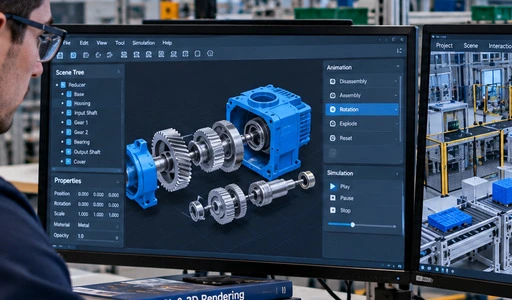
Physical prototyping involves real materials, risk, and long cycles of iteration. That cycle is sped up a lot in virtual simulation. In a virtual world, a UAV system or reducer mechanism can be taken apart, studied, and put back together hundreds of times, all for a lot less money and with no safety risk.
Essential Career Skills for Virtual Simulation Professionals
People who work in this area need a certain mix of technical know-how and the ability to improve their skills in the real world. This job isn't just about writing code or making designs; it's kind of in the middle of both.
Technical Platform Proficiency
You need to have used browser-based simulation tools that let you edit scenes in real time, create motion logic, and handle multimedia assets. For building interface code and plug-in modules, knowing JavaScript and TypeScript is very helpful. If you know how to write scripts, you can do more than just use pre-made templates. You can also make your own actions in virtual production settings.
3D Scene Development and Motion Logic
Layouting the space, rendering materials, adjusting the lighting, and simulating object motion are all parts of industrial production virtual simulation & development. A very important production skill is being able to simulate rotation, linear movement, and mechanical transmission in a virtual world, as well as connecting those movements to user actions. This is immediately relevant to situations like traffic light systems, conveyor belts, and robotic arms with multiple axes.
Cross-Disciplinary Knowledge Integration
Professionals who are good at this field also know a lot about mechanical principles, industrial automation, and the order of production processes. If you know how a real reducer mechanism or UAV navigation system is put together, you can make your training content and virtual models more accurate. This foundation cuts across disciplines and separates new developers from senior simulation engineers.
How Virtual Simulation Changes Industrial Training in Practice
When you move from classroom theory to working on a project online, that's when you really learn. The Industrial production virtual simulation & development course at ECR Academy is based on a project-driven model. Students work on full industrial case projects that cover everything from analyzing requirements to releasing the final product.
From Concept to Deployable Product
The way the course works is similar to how things are done in the real world. Learners begin by designing functions for recognizing equipment. Next, they move on to developing multimedia interactions, programming motion logic, simulating the production process, and finally packaging the product and deploying it in a browser. Each step builds on the last, making a set of skills that work together instead of separate pieces of information.
Real Industrial Case Projects
Throughout the course, there are three main types of projects that students work on: UAV systems, reducer mechanisms, and traffic light control systems. These are not easy-to-understand examples. Learners have to use scripting, motion commands, scene configuration, and interaction logic in workflows that work together. The 2023 report on workforce reskilling from the McKinsey Global Institute says that project-based learning helps people remember skills up to 75% better than passive instruction.
Addressing Common Development Challenges
A lot of people who are learning about virtual simulation development are concerned about the programming difficulties. That worry is directly dealt with by the VeryEngine tool used in this course. Its visual editing interface lets newbies build scenes and see what they'll look like before they're finished without having to write any code. For more experienced learners, it has JavaScript and TypeScript scripting modules that let them add more complex interaction logic. The platform makes it easier to manage resources, and the technical overhead that comes with 3D development tools is also cut down.
Choosing the Right Simulation Platform for Your Institution
For educational institutions building virtual simulation training bases, platform selection determines whether the system actually gets used. A platform that requires complex local installation, has limited scenario coverage, or cannot integrate with existing academic management systems will collect dust after the first semester.
Browser-Based Architecture as a Baseline Requirement
A B/S architecture platform requires no client-side installation and supports remote access across devices. This is critical for institutions serving thousands of students simultaneously, and it aligns with national information infrastructure requirements. VeryEngine meets this standard, running entirely through a web browser using HTML5 and WebGL.
Scenario Library Depth and Customization Capacity
A rich scenario library for industrial production virtual simulation & development — covering mechanical systems, automation equipment, and electronic control scenarios — reduces the time and cost of initial deployment. Equally important is the ability for instructors to extend or customize scenes using script tools. A platform that only delivers fixed content becomes outdated quickly. The ability to build new scenarios using plug-in workflows and TypeScript scripting keeps content current.
Integration and Faculty Support
The platform must be able to fit into current academic systems, and be used by professors. “ECR Academy courses are accompanied by structured teacher training and project support, so institutions don’t have the common problem of buying a platform that staff can’t operate independently.”
Training and Certification Pathways
Building verified skills in this field requires structured learning connected to recognized outcomes. ECR Academy's course integrates international technical skills standards, making its certifications relevant across both domestic and international manufacturing education contexts.
Who This Training Is For
The course is designed for instructors in smart manufacturing programs, vocational training developers, simulation engineers entering the industrial sector, and professionals in manufacturing enterprises looking to build internal training content. It is also accessible to motivated beginners, as the project-driven structure starts with foundational recognition functions before advancing to scripting and production simulation.
Career Roles After Certification
Completing this training prepares learners for roles that are in growing demand across the manufacturing sector. Here are the primary career directions graduates are positioned for:
- Virtual Simulation Engineer — Designs and builds interactive VR training environments for industrial equipment and production lines.
- Industrial Digital Twin Developer — Creates and maintains digital replicas of physical manufacturing systems for analysis and training.
- Smart Manufacturing Simulation Specialist — Develops production process simulations that support workflow planning and workforce training in automated facilities.
- Industrial Training Courseware Designer — Produces browser-deployed training content for technical education programs and enterprise onboarding.
These roles span manufacturing enterprises, vocational institutions, and digital transformation consultancies — all sectors where demand for simulation-qualified professionals continues to grow.
Conclusion
Virtual simulation is no longer a niche field; it is now commonly used for teaching and planning processes in industry, particularly industrial production virtual simulation & development. People and businesses that learn useful skills in this area now will be in a good position as the business world continues to move toward digital-first operations. The industrial production virtual simulation & development course at the ECR Academy gives students a structured, hands-on way to get into this field. The course is based on real industry projects and has a curriculum that is matched with those in other countries.
FAQ
1. Do I need prior programming experience to take this course?
No. The course begins with visual scene editing and basic recognition function development. Learners build programming skills progressively. JavaScript and TypeScript scripting are introduced after foundational skills are established, making the course accessible to beginners.
2. What industries use virtual simulation training most?
Automotive manufacturing, aerospace engineering, and electronics assembly are the heaviest users of industrial virtual simulation. These sectors benefit from the ability to train workers on complex equipment without interrupting production or creating safety risks.
3. How does virtual simulation integrate with factory automation systems?
Simulation platforms can connect with systems like MES (Manufacturing Execution Systems), PLC controllers, and SCADA platforms through APIs and data protocols. This allows simulated environments to reflect real production data and prepares learners for actual system operation.
Build Your Virtual Simulation Career with ECR Academy
ECR Academy has supplier-grade educational solutions for industrial production virtual simulation & development that are made for schools and business training programs. Our course uses standards that are recognized around the world, is taught by engineers, and is based in a browser so it doesn't need to be installed. Contact us to talk about how we can help you reach your goals, whether you are an institution building a simulation training base or a business growing its own technical talent. To ask for a program consultation, email us at ecr2008@enteredu.com or go to enteredu.com.
References
1. Deloitte & The Manufacturing Institute. The Manufacturers' Talent Challenge: Closing the Skills Gap. 2022.
2. McKinsey Global Institute. Jobs Lost, Jobs Gained: Workforce Transitions in a Time of Automation. 2023.
3. International Labour Organization. World Employment and Social Outlook: Trends 2023. ILO, 2023.
4. Siemens AG. Digital Twin: The Key to Smart Manufacturing. Siemens Digital Industries Software, 2021.
5. National Science Foundation. Simulation-Based Learning in Technical and Vocational Education. NSF STEM Education Report, 2022.
6. World Economic Forum. The Future of Jobs Report 2023. WEF, 2023.