The Future of Automotive Electronic Technology Applications
The future of automotive electronic technology applications is reshaping how vehicles are built, maintained, and certified. As the industry pivots from combustion engines toward electrification and intelligent connectivity, the demand for technicians who truly understand in-vehicle electronic systems has never been more urgent. Automotive electronic technology applications now span power battery management, ECU diagnostics, vehicle network communication, and smart sensor calibration — forming the backbone of every modern NEV and intelligent connected vehicle on the road today.
Emerging Trends Shaping the Future of Automotive Electronic Technology
From Distributed ECUs to Domain-Centralized Architectures
The landscape of car technology is changing in a big way. In older cars, there were dozens of different Electronic Control Units, and each one controlled a specific function. Today's Software-Defined Vehicles combine these into Domain Control Units, which makes connecting a lot easier and lets software changes happen over-the-air. McKinsey & Company predicts that the global market for automotive electronic technology applications will grow to more than $400 billion by 2030. This growth will be mainly caused by demand for electric vehicles and self-driving cars. For people in charge of training and buying things, this change means that technicians must now know how to do integrated system diagnostics as well as individual component repair.
The Rise of Wide Bandgap Semiconductors and 800V Architectures
Silicon Carbide (SiC)-based parts are becoming more common as EV platforms move toward 800V architectures. These Wide Bandgap semiconductors can handle higher voltage loads with less heat loss, which lets them charge faster and work over a longer range. Technicians who haven't worked with high-voltage power electronics have a real skills gap that can only be filled by standardized, lab-based training programs.
Core Applications and Benefits of Automotive Electronics in Modern Vehicles
Safety Systems, V2X Communication, and Real-Time Diagnostics
Electronic stability controls, advanced driver assistance systems, and Vehicle-to-Everything communication protocols are no longer extras; they are required by law. All new passenger cars in the U.S. must have automatic emergency brakes by 2029, which shows how deeply electronics will be integrated in the future. A 2022 Deloitte automotive services study says that smart diagnostic tools that use CAN bus and automotive Ethernet now let fleet managers watch problem codes in real time, which increases safety and cuts unplanned downtime by up to 30%. Technicians who are good at both hardware-level assembly and software-level diagnostics are needed for these features.
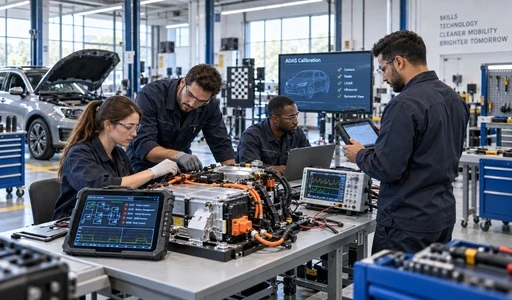
For B2B buyers, the value proposition is clear: spending money on structured training for automotive electronic technology applications directly leads to fewer warranty claims, faster technician ramp-up, and consistent service quality across chains with multiple locations.
Comparing Automotive Electronic Technologies: Making Informed Procurement Decisions
Sensor Technologies: Radar, LiDAR, Ultrasonic, and Camera Systems
The deployment situation is very important when picking the right sensor platform. Radar works great in bad weather and over long distances, which is why it is a standard part of ADAS systems on highways. LiDAR has better spatial precision for self-driving cars in cities, but it costs more per unit. Ultrasonic sensors are still the most affordable way to help with parking at low speeds. Camera-based systems need powerful image processing tools because they collect the most data for lane exit and traffic sign recognition. When purchasing teams use a multi-brand service network to find parts, knowing these trade-offs keeps them from over-specifying and wasting money.
ECU vs. Legacy Mechanical Control: Why the Gap Is Widening
Big names in the industry, like Bosch, Continental, and Denso, have all put a lot of money into research and development for next-generation automotive electronic technology applications. For instance, Bosch's cross-domain ECU platform cuts the number of separate drivers by more than 40% compared to older systems while making diagnostics clearer. For aftermarket suppliers and training academies, this means that technicians need to know more about software in addition to being good at mechanics. Traditional apprenticeship models have trouble teaching both of these skills at the same time.
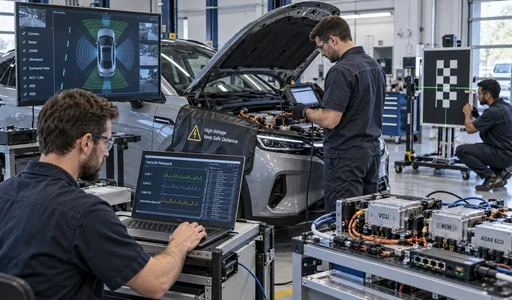
Practical Guide to Sourcing and Procuring Automotive Electronic Components
More than a low price quote is needed to buy reliable automotive electronic technology applications. Benchmarks for quality assurance are the basis of any responsible buying plan. Before finalizing a relationship with a supplier, procurement managers should make sure of the following important compliance checkpoints:
- AEC-Q100 / AEC-Q101 Certification: These standards show that integrated circuits and discrete semiconductors have been through automotive-grade stress testing, which includes heat cycling, high-temperature working life, and resistance to electrostatic discharge.
- ISO 26262 Functional Safety Compliance: Suppliers must show that their ASIL (Automotive Safety Integrity Level) ratings are right for the job, especially for parts that control the brakes, steering, and batteries.
- ISO 16750-3 Vibration and Shock Testing: For parts installed under the hood or in the chassis, it is required that their mechanical integrity be confirmed throughout the vehicle's expected service life.
- ASPICE Software Process Assessment: Following Automotive SPICE levels for ECU firmware and integrated control software makes sure that the code is reliable and can be maintained for a long time.
All of these steps lower the risk in the supply chain and help meet traceability standards that are becoming more common in OEM contract terms. Once procurement managers have a list of suppliers they have checked out, they should make sure that the delivery terms, warranty conditions, and batch traceability protocols are all in line with each other before committing to large orders.
Future-Proofing Your Automotive Electronics Investment
Modular Systems, Cybersecurity, and Predictive Maintenance
To be ready for the future when buying automotive electronic technology applications, you need to pay attention to three forces that are coming together. As technology cycles get shorter, modular electronic designs are very useful because they let you make small changes to systems without having to update the whole platform. The UN ECE WP.29 regulation now requires all new vehicle types in signatory markets to have cybersecurity management systems. This means that cybersecurity is now a regulatory priority. At the same time, AI-powered predictive maintenance tools let fleet operators guess when parts will break down before they do. This is possible thanks to real-time data streams from sensor networks in vehicles.
Aligning the curriculum with these paths helps training academies and enterprise clients build long-term competency frameworks. This way, graduates and certified technicians will still be useful across platform generations without having to go through full retraining every time a new product comes out.
ECR Academy's Automotive Electronic Technology Applications Course: A Structured Answer to Industry Demand
ECR Academy has created a program specifically for automotive electronic technology applications. This program directly fills the workforce gap. The course is based on four main competency areas: assembly, debugging, testing, and inspection. It gives students skills that are directly applicable to production and service jobs in the car parts manufacturing and intelligent in-vehicle equipment sectors.
The lessons are organized into modules and are based on projects. They are taught by a combination of academic lessons and lab-based tasks that are meant to be like working in a real workshop. The faculty members have both academic credentials and real-world experience in the field. The program also uses a network of more than 500 business partners that has been built up over 16 years of operation.
Five dedicated labs are used for training, and each one is set up to focus on a different set of skills. There are training benches for power battery management, training benches for drive motors, and clever sensor stations in the Automotive Electrical Training Lab. There are engine, chassis, and body ECU benches, as well as vehicle network training platforms and diagnostic scanners, in the Electronic Control System Testing Lab. When learners finish, they have real-world experience that they can use right away in NEV assembly roles.
Importantly, the program directly links to paths for practical certificates, such as credentials for testing NEV assembly and adjustment and credentials for testing intelligent connected vehicles. This standardized, certificate-aligned structure gives training leaders who are in charge of multiple sites the stability and scalability that chain operations need.
Conclusion
It's clear where automotive electronic technology applications are going. Electrification, smart connectivity, and software-defined vehicle architectures are changing what technicians need to know and be able to do. Companies that spend money on structured training that leads to certification will have a clear edge in service quality and staff flexibility in the future. The program at ECR Academy is a legitimate, lab-based, and scalable way to meet that demand. It is based on 16 years of global skills education.
FAQ
1. What vocational certifications does this course connect to?
This program is in line with credentials for both NEV construction and adjustment testing and intelligent connected vehicle testing and adjustment. These pathways help with integrated course-certificate training, which lets students get formal credentials while also improving their skills.
2. Does the course address high-voltage safety training?
Yes. Power battery management, drive motor systems, and high-voltage assembly procedures are all part of the program. Safety compliance testing and electrical performance validation are two of the program's main inspection skills.
3. How does ECR Academy support multi-location enterprise deployment?
Chain-network scalability is built into the modular curriculum structure and standardized assessment framework. With over 60,000 learning tools and more than 3,300 industry experts at ECR Academy's disposal, businesses can set uniform training standards across multiple places.
4. What industries does this course serve?
The program is mostly aimed at companies that make automotive parts and components, smart tools for cars, NEV service chains, 4S group training centers, and vocational schools with automotive technology programs.
Partner with ECR Academy to Build Your Next-Generation Technician Workforce
Since 2010, ECR Academy has trained almost 500,000 people in 28 countries. Our supplier-aligned program for automotive electronic technology applications gives your company a tried-and-true, scalable way to help employees move to new jobs. If you are a business, school, or industry group, please email us at ecr2008@enteredu.com or visit enteredu.com to learn more about partnership possibilities and unique deployment choices.
References
1. McKinsey & Company. Automotive Software and Electronics 2030. McKinsey Center for Future Mobility, 2023.
2. Deloitte. 2022 Global Automotive Consumer Study. Deloitte Insights, 2022.
3. National Highway Traffic Safety Administration (NHTSA). Federal Motor Vehicle Safety Standards: Automatic Emergency Braking. NHTSA, 2023.
4. Bosch Mobility. Automotive Electronics: Trends and System Solutions. Robert Bosch GmbH, 2022.
5. SAE International. Automotive SPICE Process Assessment Model, Version 3.1. SAE International, 2017.
6. United Nations Economic Commission for Europe. UN Regulation No. 155 – Cybersecurity and Cybersecurity Management System. UNECE WP.29, 2021.


_1781601799781.webp)