Why New Energy Vehicle Fault Diagnosis & Troubleshooting Requires Safety Skills
When a technician opens a high-voltage battery pack without proper insulation protection, the consequences can be fatal. New energy vehicle fault diagnosis & troubleshooting is not simply a technical skill set — it is a safety-critical discipline. With NEV adoption accelerating globally and high-voltage architectures now reaching 800V platforms, the gap between qualified and unqualified technicians has never carried higher stakes. This article explains why safety knowledge is inseparable from diagnostic competence, and how structured training programs address that reality.
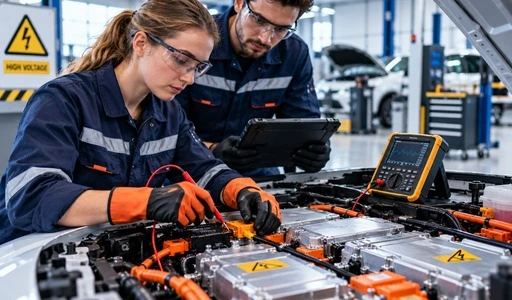
Understanding NEV Fault Diagnosis and Its Safety Implications
Electric vehicle systems break down in different ways than combustion engine systems. Voltage jumps and toxic off-gas can happen at the same time when a battery fails, the motor driver fails, or the inverter fails. The first step in any real training program is to understand this difference.
Common Fault Categories in Three-Electric Systems
There are different ways that the three-electric design (battery, motor, and computer control) can fail. Unbalanced battery cells set off BMS alerts and can also happen before heat events. When a drive motor fails, it often shows up as an odd current pattern. Electronic control unit errors can spread across CAN-FD communication busses, creating secondary fault codes that aren't clear and lead technicians in the wrong direction.
Diagnostic Tools and Their Limitations
Standard OBD-II scanners can't get to the private BMS parameters needed to check the voltage of each cell. To read BMS PIDs, log balancing data, and figure out what the high-voltage interlock loop (HVIL) status means, you need special NEV diagnostic software. If technicians don't have the right tools, they might miss the problem or put themselves at unnecessary risk by touching live circuits.
Why High-Voltage and Chemical Hazards Demand Protocol
According to IEC 60479 standards, systems that run on more than 60V DC are dangerous. A 400V or 800V traction battery stores enough energy to hurt someone with an arc flash in milliseconds. When batteries fail, hydrogen fluoride can also leak out, which is a chemical danger that isn't usually taught in mechanic school. Minimum safety standards are set by regulations like GB/T 18384 and UN ECE R100, but they can only be followed by trained workers who know why each rule exists.
The Fault Diagnosis Process — A Systematic Approach to Safe Troubleshooting
There is a set order to safe tests. People who skip steps to save time are the ones who cause most high-voltage accidents in work settings.
Step One: Pre-Work Safety Verification
Before starting any diagnostic work, technicians must check the voltage of the 12V backup battery, make sure that the HVIL is connected, and look for moisture or small cracks in the high-voltage connectors. High-voltage Contactors won't work if the safety loop is broken or there isn't enough auxiliary logic power. Trying to force them to work creates dangerous conditions.
Step Two: Fault Isolation Using Certified Equipment
It is important for technicians doing new energy vehicle fault diagnosis & troubleshooting to make sure the system is completely off before touching it. They should do this by using CAT III 1000V-rated shielded tools, Class 0 high-voltage gloves, and a certified non-contact voltage tester. An oscilloscope can help you tell the difference between software errors and hardware problems. For example, if the PWM logic signals are right but the three-phase output is uneven, the problem is in the IGBT hardware layer and not the controller software.
Step Three: Root Cause Confirmation and Repair Verification
Technicians write down what they found, fix the problem, and then do a full system recheck that includes testing the insulation resistance at 1000V stress levels. The vehicle manufacturer says that the isolation resistance should be above 500 Ω/V. This last step of verification stops problems from happening again and makes the record of compliance that regulatory audits need.
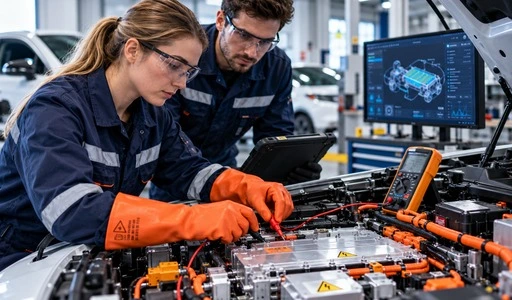
Comparing Safe Fault Diagnosis Tools for Electric Vehicles
Procurement teams responsible for equipping training labs or service stations face a real selection challenge. The market offers a wide range of tools, but safety integration varies considerably.
Onboard vs. External Diagnostic Systems
Onboard diagnostics provide real-time system monitoring and are essential for continuous fault logging during vehicle operation. External diagnostic platforms, however, offer deeper access to proprietary manufacturer data, support multi-brand vehicle coverage, and allow technicians to perform guided fault-tree analysis. For training institutions running order-class programs aligned with manufacturers like BYD or NIO, external platforms that mirror factory diagnostic workflows hold significant advantages.
Manual vs. Automated Troubleshooting Systems
Manual diagnostic methods demand strong foundational knowledge — a technician must correctly interpret oscilloscope waveforms and raw data streams independently. Automated systems guide less experienced technicians through structured diagnostic trees, reducing the risk of misinterpretation. The best training programs teach both approaches, ensuring graduates can operate confidently across different workshop environments.
What to Prioritize When Selecting Tools
Here are the core criteria procurement professionals should apply when evaluating diagnostic platforms:
- Safety certification alignment: Tools must comply with ECE R10 electromagnetic compatibility standards so diagnostic equipment does not introduce EMI noise into vehicle control networks.
- Multi-system coverage: A platform covering battery, motor, and electronic control diagnostics in one environment reduces equipment gaps and training inconsistencies.
- Software update frequency: NEV technology changes rapidly — 800V platforms, SiC inverters, and CTP/CTC battery architectures require regular curriculum and tool updates.
These criteria directly affect whether a training institution or enterprise service team can stay technically current and operationally safe over a multi-year program lifecycle.
Risk Avoidance and Safety Pitfalls in NEV Fault Diagnosis
The main reason why most NEV repair mistakes happen is that people don't realize how different it is to diagnose a regular car versus a high-voltage electric engine.
Misreading Fault Codes Without Context
Fault codes in new energy vehicle fault diagnosis & troubleshooting talk about symptoms, not what caused them. If a technician fixes a battery isolation fault without looking into how the moisture got in and caused it, the fault will come back, or even worse, the insulation will fail during the next high-current demand event. Insulation faults often happen in places with a lot of moisture because the sealants on the connectors have worn down, letting water lower the isolation resistance below the BMS threshold.
Ignoring Layered Safety Protocols
A lot of techs who are taught to work on combustion engines think of high-voltage systems as just "bigger electrical systems." This mental model is wrong and could be dangerous. There are several lockout steps, required wait times for capacitor discharge, and verification sequences that are unique to high-voltage de-energization procedures that are not present in low-voltage work.
Absence of Periodic Safety Audits
If a service team doesn't do regular safety checks, they start to take shorter-cuts. Regular checks, which look at PPE condition records, tool calibration records, and incident near-miss logs, are what make safety measures work instead of just being ideas.
Integrating Safety Skills into Your NEV Diagnosis Strategy — Practical Recommendations
Integrating safety knowledge into diagnostic training is both required by law and a way for program directors, buying managers, and training team leaders to stand out in the market.
Role-Based Training Segmentation
Different technicians don't need to know the same amount about high voltage. First-level technicians who do routine diagnostics need to learn the basics of safety protocols. Senior engineers who change battery modules or fix motor controllers need to be certified in advanced high-voltage operation. When you match the level of training to the job, both productivity and safety go up.
Procurement Criteria for Training Program Partners
When choosing a training program provider, give more weight to partners whose platforms cover the whole three-electric workflow: wiring, checking the battery system, and finding motor faults in a single, unified space. Check that the platform has hardware-level safety features like monitoring the insulation, protecting against overcurrents, and having emergency stop systems.
Building a Forward-Looking Training Infrastructure
NEV technology will keep changing. Programs that are based on ISO 26262 functional safety principles and SAE J1979 diagnostic communication standards are better because they can be easily changed to work with new vehicle architectures than programs that are based on specific model procedures. When schools teach safety skills as a core subject, not an extra, their grads are able to work with new technologies for a long time.
Conclusion
High-voltage system work carries real physical risk, and that risk grows when technicians lack structured safety training in new energy vehicle fault diagnosis & troubleshooting. The evidence from regulatory frameworks, industry incident records, and diagnostic tool requirements all point to the same conclusion: safety skills are not optional in NEV fault diagnosis — they are the technical baseline. Programs that integrate safety protocols into every diagnostic module, from battery assembly to motor controller troubleshooting, produce graduates who are genuinely job-ready and operationally reliable.
FAQ
1. Can someone with no automotive background take an NEV fault diagnosis course?
Yes. Structured programs begin with basic NEV architecture and low-voltage systems, then move on to high-voltage operation and finding faults. It's helpful to have a basic understanding of electrical circuits and mechanics, but it's not necessary.
2. What safety equipment is mandatory during high-voltage diagnostic work?
Technicians need to have insulated tools rated at CAT III 1000V, Class 0 high-voltage gloves, and a non-contact voltage tester that has been calibrated. When working in places where battery thermal events are possible, you need to wear face protection and clothes that won't catch fire.
3. How often do NEV diagnostic course materials need updating?
New 800V platforms, SiC inverter designs, and structural battery formats are just a few examples of how quickly technology is changing. Because of this, program content should be reviewed at least once a year, and major updates should be timed to match manufacturer technical bulletins.
Start Building Qualified NEV Technicians with E.C.R Academy
Through a project-based program that is in line with global technical skills standards, E.C.R. Academy offers organized new energy vehicle fault diagnosis & troubleshooting training. For institutions and businesses looking for a dependable new energy car fault diagnosis troubleshooting provider, our integrated three-electric training platform, which covers battery systems, drive motors, and electronic control, is created. Visit enteredu.com or email our team at ecr2008@enteredu.com to talk about deploying the program for your school or group.
References
1. International Electrotechnical Commission. IEC 60479: Effects of Current on Human Beings and Livestock. IEC, 2018.
2. National Standards of China. GB/T 18384: Electric Vehicles — Safety Requirements. Standardization Administration of China, 2020.
3. United Nations Economic Commission for Europe. UN ECE Regulation No. 100: Approval of Vehicles with Regard to Specific Requirements for the Electric Power Train. UNECE, 2021.
4. SAE International. SAE J1979: E/E Diagnostic Test Modes. SAE International, 2020.
5. International Organization for Standardization. ISO 26262: Road Vehicles — Functional Safety. ISO, 2018.
6. U.S. Department of Energy, Office of Energy Efficiency & Renewable Energy. Electric Vehicle Safety Training for First and Second Responders. DOE, 2022.


_1781601799781.webp)