New Energy Vehicle Design & Control Technology: Virtual Training vs. Physical Labs
The debate is no longer whether we should train engineers for the EV business, but how we should train them. The New energy vehicle design & control technology vehicle includes battery management system, motor drive control, electronic architecture and charging system integration. Traditional physical laboratories provide actual hands-on experience, but they are expensive and not easily scalable. The benefits of virtual platforms include speed and flexibility, but they need to reflect actual industrial circumstances to be of any use. This essay looks honestly at both techniques so you may make a well-grounded conclusion for your school or business.
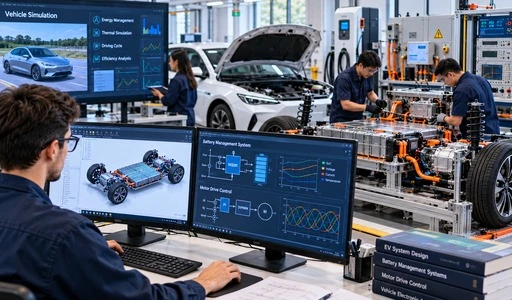
Challenges and Opportunities in NEV Engineering Training
Many of the training systems that are already in place can't keep up with the speed of EV development. When you know where the pressure points are, you can have a more targeted training talk.
Battery Management and Thermal Complexity
Monitoring the State of Charge (SoC), stopping thermal runaway, and testing cycle life are all important parts of power battery systems that are not easy to copy. To test a battery physically, you need charge-discharge tools, a controlled setting, and safety rules that are in line with ISO 26262 (ASIL-D) standards. If a lab doesn't have the right equipment, these tests are often skipped, which means engineers aren't ready when they need to be.
High-Voltage Safety and EMC Requirements
To work on 400V–800V platforms, you need to follow strict de-energization steps and use CAT III/IV-rated test instruments. Electromagnetic compatibility (EMC) between ADAS sensors and power systems adds another level of difficulty. Engineers who don't get enough real-life experience with high voltage can become dangerous. Virtual models can fill in this gap without putting people in danger.
Scalability for Institutions and Enterprise Teams
Universities that offer programs and companies that hire a lot of engineers have the same scaling problem: they can't add more physical labs fast enough. Twenty students can use a single motor test bench at the same time, but 200 students can use a virtual simulation platform at the same time. Because of this imbalance, the choice of training style is not just an educational one, but also a strategic one.
Virtual Training vs. Physical Labs: Core Features and Comparative Analysis
Both formats carry genuine value. The goal is not to pick one and discard the other—it is to understand what each does well and where each falls short.
What Virtual Platforms Do Well
Learners may build BMS algorithms, simulate motor vector control and test charge control techniques in virtual settings using tools such as MATLAB/Simulink, AVL CRUISE or CarMaker, without touching actual hardware. Remote access means a student in Beijing and an engineer in Kuala Lumpur may run the same simulation at the same time. The iteration speed is high and the cost per test cycle is minimal. In fact, the International Energy Agency’s 2022 study showed that more than 30% of all worldwide EV R&D spending is currently focused on software-defined vehicle development, underscoring the essential part that simulation plays in the design process.
Where Physical Labs Remain Necessary
Certain competencies in new energy vehicle design & control technology simply cannot be built through a screen. PCB designing and routing using Altium Designer or Cadence must, ultimately, be converted to a produced board. Motor torque consistency under dynamic load, regenerative braking response, CAN bus signal integrity, etc. need physical test benches and oscilloscopes. These hands-on validations are what differentiate a good engineer from an engineer who simply knows theory. Insulation resistance testing, coolant conductivity checks, and leak testing to IP67/IP68 standards—these are physical procedures with physical consequences.
A Direct Comparison for B2B Decision-Makers
Here are the key differentiators between the two formats that matter most to procurement and program leaders:
- Upfront investment: Physical labs (motor test benches, battery pack testing systems, FPGA boards) carry significant capital costs. Virtual platforms typically operate on software licensing models, which are more predictable.
- Prototyping speed: Virtual environments allow rapid design iteration—a chassis layout or PCB schematic can be modified and re-simulated within hours. Physical prototyping cycles take days or weeks.
- Geographic flexibility: Virtual platforms support distributed teams and remote learners with no additional infrastructure cost. Physical labs are fixed assets tied to a specific location.
- Depth of validation: Physical testing provides the final word on component behavior under real operating conditions—something no simulation fully replicates.
These trade-offs make a hybrid model the most defensible choice for most institutions and enterprise training programs.
Practical Applications: How Leading Programs Combine Both Formats
This combined idea is at the heart of ECR Academy's New energy vehicle design & control technology program. The course includes CAD structure design, EDA circuit design, digital simulations, and hands-on lab work all in one logical progression.
Virtual-Physical Lab Integration at ECR Academy
The NEV Three-Electric System Performance Testing Laboratory for the program has CAN bus analyzers, motor test benches, and battery charge-discharge systems. The Component Design Training Laboratory also has EDA platforms with Altium Designer and KiCad and CAD workstations that run CATIA, UG, and SolidWorks. Learners don't have to pick between virtual and real; they have to use both in the right order for real engineering work.
From Simulation to Physical Validation
A typical learning path goes like this: a student designs a motor controller schematic in EDA software, simulates how it works in MATLAB/Simulink, makes a prototype PCB using the lab's 3D printers and board preparation tools, and then tests it on the electronic control system test bench to make sure it works. This whole process is exactly the same as how things are done at companies like BYD, CATL, and Inovance Technology.
Enterprise and Institutional Outcomes
This kind of program framework has shown measurable effects. Based on internal benchmarks from companies with 30% or more new hires in R&D teams, enterprise training programs that mix simulation-based onboarding with real lab rotations have cut the time it takes to train a new engineer by an average of four to six months. Universities that want to be recognized at the national level must now be able to show that they have MATLAB/Simulink integration and real lab facilities.
How to Select the Right Training Approach for Your Needs
Define Your Scope and Constraints First
First, think about what your students or engineers need to do for work. If the job involves making BMS algorithms, platforms that can handle a lot of simulations should be chosen. If the job requires physical assembly, fault detection, or high-voltage repair, then you have to be there for lab time. Time and money are important, but they shouldn't decide whether you use both formats or not. Instead, they should decide how you balance them.
Evaluate Software Realism and Hardware Coverage
Check to see if the modeling tools for virtual platforms in new energy vehicle design & control technology are in line with industry standards. For example, MATLAB/Simulink is used for control methods, AVL CRUISE is used for powertrain dynamics, and CarMaker is used for car systems. Check that the three-electric system equipment for physical labs includes a power battery, a drive motor, and an electronic control unit. If a lab only has two or one of these three, it's missing out on important training in how to integrate.
Plan for Certification and Career Outcomes
Institutions don't see much value in training that doesn't lead to a clear result. The program at ECR Academy helps people get certified in NEV engineering, CAD mechanical design, and EDA electronic design. These are all credentials that are useful for jobs in design, testing, and research and development. These certifications help university departments keep track of graduate jobs, which is directly related to the requirements for 2.0 reporting.
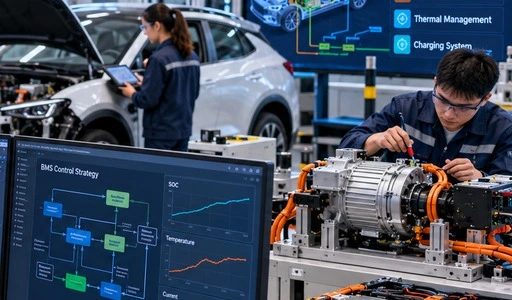
Future Trends in NEV Training and Control Technology
Digital Twins and AI-Driven Simulation
Digital twin technology, in which a real part is mirrored by a virtual model that is constantly being updated, is making its way from aerospace to cars. Engineers can now use digital twins of batteries to predict degradation trends and temperature behavior without having to cycle a real cell. AI-assisted modeling tools can find mistakes in PCB layouts or control logic designs before a prototype is built. This cuts validation times by a large amount.
Remote and Distributed Training Infrastructure
After 2020, both businesses and universities have put money into infrastructure that allows training to happen in different places. Now that there are cloud-based EDA systems, remote-access motor simulation environments, and collaborative CAE tools, teams from all over the world can work on the same car design at the same time. This change is good for businesses with engineering teams in different time zones and schools with more than one campus.
Industry-Education Integration as Standard Practice
The line between business training and education courses is getting thinner. More and more, programs like the ECR Academy model, created by automotive engineers and university professors, are becoming the norm rather than the exception. In China, this collaboration between industry and academia is officially supported through the automotive industry-education integration system, along with similar initiatives in other regions.
Conclusion
Virtual training and real labs are not enough to make an engineer ready in new energy vehicle design & control technology. Industry practice and program design both point to integration: use simulations for speed, iteration, and safety; use physical labs for validation, hands-on accuracy, and fidelity to the real world. The curriculum, faculty model, lab infrastructure, and certification pathways of ECR Academy's New energy vehicle design & control technology program all reflect this balance. Business and institutions thinking about investing in EV training shouldn't ask which format is best. Instead, they should ask if their current program offers both.
FAQ
1. Can this program be adapted for university curriculum integration?
Yes. The structure of the program is based on the typical sequence of first-year engineering courses. It covers mechanical design, electrical control, and system integration. It works with CAD/EDA software already used in most engineering programs and meets the requirements of the Engineering Education 2.0 curriculum. Because the program can be aligned with existing course structures, university departments can adopt individual courses or the entire program, depending on their needs.
2. What software tools does the training cover?
For 3D mechanical design, the program covers CATIA, UG, and SolidWorks. For EDA and PCB design, it covers Altium Designer, Cadence, and KiCad. For modeling and CAE analysis, it covers ANSYS and MATLAB/Simulink. Learners can focus on the tools that will help them the most in the career path they want to take.
3. Is this program suitable for engineers with no prior EV background?
Yes. The program starts with basic modules that teach mechanical drawing, engineering mechanics, and the basics of automotive electrical wiring. Later, it moves on to more advanced topics like BMS design, motor controller development, and integrating three-electric systems. It is set up to help students from the very beginning all the way up to applied engineering proficiency.
Start Your NEV Training Partnership with ECR Academy
With 16 years of experience, more than 500,000 trained participants, and relationships in 28 countries, ECR Academy is a reliable training provider for new energy vehicle design & control technology. Virtual simulations and real-life three-electric system labs are both part of our program. Automotive experts and academic teachers teach the classes. If you are from a university school, an enterprise R&D team, or an industry group, please email us at ecr2008@enteredu.com or visit our website at enteredu.com to talk about how we can help you reach your training goals.
References
1. International Energy Agency. Global EV Outlook 2023. IEA, 2023.
2. Society of Automotive Engineers International. SAE J1772: Electric Vehicle and Plug-in Hybrid Electric Vehicle Conductive Charge Coupler. SAE International, 2017.
3. ISO. ISO 26262: Road Vehicles – Functional Safety. International Organization for Standardization, 2018.
4. Larminie, J., & Lowry, J. Electric Vehicle Technology Explained (2nd ed.). Wiley, 2012.
5. Emadi, A. Advanced Electric Drive Vehicles. CRC Press, 2014.
6. Chan, C. C., & Wong, Y. S. "Electric vehicles charge forward." IEEE Power and Energy Magazine, vol. 2, no. 6, 2004.