What You Will Learn in Humanoid Robot Programming Development Course
If you are evaluating whether to bring a humanoid robot programming course into your institution, this guide is written for you. By the end of this page, you will have a clear picture of the skills students gain, the technical depth covered, and why this course stands apart from general robotics offerings. The course at ECR Academy teaches learners to build, control, and deploy intelligent robot systems using ROS/ROS2, Python, and C++, covering everything from joint-level motion control to multi-robot collaboration in real industrial scenarios.
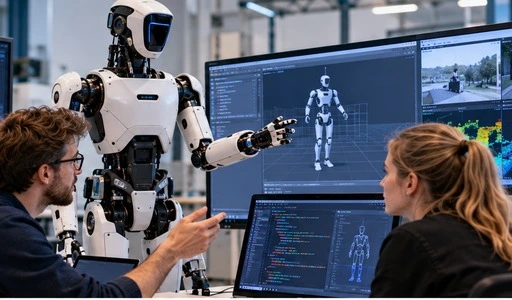
Understanding the Fundamentals of Robot Programming for Humanoid Systems
Students need to have a good understanding of the subject before they can write a single line of code. This class carefully and gradually builds on that base.
Hardware and Software Architecture
The first thing students do is look at the MagicBot Gen 1 platform. This is a 174 cm full-size humanoid robot with 42 active degrees of freedom and a self-developed dexterous hand called MagicHand S01 that has 11 degrees of freedom per hand. Knowing how hardware talks to software control layers gives students a realistic mental model that is hard to find in general textbooks.
Core Programming Languages and Middleware
The course covers Python and C++ as main programming languages, with ROS2 as the main piece of software. ROS2's DDS communication layer lets real-time control loops work at frequencies higher than 1 kHz, which is needed for stable two-legged balance. Students learn why the choice of language has a direct effect on the speed and ability to grow of a system.
SDK Integration and Development Environment Setup
The students set up Ubuntu 22.04 as their programming setup and use the magicbot-gen1_sdk open-source SDK to work on their projects. This SDK has interfaces in two languages and a large library of pre-set actions, such as shaking hands, nodding, and celebrating. This way, learners can quickly call or change motion programs without having to start from scratch with basic functions.
Exploring Motion Control, Sensor Fusion, and AI Integration
After going over the basics, the course moves on to the technical parts that make modern embodied intelligence systems different from older robotic automation.
Motion Planning and Dynamic Movement Programming
Students use high-level motion control APIs to do acrobatic moves like backbends and getting back up after falling. They also work on standing and balance. They can also use low-level joint control interfaces to position things with sub-millimeter accuracy. This is a skill that can be used right away in industrial assembly tasks where accurate end-effectors are necessary.
Multi-Sensor Perception and Data Processing
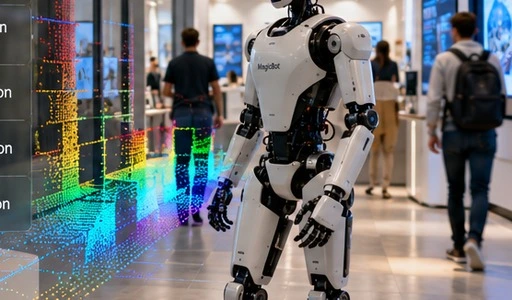
There is a 3D LiDAR unit, two depth cameras, and three fisheye cameras on the MagicBot Gen 1 for humanoid robot programming. Students learn how to get information from all of these places at the same time and process it. Using YOLO, which is one of the most popular real-time detection systems in production robots right now, they build multi-modal perception pipelines that include obstacle detection, environment mapping, and object identification.
AI-Driven Interaction and Autonomous Navigation
Students make smart tour guide apps that use SLAM to map, plan routes, connect with users through voice, and recognize faces all in one system. This is like real-life deployment settings like museums and art galleries, where robots have to react to both their physical surroundings and human social cues at the same time.
Comparing Programming Platforms and Tools for Procurement Decisions
When schools are looking at robotics courses, they often ask, "Which platform offers the best balance between technical depth, cost, and educational return?" This part directly answers that question.
Open-Source SDK vs. Proprietary Platforms
The Magic Atom SDK is free to use and works with both C++ and Python. This means that you can be sure of the long-term costs of licensing. Proprietary systems, such as NAOqi, which is used with Softbank's NAO and Pepper robots, have nice user interfaces but make it hard to change the software. If schools want their students to learn more about how systems work and not just call pre-written functions, they should use an open-source approach.
Platform Compatibility and Remote Learning Support
Students don't have to be in the same room with the robot for every session because the course allows for remote and flexible learning. Standard gear that meets these requirements can be used for simulation settings and SDK-level development: You need at least an Intel Core i5, 16 GB of RAM, 256 GB of storage, a dedicated GPU with 4 GB of VRAM, and Python 3.10 with CMake 3.16 or later. This makes it easier for schools that are just starting to set up labs.
Matching Platform Choice to Institutional Goals
A platform that allows high-dynamic movements and custom motion design is helpful for institutions that focus on skill challenges. Multi-robot coordination features that use tools like MagicDraw for map sharing and task scheduling are useful for industrial training institutions. The MagicBot Gen 1 platform meets both goals with a single curriculum, which makes buying equipment easier and lowers the total cost.
Practical Course Structure: What Students Work Through
The course is broken up into six training units that build on each other. This is how they add to each other.
There is a clear progression from basic knowledge to real-world scenario work in the six modules:
- Module 1 – Robot Platform Introduction: Students learn hardware/software architecture, set up the development environment, and get oriented with ROS2 and core perception technologies.
- Module 2 – Basic Module Usage: Students control lighting, voice interaction, and perform human-like motions including waving, handshaking, and dexterous hand manipulation tasks such as grasping.
- Module 3 – Motion Control and Acrobatics Development: Students move from high-level API calls to low-level joint control, programming advanced motions including fall recovery and disturbance response.
- Module 4 – Multi-Sensor Data Processing: Students in humanoid robot programming process LiDAR, depth camera, and fisheye data to develop obstacle detection, environment mapping, and object recognition capabilities.
- Module 5 – Smart Tour Guide Case Training: Students integrate navigation, path planning, voice interaction, and face recognition into a complete application modeled on real public-service deployment scenarios.
- Module 6 – Industrial Multi-Robot Collaborative Development: Students implement coordinated multi-robot operations for material handling and parts assembly, using fault-tolerant scheduling and shared map management.
Each section is directly related to a job in the field of embodied intelligence, ranging from engineers working on ROS2 to experts in autonomous guidance and teachers at international competitions.
Ensuring Implementation Success and Keeping Pace with Technology
One of the most common concerns institutions raise is whether a newly purchased course will remain technically current two or three years after purchase. This is a fair question in a field where model architectures and middleware standards shift frequently.
Faculty with Industry and Academic Backgrounds
The course is taught by both enterprise engineers and academic experts. This dual-track faculty model means the curriculum stays connected to what employers actually require, not just what is established in academic literature. According to a 2023 UNESCO-UNEVOC report, the gap between vocational curriculum content and industry practice remains one of the top barriers to graduate employability in technical fields.
Curriculum Aligned to International Technical Skills Standards
The course is structured around international technical skills standards, which supports institutions seeking internationally recognized certification outcomes for their students. This matters particularly for institutions across Southeast Asia, the Middle East, and Africa that are building new engineering programs and need external validation to attract enrollment.
Continuous Technical Support and Course Updates
ECR Academy has delivered professional training to nearly 500,000 participants across 28 countries since 2010, with over 300,000 learners earning recognized skills certifications. That operational track record means institutions receive support from an organization that has managed curriculum updates and technical transitions across many technology generations — not just the current one.
Conclusion
This humanoid robot programming class takes students from having no experience at all to having skills that will get them jobs in the field of embodied intelligence development. They study how to use and manage a full-size humanoid robot, create smart apps with ROS2, handle data from multiple sensors, and set up unified systems for both service and manufacturing situations. This curriculum covers the most important technical topics right now for schools that want to start a real robotics program that turns out competitive graduates who can get jobs.
FAQ
1. Can students with no coding background take this course?
Yes. The course starts with fundamentals and progresses step by step. Students learn basic robot operation before writing any application code, and the SDK's preset action library lets beginners see results early, which maintains motivation through the more demanding programming modules.
2. What career roles does this course prepare students for?
Graduates can pursue roles including ROS/ROS2 Development Engineer, Embodied Intelligence Development Engineer, Robot Vision Algorithm Engineer, Motion Control Engineer, Autonomous Navigation Engineer, Dexterous Hand Development Engineer, Multi-Robot Collaborative Systems Engineer, and International Competition Instructor.
3. Does the course work without a physical robot on-site?
Partially. The SDK-level development and simulation work runs on standard hardware meeting the minimum specs: Ubuntu 22.04, Intel Core i5, 16 GB RAM, and a 4 GB VRAM GPU. Full physical platform exercises require the MagicBot Gen 1 hardware, which ECR Academy can advise on as part of an institution's procurement plan.
Partner with ECR Academy — Humanoid Robot Programming Supplier for Institutions
ECR Academy connects vocational schools to a course system made with real hardware, open-source tools, and instructors who work in the field. Whether your school is starting a new robotics program or improving an old one, our humanoid robot programming supply team can help you choose the right curriculum, gear, and teacher training paths based on your enrollment goals. You can email ecr2008@enteredu.com or go to enteredu.com to ask for a course demo or get the full list of programs.
References
1. UNESCO-UNEVOC. Vocational Education and Training for a World of Work. UNESCO-UNEVOC International Centre, 2023.
2. International Federation of Robotics. World Robotics Report: Service Robots. IFR Press, 2023.
3. Siciliano, B., & Khatib, O. (Eds.). Springer Handbook of Robotics. Springer, 2016.
4. Thrun, S., Burgard, W., & Fox, D. Probabilistic Robotics. MIT Press, 2005.
5. Redmon, J., & Farhadi, A. "YOLOv3: An Incremental Improvement." arXiv preprint arXiv:1804.02767, 2018.
6. Maciejewski, A. A., & Klein, C. A. "Obstacle Avoidance for Kinematically Redundant Manipulators in Dynamically Varying Environments." International Journal of Robotics Research, 1985.


_1781601799781.webp)