Which Companies Offer Humanoid Robot Programming Training Courses
The need for qualified personnel to program and run anthropomorphic robots has exploded in industrial, health care, research, and service sectors. Top suppliers of Humanoid Robot Programming courses include major robotics companies such as SoftBank Robotics, Boston Dynamics, Honda Robotics, Ubtech, and Hanson Robotics, as well as specialised training institutions like ECR Academy. These suppliers provide organised programs in ROS/ROS2 development, sensor integration, motion control and AI-based interaction systems. Training options include online courses and hands-on workshops using actual robot platforms, allowing students to gain the technical skills needed for deploying and customising humanoid systems in real-world scenarios.
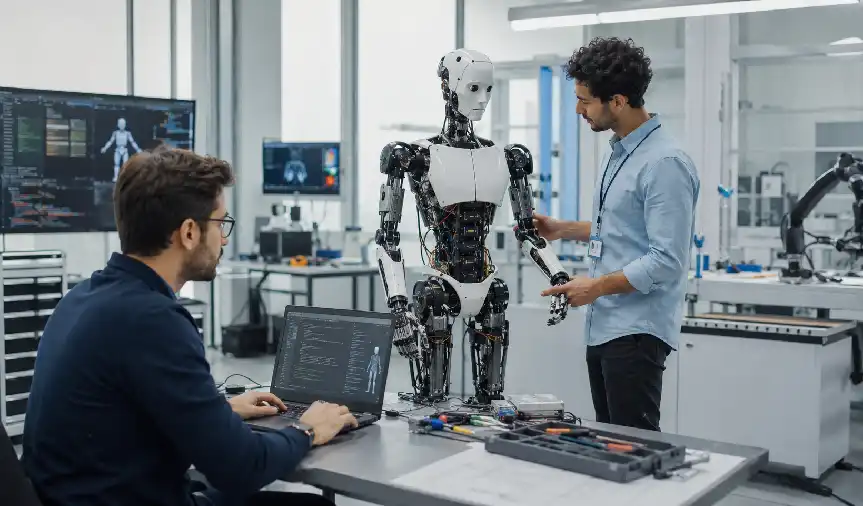
Understanding the Importance of Humanoid Robot Programming Training
Closing the Skills Gap: From Theory to Operational Mastery
Humanoid robots are taking human jobs and altering the industry. These gadgets are not only like regular industrial arms since they can communicate, move to unpredictable areas, and adapt to new surroundings. Programming such systems needs understanding of real-time control loops, sensor fusions, behavioural algorithms and safety measures Poor training may lead to longer rollout timeframes, poor integration and underutilisation of technology purchases by companies.
Professional training bridges the gap between theory and practice. Engineers apply proprietary SDKs, debug sensor data, and build up compliant motion control to avoid harm from touch. Procurement managers enhance investment choices by knowing platform integration and vendor ecosystem support. Debugging and system monitoring interfaces are practiced by technicians. It lowers downtime and maintenance expenses.
Humanoid Robot Programming is tough because it demands smooth functioning of high-DoF systems (usually 30 to 50 joints) for stable movement and precision handling. Training programs teach robots whole-body control frameworks, model predictive control, and reinforcement learning to adapt to new surroundings. Businesses may utilise humanoid technology to automate warehouse activities, help elderly, or research embodied artificial intelligence by obtaining these skills.
Why Specialized Training Matters for B2B Stakeholders
Businesses-to-business clients, like system integrators and company HR departments, need teams that can change how robots act in different operating situations. When working with private middleware, specialized sensor arrays, and industry-specific safety standards like ISO 13482, general computer skills are not enough. People who go through structured training make sure they know not only the syntax but also the architectural principles behind it. For example, they learn how perception modules feed into decision-making layers, how low-level joint controllers balance stability and responsiveness, and how to check that the system meets formal safety requirements.
Time-to-value is also sped up by training. Teams that know a lot about a certain platform can go from unboxing to productive deployment in weeks instead of months. When competition forces require quick adoption of automation technologies or when a lack of workers means that current employees need to quickly learn new skills, this ability becomes very important.
Top Companies Offering Humanoid Robot Programming Training Courses
SoftBank Robotics
SoftBank Robotics offers full training for its NAO and Pepper platforms, which are used a lot in healthcare, retail, and education. Their course covers both Python-based SDK creation and the Choregraphe visual programming tools. Learners practice putting into practice routines for recognizing emotions, dialogue flows, and self-navigation. There are both online lessons and classes where people can program real robots to do complicated interactions as part of training packages. SoftBank's projects are especially useful for the service business because they focus on social robotics.
Boston Dynamics
Boston Dynamics offers specialized training on their Spot and Atlas platforms, with a focus on teaching students how to move and manipulate objects in naturally occurring settings. Training lessons cover things like algorithms for adapting to different terrains, routines for recovering from falls, and coordinating activities involving multiple robots. Participants use the Spot SDK to create their own payloads and inspection routines that run on their own. People who work in building, crisis response, and industrial inspection, where strong movement and knowledge of your surroundings are very important, like the tough curriculum.
ECR Academy
ECR Academy stands out because it combines practical, industry-aligned training with international standards for technical skills. The MagicBot Gen 1 platform is at the heart of our Humanoid Robot Programming course. It is a full-size humanoid system that is 174 cm tall and has 42 active degrees of freedom. It also has advanced agile hands that have 11 DoF each. The structure of the course mirrors what is needed in the real world, going from basic robot operation to advanced situations involving multiple robots working together.
Enterprise engineering knowledge and academic precision come together in a way that makes our method for Humanoid Robot Programming unique. Some of the instructors are professionals who have used robotics in factories and research scientists who help come up with new algorithms. This two-sided view makes sure that students understand both the limitations of practical implementation and the theoretical foundations.
Our software uses the open-source magicbot-gen1_sdk for C++ and Python development. Preset action libraries allow easy creation of anthropomorphic gestures like waving, shaking hands, and rejoicing. Custom behaviour joint control is fine-grained using low-level APIs. Students learn real-world sensor processing tasks including object detection utilising YOLO algorithms, point cloud filtering, and visual odometry using the platform's multi-modal perception package, which includes 3D LiDAR, depth cameras, and fisheye cameras.
Six main areas of skills are covered in the training modules: robot platform design, basic module usage, motion control and dynamic moves, multi-sensor data processing, smart tour guide application development, and working together with multiple robots in the workplace. Each module has both theoretical lessons and projects that you can do with your hands. Learners fix bugs in real code, make navigation paths more efficient, and set up force-position hybrid control for tasks that require dexterity.
The learning space is like places for career growth. Students use toolchains that are based on Ubuntu, use CMake to manage dependencies, and follow best practices for version control. System needs, such as Intel Core i5+ processors, 16GB RAM, and dedicated graphics, are based on standard setups in the industry. This makes sure that skills are directly applicable to the workplace.
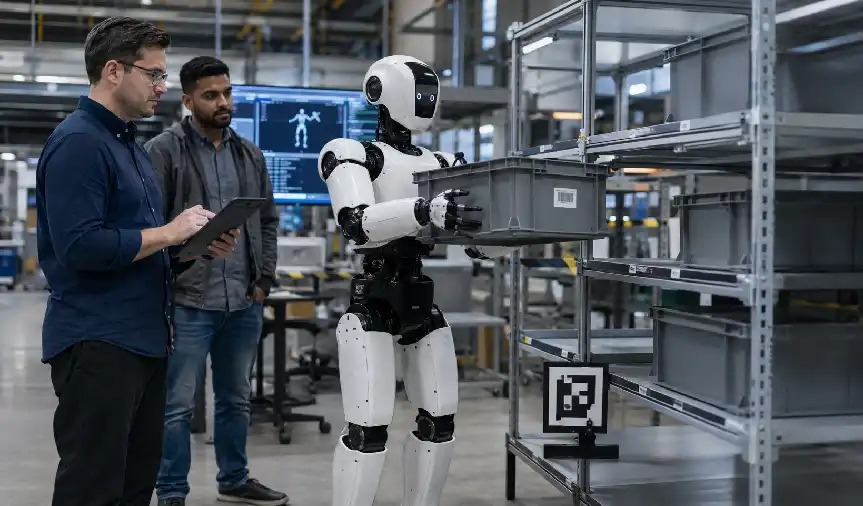
Ubtech and Hanson Robotics
Ubtech focuses on making useful and fun apps and teaches its students how to make apps quickly and with easy-to-use interfaces. For new programmers, their platforms support block-based programming, and for more experienced users, they support Python scripting. Hanson Robotics, which makes social robots like Sophia, offers training in conversational AI, controlling facial expressions, and designing ways for humans and machines to engage. These programs work well for companies that are making apps for customers that need to communicate naturally and emotionally.
Key Features and Components of Effective Humanoid Robot Programming Training
Comprehensive Curriculum Architecture
Robot coordinate systems, transformation matrices, and kinematic chains are some of the basic ideas that good courses start with. Before learning how to code at the application level, students move on to middleware architectures, which teach them how ROS nodes talk to each other through topics and services. In more advanced modules, perception pipelines, motion planning algorithms, and behavioral state machines are taught. This step-by-step method builds skills gradually, avoiding brain overload while laying strong intellectual roots.
The range and depth of a curriculum must be balanced. It's not enough to just teach Python syntax; students also need to learn about object-oriented design patterns, asynchronous programming for real-time control, and how to handle errors in physical systems. In the same way, teaching people how to use sensor technologies means teaching them how to calibrate them, synchronize data across multiple streams, and filter out noise.
Hands-On Learning with Physical Platforms
Simulation tools are helpful for the first stages of research, but actual Contact with robots is still the best way to learn more. Real-world problems like motor lag, sensor drift, mechanical backlash, and changes in the environment are often hard to see in simulators. By using real hardware, students learn how to find mechanical problems, set controller gains for stable performance, and set up safety interlocks that keep equipment from getting damaged.
Good Humanoid Robot Programming training programs provide enough robots for each student—ideally, one platform for every two or three people—so they may practice. Backup parts and technical support reduce hardware downtime. As projects grow tougher, participants should follow pre-defined movements, gather and interpret sensor data, build up closed-loop navigation, and eventually integrate subsystems into cohesive applications.
Industry-Specific Customization
Generic training doesn't usually cover the needs of special industries. Manufacturing clients need to learn how to use robots and conveyor systems together, set up quality inspection routines, and stick to the time limits on the production line. For healthcare apps, you need to know about medical equipment regulations, patient privacy procedures, and compliance control. Research organizations put a high value on the adaptability of experiments, the ability to log data, and the ability to connect to external analysis tools.
Case studies, datasets, and performance metrics that are relevant to the domain are included in customized training modules. Participants practice using words and steps that are common in their business to solve problems that they will actually face. This contextualization speeds up the process of moving skills from the classroom to the job.
Post-Training Support Infrastructure
Learning extends beyond school. Effective suppliers maintain developer communities where graduates may discuss issues, identify solutions, and demonstrate their usage. Technical assistance via groups, email, or one-on-one sessions helps students solve project issues. Skills must be updated regularly to reflect platform changes, software repairs, new features, and best practices.
Learners can study difficult topics on their own when they have access to detailed documents such as API references, design diagrams, and example repositories. Video lessons, workshops, and case study books help people understand ideas better and show them how to improve them. This ecosystem of resources turns one-time training into ongoing learning for professionals.
How to Choose the Right Humanoid Robot Programming Training Provider
Assess Internal Capabilities and Goals
Start by taking a look at what skills your team already has. Do engineers already know a lot about robotics, or are they switching from software or mechanical fields? The right education level is based on this standard. Make your strategic goals clear: are you testing a single robot for research, putting multiple units to work in production, or building long-term expertise in-house? For short-term projects, intensive workshops might work best, while long-term projects would benefit from longer courses that lead to certification.
Compare Curriculum Content and Delivery
Carefully look over courses. Do the classes address the robot platform and middleware you want to use? Make sure the programming languages you're using work with the technology you have. Check to see if advanced topics like sensor fusion, machine learning integration, and multi-agent coordination fit with the plans you have for your application. Think about the different ways that the information is delivered. Online courses give you more freedom, workshops give you a lot of hands-on experience, and mixed models combine the ease of use with real-world involvement.
When checking an employee's skills or meeting client needs, the credibility of the certification is important. Check to see if the certifications are accepted by the industry, include actual tests, and need to be renewed on a regular basis to stay up-to-date.
Evaluate Cost-Effectiveness and ROI
Justify the cost of Humanoid Robot Programming training. Find the overall costs, including schooling, travel, housing, and missed job time. Estimate ROI by calculating rollout, debugging, and system usage time savings. Because they complete projects quicker and hire fewer specialists, organisations that train their own personnel break even within six months.
Think about scalability: Does the pricing allow for team training, or is it set up per seat? Larger groups can often save money with volume discounts and corporate packages.
Verify Vendor Reputation and Support
Look into a provider's track record by reading reviews, recommendations, and case studies from past clients. Please get in touch with references to find out about real-life experiences with the quality of the curriculum, the expertise of the instructors, and the responsiveness of post-training support. Check to see if the vendor offers resources that are useful after the initial training is over, such as updated materials, alumni networks, and advanced follow-on courses.
Make sure it works with the technology you already have. If you need to use certain robot models or development platforms, make sure the person teaching you knows a lot about them. Mismatched training, even if it's great on its own, isn't very useful if it doesn't apply to your practical situation.
Future Trends in Humanoid Robot Programming Training for B2B Clients
AI-Driven Personalized Learning
Adaptive learning tools use AI to change the way courses are taught based on how well each student is doing. These systems find gaps in knowledge, change the level of difficulty, and suggest extra resources that are best for each learner based on their background. Real-time analytics help teachers step in when students are having trouble and speed things up for more experienced students. Personalization is better than one-size-fits-all methods at getting people to finish, remember what they've learned, and be happy with their progress.
Immersive AR/VR Training Environments
Augmented and virtual reality technologies make training scenarios that are as real as possible without needing robots to be physically present. Learners practice programming virtual humans in artificial factories, hospitals, or disaster sites, where they can see what happens when they make mistakes in the code. Virtual reality (VR) environments let teams in different parts of the world work together on shared projects, making it feel like they are in the same workshop. As the price of technology goes down and the quality of simulations gets better, these tools will be used in addition to real platforms to make training more available and possible for more people.
Cross-Platform and Open-Source Expertise
Due to competing robot platforms, middleware standards, and programming frameworks, Humanoid Robot Programming cross-platform proficiency is in demand. Future training will emphasise universal control concepts, open communication protocols, and vendor-neutral design patterns as versatile skills. Open-source technologies like ROS are commonplace, and community-built packages are becoming increasingly essential. Training programs are increasingly addressing open-source communities and teaching students how to build complicated systems.
Remote and On-Demand Learning Models
Flexible training delivery is needed for global operations and teams that work in different places. On-demand classes let students move at their own pace, which works for people who work shifts and live in different time zones. Cloud-based creation platforms don't need local hardware, which makes them easier for people to get started. Students can handle real robots through network links in a remote lab, which is both convenient and real. These models will keep growing, especially for basic information. In-person sessions will still be used for more complicated topics that need direct teacher help.
Conclusion
The robotics industry is at a turning point where artificial platforms go from being interesting study tools to useful tools for the workplace. To make this potential come true, we need skilled workers who can design, set up, and manage these complex systems. Choosing the right Humanoid Robot Programming training provider—one that offers complete courses, hands-on training, industry-specific customization, and ongoing support—speeds up skill development and gets the most out of technology investments. When companies strategically invest in their employees' skills development, they set themselves up to be leaders in adopting automation, improving operational efficiency, and coming up with new ideas.
FAQ
1. Can individuals without prior robotics experience benefit from humanoid robot programming courses?
Of course. Beginning with fundamental concepts before moving on to more advanced themes, well-designed Humanoid Robot Programming courses make it simple for beginners. First, ECR Academy teaches fundamental operations and robot platform design. Advanced motion control and multi-robot operation follow. Step-by-step instructions guide students from simple tasks like following pre-set steps to more challenging ones like integrating sensors and navigating independently. Structured education, hands-on practice, and instructor assistance may help software developers, mechanical engineers, and technicians become proficient.
2. What career opportunities emerge after completing humanoid robot programming training?
Graduates may work as embodied intelligence development engineers, robot vision algorithm engineers, autonomous navigation specialists, dexterous manipulation developers, multi-robot system architects, ROS/ROS2 development engineers, and others. Jobs are available in healthcare, research, education, and industrial automation. Programming, data processing, and system integration may enable experts teach contests, provide technical advise, and create new robots products. These talents are in demand as humanoid systems become more widespread.
3. What technical infrastructure is required for participating in humanoid robot programming training?
Learning usually requires a computer with Ubuntu 22.04 or later, an Intel Core i5 CPU, at least 16GB of RAM, and a specialised graphics card with 4GB of VRAM. CMake 3.16+, Python 3.10, and C++20 processors are software development tools. These rules ensure proper simulation settings, code compilation, and robot system interaction. Many suppliers provide cloud-based or virtual machine settings for students without local hardware. Physical robot projects are essential to complete training programs. ECR Academy provides extensive setup instructions to provide the greatest learning settings for all participants.
Partner with ECR Academy for World-Class Robotics Education
ECR Academy offers cutting-edge training in Humanoid Robot Programming that combines the best of academia with real-world experience. Our lessons, which are based on the advanced MagicBot Gen 1 platform, teach students how to control movements, integrate sensors, and build smart systems that can do things on their own. We have the skills and tools to help you reach your goals, whether you are a government workforce development program, a business building up its own robotics capabilities, or a vocational school expanding its technical offerings. We know what it takes to develop skills around the world because we've trained almost 500,000 people in 28 countries over the past 16 years and have partnered with over 500 businesses. Email us at ecr2008@enteredu.com to talk about custom training options. Our programs teach your team how to use the best Humanoid Robot Programming tools with confidence, turning what they've learned in the classroom into top-notch operations. Join our globally connected community and give your employees skills that will help them succeed in the future.
References
1. International Federation of Robotics. (2023). World Robotics Report: Service Robots and Humanoid Systems in Industrial Applications. Frankfurt: IFR Statistical Department.
2. Murphy, R.R. & Collins, E. (2022). Humanoid Robot Programming: Foundations, Middleware, and Real-World Deployment Strategies. Cambridge: MIT Press.
3. Zhang, H., Kumar, V. & Patel, A. (2023). Whole-Body Control and Learning for Humanoid Robots: A Survey of Training Methodologies. Journal of Robotics Research, 42(8), 1127-1156.
4. National Institute of Standards and Technology. (2022). Skills Standards for Advanced Robotics Programming and System Integration. Gaithersburg: NIST Special Publication Series.
5. European Robotics Association. (2023). Professional Competency Framework for Humanoid Robot Developers: Training Requirements and Certification Pathways. Brussels: ERA Technical Committee.
6. Chen, L., Rodriguez, M. & Yamamoto, K. (2024). Bridging the Skills Gap in Embodied AI: Comparative Analysis of Global Humanoid Robot Training Programs. International Journal of Engineering Education, 40(1), 213-234.


_1781601799781.webp)