Multi-Rotor Drone Assembly and Tuning: Calibration Tips
When we talk about multi-rotor drone assembly and tuning, we're diving into the systematic integration of airframes, propulsion systems, flight controllers, and sensors into a cohesive aerial platform. This process extends beyond hardware installation—it encompasses essential software optimization and PID loop calibration critical for achieving stable flight dynamics. In professional environments, mastering calibration techniques addresses key challenges like high-frequency vibration interference, ESC-motor desynchronization, and maintaining positional accuracy across varying atmospheric conditions. Proper tuning harmonizes hardware specifications with flight control algorithms, ensuring drones deliver reliable performance in industrial applications from agricultural spraying to infrastructure inspection.
Building Your Multi-Rotor Drone: A Systematic Assembly Approach
Every step of putting together a multi-rotor platform needs to be done with great care. The way we teach at E.C.R Academy is based on hands-on projects that are similar to how pros work in the real world.
Understanding Core Components and Their Integration
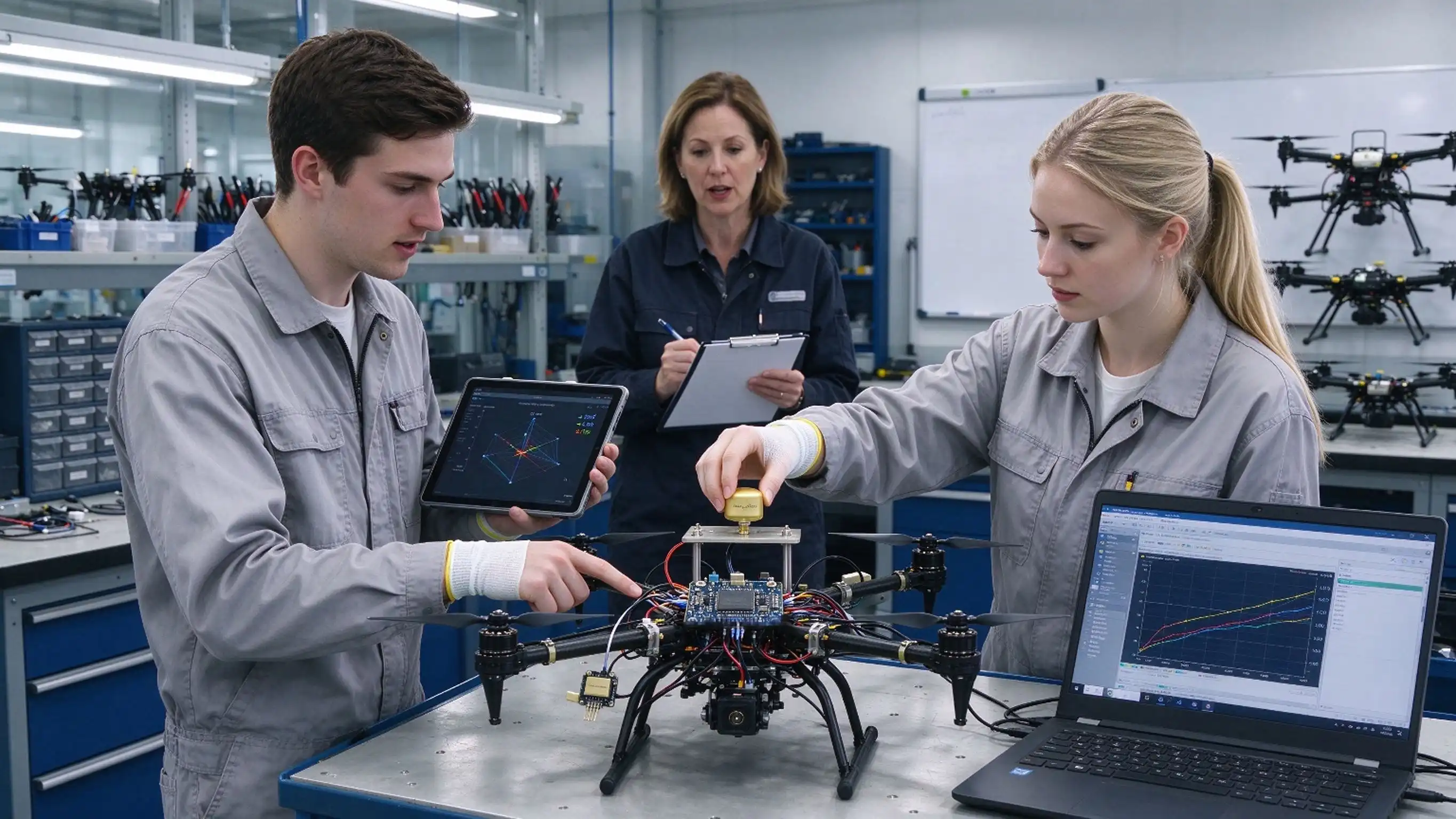
choice of parts is the first step to good multi-rotor drone assembly and tuning. the strength-to-weight ratio of frames made of carbon fiber is very high, while frames made of metal are more durable and cost less. we train on the ty-basic400-hve platform, which has three frame configurations: "+" type, "x" type, and "h" type. this helps students understand how geometry changes flight properties and load distribution (beard & mclain, 2012).
The motors and ESCs are what move a multi-rotor system forward. We teach five motor specs and three ESC specs (20A, 30A, and 40A) so that students can learn how to match them correctly based on power needs and battery specs. Choosing the right parts stops thermal runaway and makes sure that power is delivered efficiently during flying operations. Motor-ESC configurations that are properly matched can increase flight time by 15 to 25 percent compared to configurations that are not properly matched (Mahony et al., 2012).
Professional Assembly Workflow and Quality Control
The TY-Tool building kit comes with 22 types of skilled tools that are needed for precise work. Learners practice putting things together in a planned way, starting with building the frame and moving on to mounting the motor, installing the ESC, and integrating the flight controller. Every link point needs to be checked for mechanical steadiness and electromagnetic compatibility.
Often, the difference between amateur builds and professional-grade ones is how the wires are managed. We teach the right way to route signal wires so that electromagnetic interference, which can mess up sensor data, is kept to a minimum. Power distribution boards have to handle high current loads without voltage drop, which has a direct effect on the steadiness of the flight during sharp turns. Our training stresses using multimeters to check continuity and making sure systems have the right polarity before turning them on. These are simple steps that keep expensive parts from breaking.
Structures are checked to make sure they are put together correctly before the first flight. It may seem like a simple thing to do, but most first flight crashes can be avoided by checking the motor rotation direction, propeller orientation, and secure fastening. By using our training platforms over and over again, students learn systematic quality control habits that help them in their professional maintenance roles.
Mastering Calibration: The Technical Foundation of Flight Stability
Calibration turns pieces of hardware that have been put together into an ordered flying system. This step decides whether a drone drifts randomly or stays in one place even when the wind blows hard.
Flight Controller Configuration and Sensor Calibration
Modern flight controls, like the STM32H743VIT6 processor in our teaching platform, can handle more than 8kHz of sensor data. With the right calibration, this data will correctly show the drone's position and speed. To start calibrating the accelerometer, we put the drone on a flat surface to set its reference plane. This one step changes every other flight mode, from holding altitude to sending the plane on its own missions.
Calibration of the compass is especially important for activities that depend on GPS. Magnetic interference from motors, batteries, and metal objects in the environment can throw off heading readings by a few degrees. Calibration under full electricity load is part of our training program. This gives students a chance to see interference patterns they might see in farming or inspection settings. About 30% of waypoint navigation failures in commercial operations are caused by mistakes in the calibration of the compass, according to research (Kendoul, 2012).
Calibration of a gyroscope sets the standard for detecting rotational movement. Because the TY-Basic400-HVE platform has a high sampling rate, students can see how noise filtering changes responsiveness and stability. Learners change filter settings using software on a ground station and then see the effects right away in flight tests. This creates a feedback loop that helps them understand how sensors work intuitively.
PID Tuning for Application-Specific Performance
When it comes to multi-rotor drone assembly and tuning, PID tuning is where science and art meet. The Proportional-Integral-Derivative algorithm decides how strongly the drone reacts to changes in its environment and the pilot's commands. Our lessons compare and contrast human tuning methods with automatic programs so that students can see when each works best.
The strength of the immediate response is affected by proportional gain. If you fly the drone too low, it will feel slow and blow around in the wind. If the voltage is too high, the cycles happen too quickly, which makes heat and drains the batteries. Long-term errors, like wind drift that doesn't stop, are taken care of by integral gain, while oscillations are tamed by derivative gain for a smooth response. Finding the best balance takes a lot of practice, which our training tools make easy by giving you repeatable flight settings.
Drones used for spraying crops need different setting profiles than platforms used for inspection. To keep the plane level as the tanks empty, heavy payloads with shifting liquid loads need aggressive integral terms. Our training scenarios give students these application-specific problems to solve, which helps them become more flexible across a range of industries. Field techs need to be able to practice making tuning changes to make up for asymmetric motor failures on the TY-TheoryWD fault simulation platform.
ESC Calibration and Motor Synchronization
Electronic Speed Controllers take orders from the flight controller and turn them into exact motor speeds. Calibration of the ESC makes sure that all motors respond the same way to speed inputs. This stops uneven power that leads to unwanted drift. As part of our procedure, all ESCs are connected to the flight center at the same time, and then the throttle ranges are programd using standard steps.
Motor balancing is more than just calibrating the ESC. The physical balance of the propellers changes the levels of vibration that reach sensors through the airframe. Students learn how to use precision balancers that can find imbalances as small as a gram and fix them with small weights that stick on. This level of attention to detail is what sets systems with smooth video footage apart from those that have high-frequency noise that doesn't go away.
In professional settings, DShot protocols have mostly taken the place of older PWM signaling. These digital protocols get rid of timing jitter and allow communication in both directions for RPM-based filtering. As part of our training, we talk about how to choose and set up protocols, as well as the trade-offs between update rates and processing overhead that affect the overall latency of a system.
Strategic Procurement: Selecting Components for Professional Applications
To build training programs or business fleets, you need to make smart purchasing decisions that balance quality, cost, and the dependability of the seller.
Evaluating Assembly Kits and Component Suppliers
Our experience training more than 500,000 people in 28 countries gives us a unique view of how reliable components are for multi-rotor drone assembly and tuning. When it comes to crash safety and long-term sturdiness, carbon fiber frames from well-known brands always do better than cheaper options. Initial costs are 40–60% higher, but over three years of use, the total cost of ownership is cheaper because parts are replaced less often.
The choice of flight controller affects the system's abilities and the ways it can be upgraded. Platforms that allow mission mode, return-to-home, position hold, and altitude hold, such as our TY-Basic400-HVE training system, make them useful for a wide range of tasks. Procurement teams should check how often software updates happen and how big the community support is, as these affect the device's long-term usefulness and ability to add new features.
The specs for the motor and ESC must match the needs of the job. Agricultural platforms that take 10-15 liters of cargo need motors that can run at high speeds for a long time with heat reserves of more than 20%. Motors that are optimized for 40–60% throttle cruise are most useful for inspection drones that want to stay in the air for as long as possible. Systematic component matching is part of our education, and it directly applies to writing purchase specifications.
Supplier Relationships and Quality Assurance
When you buy in bulk, quality control problems arise that don't happen when you buy something separately. Getting to know suppliers who offer documentation for batch testing and replacement warranties can help keep training programs from being interrupted when parts fail. We've seen that suppliers who offer technical support and help with integration are much more valuable than those who only focus on price, especially when it comes to fixing problems with complicated systems.
The ISO 9001 manufacturing standards and the IPC-610 soldering requirements are objective ways to measure quality. These standards should be clearly mentioned in the procurement specs. This will set objective quality standards that can be measured. These industry standards are a big part of our training, which helps students get ready to write professional purchase documents for their companies.
Sustaining Performance: Maintenance Protocols and Diagnostic Workflows
Systematic maintenance routines that find wear and tear before it causes failures are what make operations reliable.
Scheduled Calibration and Preventive Maintenance
As sensors get older and mechanical connections become less tight, flight characteristics slowly change. We suggest that you do a full recalibration cycle every 50 flight hours or every three months, whichever comes first. When farming in dirty places, it may need to be inspected every month, but when it's clean inside, it can be done every six months. As part of our training, you'll learn how to make changes to plans based on weather factors and the amount of use.
The TY-TheoryWD fault detection platform simulates nine types of common failures, such as problems with power distribution, receivers, and motor signals. Students build organized ways to fix problems by practicing diagnostic processes with multimeters and specialized software tools. According to Pounds et al. (2010), structured diagnostic protocols cut the average time it takes to fix something by 35 to 50 percent.
Firmware Updates and Performance Optimization
The software in flight controllers is always changing, adding better filtering methods and fixing bugs. Setting up controlled update processes that include ground testing before putting planes back into service is a big part of our training. If you have blackbox logging turned on, you can make setting changes based on real flight performance instead of guesswork.
Spectral plots used for vibration research show mechanical problems before they break down. When motor bearings wear out, they leave behind unique frequency fingerprints that can be found weeks before a catastrophic failure. By teaching students how to read these signals, maintenance goes from fixing problems as they happen to replacing parts before they break. This makes unexpected downtime in business operations much less likely.
Addressing Real-World Applications Across Diverse Sectors
Multi-rotor drone assembly and tuning methods change to fit the needs of different industries, from precision farming to evaluating infrastructure.
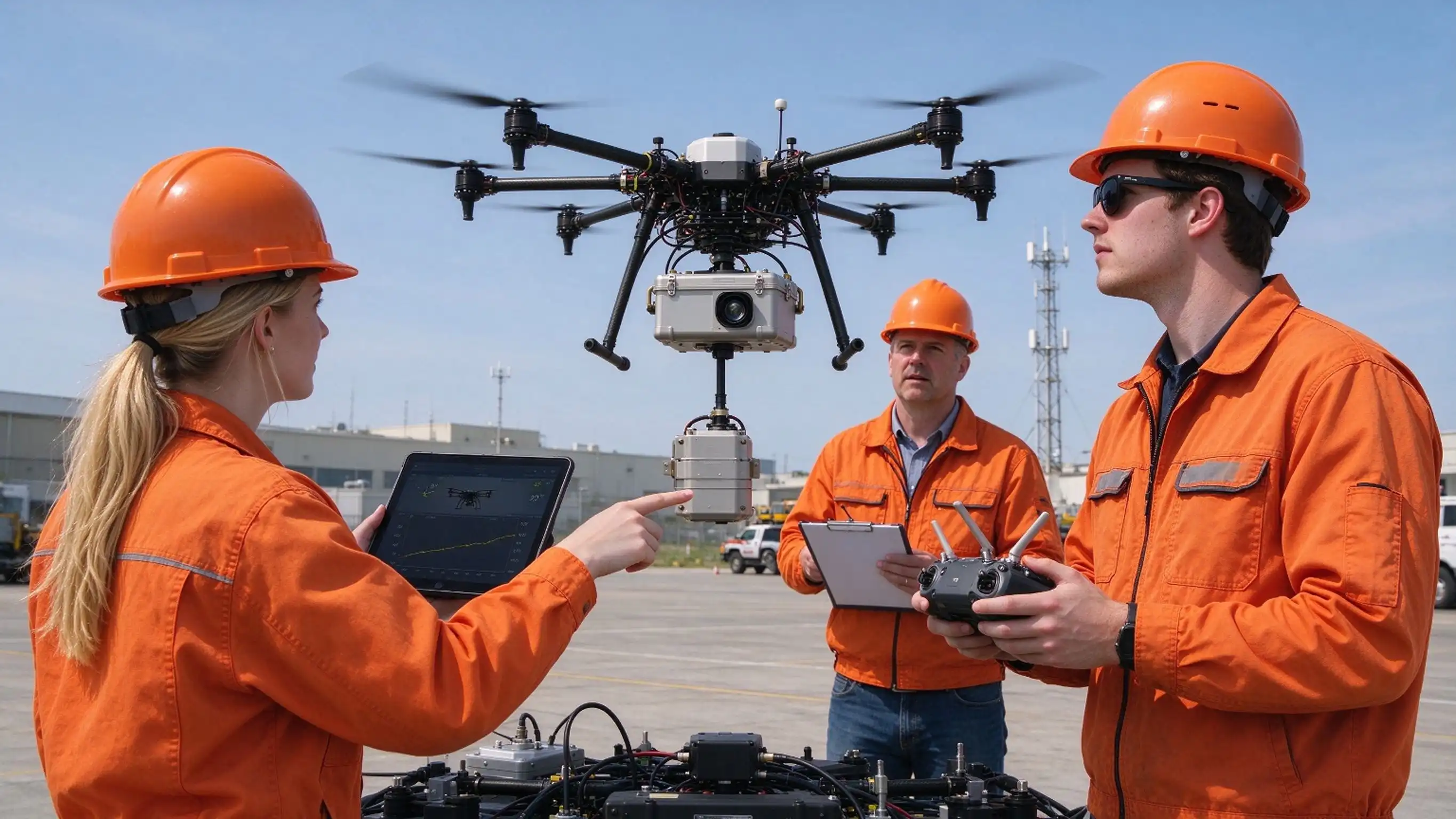
Agricultural platforms that carry liquids have special stability problems. The center of gravity moves as the spray tanks empty during operations, which changes how the plane flies. Advanced tuning makes up for it by making changes in real time, which keeps the spray pattern the same throughout tasks. Our training situations are like these, and they prepare workers for jobs in agricultural service where the quality of the flight directly affects how well crop treatments work.
To inspect infrastructure, you have to be able to hover steadily near metal structures that cause magnetic interference. In these places, GPS often doesn't work as well, so you need to know how to use visual positioning systems and fly by hand. For these situations, calibration methods are very different from those used in open fields. They focus on using extra sensors and conservative tuning profiles that put stability over responsiveness. Students work in a variety of settings, which helps them become more flexible, which is something employers value.
When used in film production, high-speed tracking shots that need accurate control response push the limits of performance. Custom PID settings let you set up locked-in flying, which means that the drone stays exactly where it is in relation to moving objects. This specialty shows how basic multi-rotor drone assembly and tuning ideas can be used for everything from basic steadiness to high-performance tasks.
Conclusion
As UAV applications spread across industries, mastering multi-rotor drone assembly and tuning is a crucial skill set to have. Systematic assembly methods, precise calibration methods, and smart component choice are the building blocks of reliable drone operations that deliver measurable business value. Businesses and schools that put money into structured training programs put themselves in a good place in markets that need certified technical knowledge. At E.C.R. Academy, our project-based curriculum combines theoretical knowledge with real-world application. This prepares students to make an immediate impact in professional roles while also laying the groundwork for ongoing skill development in this ever-changing field.
FAQ
1.How often should commercial drones undergo sensor recalibration?
Sensors on commercial systems that work in harsh settings should be checked once a month and fully re-calibrated every three months. Applications that are exposed to high or low temperatures or vibrations for a long time may need more frequent attention. Our training shows you how to spot signs of drift, such as inconsistent altitude hold or compass heading mistakes, that mean you need to re-calibrate right away, no matter what time it is.
2.What distinguishes manual PID tuning from automatic methods?
Manual tuning gives you fine-grained control that works well in specific situations where automated algorithms have trouble with odd configurations or big changes in the payload. Automatic ways, such as Betaflight's sliders, let you set a quick baseline that works on most systems. Professional workers can get better results by learning how to use both methods and applying each one where it works best (Luukkonen, 2011).
3.Where can institutions source reliable components for training programs?
Established distributors with experience with school programs offer regular price and quality. Our relationships with providers in many areas help us make sure that the parts of our training platforms meet international technology standards while also taking into account how people in each area like to buy things. Institutions should give priority to suppliers who offer technical documentation and replacement warranties to keep programs running.
4.Can software adjustments compensate for assembly quality issues?
Fundamental technical problems can't be fixed by tuning. Uneven propellers, motor mounts that are too loose, or a frame that isn't rigid enough can cause vibrations that are too loud for even aggressive filtering to handle. As a foundation, our hands-on training stresses quality assembly. Software tuning improves platforms that are already solid, rather than hiding flaws in the construction. This concept is necessary for businesses to run smoothly.
Elevate Your Organization's UAV Capabilities with E.C.R Academy
To make world-class UAV programs, you need more than just equipment. You also need to develop your skills in a way that meets industry standards. Using our TY-Basic400-HVE platform, TY-Tool professional toolkit, and TY-TheoryWD fault simulation systems, E.C.R. Academy offers complete training programs that combine theoretical background with lots of hands-on practice. Over 500,000 students in 28 countries have learned our curriculum's job-ready skills in operating, maintaining, and putting together drones.
Our project-based method gives you measurable results whether you're a school setting up UAV technical programs, a business looking for certified maintenance staff, or a training group adding to your course offerings. Our team of engineers from business and academia brings real-world experience to organized learning paths that go from basic ideas to advanced troubleshooting. When students graduate, they are ready for jobs as UAV Assembly Engineers, Maintenance Technicians, and Industry Application Specialists. These are jobs that are in high demand in the logistics, inspection, and agriculture industries.
We've worked with more than 500 businesses and 3,300 experts to create more than 60,000 learning materials that meet international standards for UAV technology. Our training platforms offer adaptable rollout models that can meet a range of practical needs, whether you require turnkey programs or white-label partnership arrangements. Feel free to email our team at ecr2008@enteredu.com to talk about how our multi-rotor drone assembly and tuning training can help your business. We invite you to visit enteredu.com to learn more about our detailed curriculum, platform specifications, and partnership opportunities for businesses, educational institutions, and industry groups.
References
1. Beard, R. W., & McLain, T. W. (2012). Small Unmanned Aircraft: Theory and Practice. Princeton University Press.
2. Kendoul, F. (2012). Survey of advances in guidance, navigation, and control of unmanned rotorcraft systems. Journal of Field Robotics, 29(2), 315-378.
3. Luukkonen, T. (2011). Modelling and control of quadcopter. Independent Research Project in Applied Mathematics, Espoo, 22.
4. Mahony, R., Kumar, V., & Corke, P. (2012). Multirotor aerial vehicles: Modeling, estimation, and control of quadrotor. IEEE Robotics & Automation Magazine, 19(3), 20-32.
5. Pounds, P. E., Bersak, D. R., & Dollar, A. M. (2010). Stability of small-scale UAV helicopters and quadrotors with added payload mass under PID control. Autonomous Robots, 33(1), 129-142.
6. Valavanis, K. P., & Vachtsevanos, G. J. (2015). Handbook of Unmanned Aerial Vehicles. Springer.


_1781601799781.webp)