Beyond Printing: Additive Manufacturing Technology Post Processing
Post processing is the stage where additive manufacturing technology truly proves its industrial worth. A printed part fresh off the build plate is rarely ready for deployment — it carries residual stresses, rough surfaces, and support remnants that must be resolved before the component can perform in demanding environments. This guide walks procurement managers, training directors, institutional decision-makers, and enterprise engineers through the full post processing landscape, from foundational techniques to emerging innovations, and explains how structured workforce training transforms post processing from a bottleneck into a competitive advantage.
What Post Processing Actually Means in Additive Manufacturing Technology?
There are a lot of apps that teach people how to use printers. Not nearly as many teach what happens after the building is done, and that's where quality in the workplace really matters.
The Full Scope of Finishing Operations
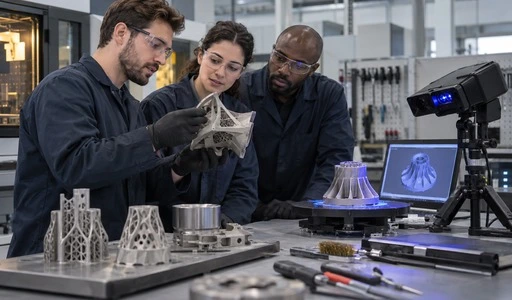
Post processing in additive manufacturing technology includes all the steps that happen after the build is finished and before the part is put into use. Finishing needs are very different depending on the process (FDM, SLA, SLS, DMLS, or Binder Jetting). Typical tasks include removing support structures (using mechanical, chemical, or thermal methods), finishing the surface by sanding, polishing, or media blasting, checking the dimensions, heating the part in a process like stress-relief annealing or Hot Isostatic Pressing (HIP), and applying a protective coating. Each step has a direct effect on how well the part works mechanically, how accurately it fits its dimensions, and how well it meets industry standards.
Why Process Knowledge Closes the Skills Gap
The global additive manufacturing market was worth more than $18 billion in 2023, according to the Wohlers Report. However, skilled post processing technicians are still hard to find in the aerospace, medical, and tooling industries. Businesses and institutions that spend money on structured post-processing training, not just printer operation, produce engineers who can make parts that meet Ra surface roughness standards, geometric tolerances within ±0.05mm, and full mechanical performance benchmarks.
Key Post Processing Techniques Across Process Families
Not every technique works with every process or material. The choice is based on the metal or polymer, the shape of the part, the amount that needs to be made, and where it will be used. Knowing about these factors is what sets a skilled post-processing expert apart from someone who is just following a list.
Here are the core finishing categories that industrial-grade AM programs must cover:
- Support Removal: For FDM thermoplastics, mechanical breakup works best, while for SLA parts with complex internal pathways, soluble support dissolving works best. To remove metal PBF parts from the build plate without changing their shape, they need to be cut with an EDM wire or ground by hand.
- Thermal Treatment: Most metal additive manufacturing parts need to be stress-relieved annealed to close micro-voids and level out grain structures. When HIP treatment is done on titanium alloys at temperatures close to 1,000°C and pressures above 100 MPa, the porosity drops below 0.1% and the properties match ASTM F3001 standards for forged components.
- Surface Metrology and Finishing: The Ra value of raw metal AM surfaces is usually between 5 and 15μm. To get Ra below 0.8μm for aircraft uses that are sensitive to wear, functional mating surfaces need to be finished with vibratory finishing, electropolishing, or secondary CNC machining.
- Quality Inspection: Checking the parts' appearance, making sure they are the right size by scanning them with blue light against the original CAD model, and testing the parts' durability by breaking them mechanically using witness coupons that were printed with the main parts are the most important parts of any industrial AM workflow.
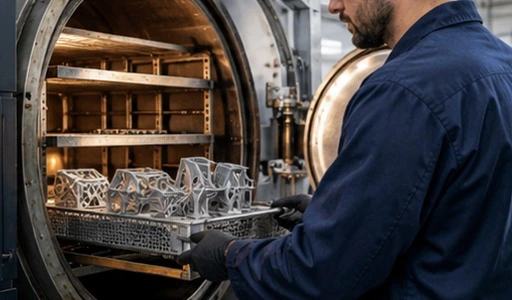
These methods are not extra steps that can be taken to make things better; they are production-critical steps that decide if a printed part ever makes it past the quality pass. Companies that train their engineers across this whole range cut down on the amount of work that needs to be redone and greatly shorten the time it takes to qualify a product.
Additive vs. Traditional Manufacturing: Where Post Processing Diverges
Finishing tasks like deburring, anodizing, and heat treatment are different for CNC machining and injection molding, but the workflows are well-known and have a lot of information on them. With additive manufacturing technology, finishing tasks become more difficult in ways that people who work in standard manufacturing often don't understand.
Anisotropy and Build Orientation
Parts made with Powder Bed Fusion have uneven mechanical behavior; the strength in the XY build plane is often 10–20% higher than the strength in the Z-axis. This means that decisions made after processing, like the rounds of heat treatment and the direction of inspection, need to take directional property change into account. This is something that traditional manufacturing schools don't cover, which is why it's important to have training paths for AM.
Cost and Lead Time Dynamics
It is faster and cheaper to use AM processes for complicated, low- to medium-volume production when post-processing is planned smartly from the design stage on. For instance, you can't make a conformal cooling insert for an injection mold by drilling. Instead, AM builds it as a single piece, and with the right post-processing, you get a final tool that cuts cycle times by up to 30%, as shown in case studies from the car tooling industry. On the other hand, badly handled post-processing lengthens lead times and takes away from the cost benefits of AM.
Selecting Post Processing Solutions: What Decision-Makers Should Evaluate
The following factors should be carefully considered by procurement directors and department heads when they look at post-processing capabilities, whether they are for building in-house labs or choosing training programs.
Alignment Between Curriculum and Industrial Workflow
If engineers are only taught how to use a printer, they won't be ready for work in a production setting. This is directly covered by the additive manufacturing technology class at the ECR Academy. The course is taught by both business engineers and school teachers, and it starts with 3D modeling and goes on to cover reverse engineering, operating equipment, post-processing, quality control, structural optimization, and process simulation. The five unified learning platforms cover reverse design, product 3D design, equipment application, post-processing and inspection, and process modeling. They are designed to be as realistic as possible, rather than being simplified for ease of use in the classroom.
The curriculum is project-driven, requiring learners to complete real tasks: reading engineering drawings, conducting dimensional inspections, running heat treatment cycles, and generating quality reports. This method makes sure that graduates who want to work as additive manufacturing product designers, process engineers, machine operators, or post-processing techs actually know how to do their jobs, rather than just knowing the basics.
Future Directions: Automation and Sustainability in AM Finishing
Things are changing in post-processing. Robotic depowdering devices can now clean SLS parts in a uniform amount of time. Laser polishing can make the surface of metal parts very smooth, down to the micron level, without using any force. Nanocoatings make aircraft metals more resistant to corrosion than anodizing alone can.
Sustainability is also changing how finishing works are done. It is becoming necessary to buy things that have powder recycling procedures, closed-loop chemical treatment systems, and waste-minimization frameworks for getting rid of support materials. This is especially true for defense and medical supply chains that have to follow strict environmental standards. Training programs that include these new practices prepare students and institutions to stay relevant over the next 5 to 10 years.
Conclusion
In conclusion, with additive manufacturing technology, post processing is not just an afterthought; it's what turns a printed shape into an industrial-grade part. Building AM training labs in schools, companies building up their own engineering departments, and equipment distributors looking to improve their courses all need the same thing: structured, industry-specific training that covers the whole workflow. That need is immediately met by ECR Academy's program, which uses project-based learning, joint faculty teaching, and a five-platform virtual simulation environment to make engineers skilled in the whole AM production cycle.
FAQ
1. Which AM processes require the most intensive post processing?
Metal Powder Bed Fusion processes, like DMLS and SLM, need the strictest post-processing. This includes stress-relieving annealing, HIP treatment for structural parts, support removal via EDM or grinding, and multiple stages of surface finishing. UV post-curing and support removal are needed for SLA parts. Most FDM parts need to have their surfaces sanded or chemically smoothed. The strength changes based on how sensitive the material is to changes in temperature and how the part needs to work.
2. How does post processing affect lead time in industrial AM production?
Post-processing adds known, manageable time when it is built into the design step, as with Design for Additive Manufacturing (DfAM). When post-processing isn't thought out ahead of time, problems happen. Unplanned rework because of surface flaws or problems with the dimensions can make production times twice as long. Structured training in quality inspection and process simulation helps engineers figure out what finishing work needs to be done before the building starts.
3. Can someone without a manufacturing background complete this program?
Yes. The additive manufacturing technology program at ECR Academy starts with basic classes in mechanical drawing, engineering materials, and heat treatment. Later, students move on to more advanced post-processing and process modeling. It helps to have a basic understanding of how machines work and how computers work, but the program is designed to build skills gradually.
4. What career roles does post processing training support?
When students finish the program, they are ready for jobs as an additive manufacturing process engineer, a post-processing technician, a quality inspection specialist, or an equipment operator in the manufacturing sectors of plastic products, metal parts, and general equipment.
Partner with E.C.R Academy for Industrial-Grade AM Training
E.C.R. Academy is a reliable source of additive manufacturing technology for businesses and colleges that want to get serious about AM. Our program uses project-based learning, enterprise faculty, and a five-platform simulation environment to prepare students for work. It is based on 16 years of experience teaching skills around the world in 28 countries. Get in touch with us to find out how our solutions can help your training lab, your new program's approval, or your company's goals for skill development. To start a discussion, email us at ecr2008@enteredu.com or go to enteredu.com.
References
1. Wohlers Associates. Wohlers Report 2023: 3D Printing and Additive Manufacturing Global State of the Industry. Wohlers Associates, 2023.
2. ASTM International. ASTM F3001-14: Standard Specification for Additive Manufacturing Titanium-6 Aluminum-4 Vanadium with Powder Bed Fusion. ASTM International, 2021.
3. ISO/ASTM International. ISO/ASTM 52900: Additive Manufacturing — General Principles — Fundamentals and Vocabulary. ISO/ASTM, 2021.
4. Gibson, I., Rosen, D., & Stucker, B. Additive Manufacturing Technologies: 3D Printing, Rapid Prototyping, and Direct Digital Manufacturing (2nd ed.). Springer, 2015.
5. Sames, W. J., List, F. A., Pannala, S., Dehoff, R. R., & Babu, S. S. "The Metallurgy and Processing Science of Metal Additive Manufacturing." International Materials Reviews, 2016.
6. Thomas, D. S., & Gilbert, S. W. Costs and Cost Effectiveness of Additive Manufacturing: A Literature Review and Discussion. NIST Special Publication 1176, National Institute of Standards and Technology, 2014.


_1781601799781.webp)