Robot Programming vs Simulation: What Should You Learn First?
When stepping into the world of automation, one question emerges repeatedly: should you master robot programming or simulation first? The answer isn't straightforward, but understanding how both disciplines interact within Industrial Robotics Technology clarifies the path forward. Robot programming establishes the command language that directs physical machines, while simulation creates a risk-free digital twin environment for testing those commands. Both skills intertwine throughout the automation lifecycle, yet the optimal learning sequence depends on your operational role, business objectives, and existing technical foundation. Choosing wisely accelerates your capability to build, deploy, and maintain sophisticated automated systems across manufacturing environments.
Understanding the Basics: Robot Programming and Simulation
Robot programming is the most important part of any automatic process because it turns what people want machines to do into exact actions. Engineers use languages like ABB RAPID, FANUC KAREL, and KUKA KRL to set safety limits, create movement patterns, and describe coordinate systems. This hands-on skill lets you talk directly to robotic hardware, which makes sure that tasks like welding, putting things together, and moving things around are done accurately to within a millimeter.
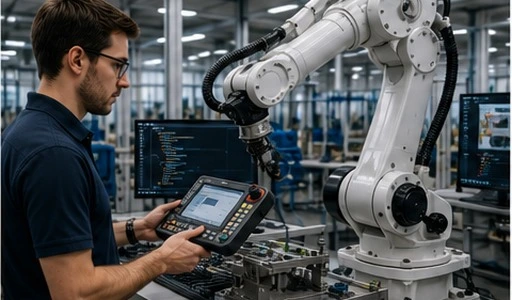
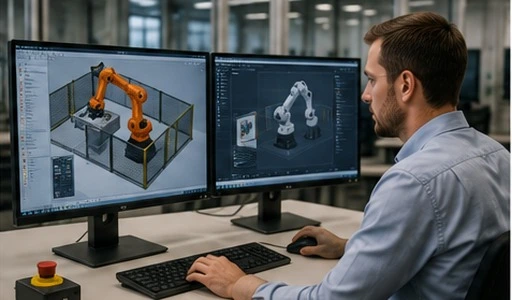
Simulation technology works with programming by digitally recreating work settings. Platforms like FANUC ROBOGUIDE and ABB RobotStudio let engineers see how processes will work, find crashes, and improve cycle times before they are actually put into use. This virtual validation cuts down on mistakes that cost a lot of money and speeds up the commissioning process, which is a huge plus for procurement managers who are looking at automation investments (Robotics Industry Association, 2022).
How Programming and Simulation Integrate
Programming and modeling are not two separate fields; they are two parts of robotics operation that work together. Simulation checks the logic of code without stopping the machine, and programming puts the tried steps into action on plant floors. Leading brands combine these two features into a single platform, which makes the change from virtual licensing to live production smooth. Combining skills is becoming more and more important for automation workers as it shortens development cycles and makes systems more reliable.
Industry Standards Across Platforms
Multi-brand ecosystems are important for modern automation. In the same facilities, engineers often work with KUKA, Universal Robots, and Yaskawa systems. Cross-brand compatibility is built into simulation systems, which lets users try programs on a variety of robot models digitally. Because standardized modeling processes cut down on retraining costs and make projects more scalable, this freedom is very useful for system designers who work with a wide range of clients.
Key Factors to Consider When Deciding What to Learn First
Your learning priorities depend on what you need to do right now and where you want to go in your career in the future. Prioritizing simulation is good for system integrators that focus on delivering custom projects because virtual prototyping speeds up client demonstrations and lowers the cost of iterations. On the other hand, maintenance engineers who are in charge of old production lines can immediately benefit from learning code because it lets them quickly fix problems and make changes to the process without having to rely on outside contractors.
Role-Based Learning Pathways
In automation ecosystems, different jobs require different sets of skills. When purchasing robots technology, purchasing managers should know about the modeling tools that are available because they have a direct effect on the total cost of ownership. On the other hand, technicians on the production floor need to know how to program well in order to make daily adjustments and do routine maintenance work. Understanding these role-specific needs helps companies create targeted training plans that boost worker productivity.
Learning patterns are also affected by how hard the project is. Beginners can quickly learn the basics of programming with simple pick-and-place apps that use teach pendant methods. Multi-robot collaborative workcells, on the other hand, need modeling experts to set up the complicated motion routes and avoid collisions. By figuring out how hard a job is before committing to a training plan, skill gaps that cause projects to take longer and cost more can be avoided.
Decision Framework for Institutions
Vocational schools that prepare students for jobs in Industrial Robotics Technology automation have to deal with some unique issues. To make sure that graduates are ready for work, curriculum designers must find a balance between basic programming skills and simulation skills. Comprehensive automation training platforms offer programs that combine the two fields through project-based learning. These programs give students skills in programming, virtual testing, system integration, and clever maintenance. This all-around method fits with the need in the industry for flexible techs who can handle the whole lifecycle of automation.
Benefits and Challenges of Robot Programming and Simulation
Learning how to program a robot gives you direct power over how it works, so you can make changes that meet the needs of your company. Programmers can fine-tune motion curves, make cycle times run more smoothly, and add custom code for specific uses. This level of skill makes it less necessary to rely on equipment providers for routine changes. This lowers long-term running costs and makes it easier to adapt to changes in production.
Simulation skills are helpful because they let you try things out without taking any risks. Engineers can check out different layout options, different throughput scenarios, and safety rules without stopping live production. Virtual settings also make it easier to train for dangerous tasks like high-temperature welding or working with chemicals, where doing them in real life could be dangerous. These benefits lead to faster project launch and less damage to equipment during the setup stages (Manufacturing Technology Insights, 2021).
Common Programming Challenges
Learning vendor-specific programming languages is hard at first. Each brand of robot has its own language and control system, which means that learning them takes time and money. Strong spatial reasoning skills are also needed for coordinate system management, which is necessary for accurate positioning. Safety standards must also be followed by programmers, who must set speed limits and force tracking for joint apps according to ISO 13849-1 guidelines.
Simulation Platform Limitations
While modeling tools have a lot of useful features, they are limited in how they can be used. Accuracy in software depends on accurate modeling of the equipment; missing specifications cause differences between what the software says will happen and what actually happens. When you try to connect modeling tools to business systems like Manufacturing Execution Systems (MES) or Product Lifecycle Management (PLM) software, you might run into problems. To get around these problems, platform providers need to provide strong technical support and keep updating software so that it works with real hardware.
Future Trends Impacting Robot Programming and Simulation Skills
By adding force sensing and adaptive motion control, collaborative robotics changes the way programs are written. Industrial robots usually work alone in safety cages, but cobots work with human workers. To make them work, programmers have to add dynamic speed changes and Contact recognition algorithms. This change requires skills beyond simple motion programming, focusing on safe interactions between humans and robots and acting in ways that are appropriate for the situation.
When artificial intelligence is added to simulations, they go from being dormant tools for testing to being active engines for improvement. Machine learning systems look at production data to suggest ways to improve the process, guess when repair will be needed, and make robot programs that work best on their own. Engineers who know how to use AI-enhanced simulation tools can get a competitive edge by speeding up rounds of continuous improvement and cutting down on unplanned downtime with predictive analytics.
Digital Twin Technology Advancement
Digital twin implementations take simulation beyond testing before deployment and add ongoing monitoring of operations. Virtual models are fed real-time data from production robots, which lets you keep comparing performance and finding problems. This coming together of physical and virtual systems helps with planned maintenance and makes troubleshooting easier from a distance, which is especially helpful for international companies with sites in different places (Digital Manufacturing Report, 202).
Cloud-Based Collaboration Platforms
Cloud-native modeling platforms let teams of people in different places work together on Industrial Robotics Technology automation projects. Engineers in various time zones can access shared virtual workcells, make changes to code logic, and hold virtual commissioning meetings together. This connectivity speeds up project timelines for global system designers and makes it easier for regional offices to share knowledge. This improves the automation of organizations while cutting down on trip costs.
How to Get Started: Practical Steps for B2B Clients and Professionals
To become good at automation technologies, you need structured learning paths that mix theory with practical use. Comprehensive training programs, like those that focus on project-based learning, are the best at building skills because they mimic problems that people face in the real world. In these classes, students learn how to use robots and how to program pendants. They then move on to PLC integration, offline simulation, machine vision application, and finally full system integration projects.
Choosing the right learning tools has a big effect on how well training works. Virtual simulation settings are safe places to try new things without having to buy expensive tools or worry about stopping work. Modern platforms work like communities for multiple brands of robots, so students can learn skills that can be used in a variety of automation settings. System designers who work with clients who have a wide range of tools need to be able to do a lot of different things.
Structured Curriculum Components
To be effective, automation training needs to cover more than just basic programming. Learners need to know how to use programmable logic controller (PLC) systems to connect robot movements to other machines, such as elevators and sensors. Understanding camera calibration, image processing algorithms, and vision-guided motion programming is needed for machine vision integration, which is becoming more and more important for quality inspection and adaptive positioning. With digital twin methodologies and virtual commissioning techniques, you'll have a full set of skills that meet the needs of Industry 4.0.
Companies can speed up the development of their employees by teaming up with specialized training providers that offer flexible course plans. Collaborations like these make it possible to create learning paths that are specific to the needs of an operation. This is useful for both training new employees to become entry-level technicians and teaching experienced engineers about new technologies like collaborative robotics and AI-enhanced optimization. Different learning styles and corporate needs can be met by using flexible delivery methods, such as on-site workshops, online virtual labs, and blended learning.
Practical Implementation Strategies
For robotic skills to be learned well, they need to be used outside of school projects. Learners can practice all stages of a project, from coming up with an idea to code, virtual commissioning, and simulated production runs, using virtual modeling platforms in pilot implementations. This hands-on method boosts confidence and shows workers problems that can't be solved with theory alone, getting them ready for deployment in the real world.
Continuous technical help from training platform providers improves how well people learn and how long they remember what they've learned. Learners can handle difficult technical problems and learn how to fix them better when they have access to teachers who are experts in the field and ideally have both academic knowledge and work experience. This mentoring part is especially helpful when moving from training exercises to putting the system into production, because problems can come up at any time and need to be solved quickly.
Conclusion
As a starting point, you should choose between robot programming and simulation based on your current operating needs and job goals. Programming gives you direct control over things you need to maintain or improve, and simulations let you test designs without any risks, which is very important for planning projects. The best way to do things is to mix the two fields through unified learning paths that teach a wide range of computer skills. As manufacturing moves toward smart systems that use AI, digital twins, and collaborative robots, people who are good at both programming and modeling will be in charge of driving innovation and practical excellence across global production networks with Industrial Robotics Technology.
FAQ
1.Should complete beginners start with programming or simulation?
For complete newbies, simulation is a better way to get started because it gives visual feedback and removes the risks that come with using real tools. Before moving on to real programming syntax, beginners can learn about robot kinematics, workspace limitations, and basic motion concepts in virtual environments. However, students who already know how to use industrial equipment may also find direct programming instruction easy to understand, especially if they are paired with structured training that progresses from basic teach pendant operations to advanced scripting.
2.How does programming knowledge reduce long-term costs?
Having programming experts in-house reduces the need to hire outside service providers for regular changes and problem-solving. Skilled programmers in facilities can quickly change processes to fit new versions of products, find the best cycle times based on production data, and set up preventive maintenance routines, all of which cut down on downtime and make equipment work better overall. This ability to work on its own is especially useful in high-mix manufacturing settings where frequent changeovers need fast reprogramming.
3.Which robot brands offer the best integrated learning ecosystems?
ABB, FANUC, and KUKA all work together with schools to offer certification programs, modeling software, and training courses that are compatible with their own systems. Universal Robots focuses on making programming easy by using simple interfaces that work well for group tasks. When purchasing managers look at long-term training efforts and supplier relationships, they need to make sure that the brands they choose have strong learning environments that help employees learn faster and get ongoing technical support (Automation World, 2022).
Elevate Your Automation Capabilities with ECR Academy
ECR Academy provides complete training programs for vocational schools, system developers, and automation equipment makers that want to hire the best industrial robots workers. Our Industrial Robotics Technology course includes project-based learning in robot programming, virtual simulation, system integration, intelligent operation and maintenance. This is done through an advanced virtual simulation platform that works with ecosystems from ABB, FANUC, KUKA, and Universal Robots, among others.
We have been a supplier of Industrial Robotics Technology for 16 years and have helped 500,000 students in 28 countries. We offer OEM partnerships that are flexible, course modules that can be changed to fit your needs, and white-label solutions that are in line with your brand and operational goals. Get in touch with us at ecr2008@enteredu.com to find out how our tried-and-true curriculum frameworks and simulation platforms can help you develop your employees faster, cut down on training costs through virtual commissioning, and put your company at the head of the smart manufacturing change. You can learn about our whole robotic training environment at enteredu.com.
References
1. Robotics Industry Association. (2022). Robotics simulation reduces deployment costs and accelerates commissioning.
2. International Federation of Robotics. (2023). World Robotics Report: Cross-platform compatibility in industrial automation.
3. Manufacturing Technology Insights. (2021). Virtual commissioning ROI analysis for industrial robotics projects.
4. Digital Manufacturing Report. (2023). Digital twin implementation trends in automotive and electronics manufacturing.
5. Automation World. (2022). Vendor educational partnerships and workforce development strategies.
6. Smart Manufacturing Institute. (2023). Collaborative robotics programming standards and safety protocols.


_1781601799781.webp)