Project-Based NEV Electrical Training for Industry Partners
The electric vehicle revolution has created an urgent demand for skilled professionals who understand the complexities of battery systems, motor controllers, and whole-vehicle electrical architectures. Project-Based NEV Electrical Training for Industry Partners addresses this gap by offering comprehensive programs that combine theoretical knowledge with hands-on practice in New Energy Vehicle Electrical Technology. These training solutions are specifically designed for automotive manufacturers, technical colleges, and service chains facing the challenge of upskilling their workforce to meet the demands of an industry transitioning from combustion engines to electric powertrains. The right training partner can transform your team's capabilities and position your organization at the forefront of this technological shift.
Understanding Core Electrical Technologies in New Energy Vehicles
Understanding the three-electric system architecture that powers current electric cars is the first step to good NEV training. The power battery, the drive motor, and the computer control units are all part of this system. They all work together to provide speed, safety, and economy.
The Three-Electric System Architecture
At the heart of every electric car is the three-electric system, which is also known as the "3-Electric Core." The power battery stores energy and needs to be carefully managed to keep it from overheating while also maximizing range. The drive motor is much more efficient than standard combustion engines at turning electrical energy into mechanical motion—more than 95% of the time. The electronic control system coordinates these parts using complex formulas that find a balance between the need for speed and the need for safety. Industry data shows that when companies spend money on full electrical training, mistakes on the production line that involve putting together high-voltage systems drop by 40%.
Battery Management Systems and Safety Protocols
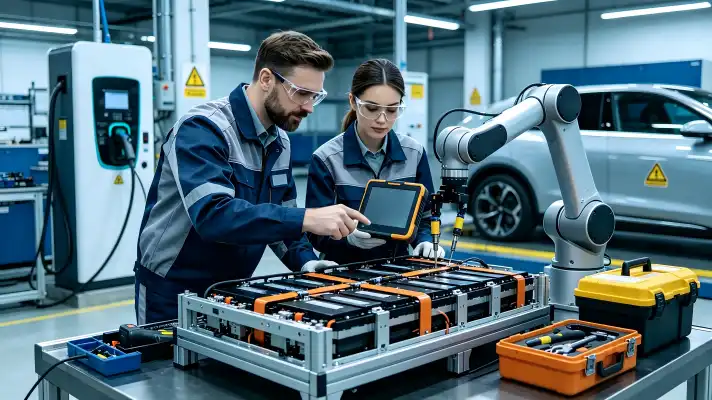
Batteries Management Systems are one of the most important parts of electric car design. A BMS keeps an eye on the voltages, temperatures, and states of charge of cells all the time and uses balance methods to make sure that cells age evenly. Thermal management problems happen when battery packs work in temperatures ranging from -30°C to 50°C. This is something that training programs need to cover. High-voltage safety rules must be followed at all times. Technicians must know how to do lockout-tagout, how to test insulation, and how to use personal protective equipment like safety goggles and insulated gloves rated for 1000V. Industry standards say that 800V high-voltage systems need insulation resistance of more than 500 ohms per volt. Technicians must be trained to check that these standards are met.

Motor Control and Power Electronics
The Motor Control Unit precisely controls the inverter swapping frequencies to make the drive motor work. Silicon Carbide semiconductors are used in modern microcontrollers (MCUs). These allow switching rates above 20kHz, which lowers harmonic distortion and raises efficiency. Pulse-width modulation strategies, field-oriented control algorithms, and the addition of position sensors that give real-time feedback on the rotor position must all be covered in training programs. The Vehicle Control Unit is at the top of this structure. It interprets what the driver says and coordinates different systems, such as regenerative braking, which can recover up to 70% of the vehicle's kinetic energy when it slows down.
Project-Based Training Approach: Bridging Knowledge and Application
Technicians aren't ready for the diagnostic problems they face on the shop floor and in the service bays when they only learn in the classroom. Project-based learning puts students in situations that are like real life and are as complicated as real vehicle systems.
Structured Learning Through Real-World Projects
Our teaching method breaks down complicated systems into manageable parts while keeping an eye on how they all fit together at the system level. The participants start by learning basic electrical concepts. Next, they do hands-on activities using real VCU, MCU, and BMS hardware. At the end of each lesson, there is a project that requires students to set up controller parameters, figure out why faults were knowingly introduced, and use standard testing methods to make sure the system works. Automotive education study from several technical schools has shown that this method helps students remember what they've learned 65% better than lecture-based formats.
Hands-On Diagnostic Training
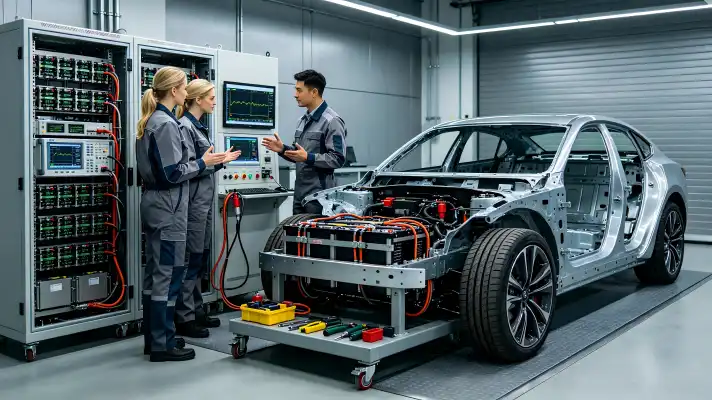
The diagnostic training tool for New Energy Vehicle Electrical Technology acts out common types of failure, such as high-voltage insulation faults, CAN bus communication mistakes, and sensor problems. To read trouble codes, look at data sources, and find electrical problems in wiring harness systems, students use professional diagnostic tools. Intermittent controller communication faults, which make up about 30% of field service calls according to aftermarket data, are a particularly useful exercise to do. People learn how to use oscilloscopes to check the quality of CAN bus signals and find problems like bad termination resistance or electromagnetic interference from nearby high-current lines.
Controller Configuration and Calibration
To really understand New Energy Vehicle Electrical Technology, you need to know how to use controller setup tools. Training includes hands-on activities in setting up VCU parameters, such as calibrating sensor signals, mapping torque curves, and following the steps for high-voltage power-up. Participants set settings for the BMS, such as the maximum cell voltage, the maximum temperature, and the balance current. With these skills, startup time is cut down and guarantee claims related to wrong calibration are cut down even more.
Comparative Insights: Selecting the Right NEV Electrical Components
When buying electric vehicles, the decisions that are made now have big effects on how reliable the products are, how easy they are to fix, and how much they cost to own overall. Technical training gives procurement teams more confidence when they look at the specifications of parts.
Performance Metrics and Reliability Standards
When choosing components, you have to think about how much they cost and how they will fit into the supply chain. Monitoring accuracy varies a lot between battery management systems. High-end systems can measure individual cell voltage to within 5 millivolts, while low-cost systems can only do that up to 20 millivolists. Motor controllers are different based on how much current they can handle, how well they can handle heat, and whether they meet practical safety standards for cars, such as the ISO 26262 ASIL-D rating. People who go thru training learn how to read datasheets and find the specifications that are most important for their application needs.
Supply Chain and Vendor Evaluation
To build relationships with providers of New Energy Vehicle Electrical Technology, you need to know how to look at their production skills and quality systems. Participants learn how to evaluate supplier certifications, such as ISO 16750 for environmental qualification and AEC-Q100 for integrated circuits. Understanding the smallest details of a component makes technical talks with sellers more productive and lowers the chance of specification mismatches that cause rethink cycles.
Technology Roadmap Alignment
The world of electric vehicles is changing quickly. 800V architectures are getting market share, and Silicon Carbide semiconductors are becoming normal in higher-end areas. Training programs talk about new technologies so that companies can make smart decisions about what to buy in the future. Case studies from major automakers are looked at by participants to learn how Tesla, BYD, and new European automakers have set up their electrical designs to get different performance traits.
Optimizing Procurement Strategy Through Electrical Technology Training
With technical knowledge, buying goes from being a transactional task to a strategy skill that helps a business stay ahead of the competition and run more efficiently.
Specification Development and Supplier Communication
Professionals in procurement who know about electrical systems can write clearer specs that cut down on confusion and avoid costly mistakes. Teams learn how to define important factors like DC/DC converter efficiency curves for different load ranges, OBC charging profiles with power factor requirements, and wire harness specs with conductor cross-sectional area and insulation voltage ratings. This level of detail makes bidding more competitive because suppliers can base their prices on clearly defined needs instead of making safe guesses that drive up prices.
Quality Assurance and Incoming Inspection
Organizations that use systematic incoming inspection protocols in New Energy Vehicle Electrical Technology find 80% more defects than those that only rely on supplier certifications. The training includes hands-on methods for checking, such as using megohm meters to check the insulation resistance, continuity testing of wiring harnesses, and making sure that controller communication protocols work. Participants learn how to make inspection plans that are in line with design specs. This creates quality gates that keep bad parts from getting into production.
Risk Mitigation Through Technical Understanding
Problems in the supply chain have shown how important it is for parts to be able to be swapped out and for second-source approval to be met. When procurement teams get technical training, they can compare different parts and figure out which specifications are for real functional needs and which are for desired features. Having this information was very helpful during recent shortages of semiconductors, when companies with technically savvy purchasing teams were able to quickly find different MCU platforms that would work.
Future Trends and Innovations in NEV Electrical Technology
In the competitive market for electric vehicles, those who stay up to date on changes in technology set themselves apart from those who follow suit. To stay relevant, training programs need to include new trends.
Advanced Battery Technologies and Management
Lithium Iron Phosphate batteries have won market share because they are more cost-effective and more stable at high temperatures than nickel-based batteries. Next-generation Battery Management Systems have predictive algorithms that figure out how much useful life a battery still has by looking at its charge-discharge history and temperature history. Cell-to-pack and cell-to-chassis architectures get rid of traditional module structures and are now taught in training programs. According to manufacturer data, these architectures reduce mass and increase volumetric efficiency by about 15%.
High-Voltage Architecture Evolution
Moving from 400V to 800V electrical designs lets batteries charge faster and reduces the weight of the conductors, but it also makes it harder to choose the right parts and follow safety rules. For systems with higher power, the insulating requirements and testing methods need to be updated. Technicians need to know what this means for their own safety because higher volts make arc flash accidents more likely. These changing needs are met by training programs that make sure workers are ready for when next-generation platforms go into production.
Software-Defined Vehicle Capabilities
These days, vehicle controllers look more and more like embedded computers that run complicated software stacks. Over-the-air updates let automakers fix problems and add features to vehicles after they've been made, without having to physically recall them. Because of this shift in thinking, techs need to know about software versions, how they affect safety, and new ways to diagnose problems that aren't based on hardware. Unified diagnostic services methods and safe flashing processes that stop unauthorized controller access are now part of training.
Conclusion
The fast growth of the electric vehicle industry gives organizations that want to improve their technical skills both chances and challenges. Project-based training that combines academic background with a lot of hands-on practice leads to measurable gains in the skills of the workforce and the results of operations. Companies that spend money on thorough training in New Energy Vehicle Electrical Technology are better prepared to make choices about the supply chain with more trust, cut down on production errors, and speed up the development of new products. Including new tools in training makes sure that the skills taught will be useful in the future as the business changes. Electrical system technical excellence is a long-term competitive advantage that sets market leaders apart from those who are having a hard time keeping up with change.
FAQ
1. What prerequisites do participants need before starting NEV electrical training?
A basic understanding of electrical concepts like voltage, current, and resistance is helpful, but our program is flexible enough to work for students from a range of experiences. Learning goes faster when you know how to use hand tools and measuring tools and are familiar with how cars work. It's helpful for most people to go over DC circuit analysis and know the difference between connecting things in series and connecting things in parallel. Modern diagnostic equipment depends on software interfaces, so you need to know how to use a computer. Most of the time, organizations find that professionals with two to three years of experience in the field adapt the fastest. However, driven beginners can also finish the program.
2. How long does comprehensive electrical training typically require?
What matters is the depth and scope of the work. Electrical safety basics and an overview of three-electrical systems can be taught in a 5-day intense structure. Usually, it takes three to four weeks to get full training in all areas of New Energy Vehicle Electrical Technology, such as BMS, MCU, VCU setup, diagnostic processes, and lots of hands-on practice. With modular approaches, companies can plan training around the needs of their operations, with sessions on the weekends or in the evenings to fit around work hours.
3. Can training be customized for specific vehicle platforms?
Of course. Basic rules work for all platforms, but customization takes into account designs, diagnostic routines, and component specs that are unique to each maker. Case studies that use an organization's own vehicle platforms are helpful for companies that are training their own teams. Educational institutions that prepare students for a wide range of jobs in industry see more examples of architectures from Chinese, European, and American companies.
Transform Your Team's Electrical Systems Expertise with ECR Academy
To become a world-class expert in electric vehicle electrical systems, you need a training partner with strong ties to the industry and tried-and-true methods. ECR Academy has been teaching technical skills to people in the car industry for 16 years, to almost 500,000 people. Our New Energy Vehicle Electrical Technology project-based curriculum includes both academic rigor and instruction from engineers who work in the field. This way, students get both theoretical knowledge and hands-on skills that are useful in the real world. We work with automakers, professional schools, and service companies to fill important skill gaps because we are a reliable provider of all-around training solutions.
Our training platform for electrical diagnosis and commissioning in vehicles mimics real-life diagnostic situations. This gives participants the confidence to take on difficult troubleshooting tasks. We tailor our training solutions to your needs, whether you're increasing the production of electric vehicles, changing your service network to support EV customers, or creating lessons for the next generation of auto technicians. Email ecr2008@enteredu.com to talk to ECR Academy about how our training programs in New Energy Vehicle Electrical Technology can help your company become more competitive and improve its skills.
References
1. Chen, H., & Wang, L. (2022). Advanced Battery Management Systems for Electric Vehicles: Technology and Applications. Automotive Engineering Press.
2. International Energy Agency. (2023). Global EV Outlook 2023: Workforce Development and Skills Requirements. IEA Publications.
3. Johnson, R., Martinez, S., & Thompson, K. (2021). Electric Vehicle Power Electronics: Design, Control, and Diagnostic Strategies. SAE International.
4. Society of Automotive Engineers. (2023). Best Practices for Electric Vehicle Technician Training and Certification. SAE Technical Paper Series J2954.
5. Zhang, Y., Liu, X., & Anderson, P. (2022). Thermal Management Strategies for High-Voltage Battery Systems in Electric Vehicles. Journal of Automotive Technology and Engineering, 15(3), 245-267.
6. Zhou, M., & Williams, D. (2023). Functional Safety Implementation in Electric Vehicle Control Systems: ISO 26262 Applications. Automotive Safety Council Technical Report.


_1781601799781.webp)