The Growing Role of Industrial Robot Maintenance and Integration Services in Integration
Industrial robot maintenance and integration services now decide whether a robotic cell delivers value after installation day. A robot no longer works alone. It exchanges signals with controllers, PLCs, conveyors, vision systems, and safety devices, so one weak link can stop an entire line. Maintenance keeps each part healthy, and integration makes the parts work together. I see demand rising because the installed base keeps growing: the International Federation of Robotics counted about 4.28 million operating industrial robots worldwide in 2023. In this article, I explain what these services cover, how to choose a provider, and how training builds the skills teams need.
What Industrial Robot Maintenance and Integration Services Include?
Preventive, Predictive, and Corrective Maintenance
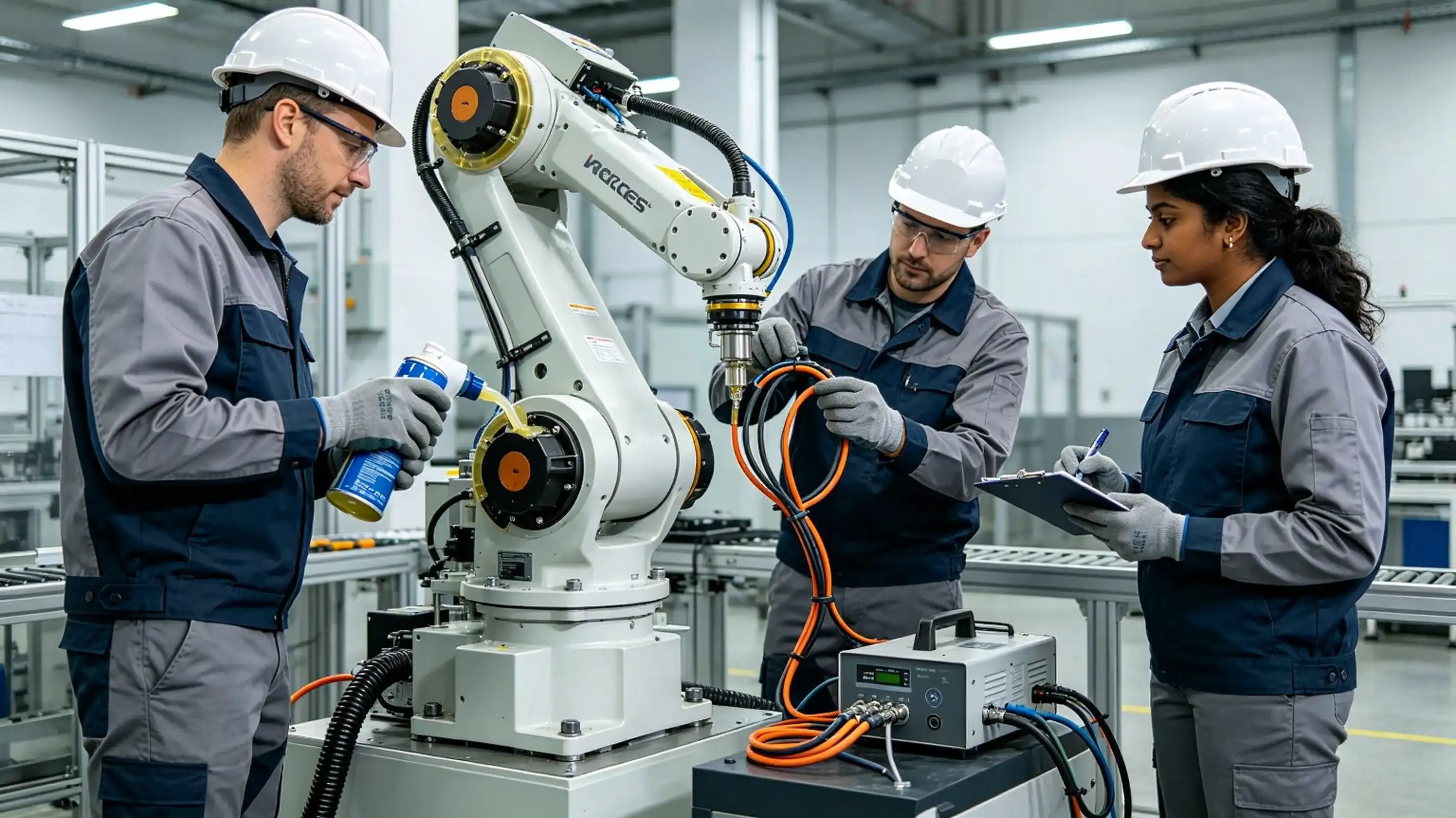
Maintenance falls into three types. Preventive work follows a schedule based on operating hours or cycle counts, and includes inspection, lubrication, battery checks, and cable review as the manufacturer's manual specifies. Predictive work relies on data such as alarm history, motor load, temperature, and vibration to flag wear before a failure occurs. Some teams also test used grease for iron content, because rising metal particles can point to gearbox wear. Corrective work responds after a fault stops production. I recommend mixing all three, since a plan built only on repairs leaves the line exposed to the next surprise stop.
Mechanical, Electrical, and Control System Scope
A complete service visit touches three systems. On the mechanical side, technicians remove and fit motors and reducers, then check belt tension and bolt torque. On the electrical side, they inspect wiring, test circuits and pneumatic connections with multimeters and oscilloscopes, and repair faults. On the control side, they configure networks, set parameters, update software, back up programs, and edit programs on the teach pendant. E.C.R Academy teaches this same skill set in its Industrial Robot Maintenance and Integration Services course. Recording each step in a service log also helps the next technician pick up where the last one stopped.
The Integration Process from Requirements to Production
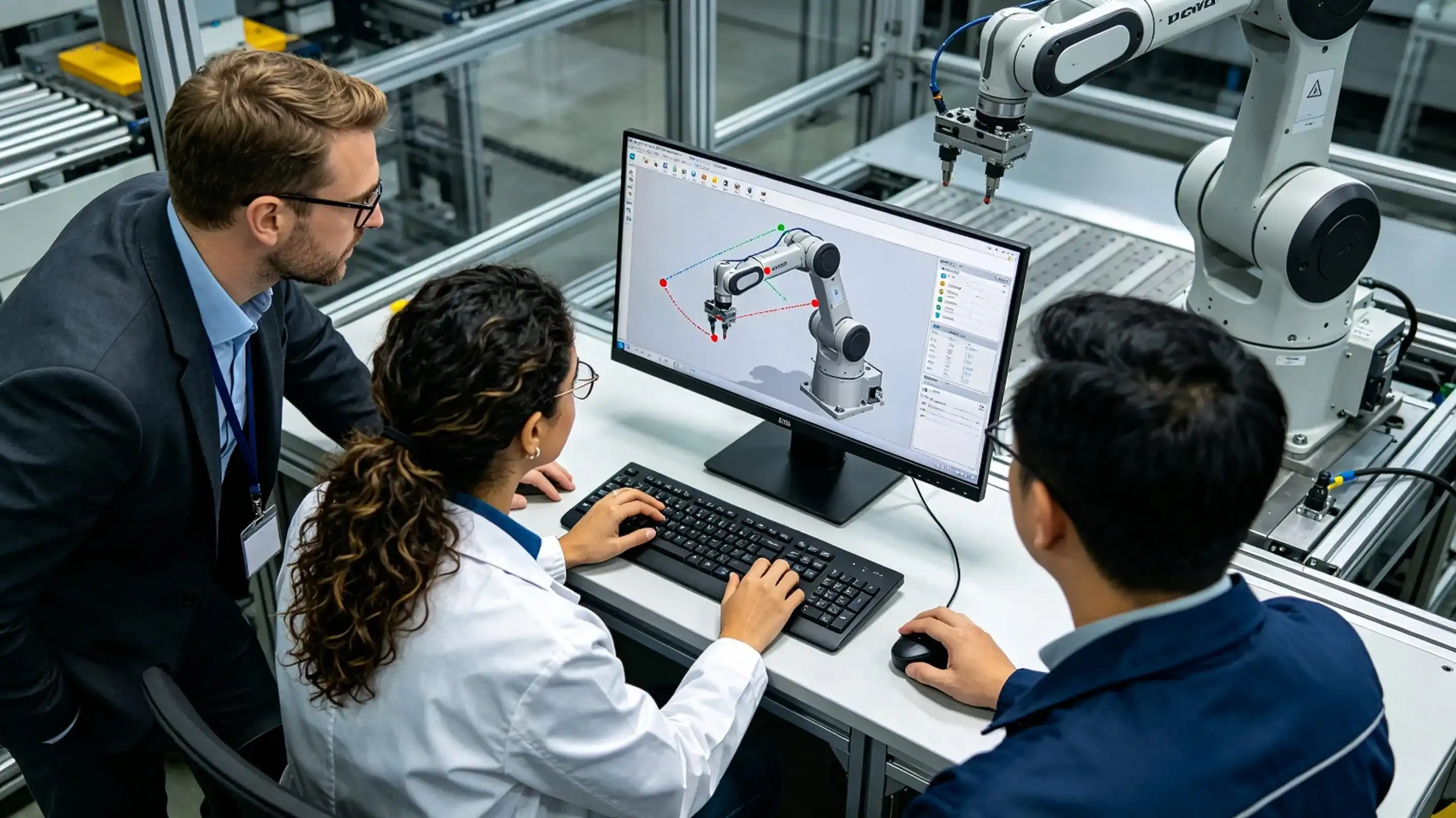
Integration starts with clear production goals: payload, reach, accuracy, cycle time, product variations, floor space, utilities, and safety needs. The integrator then selects the robot and tooling, designs the cell, connects the controls, programs the system, and commissions it. Robots must exchange data with grippers, conveyors, vision systems, PLCs, and HMIs, often through industrial networks such as PROFINET, EtherCAT, or EtherNet/IP. Before release, teams run dry cycles, test fault recovery, verify cycle time, train operators, and complete acceptance testing. Safety validation follows ANSI/RIA R15.06, the U.S. adoption of ISO 10218, so emergency stops and guarding are proven rather than assumed.
Common Failures, Troubleshooting, and Service Models
Typical Failure Points in a Robotic Cell
Failures rarely stay inside the robot arm. Mechanical causes include reducer wear and brake faults. Electrical causes include cable damage, servo alarms, and encoder errors. Software and network issues include program corruption and lost communication with the PLC. Tooling problems such as gripper misalignment, vacuum loss, and tool-center-point errors can look like robot faults, yet the robot itself is fine. A gradual drift in the home position or unexpected collision alarms often signals that calibration needs attention. Knowing where faults tend to start helps a technician choose the first test instead of guessing.
A Structured Troubleshooting Method
A disciplined method is essential for industrial robot maintenance and integration services and saves hours. First, record the alarm codes and the operating conditions at the time of the stop. Next, list possible causes and sort them into mechanical, electrical, software, and tooling groups. Then inspect the physical parts, monitor I/O signals and diagnostics, and confirm the root cause before replacing anything. Finally, document the corrective action and back up the program. This sequence prevents unsafe temporary fixes and reduces repeat failures. Failure Mode and Effects Analysis (FMEA) extends the same logic by ranking likely failures in advance, so maintenance time goes to the highest-risk items first.
Maintenance Versus Repair: In-House, Outsourced, or Hybrid
Planned inspections usually cost less than emergency repairs, because they limit secondary damage, rush freight, and missed shipments. Siemens estimated in its 2024 downtime report that unplanned stoppages cost the world's 500 largest companies about $1.4 trillion a year, roughly 11% of revenues. Choosing who performs the work matters too. Plants with standard fleets often handle first-line tasks in-house. External specialists add multi-brand expertise, advanced programming, and escalation coverage. A hybrid model combines both. Contracts range from time-and-materials work to preventive packages and full-service agreements with defined response times and reporting duties.
Selecting a Provider and Understanding Costs
Multi-Brand Coverage and Technician Skills
Many plants run FANUC, ABB, KUKA, and Yaskawa robots side by side, so a provider limited to one brand creates gaps. I advise asking which controllers the technicians have worked on, what application experience they hold, and how they handle safety circuits. Request project references from similar industries, such as automotive welding or electronics assembly. Check regional response coverage, remote diagnostics, spare-parts sourcing, documentation, and training as well. A provider with a low hourly rate but thin controls knowledge often costs more once repeat visits begin.
Cost Drivers and Quotation Clarity
Pricing depends on robot count, age, model, payload, operating hours, environment, shift pattern, and response coverage. Integration pricing adds tooling, cell design, PLC programming, vision systems, safety equipment, commissioning, validation, and training. I suggest comparing complete scopes rather than hourly rates. A clear quotation separates one-time and recurring costs and lists assumptions, exclusions, travel, parts, warranty terms, and service-level commitments. Total cost of ownership should also count uptime, maintainability, and production risk, since a cheap contract that allows long stoppages loses its savings quickly.
Quality Checks That Prove the Work
Good providers can show measurable results. Typical checks include zero-position calibration, backlash measurement in reducers, servo motor insulation resistance, and cycle-time verification. Every service should end with a safety circuit validation, confirming that emergency stops and light curtains respond as required under ANSI/RIA R15.06 and ISO 13849-1, the standard for safety-related parts of control systems. Ask for a written report listing readings, replaced parts, and open items. That report becomes the baseline for the next inspection and gives auditors and plant managers a shared record.
How E.C.R Academy Builds Job-Ready Robot Service Skills?
Project-Based Curriculum and Faculty
Hiring technicians is only half the challenge; training them is the other half. E.C.R Academy's course supports industrial robot maintenance and integration services through a project-based curriculum that combines theory with hands-on practice, and learners complete real tasks across robot assembly, setup, and maintenance. The content follows international technical skills standards. Instruction comes from industry engineers and experienced academic experts, which keeps lessons close to shop-floor conditions. The course starts with fundamentals, so beginners can join, and instructors adjust guidance to each learner's progress. Since 2010, E.C.R Academy has delivered training and assessment to nearly 500,000 participants across China and 28 countries.
The BN-R365 Training Platform
Learners train on an integrated platform for robot assembly, adjustment, and maintenance, the Industrial Robot System Operations and Maintenance Training and Assessment System (BN-R365). It covers robot operation, programming, fault diagnosis, system integration, and machine vision applications, moving from basic operations to advanced fault diagnosis. Practice includes disassembling and assembling motors and reducers, checking belt tension and bolt torque, wiring circuits and pneumatic lines, configuring networks, updating software, and programming with a teach pendant. One platform keeps the whole workflow in a single training space.
Career Outcomes and Program Fit
After completing the course and passing the assessment, graduates can pursue roles such as industrial robot system operations and maintenance technician, industrial robot system operator, mechanical equipment installer, robotics engineering technician, electrical equipment installer, or computer programmer. The target partners are enterprises, educational institutions, industry associations, and other organizations. Program directors can use the course to cover operation, maintenance, and integration within one curriculum. Employers can use it to prepare new hires for real industrial needs, including the troubleshooting and calibration tasks described earlier.
The Future of Industrial Robot Maintenance and Integration Services
Connected Lifecycle Management
Support is shifting from breakdown repair to connected lifecycle management. Remote diagnostics, alarm analytics, digital maintenance records, and condition monitoring let teams set service intervals from motor load, temperature, vibration, and cycle data instead of the calendar alone. Connected robots also raise cybersecurity questions, so access to controllers should be limited, logged, and approved. The International Federation of Robotics reported 541,302 industrial robot installations worldwide in 2023, so more connected assets will need this level of care each year.
Retrofit and Modernization
Many plants cannot replace a whole cell whenever a part becomes obsolete. Retrofit work upgrades controllers, safety systems, tooling, and vision capabilities while keeping the robot mechanics and fixtures that still perform. A retrofit also gives teams a chance to correct old programming habits and update documentation. Integration skills matter here, since a new controller must still communicate with legacy PLCs, conveyors, and HMIs. Technicians who understand both maintenance and integration can judge when repair makes sense and when an upgrade costs less over the asset's life.
Preparing Your Team and Records
Preparation starts with basics. Keep an accurate asset register listing each robot's model, controller, software version, and operating hours. Store standardized program backups off the robot, and keep a spare-parts plan for items with long lead times, such as motors and reducers. Agree on programming conventions across shifts and sites. Then invest in people: a technician trained in mechanical, electrical, and control skills can read these records and act on them. That combination is what multi-site automation growth requires.
Conclusion
Industrial robot maintenance and integration services keep connected robotic cells productive after installation. This article showed that the scope covers preventive, predictive, and corrective maintenance across mechanical, electrical, and control systems, plus an integration process that runs from requirements to validated production. Structured troubleshooting and planned maintenance reduce repeat failures and costly stoppages, which Siemens estimated at about 11% of revenues for the largest firms. Provider selection depends on multi-brand experience, clear quotations, and measurable quality checks such as calibration and safety validation. Skilled people remain the deciding factor, and project-based training on a platform such as BN-R365 builds that capacity. Connected monitoring and retrofit work will extend these needs as installed robots grow in number.
FAQ
1. Can I take the course with no prior experience?
Yes. The course is beginner-friendly and starts with fundamentals. Instructors adjust their guidance to each learner's progress.
2. What careers can follow the course?
After finishing the course and passing the assessment, learners can pursue roles such as robot system operations and maintenance technician, robot system operator, mechanical or electrical equipment installer, robotics engineering technician, or computer programmer.
3. What computer does the course require?
The platform needs Windows 10 or above, an Intel Core i5 processor or better, 16GB of memory, a 256GB hard drive, and a dedicated graphics card with 4GB of VRAM.
4. How often should a robot receive maintenance?
Frequency depends on the robot model, operating hours, payload, environment, application, and manufacturer guidance. Follow the maintenance manual for your specific model.
Contact E.C.R Academy About Industrial Robot Maintenance and Integration Services
Planning a training program or searching for an industrial robot maintenance and integration services supplier for your team? E.C.R Academy offers a project-based course taught by industry engineers and academic experts on the BN-R365 platform. Email ecr2008@enteredu.com with your robot models, team size, and training goals, and our specialists will reply with a suitable plan. Visit enteredu.com for details.
References
1. International Federation of Robotics, World Robotics 2024: Industrial Robots, 2024
2. Siemens, The True Cost of Downtime 2024, 2024
3. International Organization for Standardization, ISO 10218-1: Robots and Robotic Devices – Safety Requirements for Industrial Robots – Part 1: Robots, 2011
4. International Organization for Standardization, ISO 10218-2: Robots and Robotic Devices – Safety Requirements for Industrial Robots – Part 2: Robot Systems and Integration, 2011
5. Robotic Industries Association, ANSI/RIA R15.06: Industrial Robots and Robot Systems – Safety Requirements, 2012
6. International Organization for Standardization, ISO 13849-1: Safety of Machinery – Safety-Related Parts of Control Systems – Part 1: General Principles for Design, 2023