How Industrial Energy Conservation Technology Uses Variable Frequency Drives
Variable frequency drives (VFDs) are a technology that blurs the line between motor control and industrial energy conservation technology. A VFD controls the frequency and voltage going to an electric motor. By altering these, the motor speed can be perfectly matched to the real load demand at any point in time. This avoids the constant power drain of motors running at full speed when partial speed suffices. Studies by the U.S. Department of Energy show that motor systems account for roughly 70% of industrial electricity consumption, making VFD-based speed control one of the most impactful tools available for reducing a facility's energy intensity and carbon footprint.
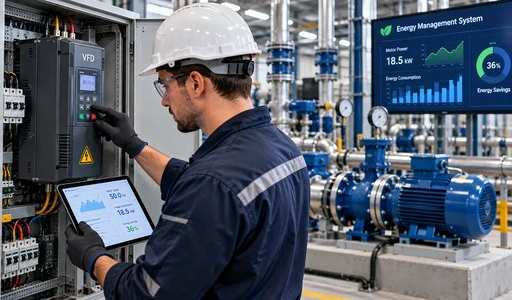
Understanding the Role of Variable Frequency Drives in Industrial Energy Conservation
How VFDs Work at the Component Level
An AC stage takes in power and changes it to DC. A DC bus then makes the DC power more even. Finally, an IGBT-based transformer changes the DC power back into AC power with a changeable frequency. With these three steps, engineers can change the motor's speed however they want. It doesn't stay at the same speed no matter what the demand is; it changes based on real-time process signals.
The Problem with Fixed-Speed Motor Control
Motors always have to run at their maximum speed with standard fixed-speed starters. The extra energy that a pump or fan doesn't move as much fluid or air as it should is lost as heat, shaking, or moving less quickly. According to the Lawrence Berkeley National Laboratory, a centrifugal pump system can use 30–50% less energy if it doesn't have to deal with slowing and has VFD control added. In and of itself, that number is reason enough to buy.
Core Benefits Beyond Energy Savings
By letting you set up soft-start and soft-stop sequences, VFDs lower mechanical stress. Gears and seals will last longer because of this. Versions that meet IEEE 519 standards and have less harmonic distortion also protect sensitive equipment further down the line. The products are of higher quality because of tighter process control. Also, motors don't have to deal with full-voltage switching surges as often, so they don't need to be fixed as often.
Industrial Energy Conservation Technology Principles Applied Through VFDs
Energy Auditing and Load Matching
A good way to deal with energy starts with an audit that checks how much the motors can really handle. Most plants have motors that are 20–30% bigger than they need to be to handle peak conditions that don't happen very often. Here, VFDs come in handy because they make it easy for a single motor to handle a lot of different loads. This is in line with the load-matching theory, which is the main idea behind all real programs to save energy.
IoT-Enabled Smart Monitoring
Fieldbus protocols like Modbus, PROFIBUS, or EtherNet/IP can be used by modern VFD controls to talk to an energy management system (EMS) as part of industrial energy conservation technology. Their speed, torque, and power are sent in real time. They can find changes in motor efficiency before they cause losses that can be measured when this data is sent to a cloud-based analytics platform. People who go to ECR Academy and take the course Industrial energy conservation technology learn how to use these kinds of smart monitoring tools.
Predictive Maintenance Integration
Some vibrations that can be seen in VFD current patterns can be used to tell when a bearing is wearing out weeks before it breaks physically. The capacity to look ahead minimises unnecessary downtime and guarantees that the Specific Energy Consumption (SEC) data are consistent from one reporting period to the next. This links VFD diagnosis to an ISO 50001 certified energy management system to integrate long-term carbon reduction goals with real-time machine health.
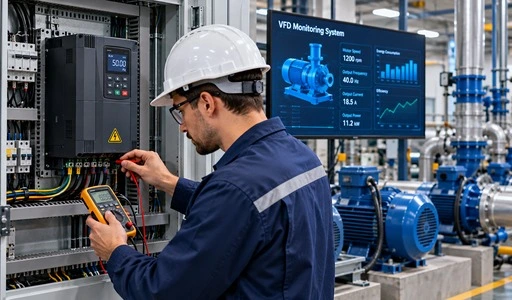
Practical Applications and Case Studies of VFDs in Industrial Energy Conservation
VFDs are used in a huge range of industrial equipment. The type of equipment they are used for determines how much money they can save. When the technology is used in these main ways, we can always measure the results:
- HVAC and fan systems: A commercial building study cited by ASHRAE recorded a 38% reduction in fan energy after VFD retrofits replaced inlet vane controls. In industrial facilities with larger air-handling units, the absolute kilowatt savings scale accordingly.
- Pump systems in chemical processing: A mid-size chemical plant reported annual electricity savings equivalent to 1,200 MWh after installing VFDs on cooling-water circulation pumps, cutting both energy cost and CO₂ emissions.
- Air compressor systems: Compressors running at fixed speed waste energy during unloaded cycles. VFD-controlled variable-speed compressors tracked in a U.S. manufacturing audit achieved a 25% reduction in compressed-air energy cost.
- CHP and thermal system integration: When paired with combined heat and power (CHP) systems, VFDs modulate auxiliary pump and fan speeds in response to thermal demand, raising overall system efficiency above 80% in several documented installations.
These numbers show that people really do accept VFDs. The International Performance Measurement and Verification Protocol (IPMVP) makes it possible to show, measure, and check the effects. So, buying teams can be sure to make ROI models before they place orders.
Selecting and Procuring the Right Variable Frequency Drives for Your Industrial Needs
Matching Power Rating and System Compatibility
A VFD must be the right size for the motor's full-load voltage, not just the number of kilowatts it says on the box. Too big of a VFD wastes money, and too little of one and overcurrent faults happen during peak loads. The people who are buying things should also make sure that the enclosure rating (IP54 or IP65) matches the weather at the site and that the output frequency range of the chosen drive matches the motor's design parameters.
Evaluating Total Cost of Ownership
The price at first is only a small part of how much industrial energy conservation technology will cost in the long run. Most VFD projects pay for themselves in 18 to 36 months when they are used with pumps and fans. After that, the drive starts making money by cutting down on power use. In the US, that time frame can be cut down by government programs like Section 179D tax breaks and energy refunds. Teams in charge of buying things should ask to see energy savings estimates that have been compared to IPMVP Option B before they choose a service.
Sourcing Through Trusted Industrial Energy Conservation Technology Suppliers
Industrial energy saving technology suppliers do more than just ship gear; they also offer help with commissioning, harmonic analysis, and application engineering. When choosing a supplier, make sure that their technical team can connect the VFD to your current SCADA or EMS system. You should also ask for written case studies from companies in the same industry as you.
Optimizing Performance and Maintenance of Variable Frequency Drives
Addressing Electrical Disturbances
When it comes to VFDs, the most common problem with the electricity is Total Harmonic Distortion (THD). To get THD values that meet IEEE 519 guidelines, line reactors or active front-end filters are used. This keeps transformers and capacitors for power factor correction safe. You won't have to spend a lot of money fixing these parts if you buy the right sizes.
Routine Monitoring and Fine-Tuning
The best thing to do is to thermally scan VFD cabinets every three months to find places where bus bars or capacitors are getting too hot. Every year, process measurements should be used to calibrate speed-reference signals, and software should be updated whenever the machine's makers make changes that make them work better. Advanced drive management software can do a lot of this normal work for you. It can also find problems before they affect production.
Staff Training as a Maintenance Strategy
If you fix a VFD but don't use it right, it stops saving energy in a big way. Real variable frequency drive systems, reactive power adjustment tools, and energy management software are used in the labs as part of the ECR Academy program to teach this. They make sure that the training materials are both very formal and up to date with what is happening in the field right now. The teachers come from both business engineering teams and academic schools.
Conclusion
Variable frequency drives are one of the most cost-effective ways for factories to cut down on their energy use and carbon emissions through industrial energy conservation technology. For them to work well, they need to be the right size, be able to connect to other systems, and keep staff trained. There is a big difference between these three things when you have structured training. VFD systems, CHP, heat pumps, air compressor controls, and energy management platforms are all part of the Industrial energy conservation technology program at ECR Academy. This teaches kids all the skills they will need for a low-carbon economy.
FAQ
1. Which industries gain the most from VFD deployment?
Motor-intensive industries benefit most: steel, chemical processing, cement, water treatment, HVAC, and food manufacturing all run large pump, fan, and compressor loads that respond well to variable speed control. Any facility where motors account for more than 50% of electricity spend should treat VFD evaluation as a near-term priority.
2. How do VFDs contribute to carbon footprint reduction?
By cutting electricity consumption directly, VFDs lower Scope 2 emissions. In facilities tied to carbon trading markets, each megawatt-hour saved translates to a quantifiable reduction in carbon allowance obligations. Energy auditors can calculate these reductions under established protocols such as IPMVP and ISO 14064.
3. What maintenance does a VFD typically require?
Key tasks include cleaning cooling fans and air filters every three to six months, inspecting DC bus capacitors annually, verifying input/output voltage balance, and updating control firmware. Most manufacturers publish preventive maintenance schedules; following them keeps mean-time-between-failures above 50,000 hours for well-designed units.
Advance Your Energy Goals with ECR Academy
The industrial energy conservation technology program at ECR. Academy is made for groups and companies that need more than just a lecture series. Professors and business engineers teach together in our course, and each subject is taught in simulation labs with real VFDs, CHP rigs, and cloud-based tools for controlling energy. If you are a business or school starting a dual-carbon skills program or want to learn more about industrial energy conservation technology, please email us at ecr2008@enteredu.com or go to our website at enteredu.com right away to get a program outline.
References
1. U.S. Department of Energy, Improving Motor and Drive System Performance: A Sourcebook for Industry, 2014.
2. Lawrence Berkeley National Laboratory, Assessment of the Market for Compressor Controls, 2012.
3. ASHRAE, ASHRAE Handbook — HVAC Systems and Equipment, 2020.
4. International Energy Agency, Energy Efficiency 2023: Analysis and Outlooks to 2030, 2023.
5. McKane, A. & Hasanbeigi, A., Motor Systems Energy Efficiency Supply Curves: A Methodology for Assessing the Energy Efficiency Potential of Industrial Motor Systems, Energy Policy, 2011.
6. International Organization for Standardization, ISO 50001:2018 Energy Management Systems — Requirements with Guidance for Use, 2018.